Onchain FX enters Nigeria's stablecoin stack
In Q3 a new onchain FX layer — Textile and HyperFX — began composing with cNGN and Paycrest. 43% of Paycrest's naira payout value followed a USDT→cNGN Textile swap by the same wallet within the hour.
- 43%
- Of Q3 Paycrest naira payout value, chained
- 92%
- Of chained orders within 1%
- ₦15.7B
- cNGN issuer→market & DEX, Q3
- 118
- Wallets composed ≥2 of the protocols
USDT→cNGN swap, same wallet, within 1 hour
swap size ≈ payout size
from ₦0.9B in Q2
0 in Q2
For most of this year, Nigeria's onchain money infrastructure looked like a shelf of separate products — an exchange here, an off-ramp there, a naira stablecoin somewhere else. In Q3, a new layer appeared — onchain FX — and the pieces started composing into a single route.
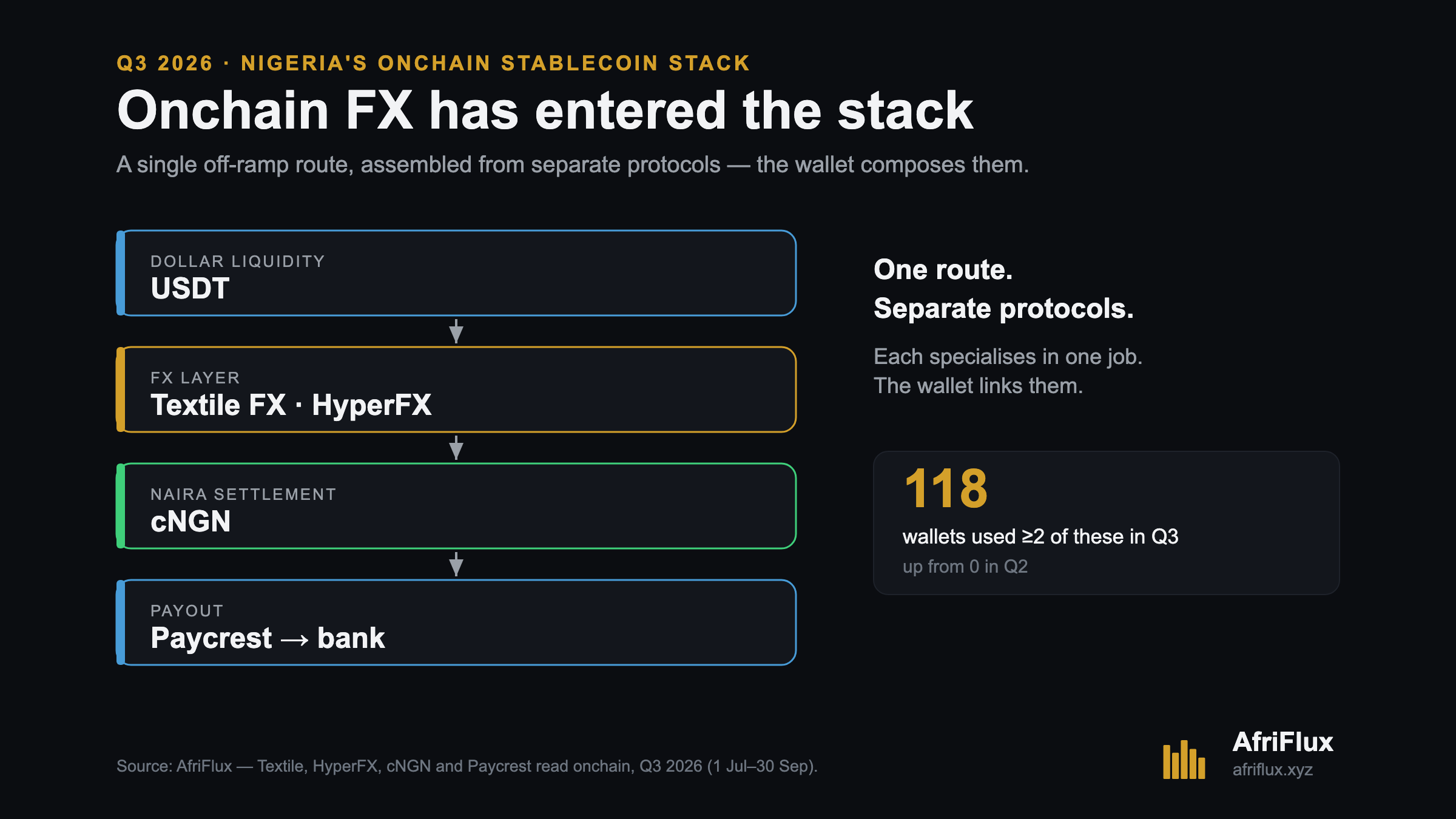
The new setup splits the job. Instead of one venue handling dollar liquidity, FX conversion and the naira payout, a wallet can swap USDT into cNGN through an FX venue like Textile, then send that cNGN into Paycrest, which handles the naira payout to a bank. Textile and HyperFX — both launched in June — provide the FX layer; cNGN carries the naira-denominated value; Paycrest connects it to the payout rails. The wallet is what makes the layers composable.
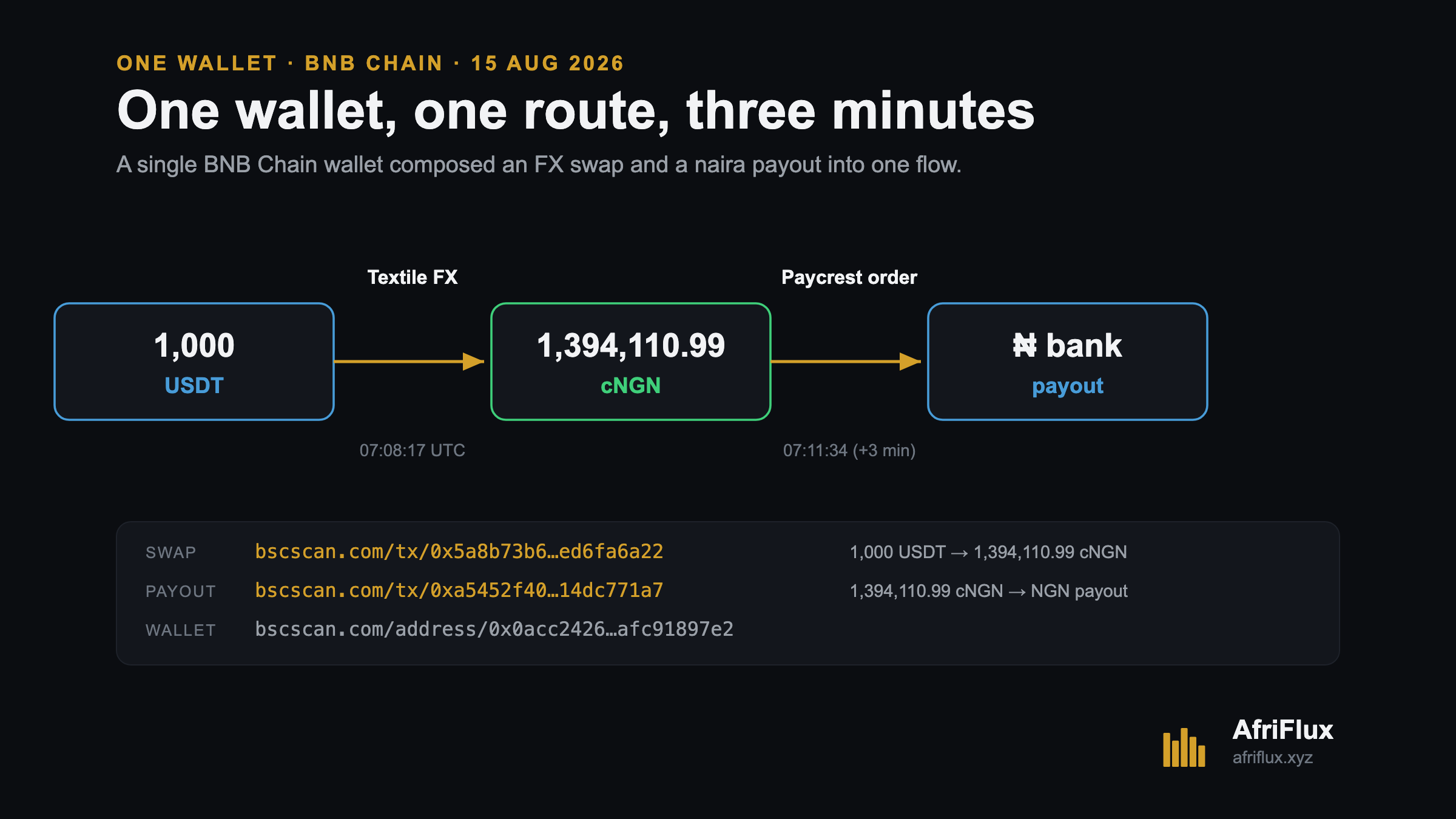
Take one wallet on BNB Chain. At 07:08 on 15 August, it swapped 1,000 USDT on Textile FX and received 1,394,110.99 cNGN. Three minutes later, at 07:11, the same wallet opened a Paycrest order to pay out that exact amount in naira. Different protocols — one route.
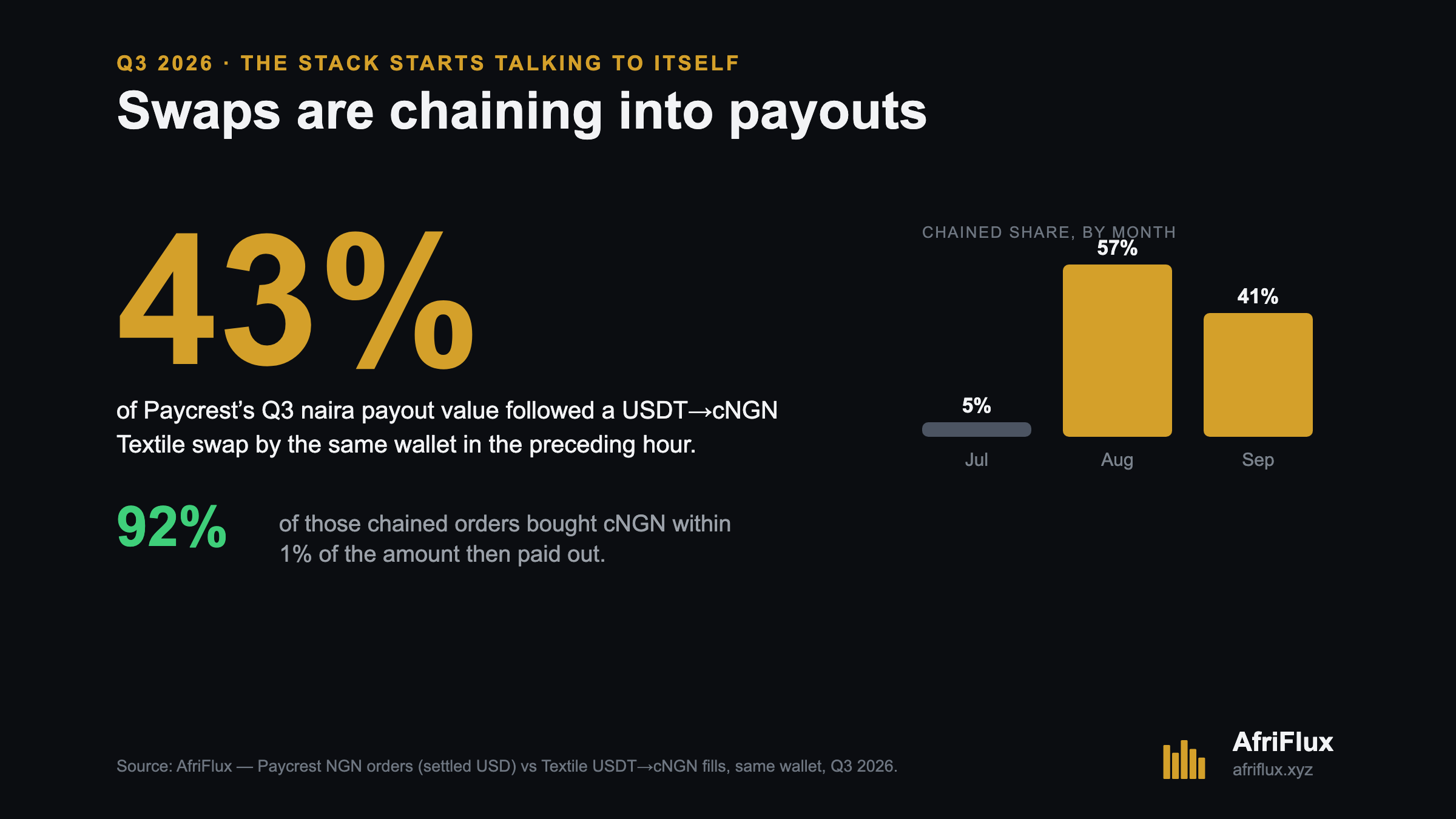
This wasn't a one-off. Across Q3, 43% of Paycrest's naira payout value had a matching USDT→cNGN swap on Textile by the same wallet within the preceding hour. In 92% of those chained orders, the cNGN purchased was within 1% of the amount subsequently paid out. The pattern switched on mid-quarter — 5% of value in July, then 57% in August — as the tooling to compose these protocols matured.
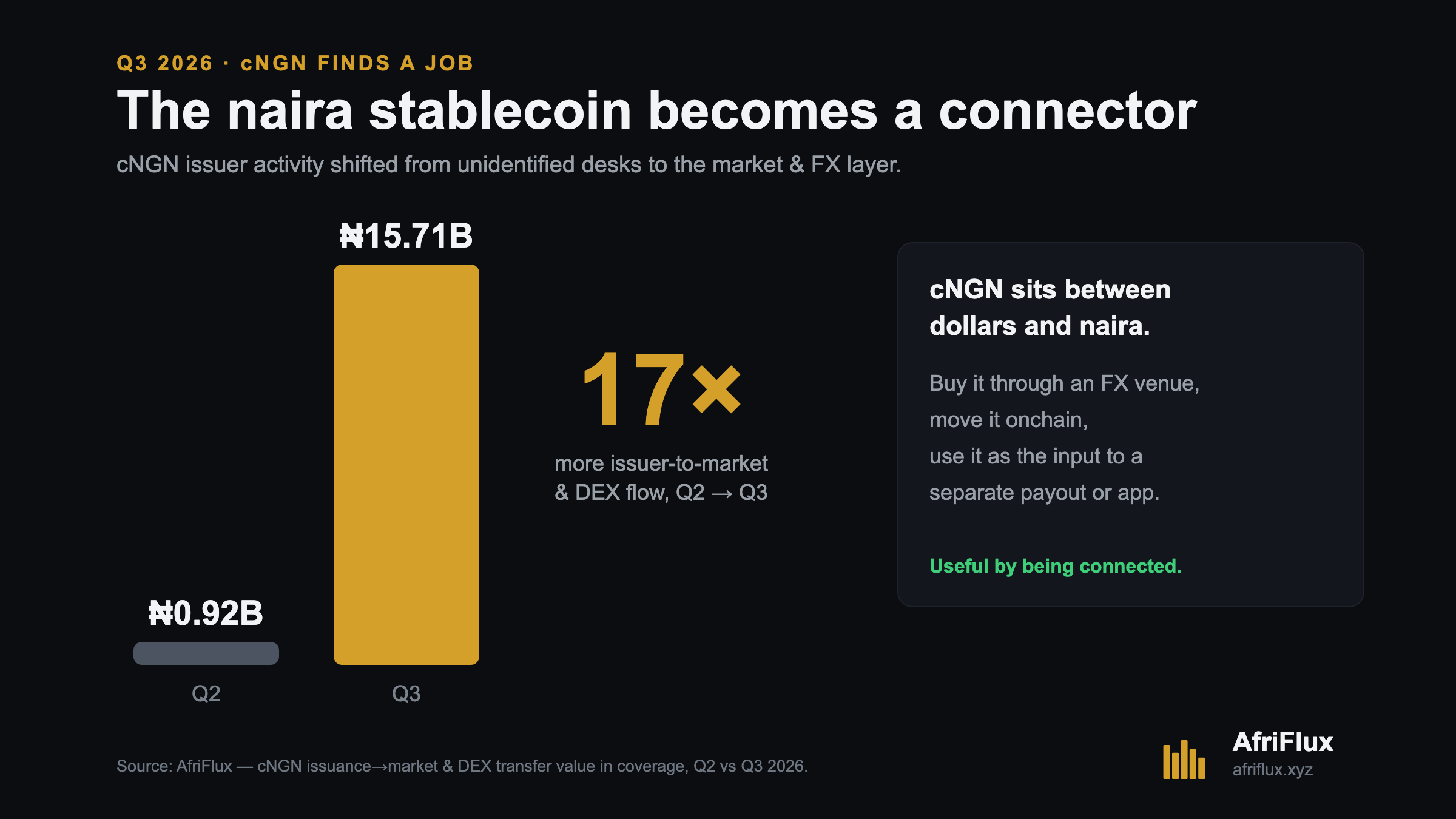
cNGN is the piece that makes it hang together. In Q2, the issuer's activity in our coverage was mostly against unidentified desks. In Q3 it shifted toward the market and FX layer: issuer-to-market and DEX flows rose from roughly ₦0.9 billion to ₦15.7 billion. A naira stablecoin becomes useful not by being minted, but by being connected — here it sits between dollar liquidity and naira liquidity, acquired through an FX venue and spent as the input to a separate application.
The clearest evidence is wallet behaviour. In Q2, zero wallets used more than one of Paycrest, HyperFX and Textile. In Q3, 118 did. Small against the broader market — but it is the behaviour that matters: each protocol can specialise in one part of the transaction, and the wallet stitches them together. The pattern even reached equity: during the Dangote refinery IPO, all 349 observed share purchases on Solana and Base were paid in cNGN, with Solana buyers' USDC converted into cNGN in the same flow.
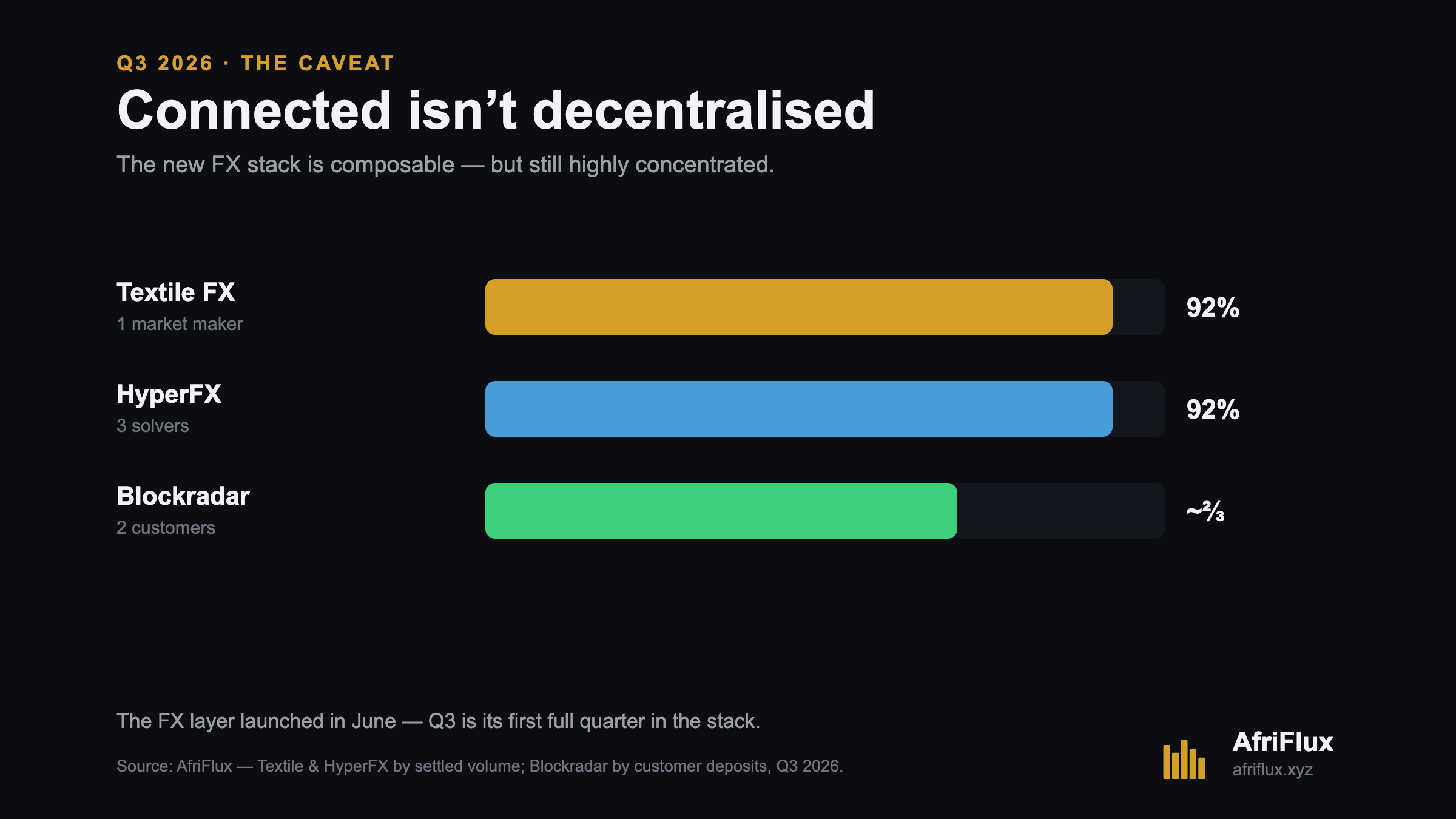
One caveat, stated up front: connected does not mean decentralised. One Textile market maker accounted for 92% of its African-pair volume; three HyperFX solvers accounted for 92% of settled volume; two Blockradar customers were roughly two-thirds of its deposits. And the FX layer is new — Q3 is its first full quarter, so there isn't yet enough history to know whether these relationships persist.
But the shift is real. In Q2, the stack was a collection of products. In Q3, a new FX layer showed up — and the rest of the stack started connecting to it.
Method
We read Textile FX fills, Paycrest orders, cNGN transfers, HyperFX orders and Blockradar deposits directly onchain for Q3 2026 (1 July–30 September), across 12 chains. A 'chained' payout is a Paycrest naira payout preceded within one hour by a USDT→cNGN Textile swap from the same wallet, weighted by settled USD; wallets are counted as addresses, not people or businesses.
How attribution works →Cite this
Free to cite with attribution. No embargo, no approval needed.
AfriFlux (2026). Onchain FX enters Nigeria's stablecoin stack. Published 13 October 2026. https://www.afriflux.xyz/feed/onchain-fx-enters-the-stack
Reproducing a chart? Use this line: Source: AfriFlux — on-chain intelligence for Africa's stablecoin economy. afriflux.xyz