Nigeria's stablecoin chains each have a job
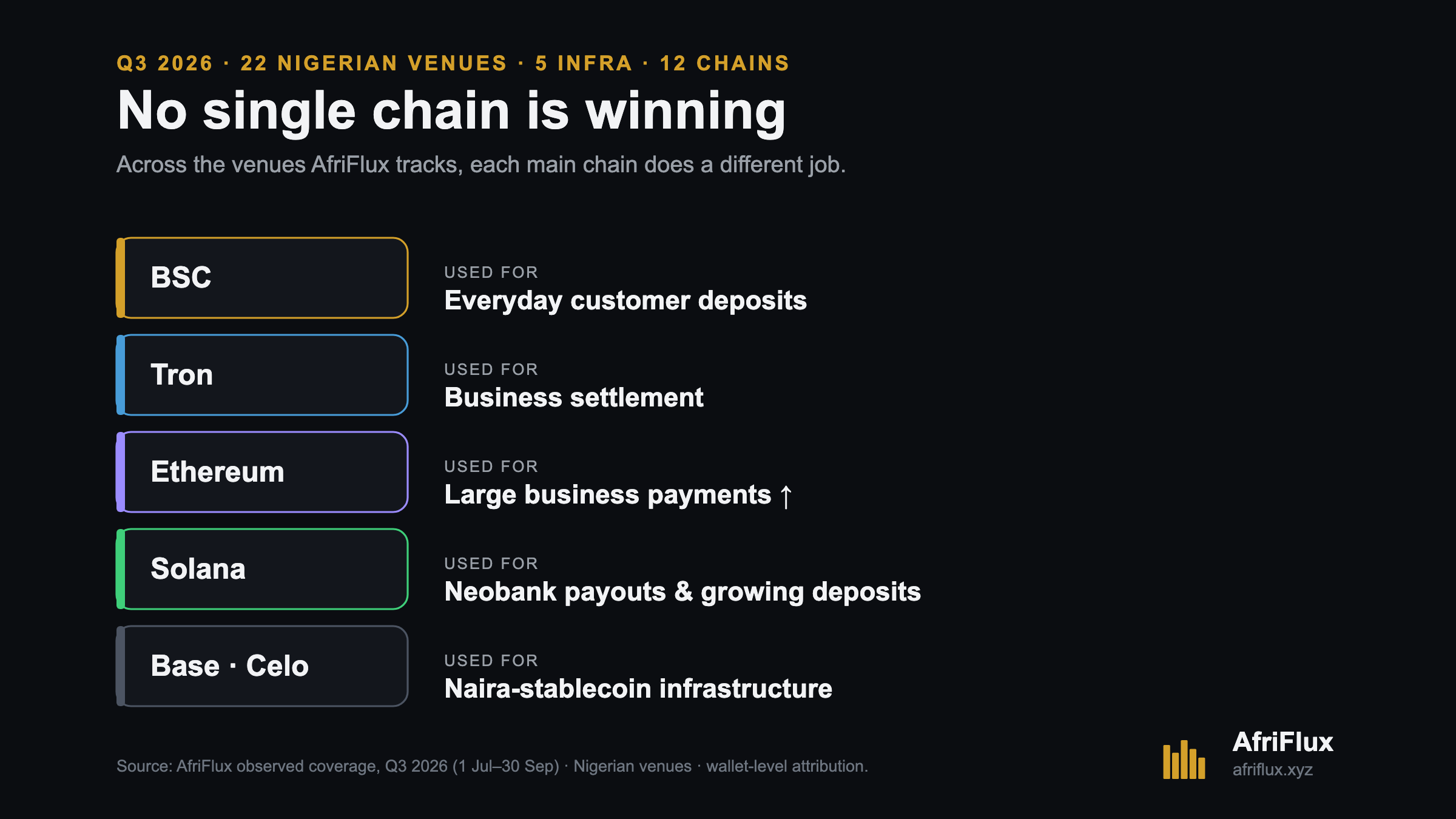
Across the Nigerian venues AfriFlux tracks, no single chain runs the stablecoin economy: BSC carries everyday deposits, Tron business settlement, Solana neobank payouts, Base and Celo the naira machinery. In Q3, the jobs moved.
- $528M
- Customer deposits, Q3
- $2.27B
- Business-class flow, Q3
- 84%
- Of Textile dollar→cNGN swaps
- ₦59.2B
- cNGN transfers on BSC, Q3
+21%; ~51% on BSC
Tron 50%, Ethereum up to 32%
on BSC
from ₦4.4B in Q2
Ask which blockchain is winning in Nigeria and you get the wrong kind of answer. The better question is what each chain is for. Across the Nigerian venues AfriFlux tracks, stablecoin money in Q3 ran on twelve chains, and the main ones were not competing for the same job — one carries everyday deposits, another business settlement, a third payouts from US-dollar virtual accounts into Nigerian fintechs, and two more host the infrastructure that turns dollars into naira stablecoins and back.
Where the people are: BSC
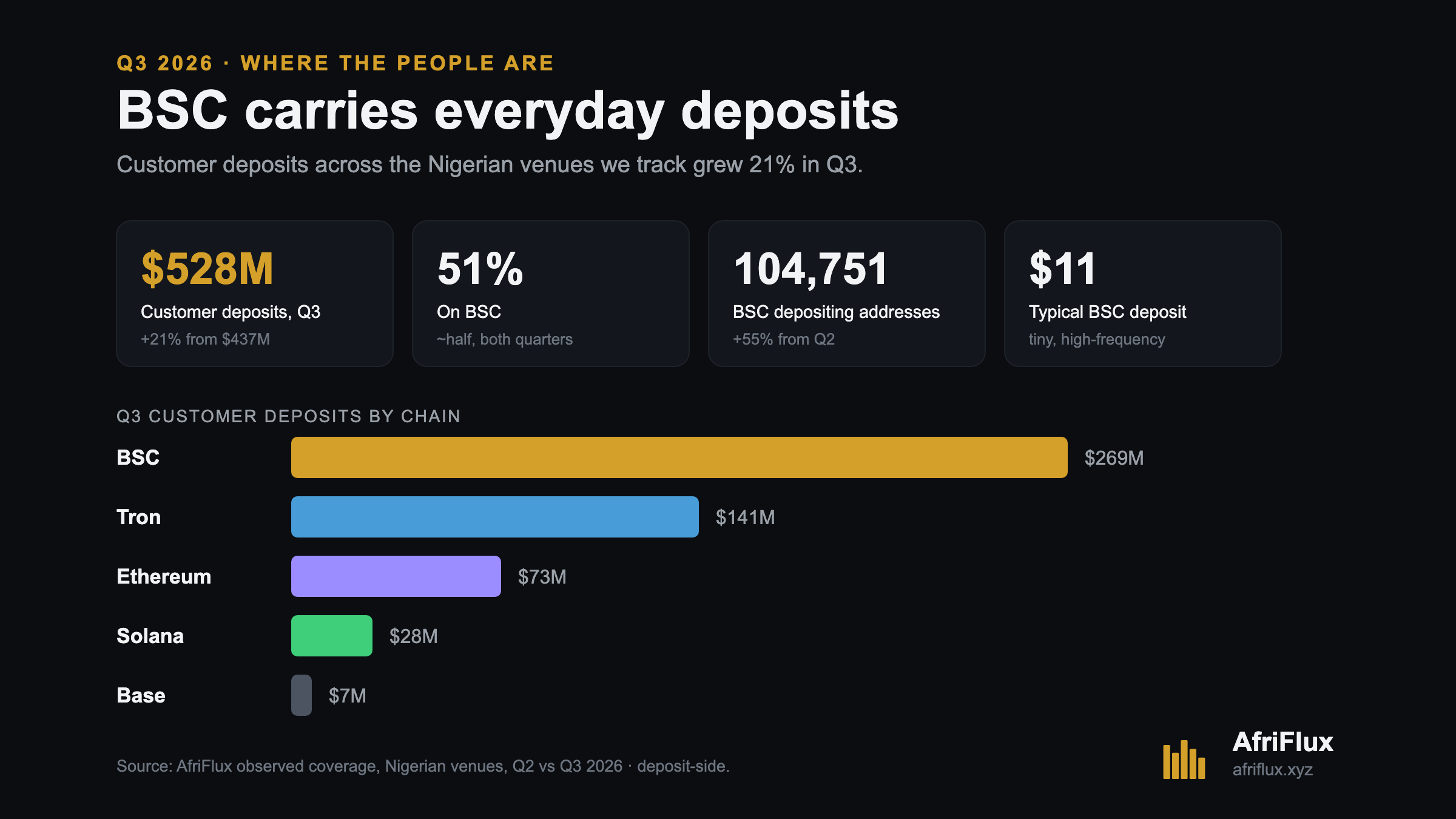
Across the venues we track, customer deposits grew 21% in Q3, from $437M to $528M, and BSC accounted for about half of them in both quarters. It had 104,751 active depositing addresses in Q3, up 55%. Its typical deposit is small — $11 — while Tron carries a quarter of deposits with far larger tickets: a typical $38, from about half as many addresses. In our coverage the app often decides the chain: venues issue deposit addresses for the chains they support, and users follow.
Where business settles: Tron, with Ethereum rising
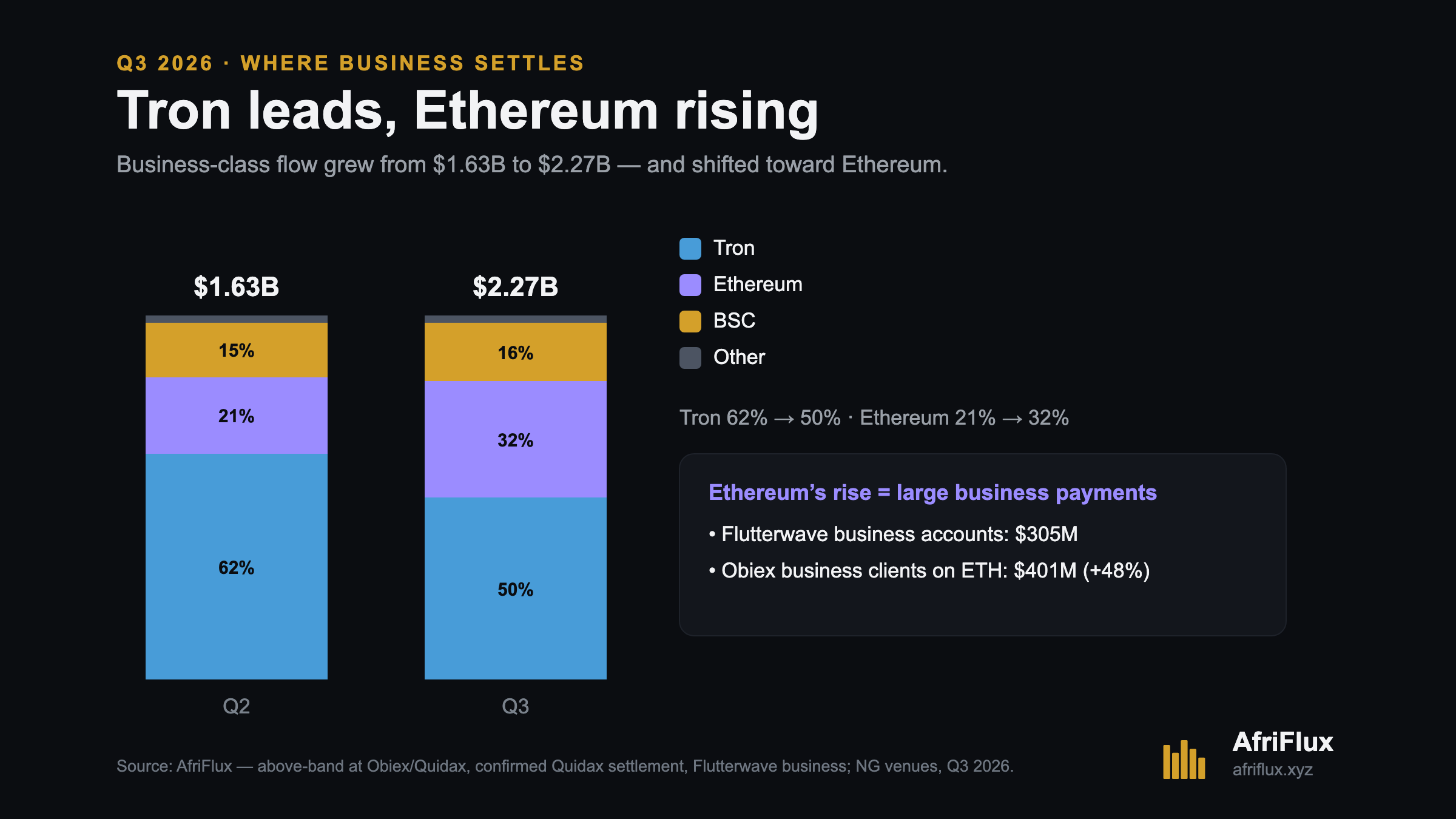
Business-class flow grew from $1.63B to $2.27B, and Tron still carried half of it — but its share fell from 62% to 50% as Ethereum's rose from 21% to 32%. Two things moved Ethereum: Flutterwave's business accounts settle there and carried $305M in Q3, and Obiex's business clients sent $401M through Ethereum, up by half. In our coverage, large scheduled business payments are moving to Ethereum; everyday deposits are not.
Solana: payouts down, deposits up
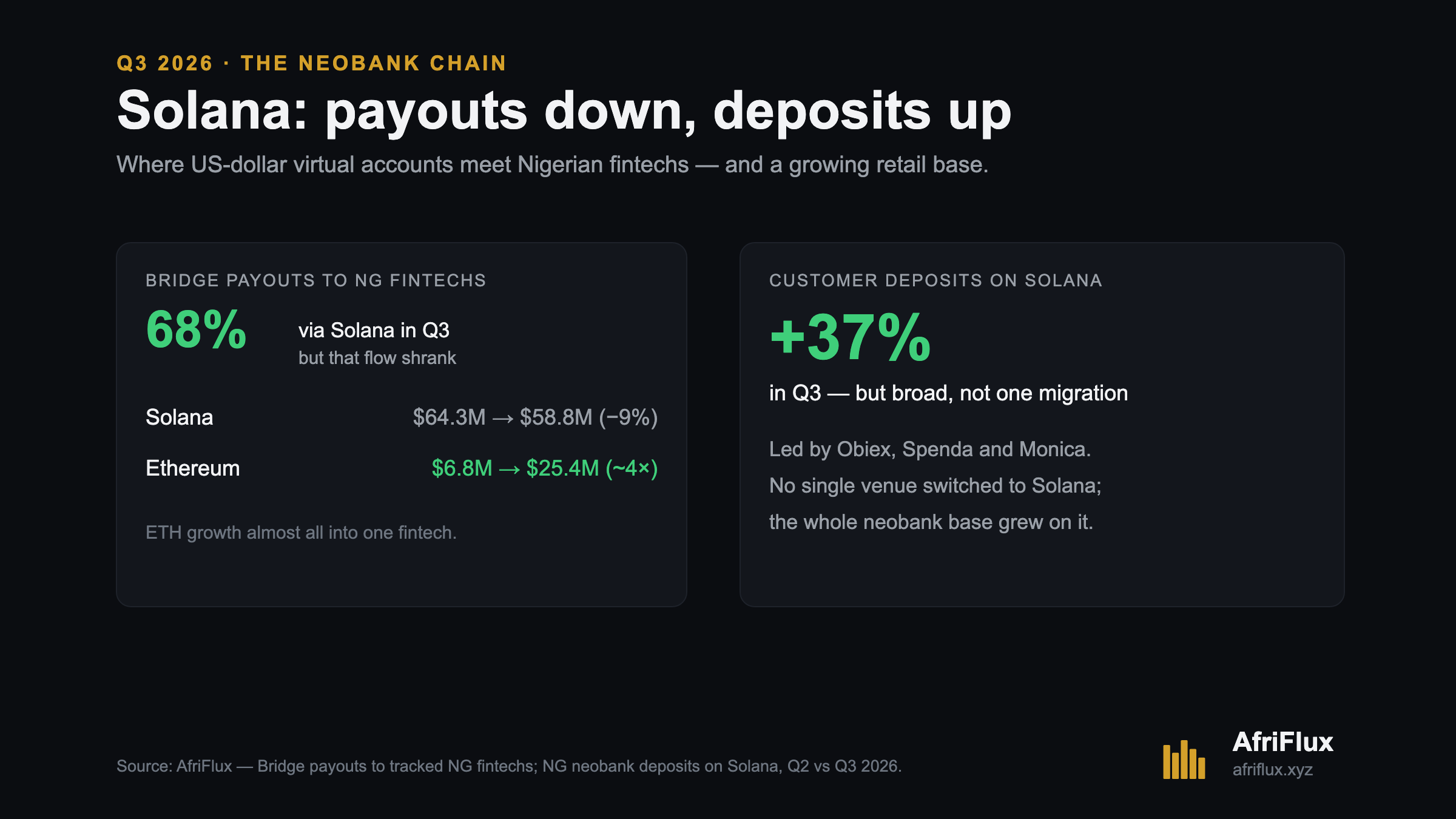
Solana is where US-dollar virtual accounts meet Nigerian fintechs. Bridge, the virtual-account provider for several neobanks, sent 68% of its payouts through Solana to the Nigerian fintechs we track — but that flow shrank 9%, from $64.3M to $58.8M, while its Ethereum payouts nearly quadrupled, from $6.8M to $25.4M, almost all into one fintech. Solana's own growth came from elsewhere: customer deposits into neobanks grew 37% on the chain, broadly across the base — led by Obiex, Spenda and Monica — not one venue switching. Solana also took a new job in September, when a slice of the Dangote Petroleum Refinery IPO sold onchain: the NectarFi app converts USDC into cNGN and buys the shares, and most of the IPO shares still held at quarter-end were bought there.
The naira machinery: BSC, Base and Celo
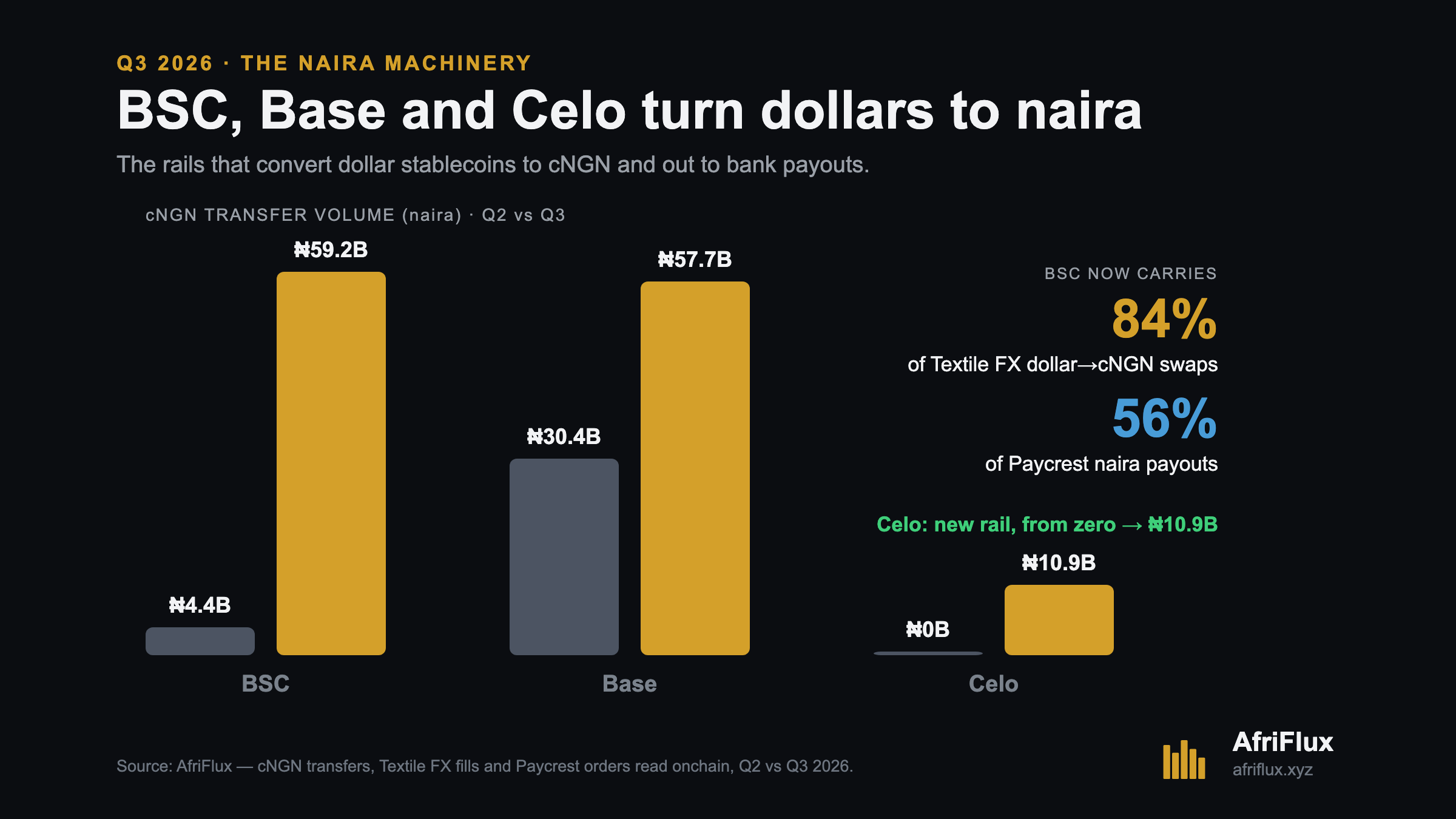
The system that converts dollars to naira stablecoins, and naira to bank payouts, runs on three chains. BSC carried 84% of Textile FX's dollar-to-cNGN swaps and 56% of Paycrest's naira payouts; cNGN transfers on BSC went from ₦4.4B to ₦59.2B. Base manages all of HyperFX's cNGN settlements, handles 39% of Paycrest's payouts and holds the largest cNGN pool; its cNGN volume grew from ₦30.4B to ₦57.7B — but BSC caught up. Celo emerged as a new rail: ₦10.9B of cNGN transfers in Q3, from zero in Q2. None of these carries much customer money directly; their job is plumbing, and in Q3 the plumbing moved onto BSC.
Chains are changing jobs
The chain map is not fixed. Q3 had persistent migrations: Daya Pro shifted its flow toward BSC — from under a fifth to roughly half — as its deposits more than doubled, and Onboard moved to Tron on the back of 70 large Tron depositors, each around $98,000 in Q3, even as its US-dollar virtual-account deposits on Base shrank. The long tail moved too: payments to betting platforms left BSC almost entirely, and payouts to the peer-to-peer desk Remitano switched from Ethereum to Tron. The amounts are small; the pattern is the same — chains are used for specific jobs, and those jobs can move.
The Nigerian stablecoin economy in our coverage is multi-chain because it has several jobs to do, not because people spread out at random. BSC handles people and naira FX; Tron manages business settlement; Ethereum is gaining the large business payments; Solana supports neobank payouts and a growing customer base, and since September tokenised Nigerian equity; Base and Celo provide the naira-stablecoin infrastructure. What the data cannot tell us is why each company chose its chain, or anything settled off-chain at a bank. What it shows, precisely, is which chain carried which money, for whom, and how that changed in a single quarter.
Method
USDT and USDC deposits at 22 Nigerian venues plus five infrastructure providers, read onchain across 12 chains for Q3 2026 (1 July–30 September), alongside cNGN transfers and the onchain Dangote IPO sale. Customer- and business-class activity is classified from onchain behaviour (deposit size and proven company-to-company settlement), not a legal registry; South-African venues are out of scope, addresses are not people, and these are observed coverage figures, not an estimate of Nigeria's total market.
How attribution works →Cite this
Free to cite with attribution. No embargo, no approval needed.
AfriFlux (2026). Nigeria's stablecoin chains each have a job. Published 15 October 2026. https://www.afriflux.xyz/feed/nigeria-stablecoin-chains-have-jobs
Reproducing a chart? Use this line: Source: AfriFlux — on-chain intelligence for Africa's stablecoin economy. afriflux.xyz