The week of 9 November: $199.31M moved, and the business book did most of the rise
$199,312,536 moved through the venues AfriFlux tracks, up 8.1%. The deposit book added $4.29M; Flutterwave's declared business book added $10.83M on its own. We also correct last week's spot record claim.
- +$10.83M
- Declared business book
- +$6.69M
- Obiex
- 97.3%
- Native spot matched by one desk
- −$32,133
- Tokenised net flow
up 46.6% — nearly three-quarters of the week's rise
up 5.6%; almost everything else fell
Textile FX, on spot down 17.2%
second net-selling week, twenty times the first
$199,312,536 moved through the venues we track in the week of 9–15 November, up 8.1% from $184,385,807.
Almost none of that rise was deposits.
The business book did three-quarters of it
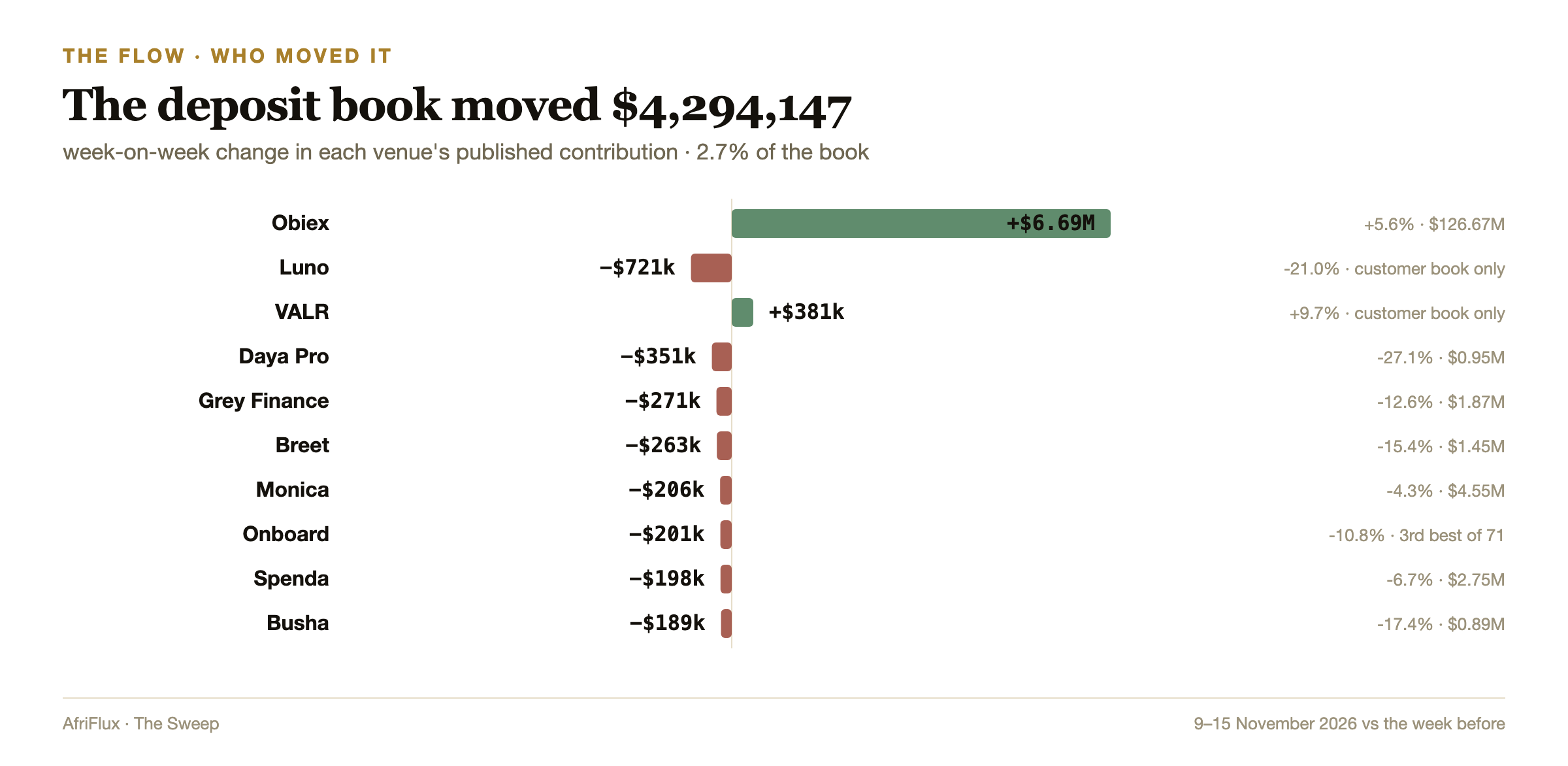
The deposit book — retail band plus above band — added $4,294,147, or 2.7%. Flutterwave's declared business book added $10,833,871 on its own, up 46.6% from $23,231,052 to $34,064,923.
That single line is nearly three-quarters of the week's increase, and it is not deposits. Flutterwave is the one venue that publishes a business figure rather than having one inferred.
Inside the deposit book, one venue carried it:
| Venue | Change | |
|---|---|---|
| Obiex | +$6,691,961 | +5.6% |
| Luno | −$721,050 | −21.0% |
| VALR | +$380,799 | +9.7% |
| Daya Pro | −$351,204 | −27.1% |
| Grey Finance | −$271,000 | −12.6% |
Luno gave back $721,050 a week after its best week in 312 — which is the shape a one-week spike usually has, and a reason to be slow about calling any single week a turn.
The retail band took $47,526,788 across 177,333 deposits — 2,416 more deposits than the week before for $113K less money, so the average ticket fell 1.6% to $268.01. That is the second week running with the same shape.
The tokenised book's biggest positions were sold
$50,733 traded, up 352% — on net flow of −$32,133, the second net-selling week in a row and twenty times larger than the first.
The volume went up because positions were closed. The three largest reductions were the three assets that led the thirty-day ranking: NVIDIA, Amazon and Alphabet, sold down by $33,893 between them — more than the entire book traded the week before.
Spot fell, and one desk is still almost all of it
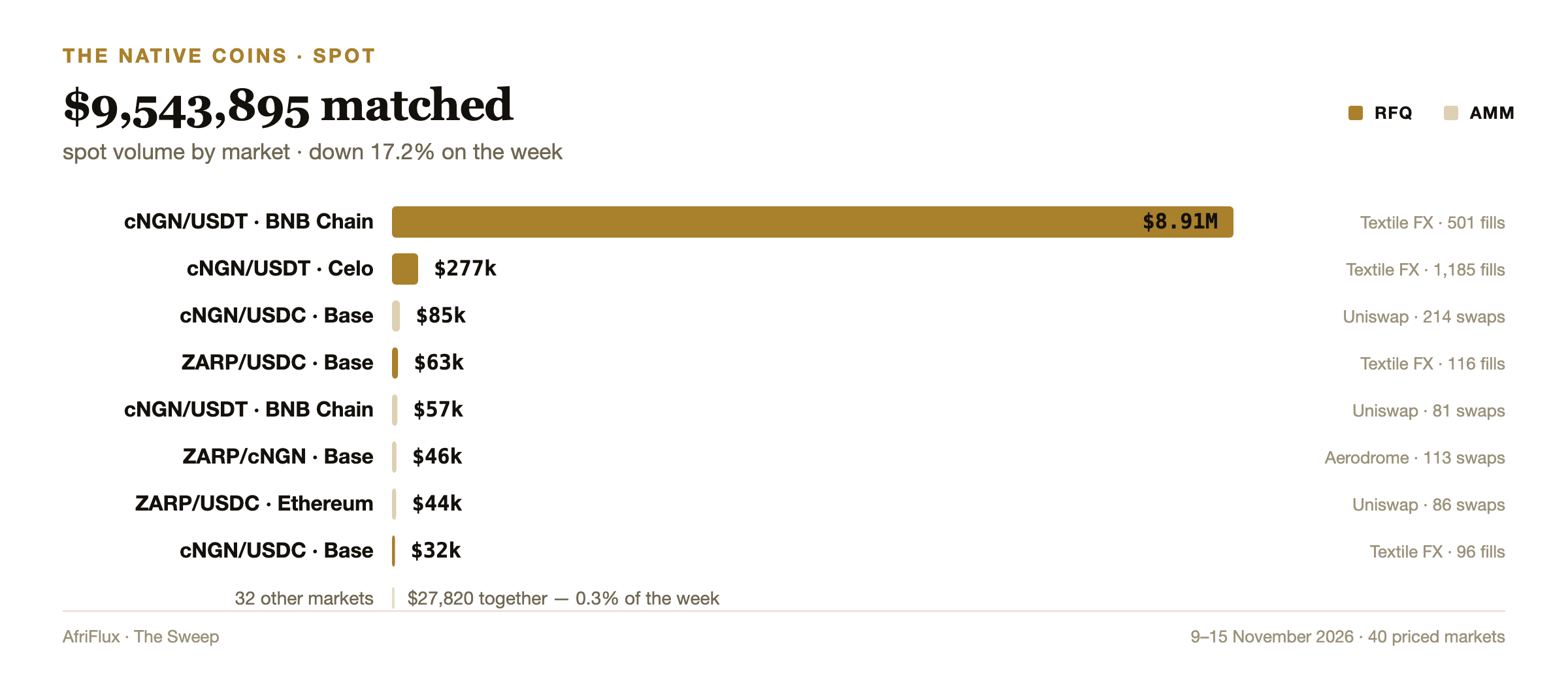
Native stablecoin spot volume was $9,543,895, down 17.2%. Textile FX matched $9,283,509 of it — 97.3%.
cNGN/USDT on BNB Chain did $8,911,075 on 501 fills. The money fell but the tickets grew: the average fill went from $12,075 to $17,787 on roughly half as many fills.
Celo went the other way. cNGN/USDT there did $277,230 across 1,185 fills against $133,117 on 666 a week earlier — more than twice the money on nearly twice the trades, at a $234 average. It remains the only cNGN market that looks like people rather than desks.
Underneath, the reverse of last week: transfer volume fell to $26,347,953 while the transfer count rose 9.8% to 30,625. Less money moving in more transfers is the shape of desks stepping back while ordinary traffic continues.
cNGN burned more than it minted — $3,089,927 against $2,894,942 — and supply fell 5.1% to $3,488,770.
A correction
Last week we reported $11,530,371 of spot volume as an all-time high. It was not.
We checked that record against the pair-level table, which at the time carried no value for markets quoted against something other than a dollar. The coin-level series — the one this site publishes — already counted those markets, and on it the high is $20,457,767, in the week of 2 December 2024, when cKES and eXOF traded heavily against CELO and cEUR on Celo.
Last week was the strongest week of 2026, and the strongest ever against dollar quotes. It was not the strongest ever.
The pair tables were corrected on 10 November so that both views now agree; that change and its restatements are in the methodology updates. The error in how we read them was ours.
Method
The flow is the full stablecoin volume attributed to every live venue, plus the declared business book of venues that publish one, plus confirmed settlement into a venue's own sinks where that venue's retail and business books are separable. Venues publishing per-client deposit boxes (VALR, Luno) contribute their published customer deposits only; the boxes above $1M are a desk carve-out, excluded from these figures and disclosed separately — $237,908,853 this week. The retail band is a size band, not a business detector. Spot volume counts every venue AfriFlux measures that matched a trade — pools, request-for-quote desks and resting order books — and is a subset of transfer volume, never an addition to it. As of 10 November every spot trade carries a value, including markets quoted against something other than a dollar; before that date the pair-level tables shipped those markets with a trade count and no value, which is the subject of the correction below. Transfer volume is on-chain transfers only and excludes mints and burns.
How attribution works →Cite this
Free to cite with attribution. No embargo, no approval needed.
AfriFlux (2026). The week of 9 November: $199.31M moved, and the business book did most of the rise. Published 16 November 2026. https://www.afriflux.xyz/feed/weekly-recap-2026-w46
Reproducing a chart? Use this line: Source: AfriFlux — on-chain intelligence for Africa's stablecoin economy. afriflux.xyz