Most stablecoin league tables measure one thing: how much money came in. Deposit volume is the easy number, and it's the wrong place to stop.
Size and dominance aren't the same thing. A venue can sit mid-table by volume and still own a market the bigger players barely touch — but you only see it if you measure two things most rankings skip: where the money actually settles, and what it's denominated in.
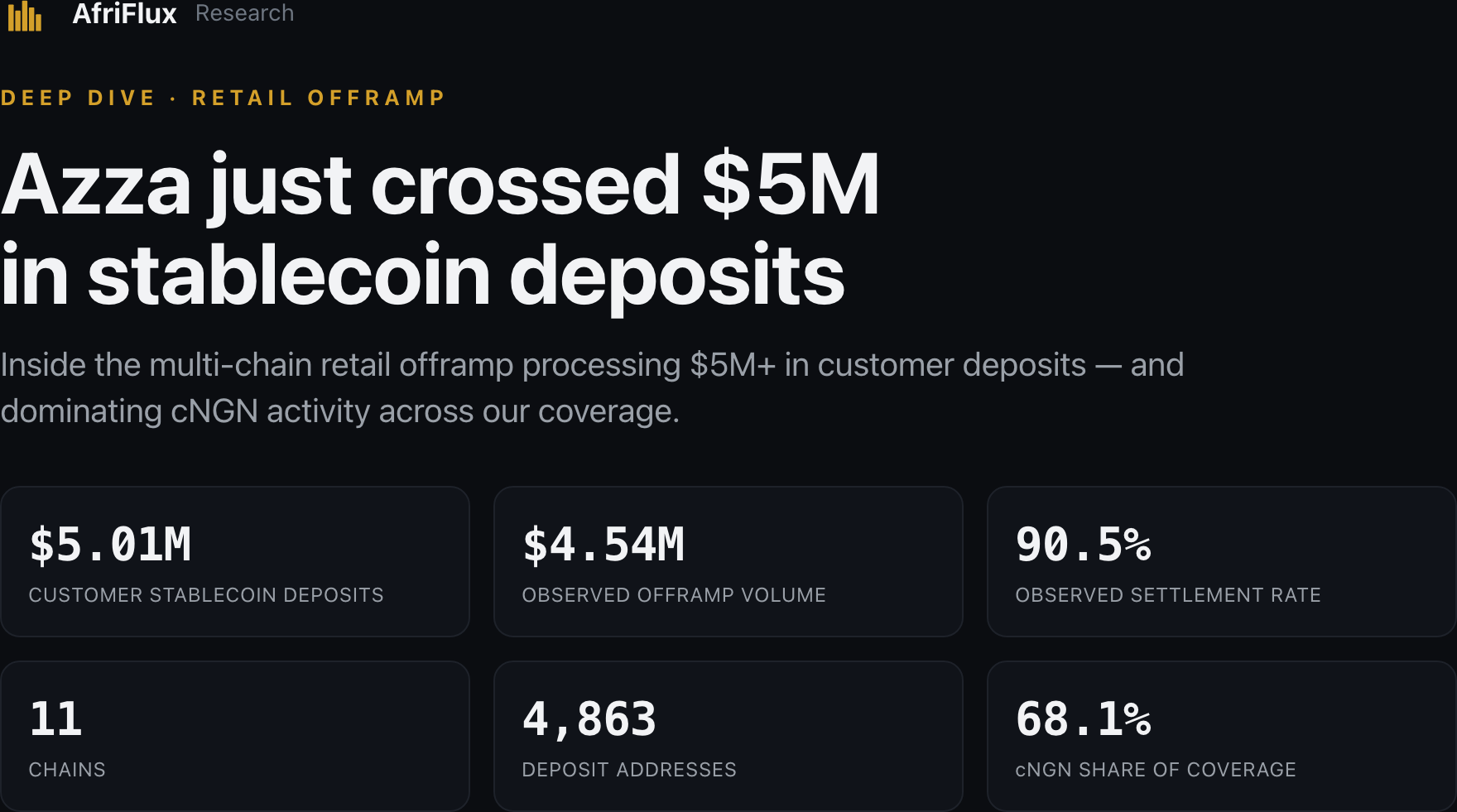
Azza is the case study. On 15 August 2026 it crossed $5M in customer stablecoin deposits across the venues we track. A real milestone, but a middle-of-the-table one. Follow the money past the deposit and a sharper picture shows up: a genuine retail offramp that settles about 90% of what it takes in, spread across 11 chains and thousands of small deposits, that quietly owns two-thirds of all the cNGN activity in our coverage.
From deposit to settlement
Every number here starts with an address. We identify the customer deposit addresses Azza controls and trace the stablecoin sent into them. But the deposit is only the first hop. Azza's architecture runs a simple path.
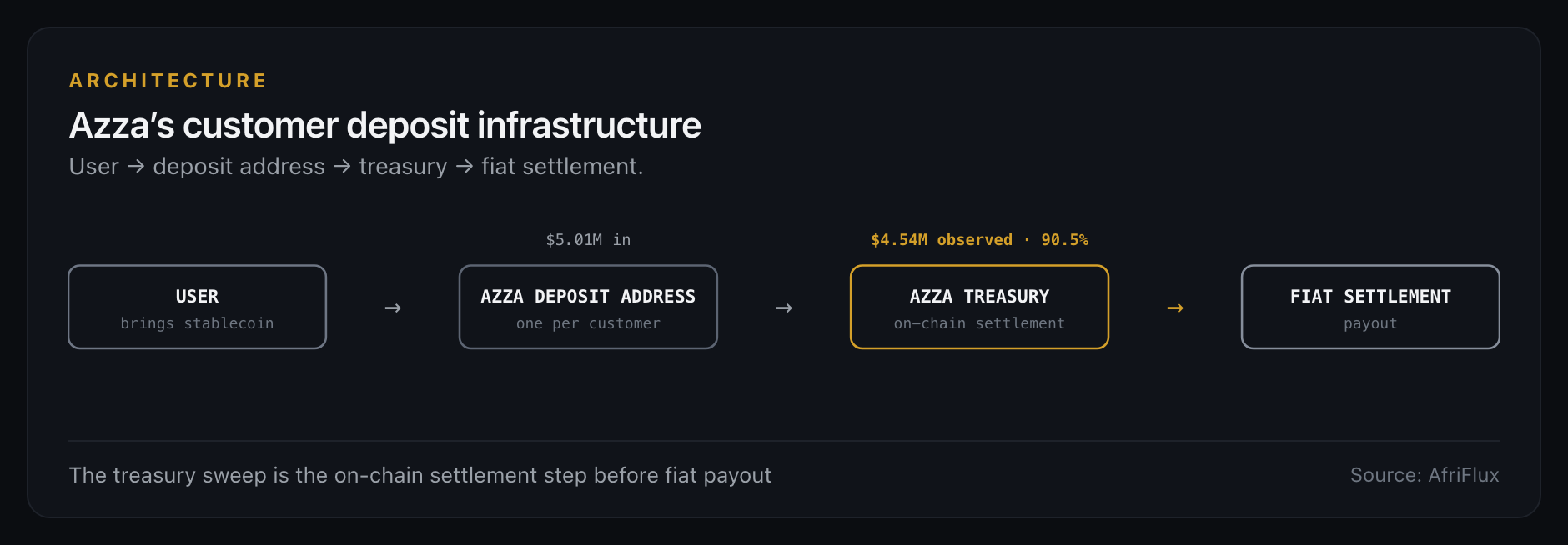
The sweep into treasury is the settlement step — the point where a customer's stablecoin reaches Azza for fiat conversion. That's what lets us measure an offramp instead of guessing at one. We're not assuming a deposit was cashed out; we're watching it move from the customer's address into Azza's treasury.
Two numbers, kept separate on purpose. Customer deposits: what came in. Observed offramp: what we can trace to treasury.
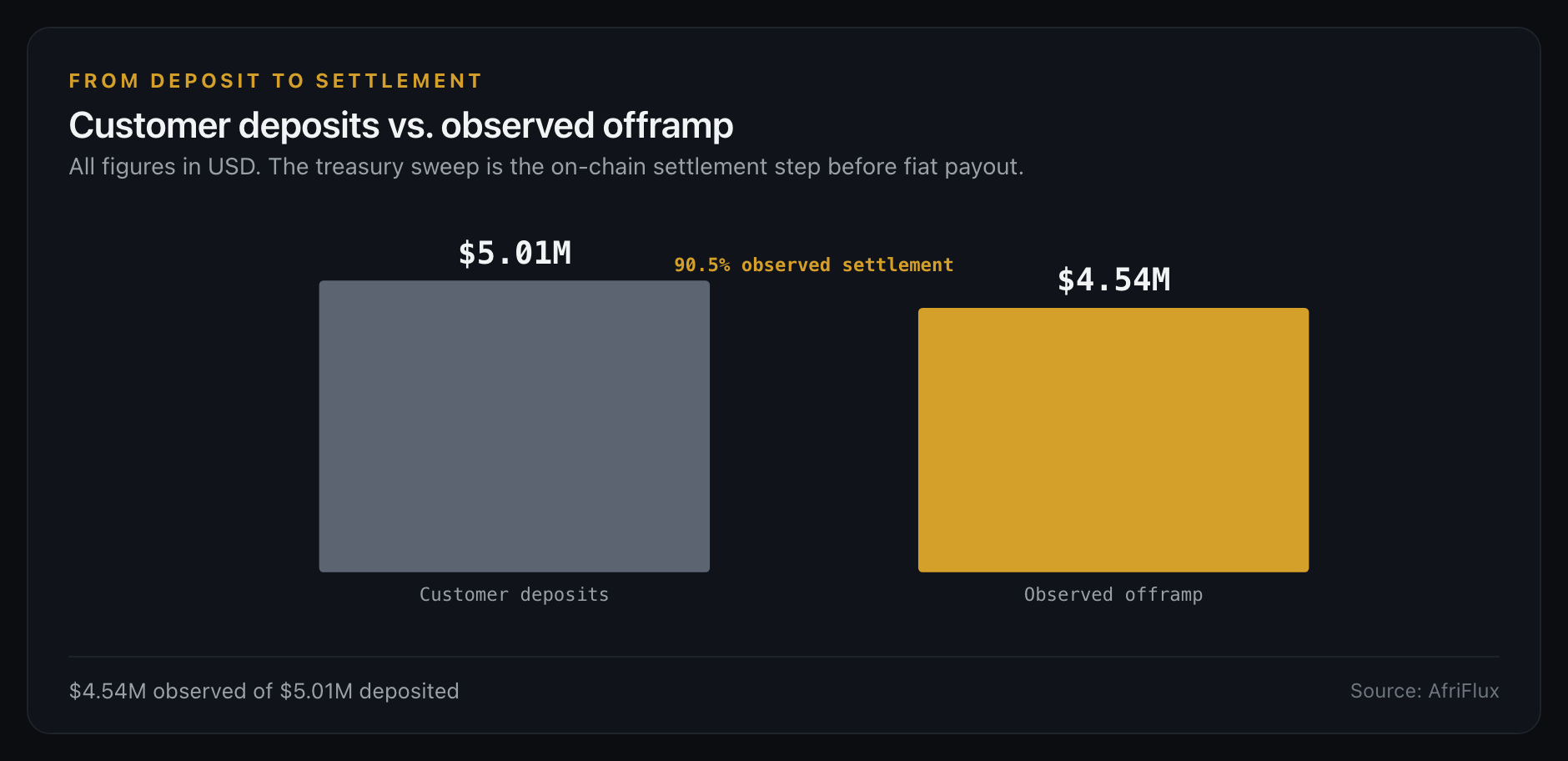
For every $1 of stablecoin we attribute to Azza's deposit infrastructure, about $0.90 is observed reaching treasury. The rest is deposits that hadn't completed the path when we measured — recent, pending, or still sitting at the address.
The milestone
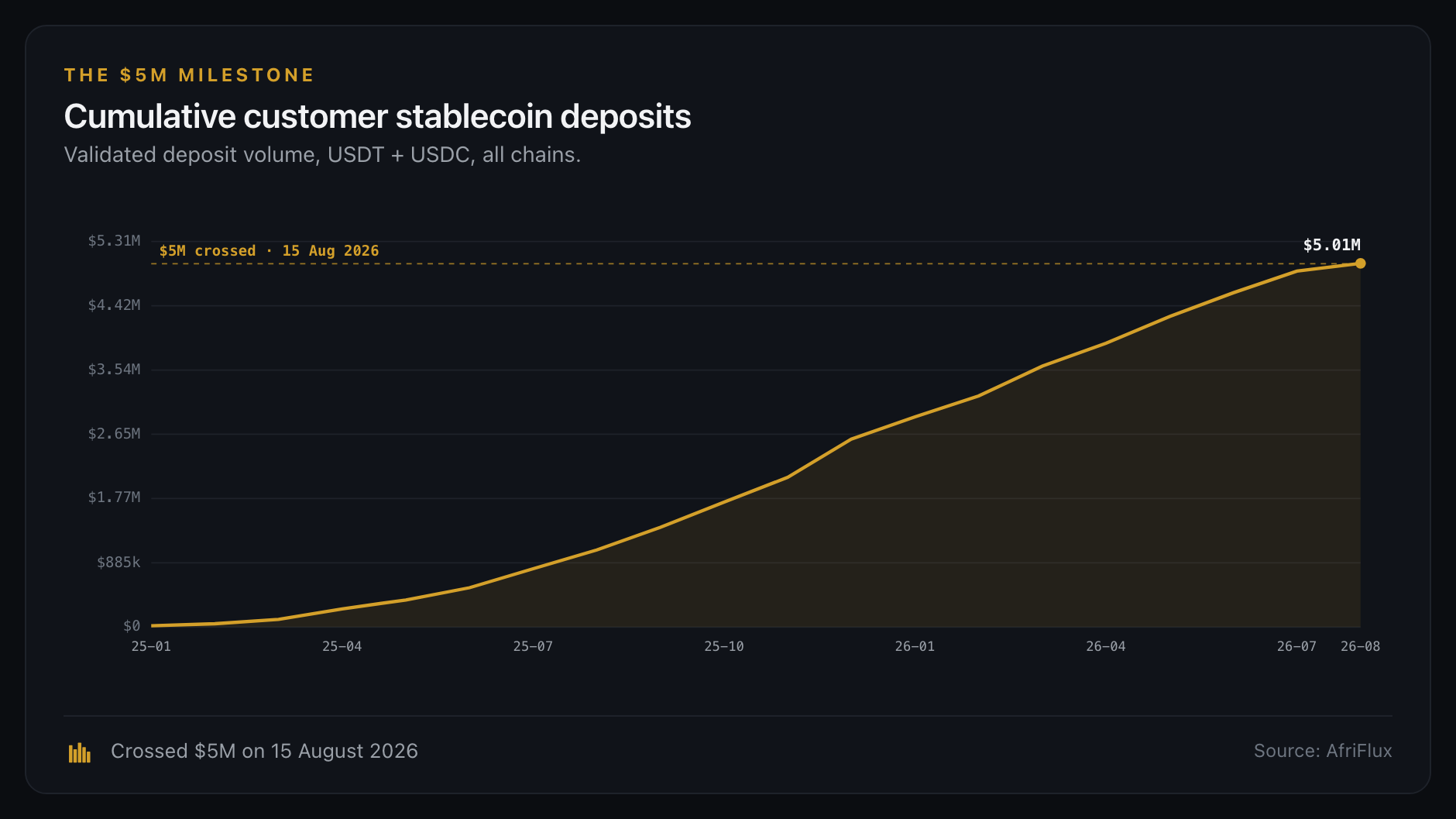
Azza crossed $5M in validated deposits on 15 August. The published figure — the one that clears our 95% leak-back rule — is $5.01M.
It's a retail-shaped offramp
That $5M isn't a handful of whales. It's spread thin.
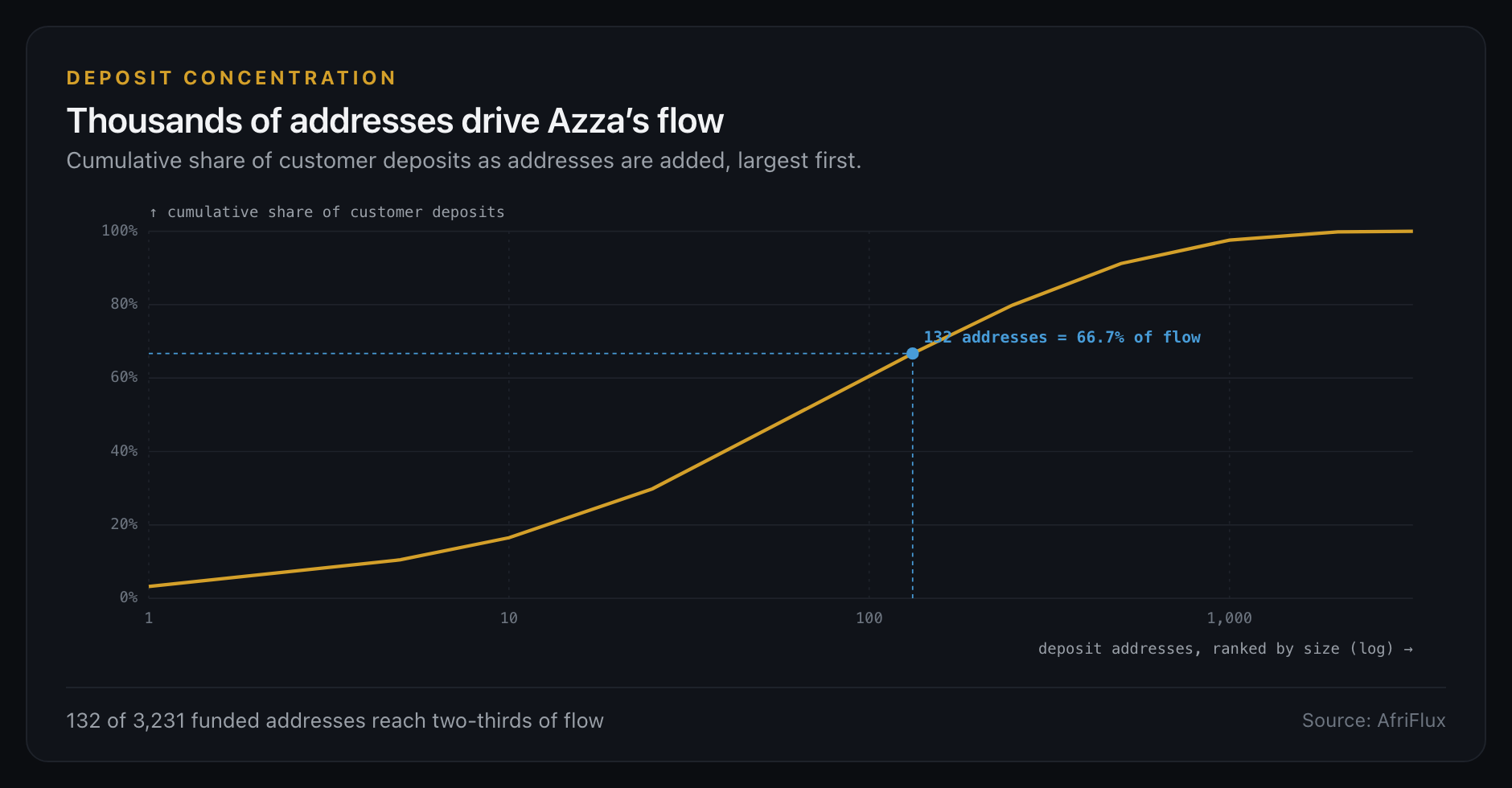
There are 4,863 validated deposit addresses. The largest single depositor is 3.2% of the total. The median deposit is $67. It takes 132 addresses to reach two-thirds of the flow. This is a lot of small customers, not a few big ones — the shape of genuine retail.
And it's accelerating
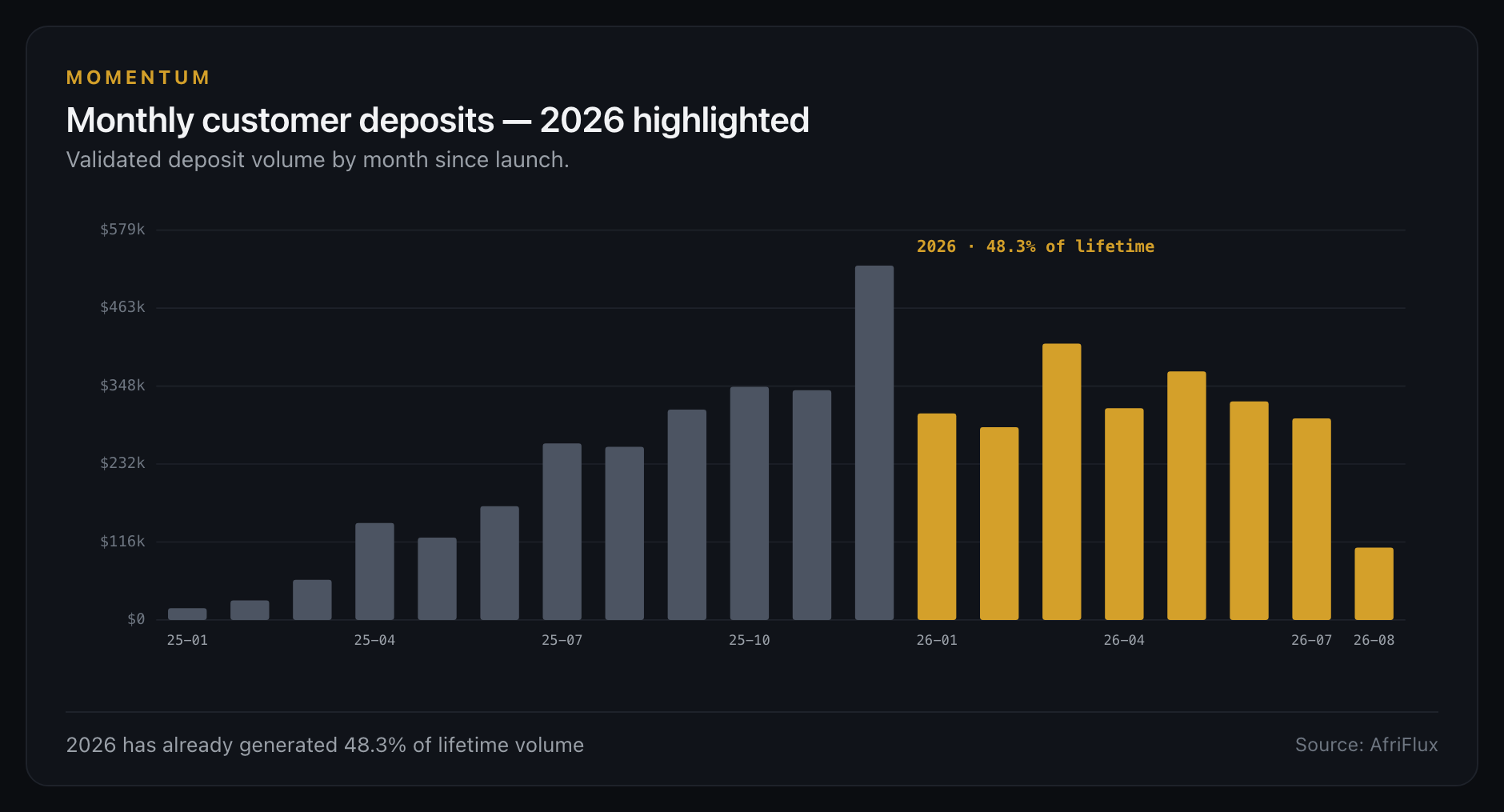
Here's what makes the milestone worth writing about: 48% of everything Azza has ever processed happened in 2026. Almost half its lifetime volume, in the current year alone. The $5M isn't accumulated history — the pace is climbing.
One offramp, eleven chains
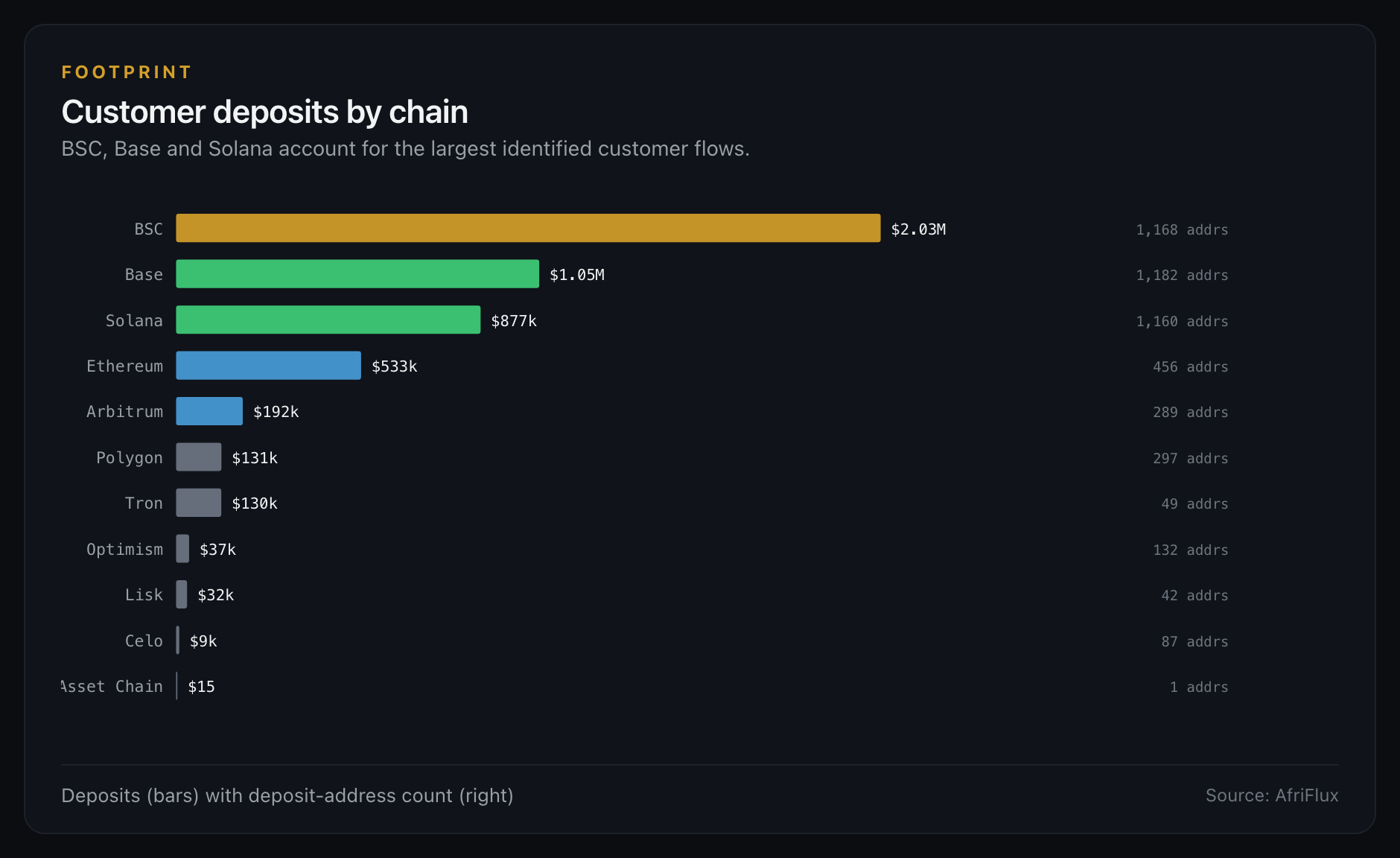
Azza's deposit infrastructure spans 11 chains. BSC leads at roughly $2.03M, then Base and Solana. It isn't leaning on a single network to reach customers.
USDT and USDC, almost evenly split
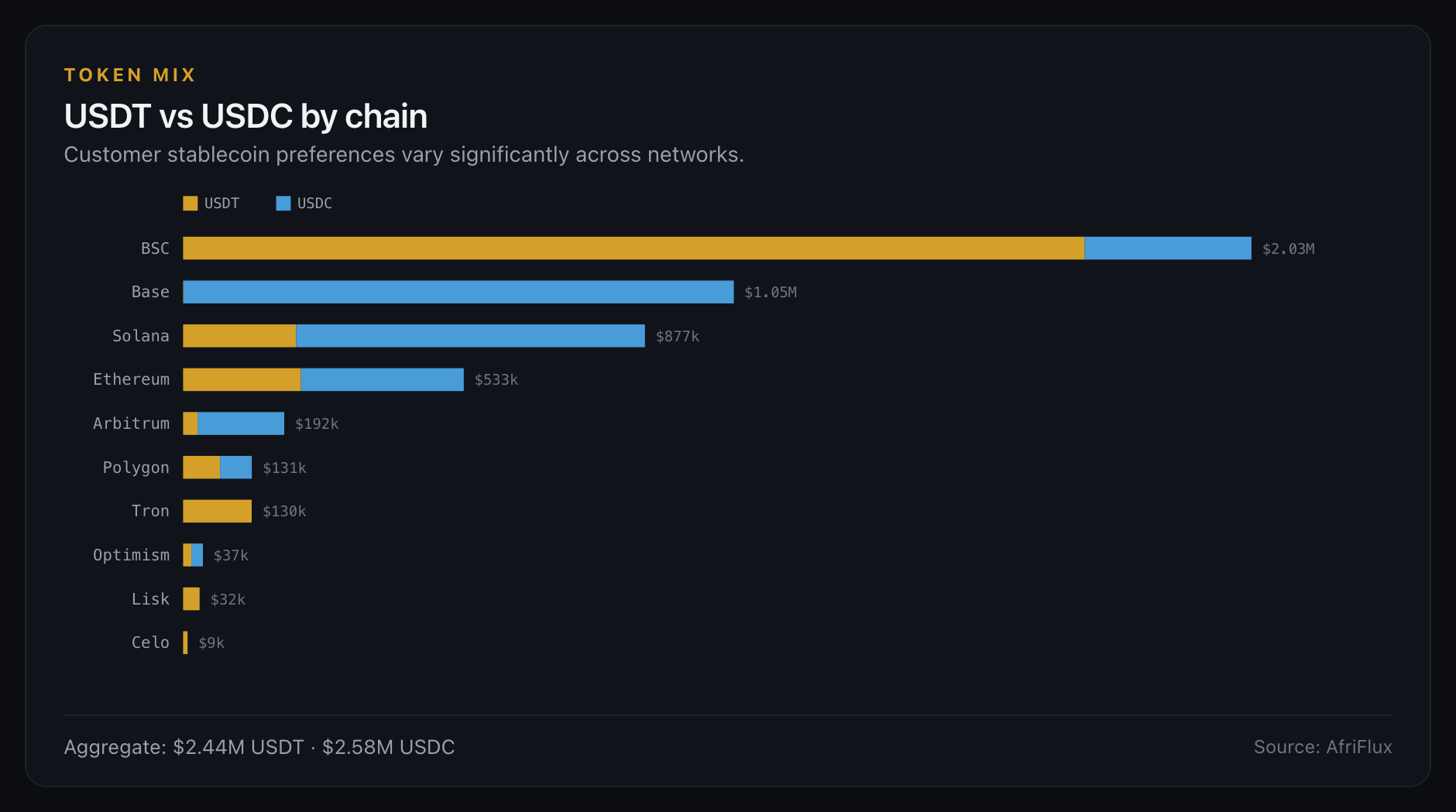
Across the whole deposit base it's nearly 50/50, with USDC just edging USDT. But the mix swings hard by chain: BSC runs USDT-heavy, while Base, Solana and Ethereum lean USDC. Customers bring whatever their chain runs on.
Then we looked at cNGN
This is where the ranking flips. Azza isn't the biggest venue we track. On cNGN, it isn't close to second.
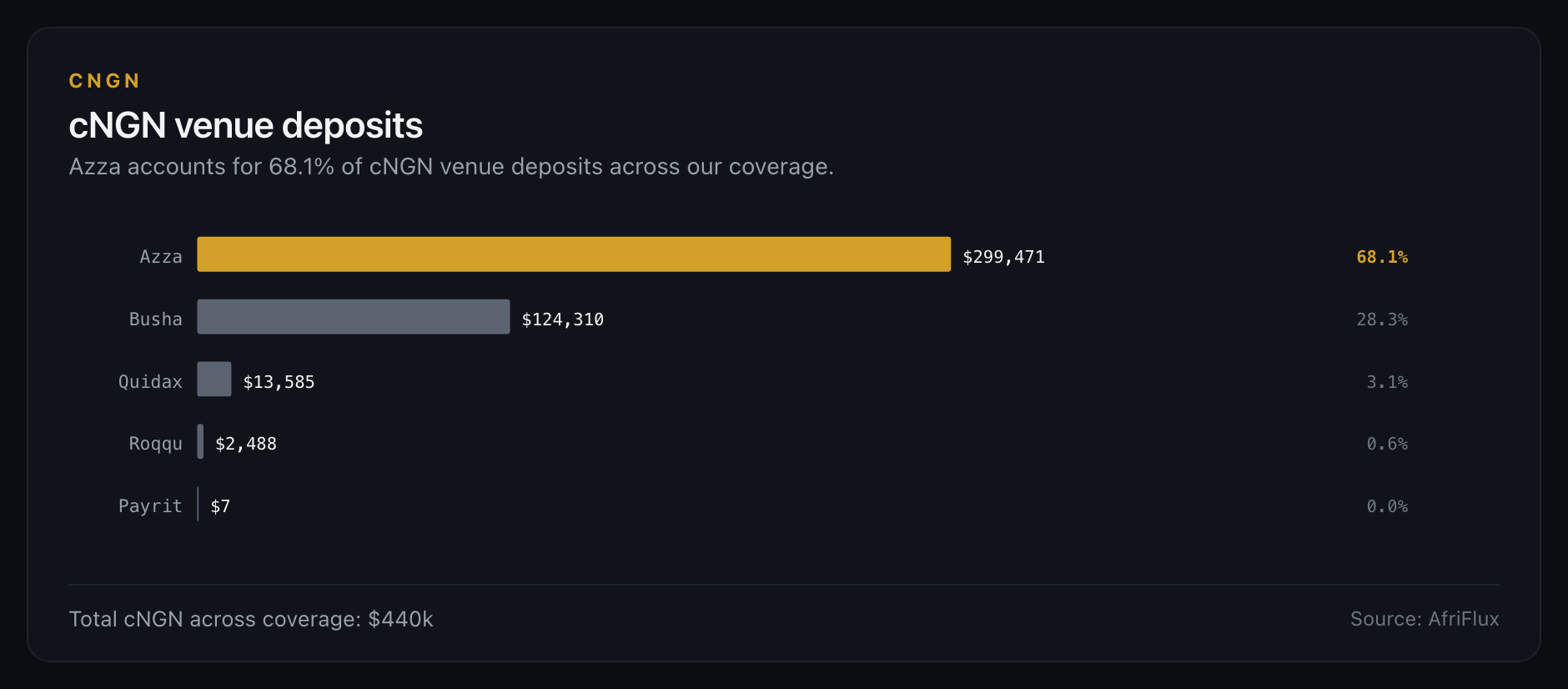
Azza takes 68% of all cNGN deposits across our coverage. Busha is next at 28%. By transaction count the gap is wider still — 3,168 cNGN deposits to Busha's 205. By value and by activity, Azza is where cNGN retail lives.
That's the reframe in one number. Azza ranks eighth of fourteen by size, and first by a mile on Nigeria's native stablecoin. Size told you one thing. The token mix told you the thing that matters.
We can trace cNGN to settlement too
The same deposit-to-treasury method works on cNGN.
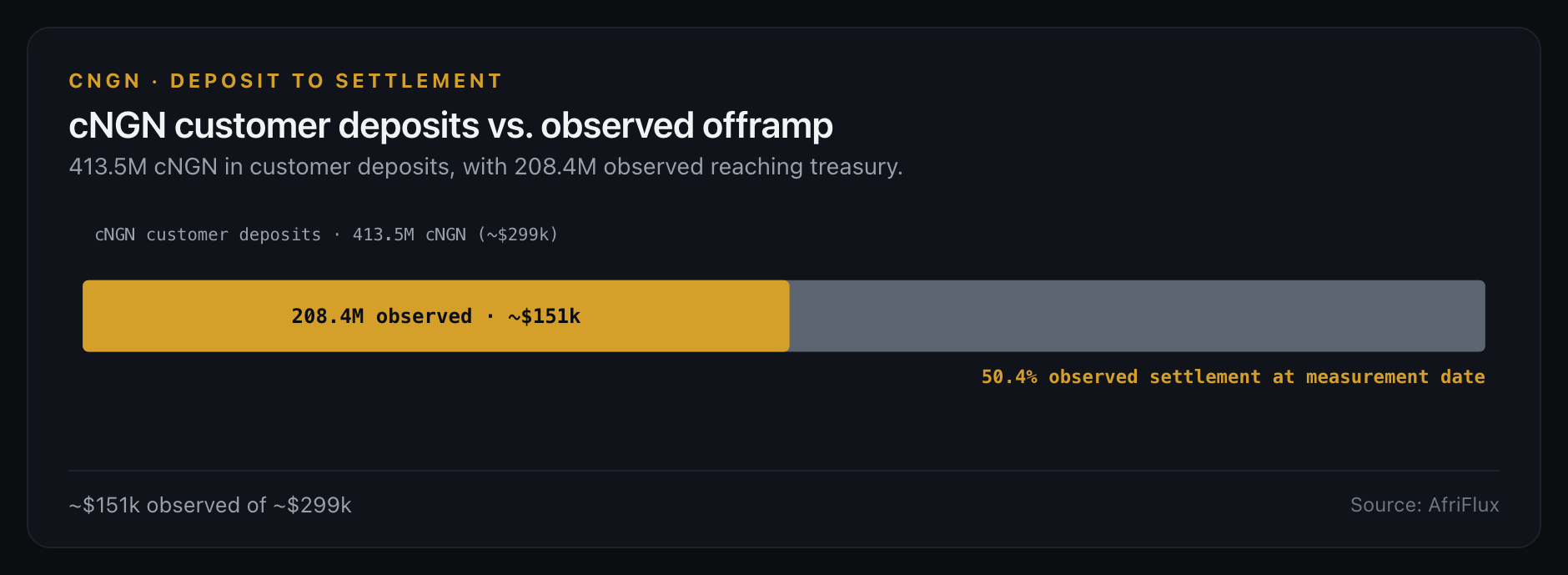
At the measurement date, about half the cNGN deposited had been observed reaching treasury. That's a snapshot, not a ceiling — the rest may be recent or pending. cNGN sits on a separate ledger from the USDT/USDC flow, so we never add the two together.
How we measure it
Azza is in our coverage because its deposit infrastructure is discovered, validated and traced — not because someone labeled a wallet. Every address has to clear the 95% leak-back rule: at least 95% of its relevant outflow reaches Azza's treasury. That strips out pass-through addresses, unrelated wallets and third-party routing. Then we follow the flow, customer to deposit address to treasury to fiat, and keep deposits and observed settlement as separate metrics so the headline never inflates.
This is the flow across the venues we track, not a census of the whole Nigerian market. When we say Azza owns 68% of cNGN, we mean 68% of the cNGN flow we measure. The same map is rebuilt every quarter as the AfriFlux Gradient — which is what makes a placement something you can build a decision on, not a one-off screenshot.
Where Azza sits
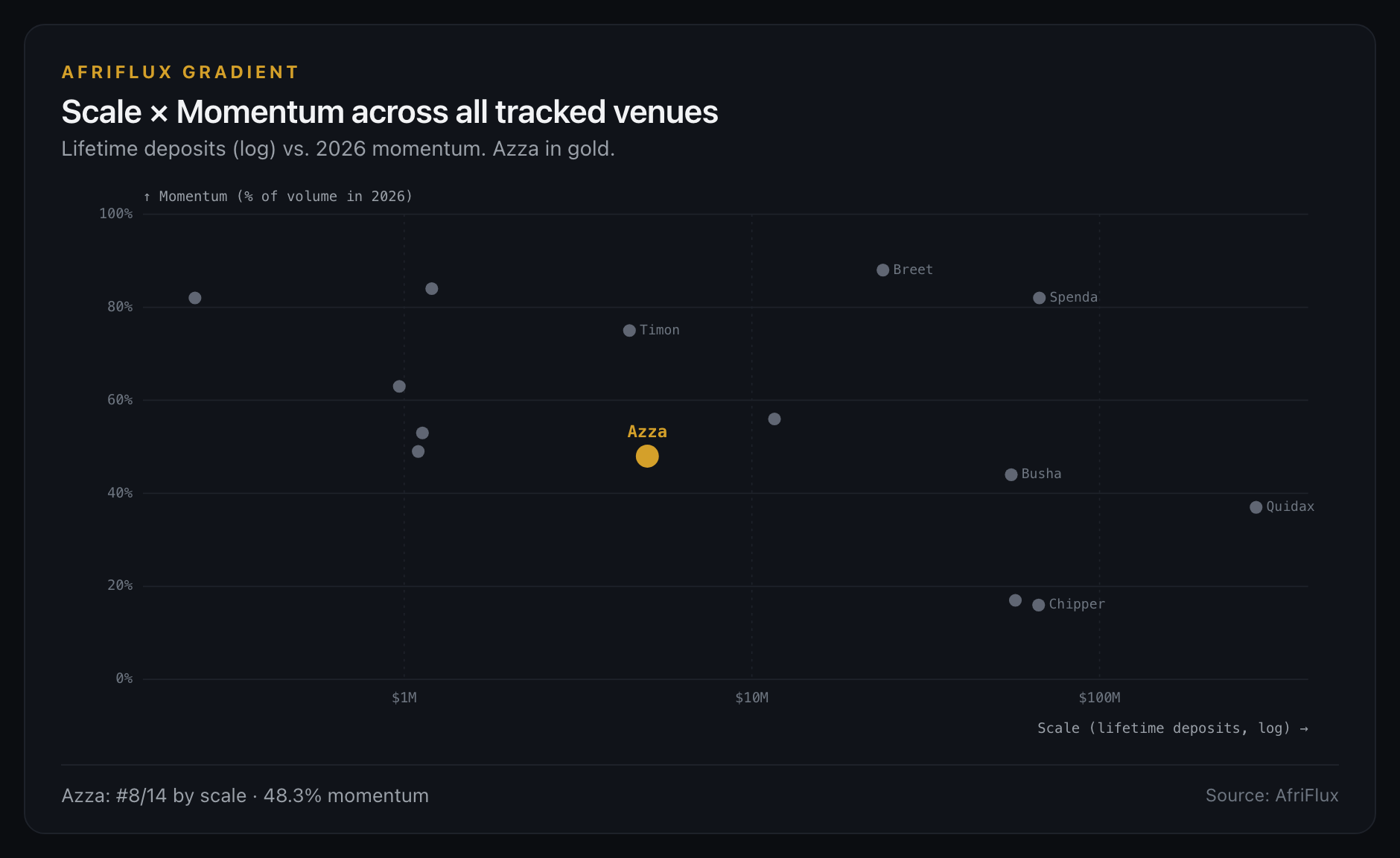
On the Gradient, Azza is eighth of fourteen by scale and third of four offramps. On momentum it ranks higher — 48% of lifetime volume in 2026, ahead of larger, flatter incumbents. It isn't the biggest offramp we track. It's one of the fastest-moving, and on cNGN it's already the leader.
That's the whole point of measuring past the deposit. Size is a snapshot of the past. Where the money settles, what it's denominated in, and how fast it's growing — that's where a venue's actual position shows up. It's the difference between how big a venue has gotten and where it actually stands.
Data as of Sunday, 16 August 2026. AfriFlux Research.