Open the Divest app and ask for a deposit address on Tron. You get one immediately. It looks like every other deposit address: fresh, empty, yours.
We funded one and waited. On 7 October 2026 at 09:37 UTC it swept, and the money went to TCCwQTDPodnpn62a… — an address AfriFlux already holds as Quidax's Tron collection point, recorded as the destination for all 20,755 Quidax Tron deposit addresses and active since April 2022, fifteen months before Divest's app launched.
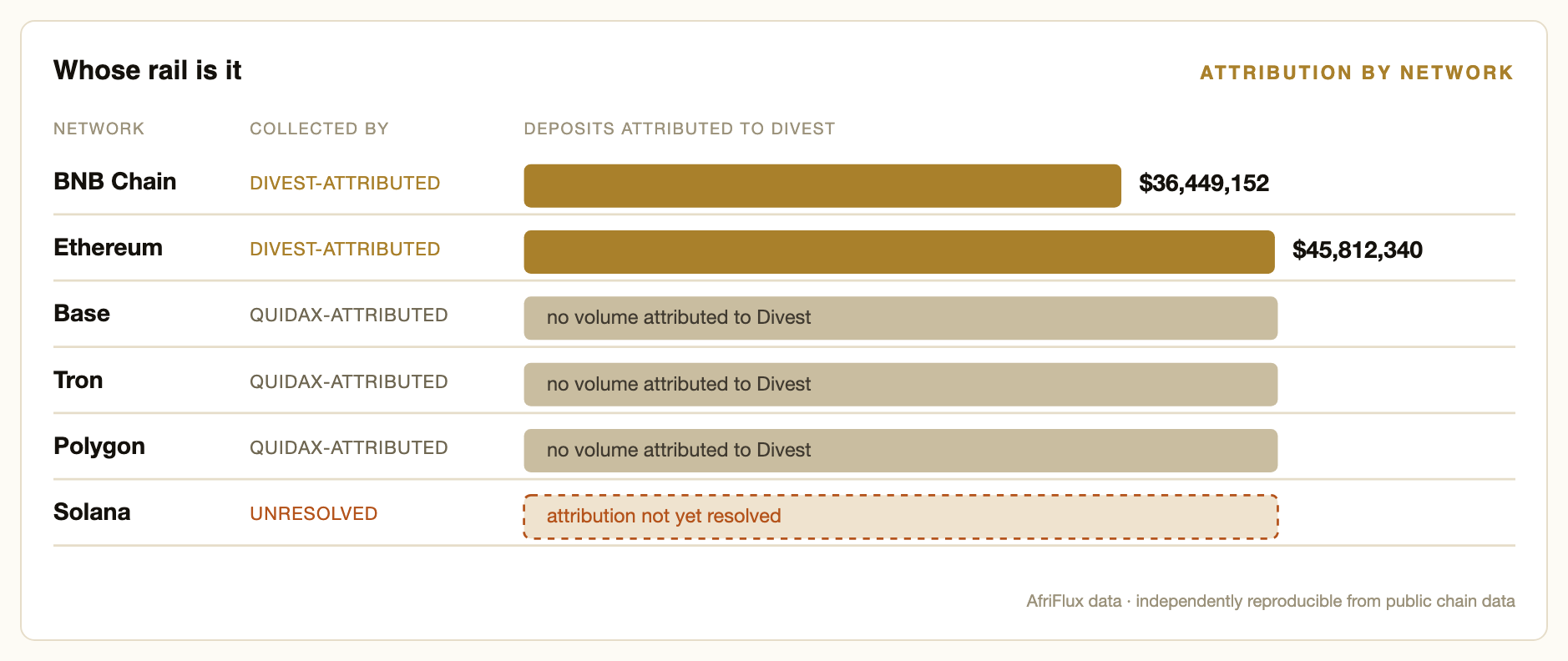
Divest is a crypto-to-cash off-ramp: send it stablecoins, it sends you naira, cedis, shillings or rand. It has never published a volume figure. AfriFlux attributes $82,261,493 of stablecoin deposits to infrastructure Divest operates on BNB Chain and Ethereum, and $36.46M of that arrived in the first nine months of this year. These are the first published onchain deposit-flow figures from AfriFlux for Divest.
On Base, Tron and Polygon, the collecting infrastructure resolves to addresses AfriFlux attributes to Quidax. These networks are excluded from Divest's attributed deposit total because the underlying rails resolve to Quidax infrastructure, rather than infrastructure we attribute to Divest. The map at the top of this page sets out which network is which.
The $82.26M we could attribute
On BNB Chain and Ethereum, the infrastructure we attribute to Divest is the standard architecture of an off-ramp, operated as one system. One wallet provisions, one wallet collects. A customer asks for an address; a funder wallet sends it a few cents of native token, enough gas for exactly one transfer; the customer deposits; the address signs its own sweep into a master wallet. The same funder and master key pair (0xd51bbaf1… and 0xd88f19f7…) runs both chains, which is itself evidence of one operation rather than two regional integrations.
That architecture is what makes the fleet knowable, and it gives us two independent ways to ask the same question. Which addresses did the funder pay gas to? and which addresses paid the master? should return the same set if the model is right. They agree on 99.9% of value on BNB Chain and 99.88% on Ethereum. Summed from the deposit addresses and summed again at the master wallet, the totals land within 0.3% on both chains.
| Attributed to Divest | BNB Chain | Ethereum | Total |
|---|---|---|---|
| Deposits, lifetime | $36,449,152 | $45,812,340 | $82,261,493 |
| Deposit legs | 423,280 | 167,402 | 590,682 |
| Deposit addresses | 11,356 | 6,644 | 18,000 |
| Median deposit | $19.00 | $52.00 | — |
| Deposits per address | $3,210 | $6,895 | $4,570 |
Deduplicated transfer ledger, 19 July 2024 to 8 October 2026. "Deposits per address" divides lifetime deposits by registered deposit addresses on that chain; it is not a per-customer figure. Chain figures are rounded to the nearest dollar and may not sum exactly to the total.
These are two different books run by one operator. BNB Chain is the volume side: 423,280 individual deposits at a median of nineteen dollars, more than twice Ethereum's leg count for less money. Ethereum is roughly half the addresses carrying more value at nearly three times the median. The higher median on Ethereum is consistent with customers using the two rails for different transaction sizes.
The lifetime 44/56 split is history, not a description of today. BNB Chain has sat between $1.3M and $1.8M a month for two years while Ethereum grew around it — from $6,610 in its first month to a peak above $3M — passing it in April 2025. In September 2026, the last complete month, Ethereum carried 66% of deposits and BNB Chain 34%.
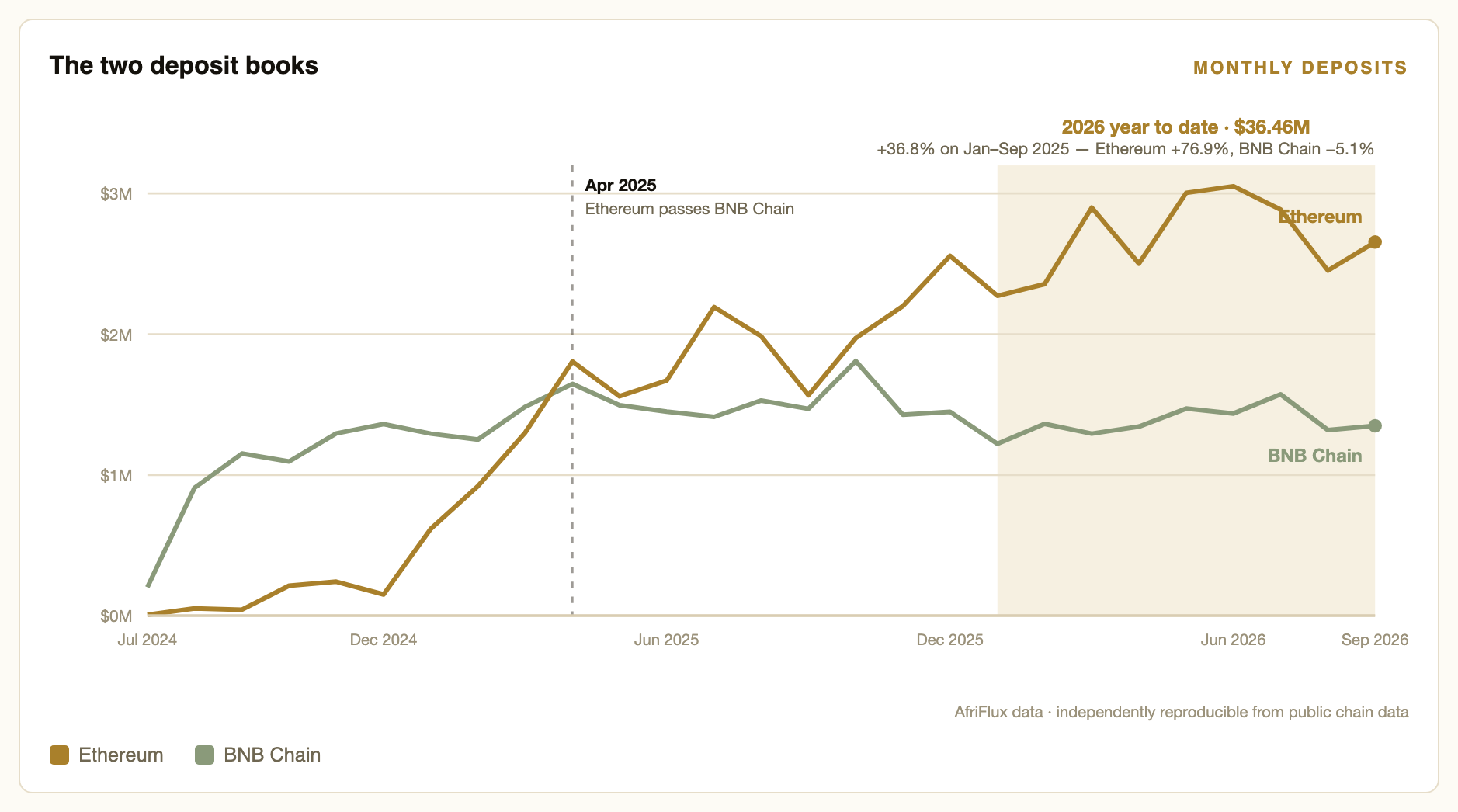
The year-to-date figures make that concentration concrete, and they show something the lifetime total hides: the two rails moved in opposite directions.
| Attributed deposits, Jan–Sep | 2025 | 2026 | Change |
|---|---|---|---|
| BNB Chain | $13,033,649 | $12,372,833 | −5.1% |
| Ethereum | $13,617,656 | $24,084,542 | +76.9% |
| Total | $26,651,305 | $36,457,375 | +36.8% |
Same nine-month window in each year, so the comparison is like for like. October 2026 is excluded. Observed deposit flow into Divest-attributed addresses only — not Divest's business volume, revenue or fees.
Observed deposit flow grew 36.8% year on year, to an average of $4.05M a month, but the growth was not shared across the two rails. Ethereum rose 76.9% while BNB Chain fell 5.1%. Ethereum is carrying the growth in the activity we can attribute to Divest.
One pattern in the deposits is worth recording even though it is not the subject here: a third of everything Divest has received arrived directly from a centralised exchange, Binance-attributed wallets alone accounting for 17.3%. These are customer withdrawals, not payments from the exchanges. It is a precise description of what the product is for.
Where the money goes
Everything above is infrastructure Divest built. Follow the money one hop further and that stops. Divest's master wallet does not hold what it collects: on BNB Chain three addresses take 98.2% of everything that has ever left it, and on Ethereum two take 99.8%. None of the four is an address we attribute to Divest.
The largest is a deposit box at Obiex, a venue AfriFlux also measures, which has taken $68.83M of Divest's settlement across both chains. On Ethereum that box has received $42.13M in its life and 98.9% of it came from Divest — in practice a dedicated account. On BNB Chain the same box is shared with 68 other senders and Divest is 57.1% of it. The second is an address we attribute to Ceffu, which has taken $11.11M.
Read as a lifetime total, settlement looks concentrated in Obiex. Read month by month, the mix has shifted sharply to the Ceffu-attributed address.
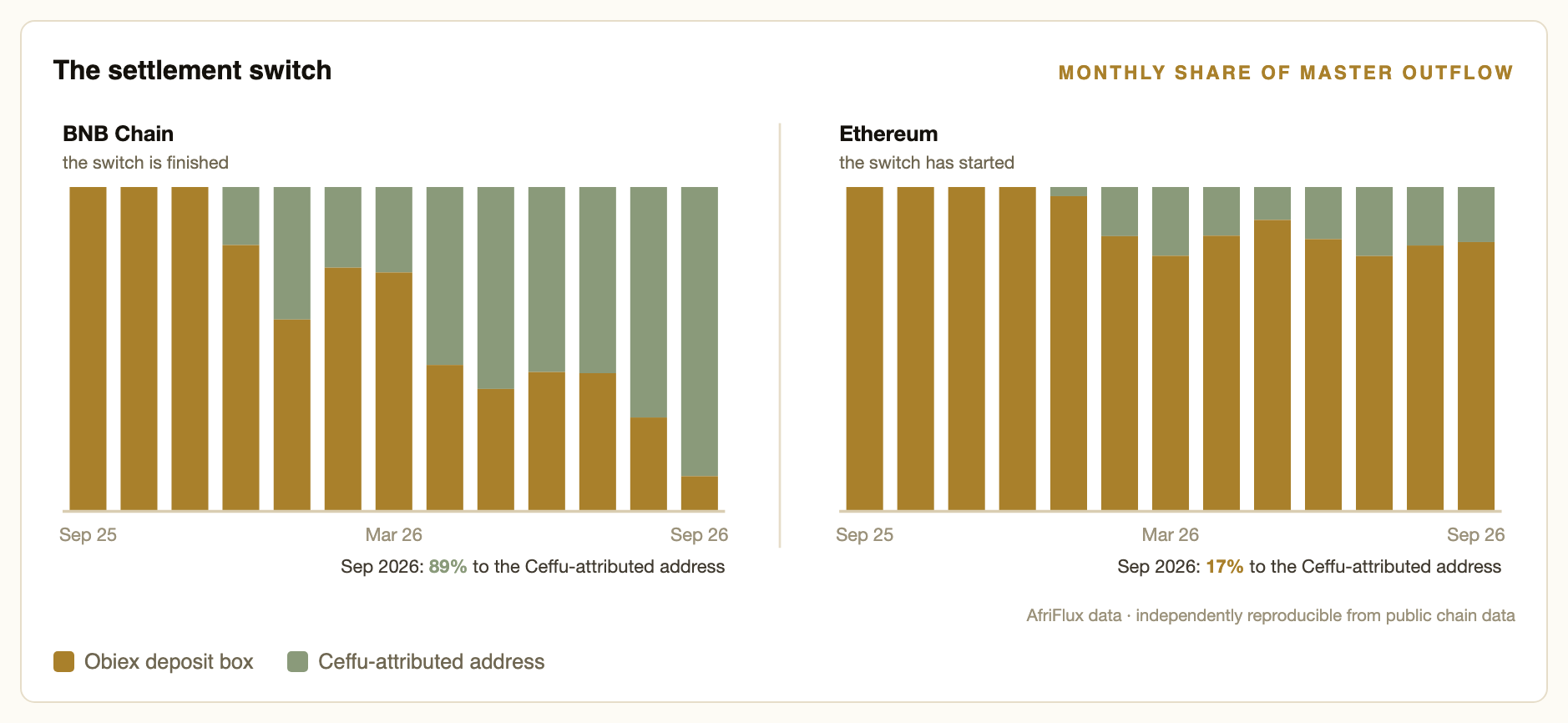
Until December 2025 the Obiex box took effectively all of Divest's settlement on both chains. By September 2026 it took 11% of the BNB Chain flow and the Ceffu-attributed address took the other 89%. The same shift began on Ethereum in the same month and is far less advanced: Obiex still took 83% there in September. What the data establishes is the flow and the address attribution; it does not establish what either company agreed, or why.
Three networks, one other rail
The Tron address at the top of this piece was not an anomaly. Base and Polygon resolve the same way, and Base is the clearest of the three.
On Base the whole chain of custody is already in our database under Quidax: the gas funder, the collecting wallet, the conduit it forwards through and the final sink are four registered Quidax operational wallets, each of which also serves Quidax on seven or eight other networks. Polygon resolves to the same four.
The deposit addresses corroborate the attribution. That Base funder has provisioned 952 addresses, and 407 of them are registered in AfriFlux's database as Quidax deposit addresses — 237 of those on Base itself, and none registered to any other venue we track. The same operational wallets appear across the other networks. We therefore attribute these rails to Quidax rather than to Divest.
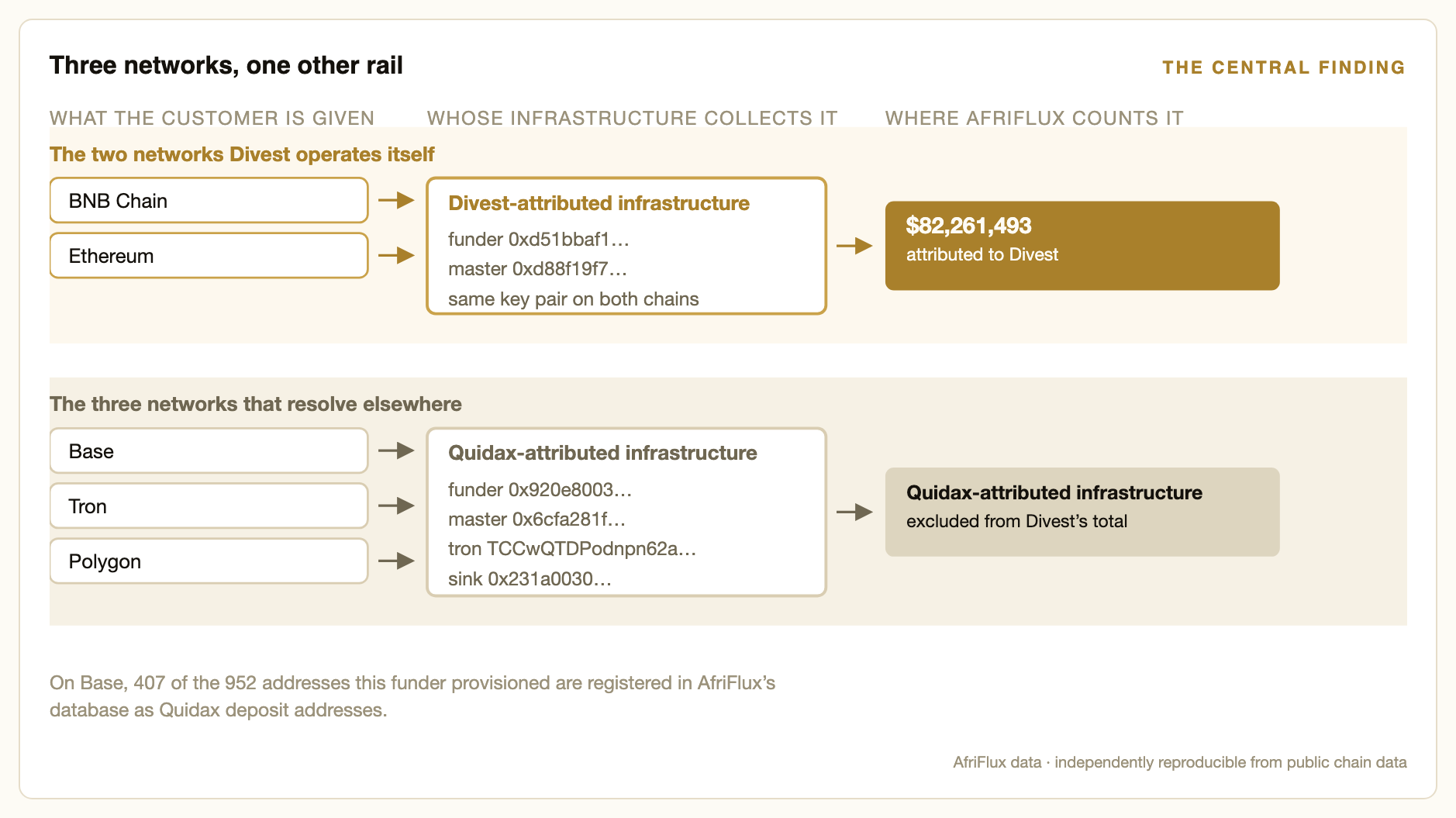
The reason none of it is added to Divest is attribution, not arithmetic. The wallets that fund, collect and settle this flow are Quidax's, so the fleet is not Divest's to claim, whatever any venue currently reports. Part of that flow is already inside the Quidax figures AfriFlux publishes and part of it is not; the methodology below sets out which is which.
The Tron rail is the harder of the three to identify through conventional gas-funding patterns. The deposit address receives a 0.001 TRX activation transfer, and the energy for its sweep is delegated and withdrawn within the same minute; the destination wallet provides the stronger attribution signal.
What the data cannot tell us
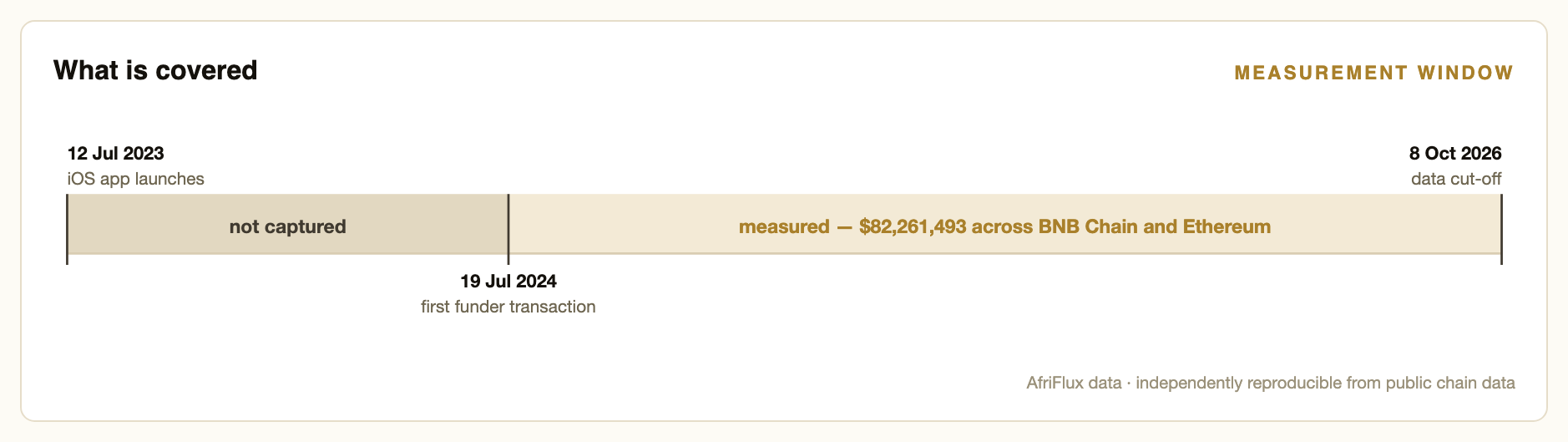
Divest's iOS app launched on 12 July 2023. The earliest infrastructure in this piece begins on 19 July 2024. We have not identified the rails used in between, and we are not inferring them. AfriFlux coverage for Divest therefore reads Partial, with July 2023 to June 2024 marked as not captured.
Four further limits bear on the conclusions above. Solana is unresolved — a Divest Solana address we funded still holds $250.50, unswept, and the chain table says so rather than guessing. Attribution is behavioural. We observe which wallet paid for whose gas and where the money went; that Base, Tron and Polygon resolve to Quidax-attributed infrastructure is observable, while any commercial agreement between the two companies is not, and neither has discussed one publicly. Deposit addresses are not people — 18,000 addresses are not 18,000 customers, and one customer can hold several. And $82,261,493 is attributed deposit flow: not revenue, not fees, and not Divest's total payment volume, since the fiat leg and everything off-chain never touch a block.
The market is not a list of brands
None of this is a criticism of Divest. Renting infrastructure is normal, cheap and usually correct; building a deposit fleet on a network you have not yet proven demand for is an expensive way to find out you were wrong. Divest built where the volume was.
The problem it creates is a measurement problem, and it is ours.
A market map built by counting brands can overstate the market, because brands share infrastructure that isn't visible from the app.
This is why AfriFlux now carries an embedded-rails disclosure wherever a venue is named: which networks it offers, and which of those it does not operate.
The finding illustrates why the African stablecoin market cannot be measured reliably by counting brands alone.
Map the layer. Name the rail. Count the dollar once.
Get the next investigation in your inbox. The Sweep is our Monday newsletter — one attributed on-chain number a week, with the method attached. Subscribe →
Methodology & limits
Period. 19 July 2024 (first transaction from Divest's funder wallet) to 8 October 2026. October 2026 is partial wherever monthly figures appear.
What the figure is. Attributed deposit flow: stablecoin transfers into addresses AfriFlux attributes to Divest on BNB Chain and Ethereum. Deposit-side only. It is not revenue, not a customer count, and not Divest's total payment volume.
How addresses were identified. From chain behaviour, not from any list Divest supplied; none was requested or given. Membership requires a gas edge — an address joins the fleet if Divest's funder paid for its gas, because an address that was never funded cannot have swept. That set is cross-checked against an independent one, every address that paid the master, and the two agree on 99.9% of value on BNB Chain and 99.88% on Ethereum. Totals reconcile from both the address side and the master side to within 0.3% on each chain; the residual is unswept balances and in-flight timing.
Exclusions. Divest's own operational wallets, the funder itself, and token contracts — the USDT contract on Ethereum had been gassed, enrolled as a "deposit address", and contributed a $20.9M phantom from people mis-sending tokens to the contract. Refunds from the master back to a customer box are also removed; they are not deposits. About 13% of the raw transfer legs we collected were zero-value address-poisoning spam aimed at the master and are stripped before any figure here. Transfer records are deduplicated before aggregation.
The Base figures. The 952 addresses provisioned by the Base gas funder have received $4,160,608.56 of inbound flow, measured from the same deduplicated production ledger and the same window as the rest of this piece. Transfers from the four Quidax operational wallets, and between the 952 addresses themselves, are excluded as internal.
Whether a dollar is already counted is decided by registration: AfriFlux attributes a deposit to a venue when it lands on an address recorded for that venue and that chain. On that test the flow splits in two. $800,836.16 reaches addresses registered as Quidax Base deposit addresses and is inside the Quidax figures we publish. $3,359,772.40 is not inside any published venue total: $3,199,594.73 of it reaches addresses registered to Quidax on other networks but not on Base, and $160,177.67 reaches addresses registered to no venue at all. That second portion is a gap in registration, not Divest volume.
Two address counts appear above and they measure different things. 237 of the 952 are registered as Quidax Base deposit addresses; 234 of those received qualifying inbound flow inside the window, and three received none. The 407-address overlap counts distinct addresses present in user_deposit_addresses under Quidax on any chain, not database rows.
Settlement. Destination shares are measured against total outflow from Divest's master wallet over the same period, $82,196,046 across both chains, of which the Obiex deposit box accounts for $68,834,577 and the Ceffu-attributed address $11,108,069.
Base, Tron and Polygon are excluded because the funder, collecting wallet and sweep destination on those networks are addresses AfriFlux attributes to Quidax and already counts under Quidax. Including them in Divest's total would double-count the same flow.
Labels. Exchange and custodian names — Obiex aside, which AfriFlux maps directly — are attributions from our address register, not confirmations from the companies named. Behavioural attribution establishes whose infrastructure processed a transaction; it does not establish a commercial relationship.
Coverage. This is the flow we can attribute onchain across the 25 venues in AfriFlux's coverage — not a census of the whole market. The attribution refreshes nightly, so the same map comes out every morning rather than once when a report is written, which is what lets a figure like this one be checked rather than taken on trust.