A friend asked me last week what I actually do. He doesn't work in crypto. I told him, "We're a crypto data and media company focused on Africa's stablecoin economy." He didn’t seem to get it.
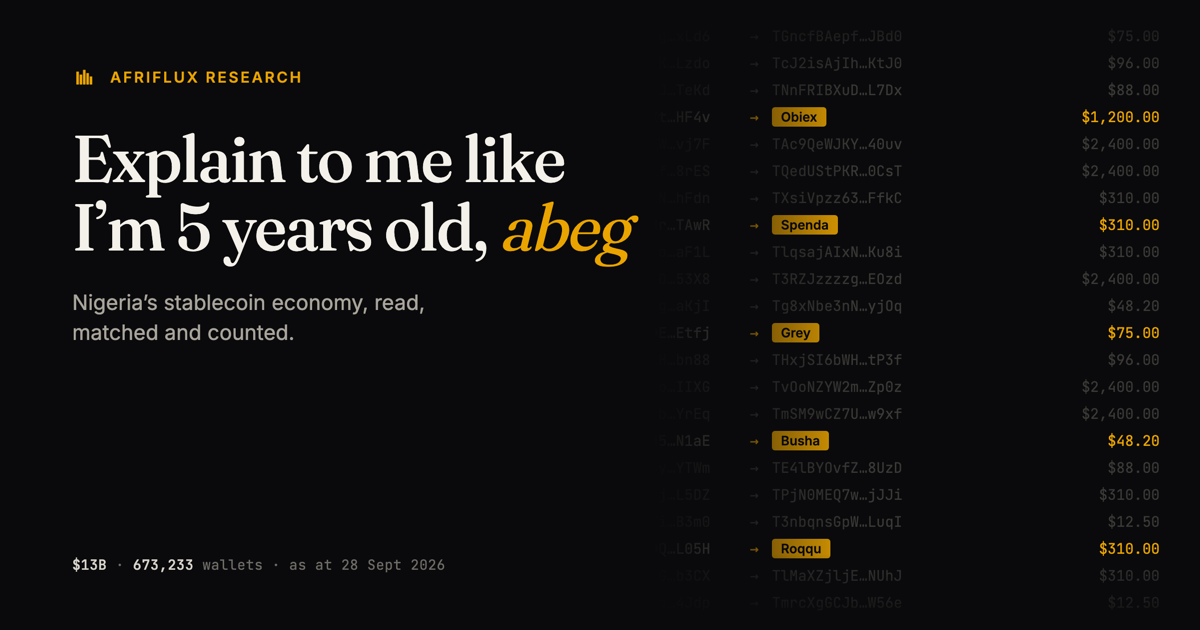
"Explain it like I'm five years old abeg," he said.
So I tried:
Some money lives on phones instead of in wallets. One kind of phone money is special: one coin is always worth one American dollar. It doesn't go up and it doesn't go down. People call it a stablecoin, because it stays still.
In Nigeria, the naira keeps getting weaker. The same money buys less bread this year than it did last year. So lots of people swap their naira for these dollar coins, because the coins don't shrink. They save with them. They use them to pay people in other countries, and people in other countries pay them with them.
When someone sends these coins, it gets written down in a big public notebook that anyone in the world can read. The notebook never forgets and nobody can erase it.
But the notebook is hard to read. It doesn't say "Tunde sent money to a shop in Lagos." It says a long jumble of letters and numbers sent coins to another long jumble of letters and numbers. Millions of lines, every day.
That's our job. We read the notebook. We work out which jumbles belong to which companies. We count how much money is moving, where it goes, and whether more people are using it this month than last month. Then we tell people what we found, in words they can understand.
He was quiet for a second, then said: "So the information is all out there, but nobody's reading it for us?"
Yes. That's it exactly.
The strange thing about this money
Most money is private. Your bank knows what's in your account, but I can't look it up. To know how much money moved between Nigerian banks last month, I need to wait for an official report. Then, I have to trust the number.
Stablecoins work the other way round. The blockchain notes every transfer. It’s like the public notebook from the story. Anyone can read it. The record goes back to the first transaction. You don't need permission to read it and you can't delete it.
In theory, then, we should know more about stablecoins in Africa than about almost any other kind of money. In practice we know surprisingly little. Many people talk about how much Africans use stablecoins based on a global report. This report estimates usage based on outside perspectives.
The information isn't missing. It's unread. Getting from a public notebook to a number you can trust takes three steps.
Step one: reading
The notebook isn't one book. Stablecoins operate on various blockchains. Each one has its own records and format. As of September 28, 2026, we read 13 of them, and for some platforms our records go back to 2020. Each line shows an amount, a time, and two addresses. These addresses are long strings, like TQn9Y2khEsLJW1ChVWFMSMeRDow5KcbLSE.
Reading means collecting all of it, cleaning it up and storing it so you can ask it questions. We read more than 740,000 deposit addresses. It's plumbing work. Nobody sees it when it works, but nothing else is possible until it's done.
Step two: matching
An address on its own tells you nothing. It could be a person, an exchange, a payment app or a scammer. The notebook doesn't know anyone's address. So, you must find out who lives at each one before you can discuss Nigeria.
We do that by watching how money behaves. Addresses that move together usually belong together. Deposits that flow to the same place usually end at the same company. One match leads to the next. So far we've matched addresses to 22 platforms.
I expected the list to be mostly crypto exchanges, and there are five of them. There are nine digital banks. There are also six "offramps" that convert digital dollars to naira. Plus, there's a prediction market and a payments company. One service lets you cash out over WhatsApp. Another is built for travellers. Another turns gift cards into money. Stablecoins are now used in everyday financial tools, not just crypto apps. Many people haven't noticed this change.
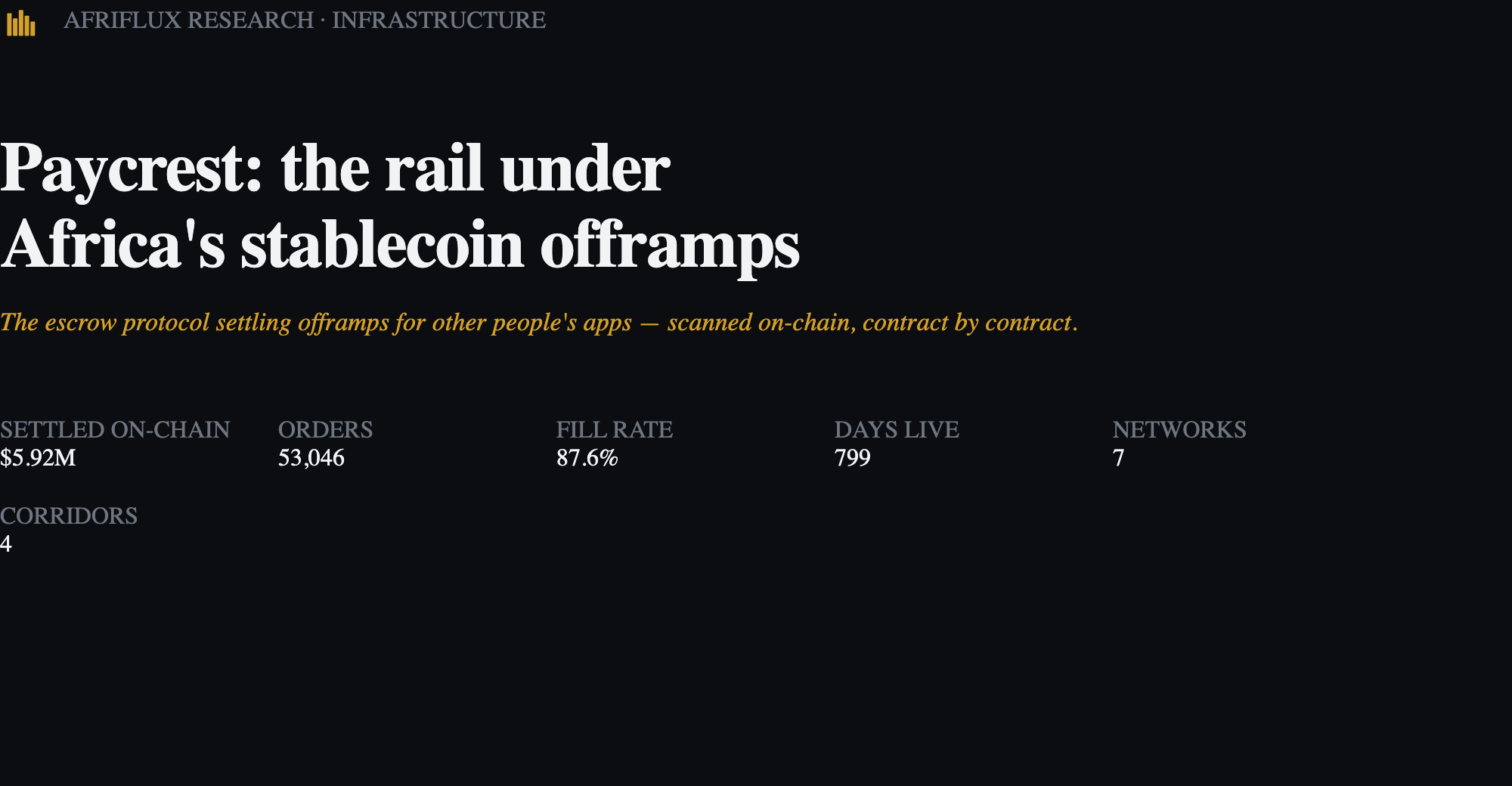
Behind those apps is another layer: the pipes. Other apps plug these protocols in to hold customer money, swap currencies or pay people out in local cash. Most users never see them. We track four. The biggest, Blockradar, provides wallets that other companies build on. It has moved $1.4 billion since July 2024. Its monthly volume went from about $3.5 million to about $250 million in two years.
We treat every match as strong evidence, not legal proof, and we keep checking it. Once the addresses are matched, the notebook begins to report: this much money moved through this Nigerian platform this week.
Step three: counting
With the notebook read and its addresses matched, you can count. Here's what the counting showed as of September 28, 2026. All of it comes from Nigeria.
It's big. Regular people have sent about $2.8 billion in personal stablecoin deposits to the platforms we track. Businesses have shifted another $10.3 billion. Payment companies, merchants, and treasuries are moving big amounts. One exchange, Obiex, has handled more than $11 billion by itself.
It's a lot of wallets. 673,233 different wallets have sent money through these platforms. We count a wallet once, even if it has used several platforms or several blockchains. That isn't the same as 673,233 people, because one person can have more than one wallet. But it isn't a small number of wallets.
Business flow grew even faster, increasing about sixfold.
It looks like wages, not speculation. Over $300 million has gone to Grey, a digital bank, through US-dollar virtual accounts. This happened across 728,314 transfers. The typical transfer is about $96. That's the size of a freelancer's invoice or a remote worker's weekly pay. It's more consistent with an everyday payment than a speculative crypto bet.
Some digital coins are African. Not every stablecoin is a dollar. We track eight coins linked to African currencies. This includes the digital naira, shillings, cedis, rands, and the CFA franc. Only about $7 million of them are out there. Yet, they've traded for over $1 billion. A small amount of money moving very often is what currency looks like when people actually use it.
And that's one country. The platforms we track already serve people in 24 African countries. Kenya is next, and the rest are being mapped.
These numbers matter to more than crypto traders. A bank wonders where its deposits go. A founder decides where to build. All of them rely on clear guidelines. Until now, most of them have had to guess.
The step people forget: telling
This is why I say we're a data and media company, not just a data company.
A number nobody reads changes nothing. The public notebook was already full of facts nobody read. If we turned it into a spreadsheet only analysts open, we'd have built a second notebook nobody reads.
So we tell people, in different ways for different readers:
-
The Terminal is for people who need this every day: banks, fintechs, investors, regulators. Everything in this essay comes from it, and it holds much more. Each platform has its own page. You can put the platforms you care about on a watchlist and get alerts when they move. You can compare platforms side by side, and screen the whole market for what's changing. The Terminal always runs ahead of what we publish.
-
The newsletter is for everyone else. Every Monday it sums up what changed the previous week, in plain language. When we publish something important, it goes out on its own.
-
Research and stories are the longer pieces: reports, explainers and live trackers during big moments.
The Terminal provides the depth. The newsletter and the stories are how the findings reach people who will never open a dashboard.
We hold ourselves to one rule across all of it: the numbers decide the story. That applies even when someone pays for the research. If the data says something awkward, we say the awkward thing.
The money writes everything down. We're the ones reading it.
All figures are as at 28 September 2026, measured on-chain by AfriFlux