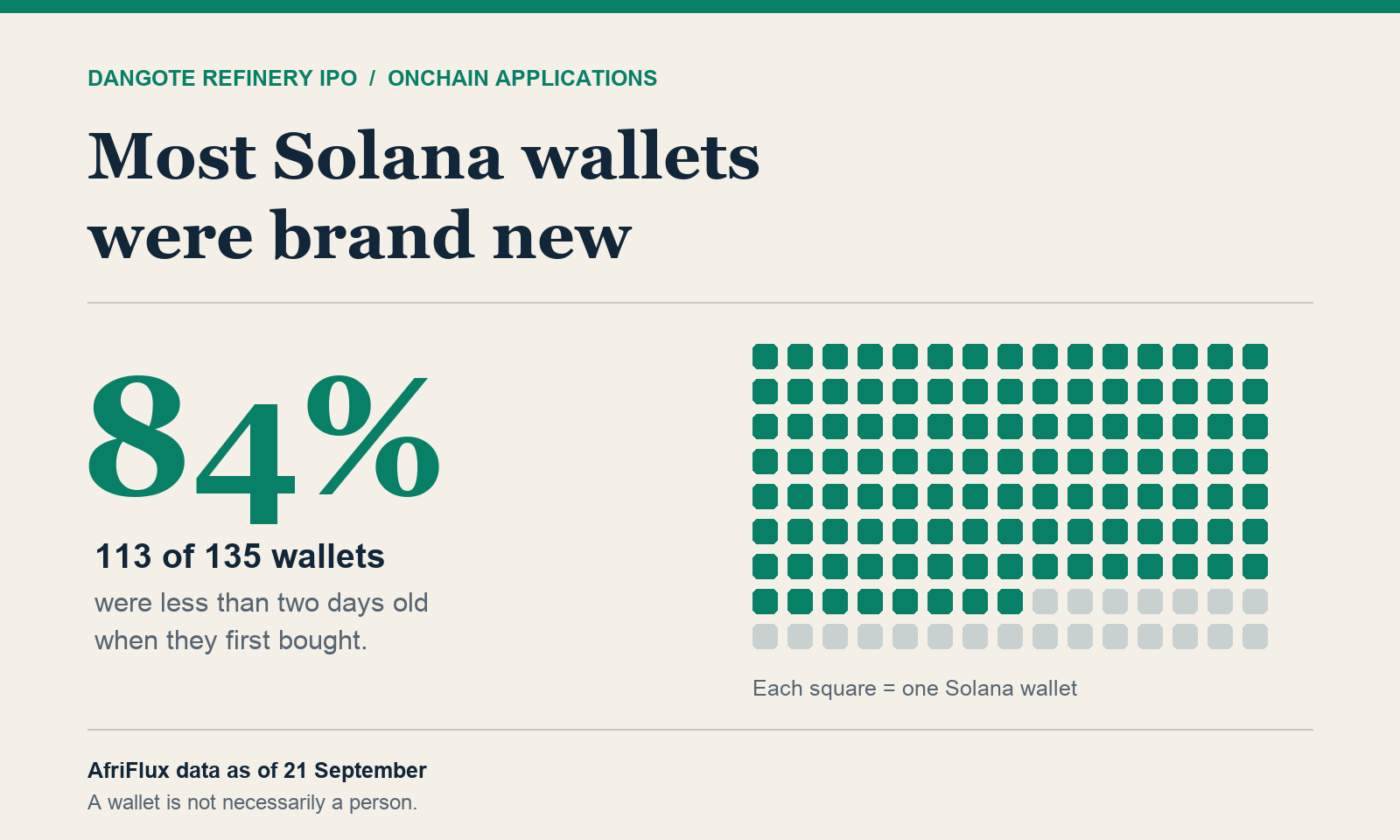
Most wallets that applied for Dangote Refinery IPO shares on Solana were brand new. Of 135 buyer wallets AfriFlux tracked there as of 21 September, 113 were less than two days old when they made their first purchase. So what does it actually mean to apply for shares "onchain," and what happens after you click buy?
An IPO, or initial public offering, is the first time a company invites ordinary people to own a small piece of it. Before that, only the founders and a few big investors own it. Each piece is called a share, and owning one makes you a tiny part-owner of the company. In Dangote's case, the refinery is making brand-new shares and using the money to grow. But you don't just buy a share the way you buy bread. You ask for some, and when the offer closes, the company decides how many each person actually gets.
Most people apply through a bank or an investment app. Some are using a digital wallet instead: an app that holds digital money, known as stablecoins, and lets you pay with it. Here the shares are priced in cNGN, a digital naira worth one naira each, though buyers holding digital dollars can have them converted as they pay. Every wallet payment is recorded publicly on a blockchain, in this case Solana or Base, which is why AfriFlux can see this activity at all.
This route is run by GetEquity, an investment platform. You can reach it directly or through Nectar, which most buyers used. GetEquity takes the digital naira and turns them into a regular IPO application, filed through the same Nigerian Exchange system everyone else uses. What lands in your wallet is a digital receipt, not a share.
That receipt shows you paid. It doesn't show that you own Dangote shares. You become a shareholder only if shares are allotted to you after the offer closes on 13 October. Dangote's IPO guide makes that distinction.
What the numbers show
By 21 September, about ₦21 million had gone toward Dangote shares this way, from 206 wallets. Three things stand out.
First, most of these wallets are new: 113 of the 135 on Solana. The simplest explanation is that Nectar creates a wallet for every new user, so people who signed up just for this IPO show up with a brand-new one.
Second, a few wallets put in most of the money. Four in five wallets bought only once. But a single wallet accounts for almost a quarter of all the money (₦5.25 million, enough for 10,000 shares), and the five biggest wallets together account for close to half. Think of a church harvest: plenty of people drop an envelope, but a few families cover most of the target.
Third, some people have already left. A normal IPO application ties up your money until shares are handed out. This route lets you sell back to GetEquity at the ₦525 offer price before the offer closes. Sixteen wallets have already bought and then sold everything back.
What the numbers can't show
A wallet is not a person. One person can open five wallets, and five friends can share one. So we can't say how many people are behind these numbers, whether they're new to investing, or, the big one, whether they'll end up with Dangote shares after 13 October. That last step happens off the blockchain, between GetEquity and the Nigerian Exchange.
AfriFlux is not affiliated with Dangote Petroleum Refinery, GetEquity, or Nectar. This is not financial advice.
Join our newsletter here.