The African stablecoin flow we track is growing fast — up 18% last quarter, and more than 2.6× since the start of 2025. When a market moves that quickly, the interesting question stops being who is biggest and becomes who is capturing the growth. That's the one thing a size ranking can't tell you.
Sort venues by lifetime volume and you get a board that barely moves. The same names sit on top quarter after quarter, because a lifetime total only ever climbs. A venue that stopped growing a year ago still looks enormous. The number is real — it's just a record of what a venue was, not what it is.
Deep pockets are worth knowing. They're just not the whole story.
We're not throwing lifetime volume out. It's the best read we have on depth — the venues that have moved the most money are the ones with the liquidity, the rails, and the trust to keep doing it. If you want to know who can absorb a large flow today, size answers that well.
What it can't answer is direction. Two venues sitting on the same lifetime book can be heading opposite ways — one compounding, one coasting — and a size ranking shows them as equals. To tell them apart you have to measure not how much a venue has ever moved, but how much of it is moving now.
So we started rating venues on momentum.
Momentum asks a simple question: of everything a venue has ever moved, how much landed this quarter? A high reading means the flow is mostly recent — the venue is winning business right now. A low reading means it's living off a book built long ago.
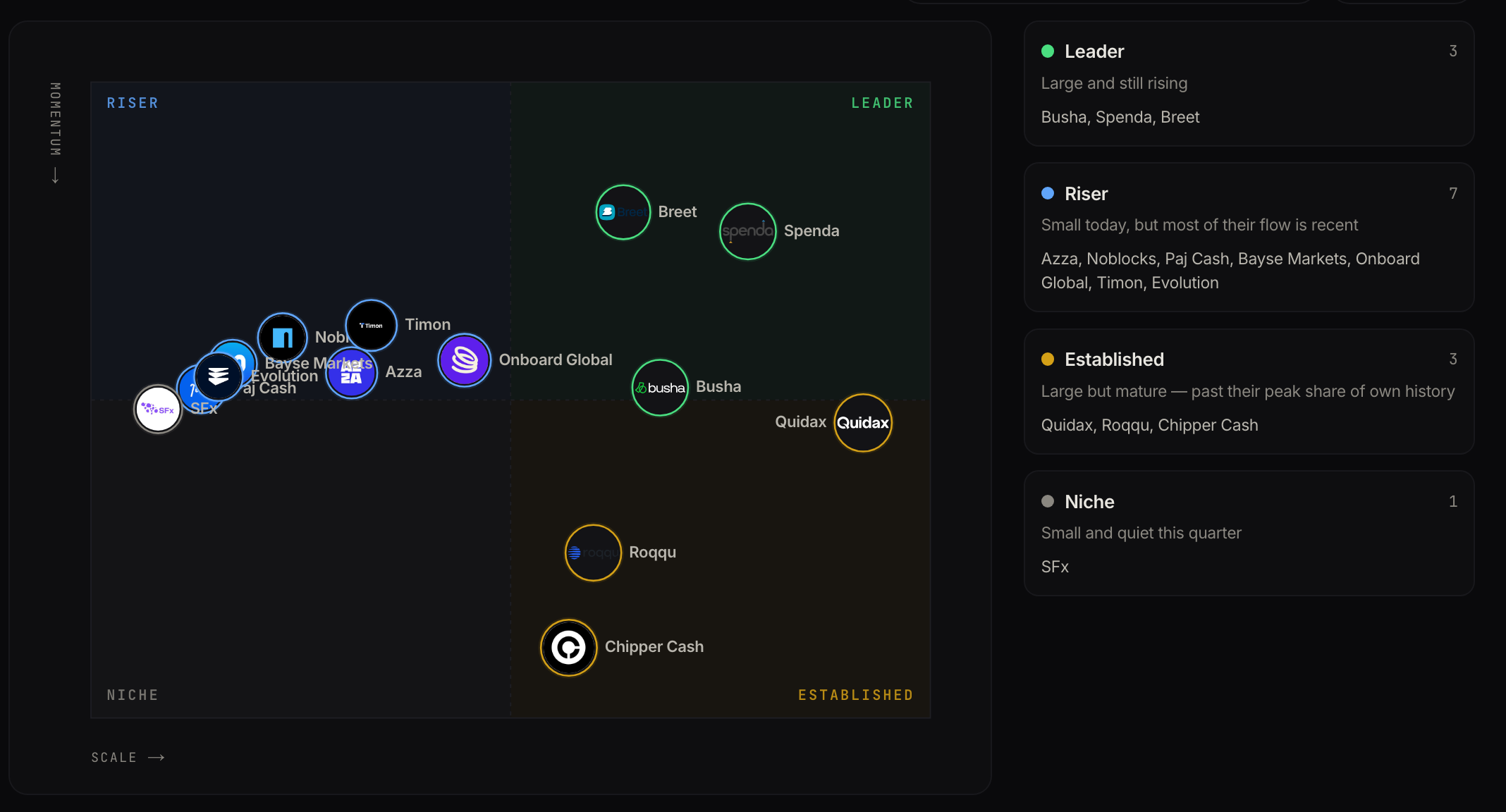
Plot momentum against scale and you stop ranking venues and start mapping them. Four kinds of company fall out — Leader (large and rising), Riser (small, but flow mostly recent), Established (large, but past its peak) and Niche (small and quiet). That's the map at the top of this page — and where a venue lands on it says more than any single column of numbers. We keep it updated every quarter as the AfriFlux Gradient: a live read of who's winning the market we cover, not who won it years ago.
Who's winning now — and who's quietly losing ground
Start at the top of the size ranking. Quidax is the biggest venue we track: $265M in lifetime settlement, 40% of all the volume we measure, the highest scale reading in our coverage. By size it's number one, and it isn't close.
But growth tells the other half, and the comparison has to be fair. The market grew 18% by volume last quarter — a figure the giants inflate by their own weight — so set it aside and look at the typical venue instead: the median venue we track grew about 11%. Quidax grew 7%, behind both. Expanding slower than your peers and slower than the market at once is the definition of losing share — and it's why momentum lands Quidax in the Established corner, large but past its peak. Chipper Cash has gone further and actually shrank, down 19% on the quarter. Neither is failing. Both are ceding ground while a size ranking still calls them leaders.
The market grew 18% last quarter. The median venue we track grew 11%. The biggest grew 7%.
Put the ratings side by side and the divide is clear — the venues losing share, and the ones taking it:
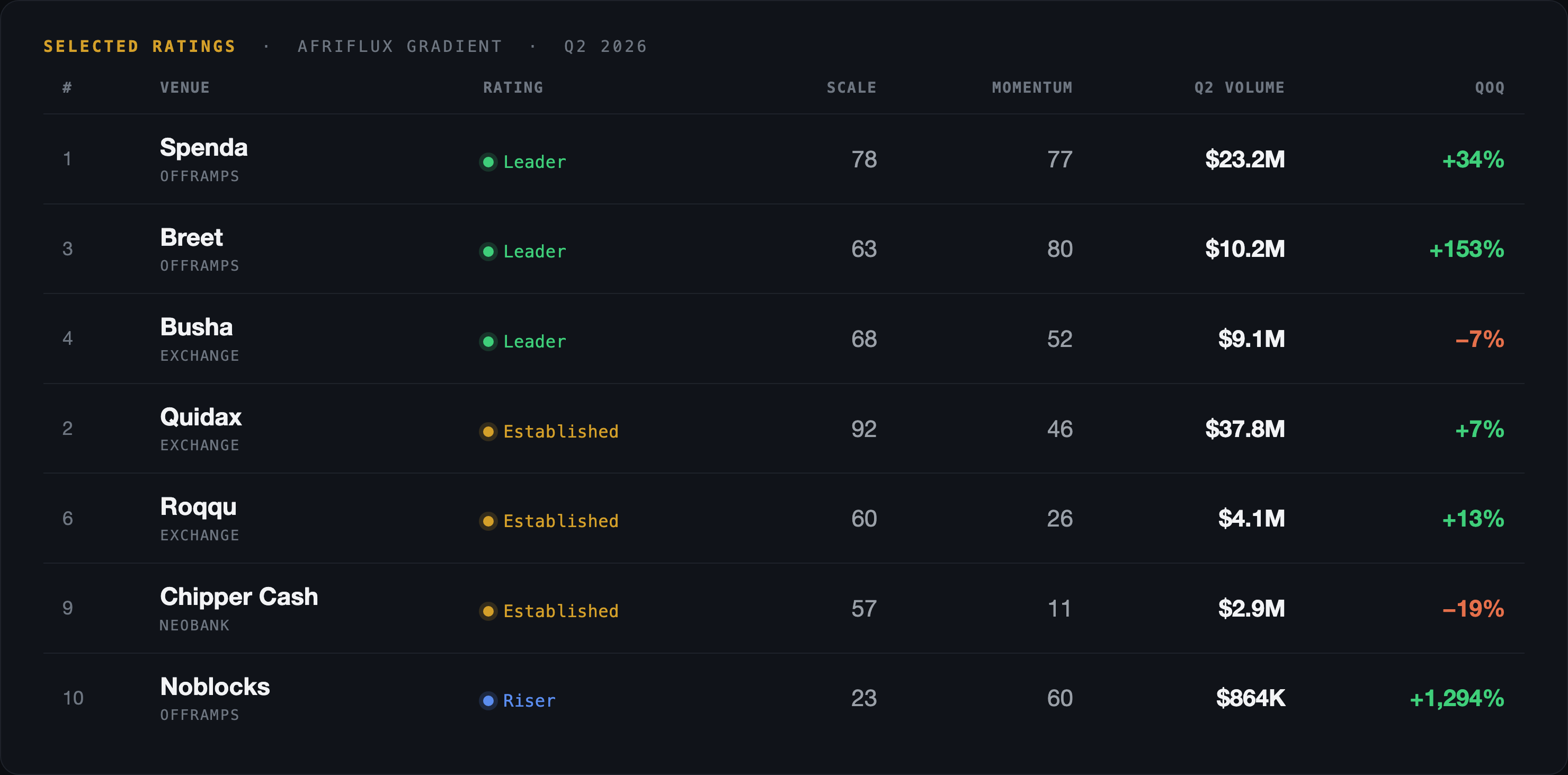
Now the other corner. The three venues momentum rates Leader — Spenda, Breet and Busha — are all smaller than Quidax. Spenda grew 34% last quarter and Breet 153%, both streets ahead of the market; Busha sits on a large, mostly-recent book. They're picking up exactly the share the incumbents are handing back. And two of the three are offramps, not the old exchanges — a tell for where the weight is heading.
Below them is the Riser box, where next quarter's Leaders sit today: seven small venues whose flow is almost entirely recent. Noblocks grew 1,294% quarter-over-quarter. They barely register by size — but momentum sees them a quarter or two before a size ranking ever would.
A scoreboard that only counts size rewards incumbency and misses the turn
Rank venues by size alone and you build a system that congratulates whoever got biggest and never notices when they stop growing. And the blind spot is wide: last quarter only 6 of the 14 venues we track outgrew the market — the other eight lost share, four of them while still growing in absolute terms. A size ranking sees eight venues getting bigger; momentum sees eight venues falling behind. It doesn't replace scale — the two sit side by side — but it's the axis that tells you whether a venue is winning the market that exists today or slowly ceding it.
How this is measured
Every position here is a mechanical function of measured on-chain volume — last complete quarter, lifetime, and share of tracked flow — across the fourteen venues in our coverage. Not a census of the whole market: a set we attribute wallet by wallet, on-chain. No self-declared geography, no wallet counts that don't compare across venues, no editorial override, and no venue pays for its rating. Feed the same public chain data in and the same map comes out, every quarter — which is what makes the Gradient a scoreboard you can build a decision on, not a one-off chart.
The bottom line
Lifetime volume still matters — it's how you know who has the depth to keep playing. But it can't tell you who's winning the market as it stands today. Momentum can. Size tells you who got big; momentum tells you who's next. From this quarter on, we rate the venues we track on both.
The AfriFlux Gradient re-rates every venue we track each quarter — scale, momentum, and rating class. Inside the AfriFlux workspace it's how a venue sees where it actually stands, not just how big it's grown.