If you're a Nigerian who earns, buys or sends money beyond our borders, you know the wall.
You've watched your naira card get declined on a foreign website. By 2022, it was normal. Bank after bank had blocked naira cards for international payments.
You've watched the naira lose more than two-thirds of its value against the dollar in little over a year. You've probably tried to sign up for a popular payment app. Then you got a message: "Your region is not supported." Many of these apps simply don't open accounts for Nigerians.
Maybe you're a freelancer with foreign clients. Maybe you pay your child's school fees in Canada, or you buy goods from China. Either way, you know you need dollars. It's where you get them, what they cost, and whether you'll still have them next week.
Millions of Nigerians have quietly answered this question with services backed by crypto. Most of them would never call themselves "crypto people."
The answer Nigerians built for themselves
The answer is the stablecoin: a digital dollar that lives on your phone. Each unit is worth one US dollar. You can hold it, send it, or swap it for naira in an app, any time of day. You don't need a domiciliary account, and you don't need a bank's approval.
At AfriFlux we measure it directly. We trace real deposits into the apps Nigerians use, and here's what we've found:
-
665,000 wallets held $1.04 billion in stablecoins across the Nigerian apps we track.
-
In the week of 14–20 September, a record 54,869 wallets were active across the 20 platforms we now track. Every one of those platforms serves Nigerians.
-
The average deposit that week was $122.
A hundred and twenty-two dollars isn't a whale moving a fortune. It's a salary, a supplier invoice, a month of school fees. 85% of this money is in Tether's USDT, the most common digital dollar in Nigeria across the venues we monitor.
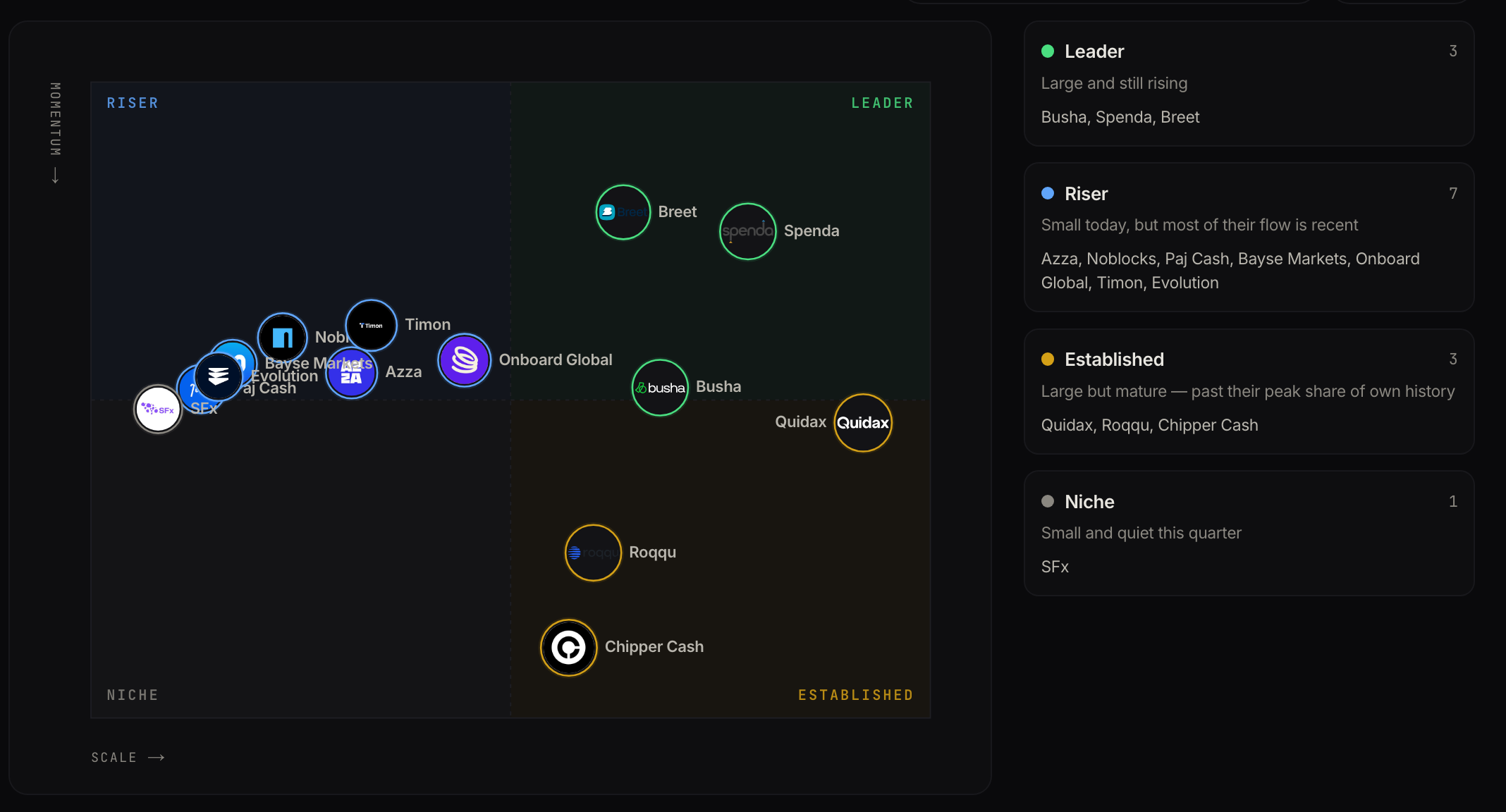
And the growth isn't where you'd expect. The big exchanges hold the most money, about $1,800 per wallet. But the fastest growth is in the cash-out apps, the ones that turn digital dollars into naira in your bank account: they hold a comparable ~$1,360 per wallet and grew 45% in a single quarter — more than twice the pace of the exchanges.
This is what happens when banks won't give ordinary people dollars. People find another way to get them.The problem: it's all happening without a safety net
Here's the uncomfortable part. Almost all of this runs in a grey zone.
If the app holding your digital dollars gets hacked, you might not get your money back. No rule puts you first in line. Patricia users learned this in 2022. If an app shuts down overnight, there's no guaranteed right to redeem your balance. When the Central Bank cut banks off from crypto firms in 2021, the activity didn't stop. It moved to people trading directly with each other. Scams are common there, and there's no one to report them to.
In June, the IMF, a global group that watches over countries' money, shared what it found. It said digital dollars help Nigerians send money to other countries faster and for less. Since 2019, Nigeria has received more digital dollars than any other country in its part of Africa. Nigeria gets about 6 out of every 10 dollars. But the IMF also gave a warning. If there are no good rules, criminals can use digital dollars too.
So the question isn't whether Nigeria regulates this. We've started.In 2025, a new Nigerian law officially counted digital assets as investments. Then in August, the SEC, the government body that watches over investments, shared a first draft of new rules for them. The question is what kind of rules: rules that protect the people already using this, or rules that push them back into the shadows.
Kenya has just answered that question. Nigeria should read the answer carefully.
What Kenya got right for the ordinary user
Kenya passed its Virtual Asset Service Providers Act in October 2025 and published the detailed rules in July 2026. Every provider has until 4 November 2026 to be licensed. The law is built around a simple idea: if a company holds your digital money, it owes you the same protections a bank does.
You can always get your money back, at full value, quickly. A stablecoin holder in Kenya can redeem at any time, and the issuer must pay out in cash within two working days. No discount and no indefinite "processing."
The money behind your digital shilling or dollar must actually exist, and be ring-fenced. Every coin must be fully backed by cash, bank deposits or short-term government securities. Those reserves are kept separate from the company's own money and protected from its creditors. If the company goes under, your backing isn't part of the wreckage.
If a platform collapses, customers are paid first. In a voluntary wind-down, customers come before every other creditor.
Your money has to be available when you want it. Approved companies must keep your money ready to pay back to you at any time. They must also tell you clearly what risks you're taking.
These aren't exotic ideas. They're the protections Nigerians would expect from a bank, applied to the tool Nigerians are already using instead of a bank.
What Kenya got right for the businesses
A law that protects users but kills the platforms protects nobody. Kenya's second smart choice was making it possible to comply.
There's a licence that fits your business. Kenya created ten licence types, covering exchanges, wallet providers, brokers, payment processors and stablecoin issuers. A small cash-out service isn't forced into the same box as a large exchange.
The entry cost is proportionate. A broker or payment processor in Kenya needs KES 10 million in capital, roughly $77,000. An exchange needs KES 100 million, roughly $772,000.
Firms got time. A full year passed between the law taking effect (November 2025) and the licensing deadline (November 2026).
Kenya taxes the platform's fee, not your money. This is the most telling lesson. Kenya used to charge a 3% tax on the full value of every crypto transaction. It raised about KSh 1.1 billion over 21 months, and it taxed people for simply moving their own money. In July 2025 Kenya scrapped it and replaced it with a 10% tax on the fees platforms charge. The user moving $129 is no longer the target.
Where Nigeria stands
Nigeria's draft rules share some of Kenya's good instincts. They would keep customers' funds in separate wallets, require 80% of customer assets to be stored offline, and require hacks to be reported within 24 hours. That's real progress, and the SEC deserves credit for it.
But on the things that decide whether platforms survive, and whether users stay, the draft leans the other way.
The cost of entry is about double Kenya's. An exchange would need ₦2 billion, about $1.5 million, roughly twice Kenya's figure. A general service provider would need ₦200 million, about $149,000, again roughly twice what a Kenyan broker or payment processor needs. Remember where the users are: in the small cash-out apps. These are exactly the businesses least able to raise that capital.
The digital dollars people actually use face a higher bar than local ones. Under the draft, a foreign-currency stablecoin needs SEC approval and 120% reserves, against 100% for a naira stablecoin. For a market where 85% of everyday flow is USDT, that's a gate on the main road.
The tax burden points at the user. Since January, crypto gains are taxable as income, at up to 25%. Every account must be tied to your national ID number and tax number, and platforms report your transactions monthly. Kenya moved the burden off the user. Nigeria is moving it onto the user.
The direction Nigeria should take
The SEC's comment window closed on 3 September, and the final rules aren't out yet. There's still time to get this right. From Kenya, Nigeria should take five things:
-
A guaranteed right to redeem, at full value, within a fixed number of days.
-
Customers paid first if a platform fails.
-
Licences sized to the business, so a cash-out app serving 60,000 people isn't priced like a national exchange.
-
A clear, reachable path for the digital dollars Nigerians already use, instead of a bar set higher than the one for naira coins.
-
Tax the platform's margin, not the citizen's transfer. Kenya tried taxing the user and reversed course.
Kenya isn't perfect. Its central bank also kept the power to restrict foreign stablecoins, and Kenyan experts have warned that using that power too aggressively would raise costs and fragment the market. Nigeria shouldn't copy that part.
But the core of Kenya's law gets something right that Nigeria's policy has often got wrong. It starts from the person using the money, not from fear of the money.
Nigerians didn't wait for permission to solve their dollar problem. Nearly fifty-five thousand wallets in a single week tells you they solved it themselves. The only question left is whether the law will protect what they built, or push it back into the dark.
Claim your your spot on the newsletter