Obiex is a Nigerian exchange. It issues customers deposit addresses and sweeps what lands there into its own wallets.
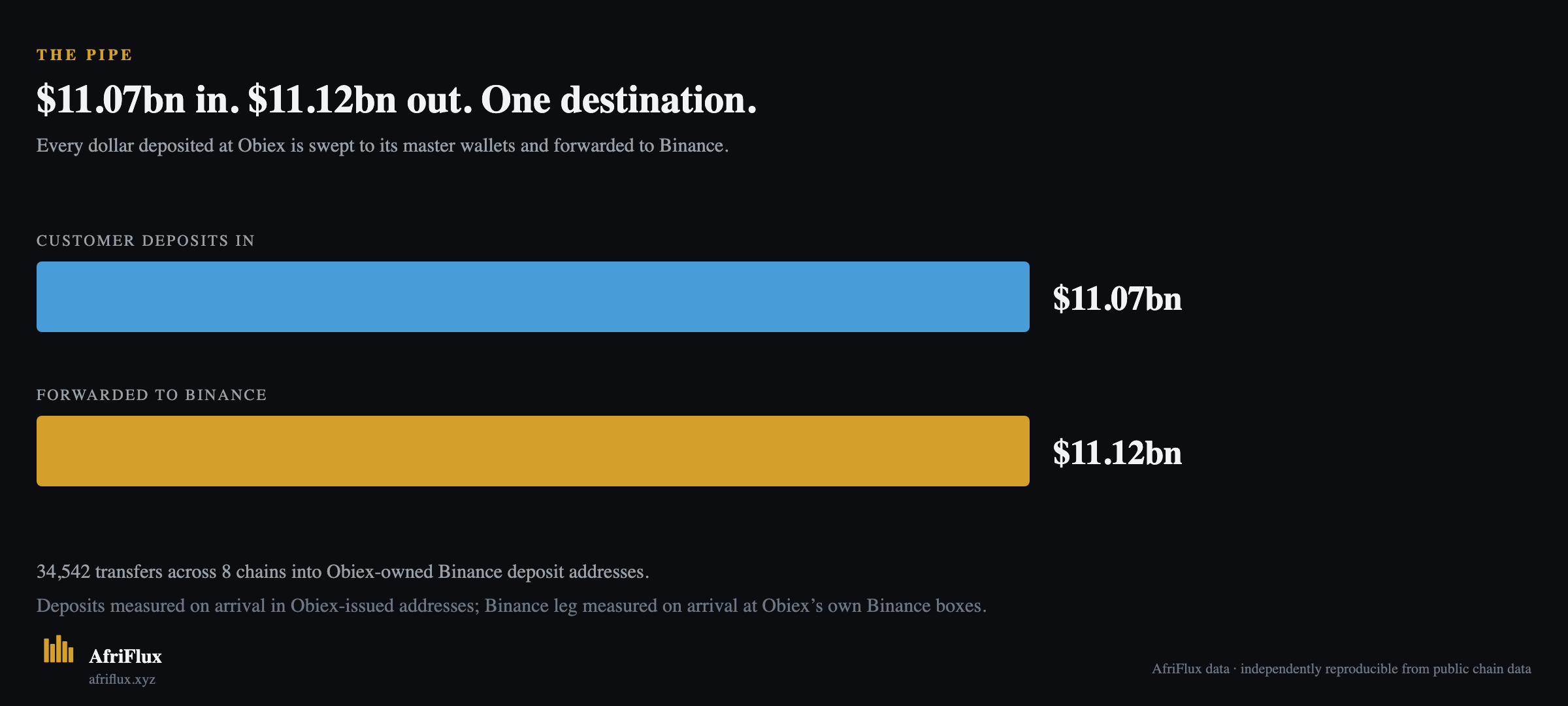
Since September 2021, we've measured 1,829,318 deposits into Obiex-issued addresses across eight chains, totalling $11.07bn. Obiex issued 20,611 deposit addresses over the period; 20,451 received at least one deposit.
That figure alone makes Obiex the largest venue in our current coverage by a wide margin.
But it was the second number that made us keep going.
Across those same eight chains, 34,542 transfers carrying $11.12bn moved into deposit addresses that Obiex holds at Binance. Not some of it. Almost all of the observable settlement.
Money arrives through Obiex's rails. It leaves through Binance's.
So we followed it.
What we found was not one giant account, but an entire deposit machine.
Obiex reviewed and confirmed these measurements with us on 19 September 2026.
Where does $11 billion actually go?
A deposit address is only the first step. Money lands there, Obiex sweeps it into a master wallet, and from that master it moves on.
Obiex holds its own deposit addresses at Binance on all eight chains we track. Following the master wallets forward, this is what we find.
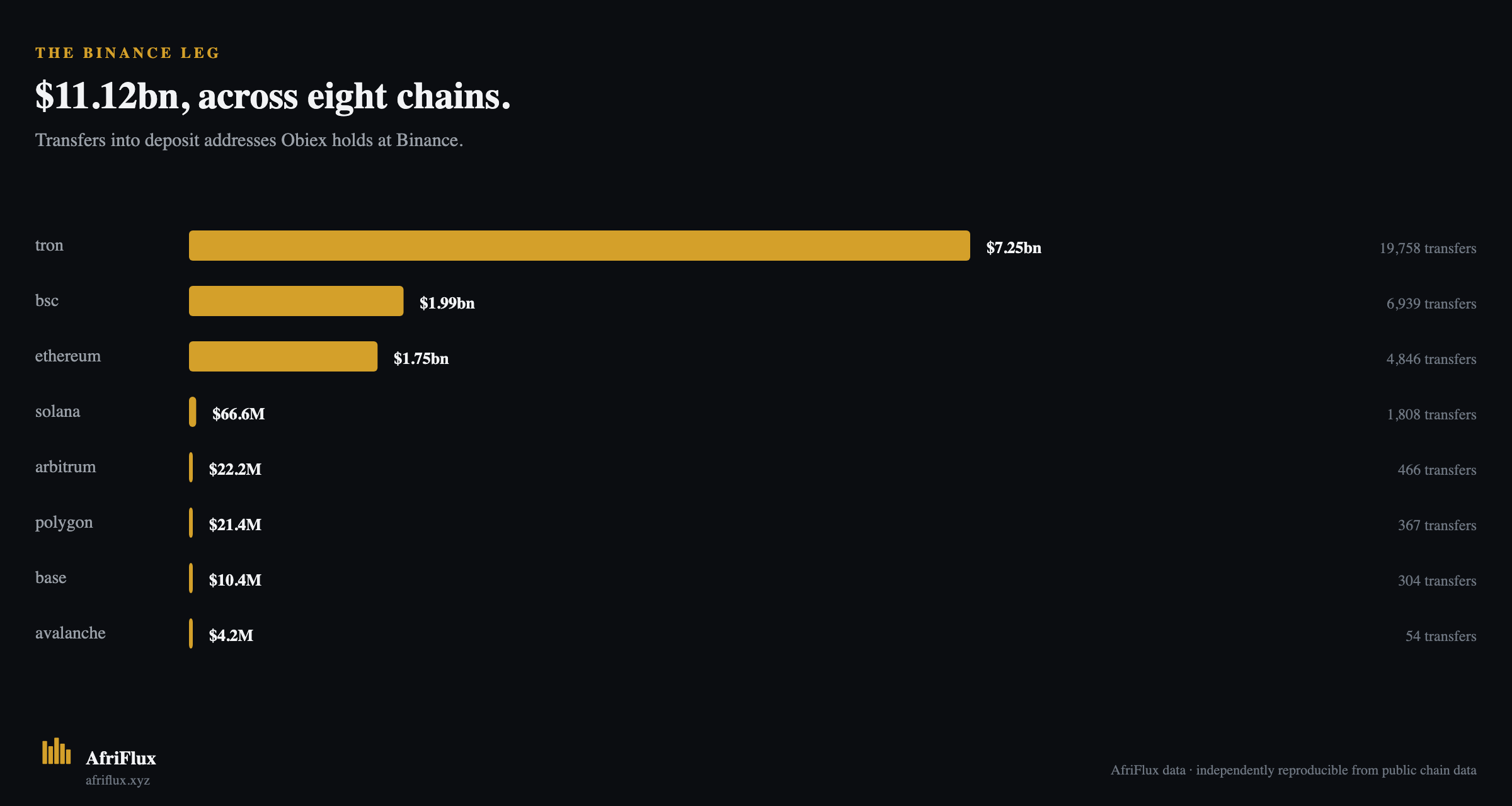
Tron alone carries $7.25bn across 19,758 transfers, beginning in July 2021 and running to the day we measured. BSC adds $1.99bn and Ethereum $1.75bn.
The destination is remarkably concentrated.
Why?
That's the question the rest of this piece is built around. To answer it, we first need to understand what kind of deposit book produces flow like this.
This is not a retail book with some large accounts in it
Our retail classification engine splits a venue's book by deposit size. On Obiex, that's $1.74bn below the band across 1,399,680 deposits averaging $1,242, and $9.33bn above it across 429,638 deposits averaging $21,720.
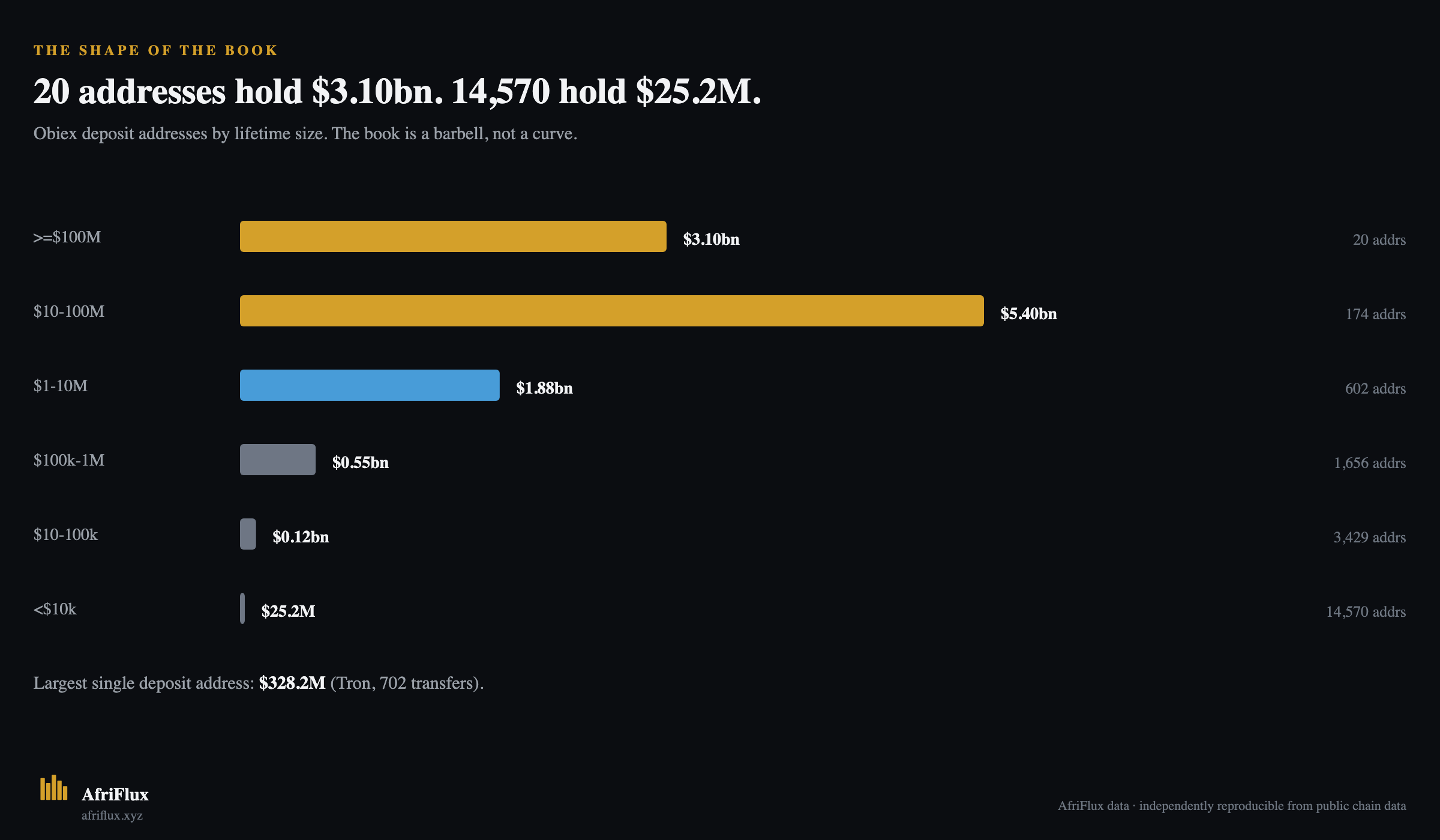
The distribution is a barbell. Twenty addresses have each received more than $100M — $3.10bn between them. At the other end, 14,570 addresses have received under $10,000 each, $25.2M in total. The largest single deposit address has received $328.2M across 702 transfers.
We don't label the upper band "B2B". Our engine splits on deposit size and frequency — it has never known what a business is. A company can deposit retail-sized amounts and sit inside the band. An individual can sit above it. We publish the distribution and let it speak.
Nobody needs us to explain what a $328 million deposit address is.
This isn't a new spike
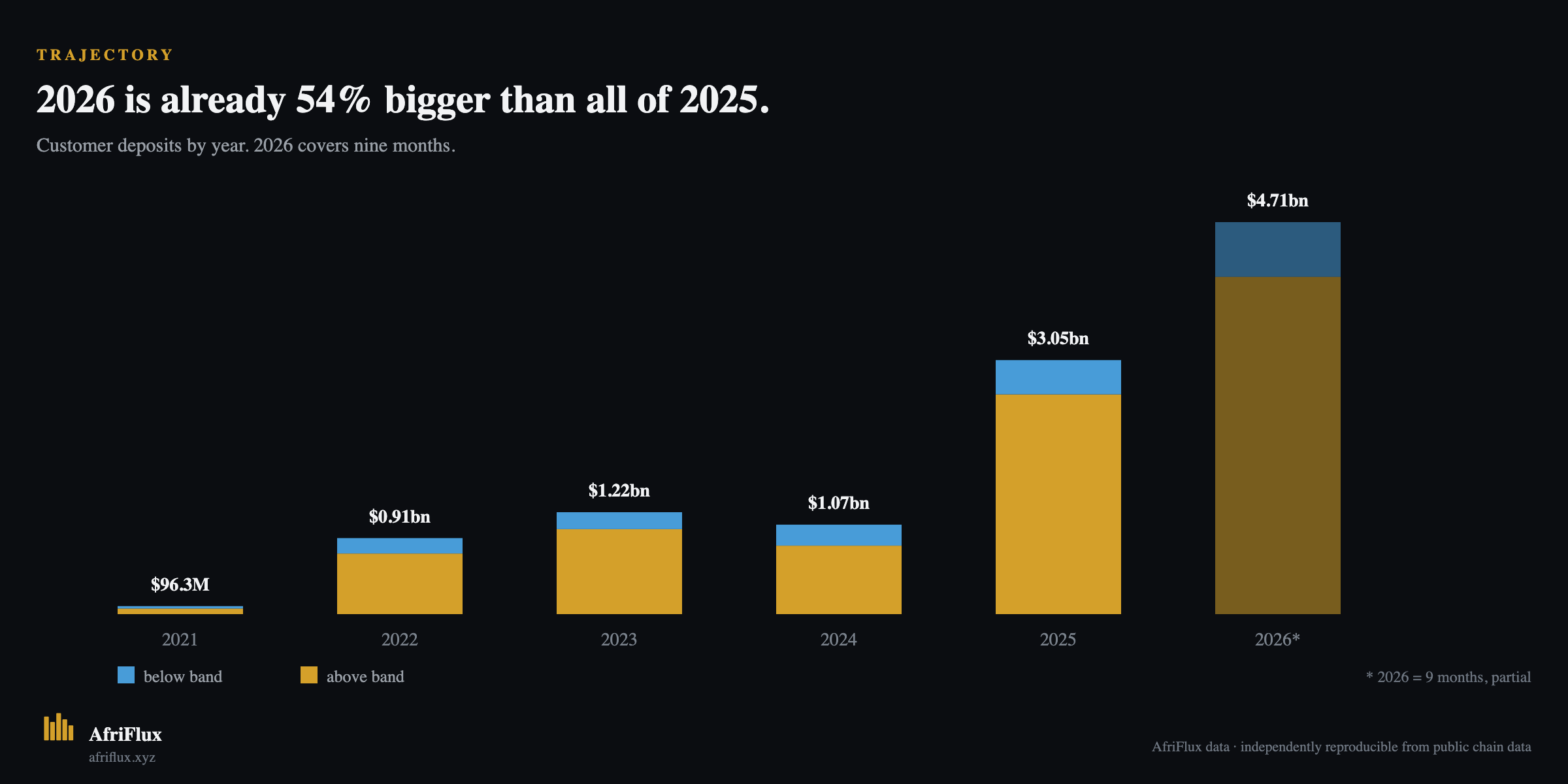
The 657 Tron deposit addresses first funded in 2021 carried $0.83bn between them — $1.27M per address, in our first year of coverage. The deposit addresses were already handling large-ticket flows from the beginning, and Obiex has provisioned fresh ones every year since.
Deposits ran $0.91bn in 2022 and $3.05bn in 2025. The first nine months of 2026 have already taken $4.71bn — half again as much as the whole of last year, with a quarter still to run.
So what changed in 2025?
The book didn't start large and stay flat. It has grown more than fourfold from 2024 to the first nine months of 2026, while the shape of the deposit distribution stayed broadly the same.
We can see the acceleration. We can see that it happened through an existing structure. What we can't establish from the deposit rail alone is exactly what caused it.
Who is actually funding this?
Among labelled exchange sources, Binance is the largest at $1.07bn, followed by Bybit at $0.65bn. Self-custodied wallets account for $4.44bn, while a further $2.29bn comes from senders we haven't identified.
There's another interesting layer.
Two venues in our own coverage hold their own Obiex deposit addresses and settle through them directly: Quidax, $0.12bn across 8,035 transfers, and Jeroid, $0.016bn across 279 transfers.
Those are confirmed wallet relationships. Other tracked venues appear in the flows, but their money arrives through intermediaries rather than an address of their own — an inferred relationship at best. We don't describe it as more than that.
Why does so much of it run through Tron?
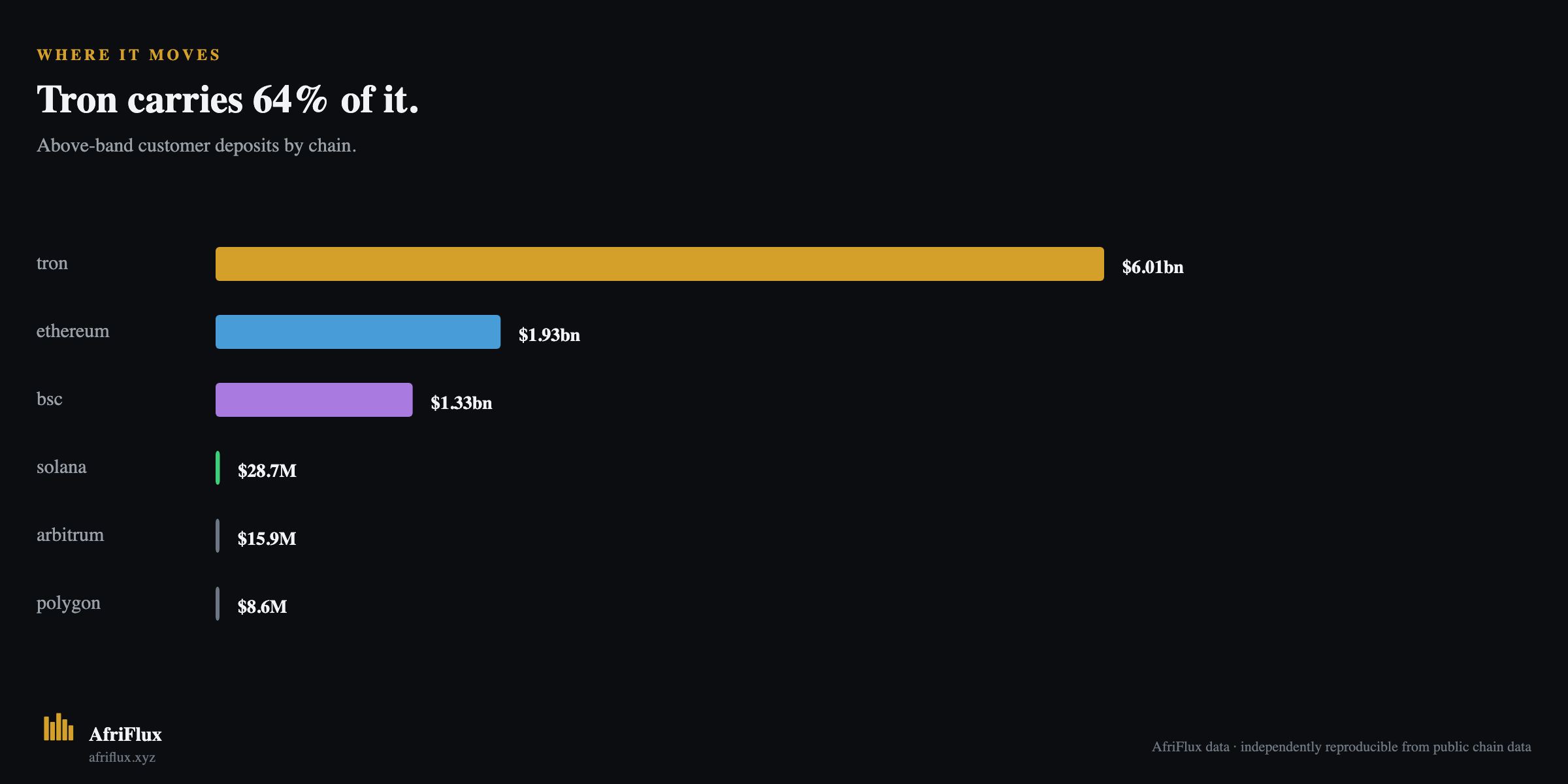
Above-band deposits are $6.01bn on Tron, $1.93bn on Ethereum and $1.33bn on BSC. By token, it's $9.05bn USDT against $0.28bn USDC — a 97/3 split.
Tron and USDT dominate the large-ticket side of the book. 64% of above-band deposits are on Tron, while USDT accounts for 97% of the observed above-band token volume.
The data shows the concentration. It doesn't, by itself, tell us why Obiex or its customers prefer those rails.
Measured like-for-like, Obiex is 8.6× the combined total of all twenty other venues in our coverage, which together account for $1.29bn. Several of those venues are still under review and their above-band books aren't fully measured, so that multiple will fall as our coverage completes. The comparison is context, not the central finding.
Then we hit the blind spot
We can follow money into Obiex, and we can follow it from Obiex to Binance. The leg we can't follow is the one that matters most to a customer: getting paid out.
Customer withdrawals are processed directly from Binance. They never touch an Obiex address, so they leave no trace on the rails we observe.
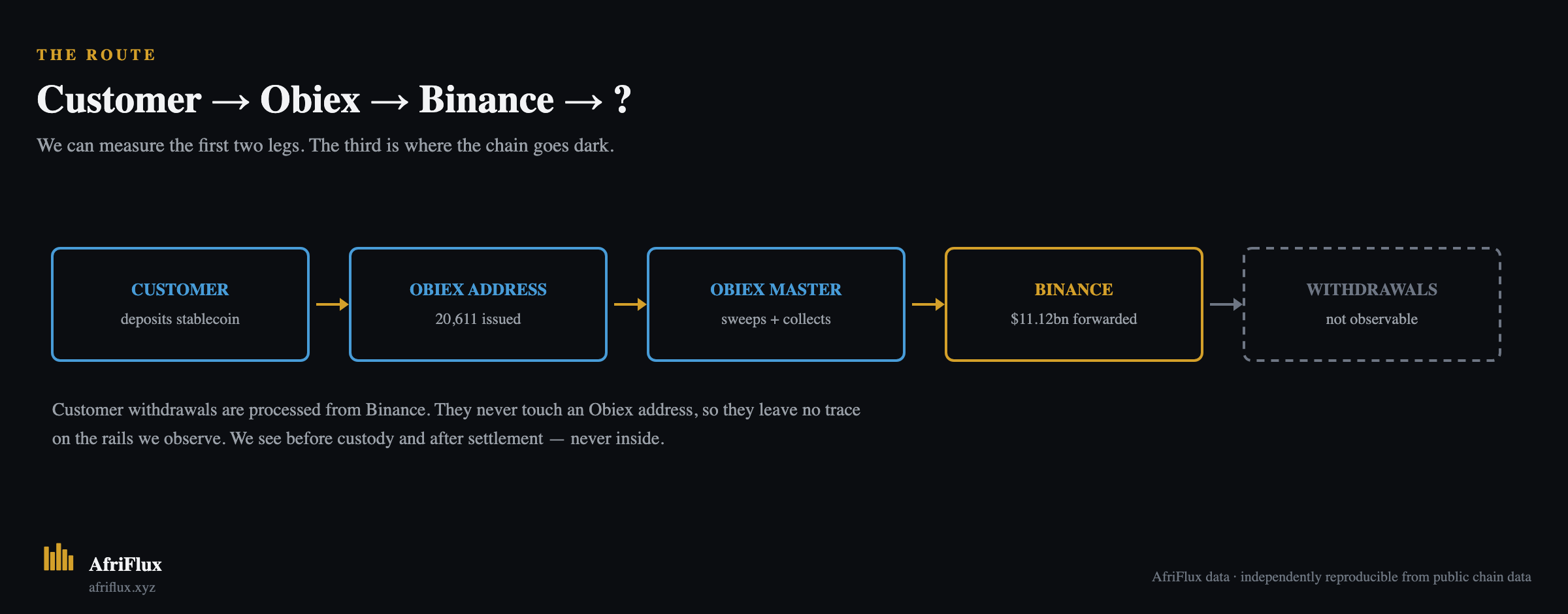
This isn't a gap in our coverage that better tooling would close. It's structural. The money leaves from infrastructure that isn't Obiex's.
So the investigation ends where the ledger begins. We can see what enters. We can see where it's forwarded. We can't see the internal accounting between those two edges.
What $11 billion does and does not mean
It's observable stablecoin customer deposits: money arriving in addresses Obiex issued and controls, counted once at the moment it arrives, over five years and eight chains.
It is not total company volume — trades, conversions and internal transfers aren't counted. It's not a current balance; this is cumulative inflow since 2021, not money held today. It's not revenue. It's not a customer count — addresses aren't customers, and one customer may hold several. And it's not all the crypto Obiex handles: non-stablecoin assets and the fiat leg are outside this measurement.
The unanswered middle
An eleven-billion-dollar customer deposit rail, running for five years, accelerating, with an observable settlement destination that is effectively a single counterparty — and a withdrawal leg that disappears into that counterparty's infrastructure.
We can see the edges with precision. The middle belongs to whoever keeps the ledger.
Obiex's figures update with our daily measurement — you can track the numbers here.
Get the next investigation in your inbox. The Sweep is our Monday newsletter — one attributed on-chain number a week, with the method attached. Subscribe →
Methodology & limits
A deposit is inflow to an address Obiex issued and controls. We identify those addresses structurally — by the gas-funding and sweep behaviour that proves ownership — not by any label, registry or third-party list. Address-level figures are computed from the transfers themselves, not from stored balances.
Coverage runs from September 2021 across Tron, Ethereum, BSC, Solana, Arbitrum, Polygon, Base and Avalanche. Every dollar is counted once, on arrival. The same engine, marts and method are applied to every venue we publish, which is what makes the scale comparison meaningful — and what means the same measurement comes out the same way next month.
This is the flow across the twenty-one venues in our coverage, not a census of the whole market.
Deposits and the Binance leg are measured separately and reported gross. A portion of the Binance flow returns to Obiex and is re-sent, which is why the forwarded total slightly exceeds deposits. We don't net the two into a single figure.
Addresses are not customers. We see before custody and after settlement — never inside.