Jeroid is a nine-year-old Nigerian crypto and gift-card business. It has never published a stablecoin figure. We mapped the infrastructure it runs today — every deposit address, every collection wallet, every settlement hop we could reach. The $28M is interesting. The direction of the money is more revealing.
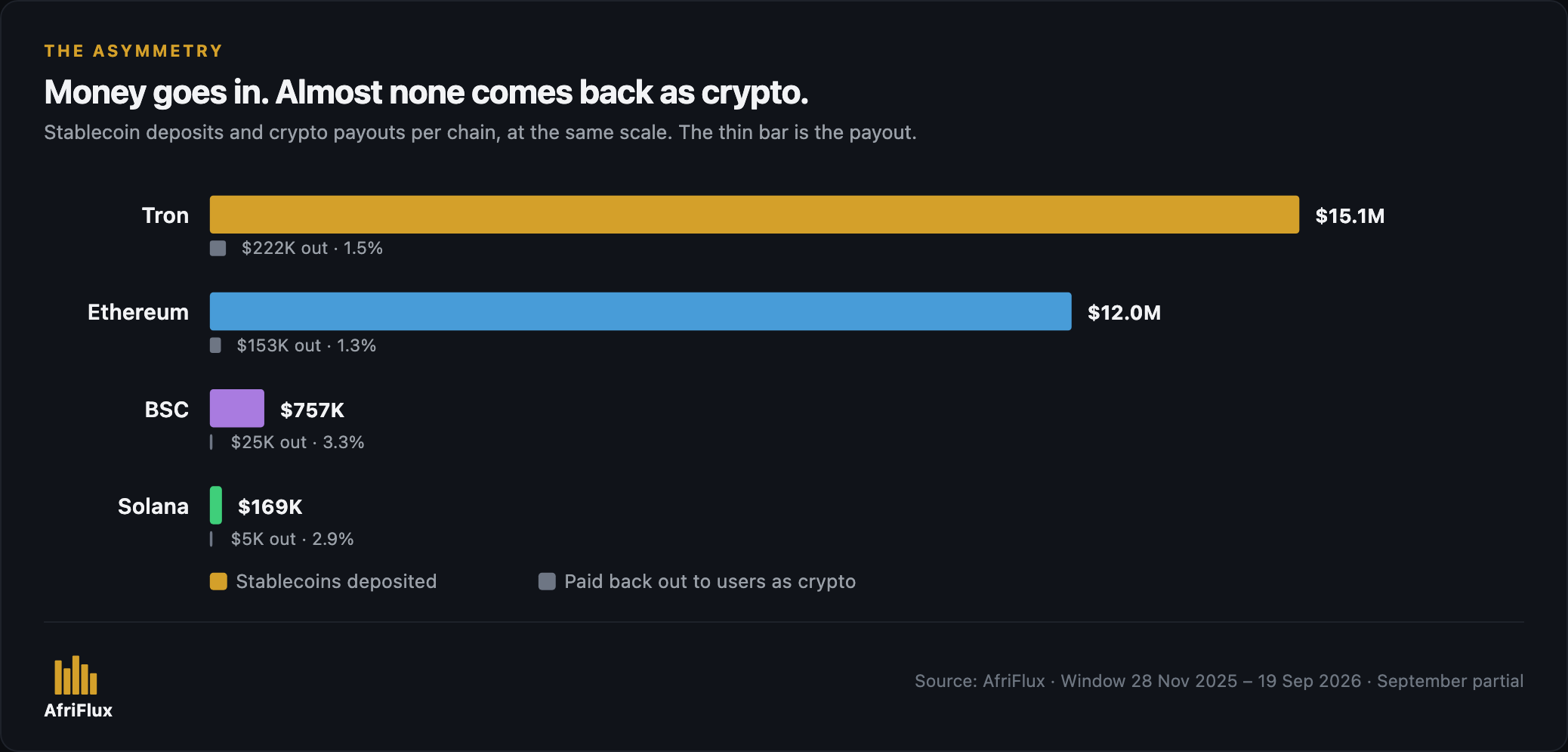
$28M went in. $405,096 came back out as crypto.
Between 28 November 2025 and 19 September 2026, $28,039,356 in USDT and USDC arrived in deposit addresses belonging to Jeroid's current wallet infrastructure. We found 8,083 provisioned addresses, of which 7,723 actually received money.
Then we followed the money back out. Jeroid-attributed payout wallets sent $405,096 to recipient addresses as crypto. That is 1.4% of what came in. We identify these as the payout side by how they behave: one wallet per chain, paying hundreds of different addresses a median of about $29 at a time, while every other Jeroid wallet pays a few dozen counterparties in amounts a thousand times larger.
Most of the collected deposits do not return to users as crypto. They move into settlement infrastructure — while whatever the customer receives on the other side happens off-chain.
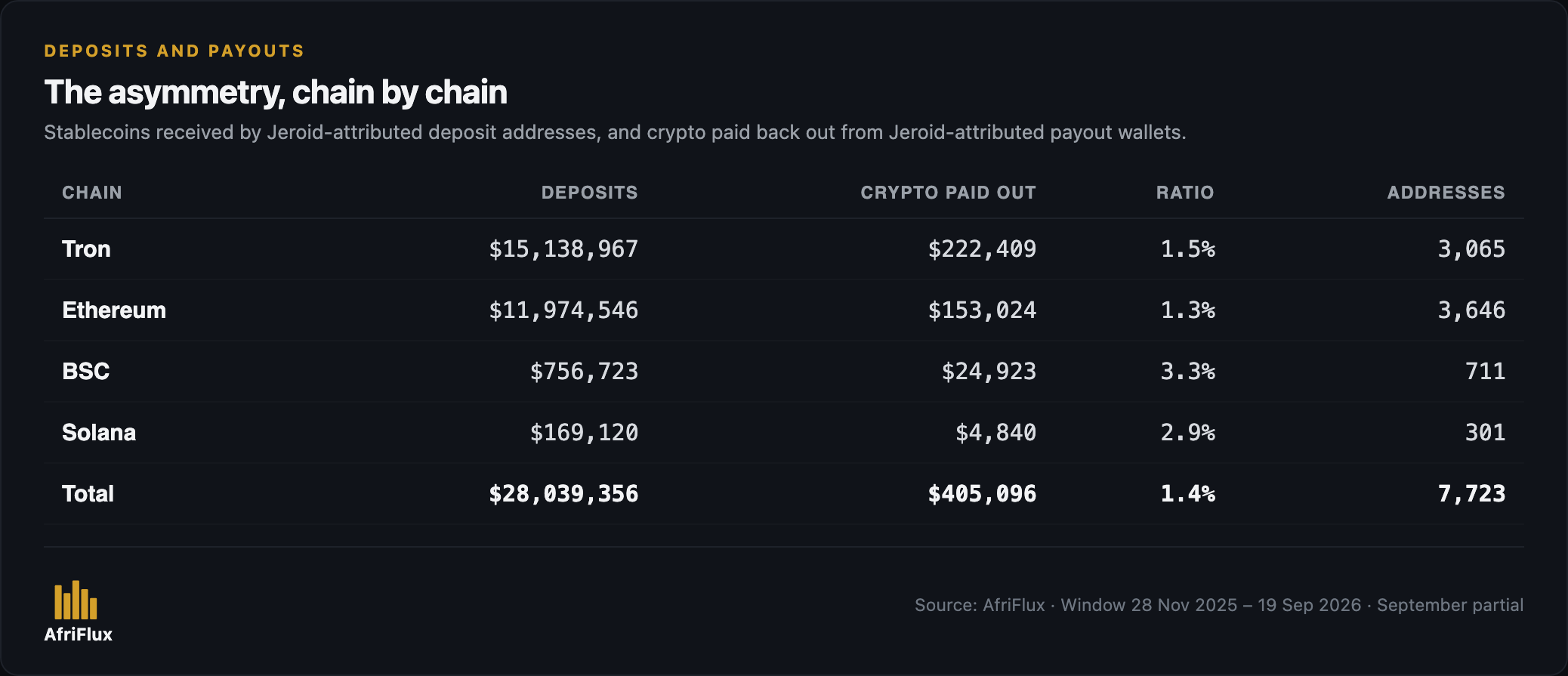
The ratio holds on four chains independently, and in every month of the window. It isn't an artifact of one period or one wallet.
What this number is, and is not. This measures observable stablecoin infrastructure — not Jeroid's total business volume. It counts USDT and USDC on four chains. It doesn't count gift cards, naira, bitcoin, litecoin, internal transfers between customer accounts, or anything that happens off-chain. We also checked there is no second payout wallet hiding: on both EVM chains, exactly one wallet pays hundreds of addresses small amounts, and every other Jeroid wallet pays a few dozen counterparties large ones.
Addresses are not people. We count deposit addresses, not customers. We can't show that one address equals one human, and we don't claim it.
The book is strongly retail-shaped
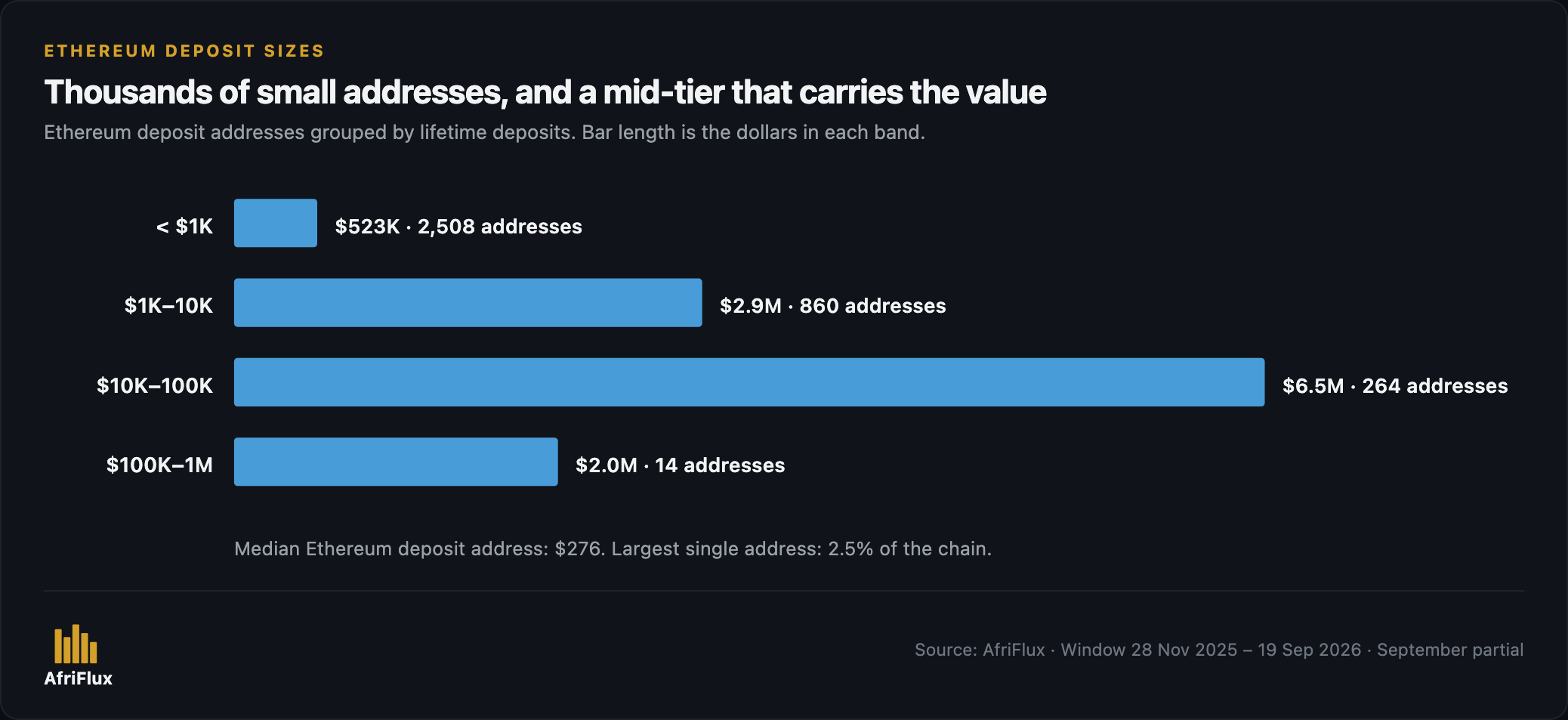
Across every chain the shape is the same: thousands of small addresses, no dominant one.
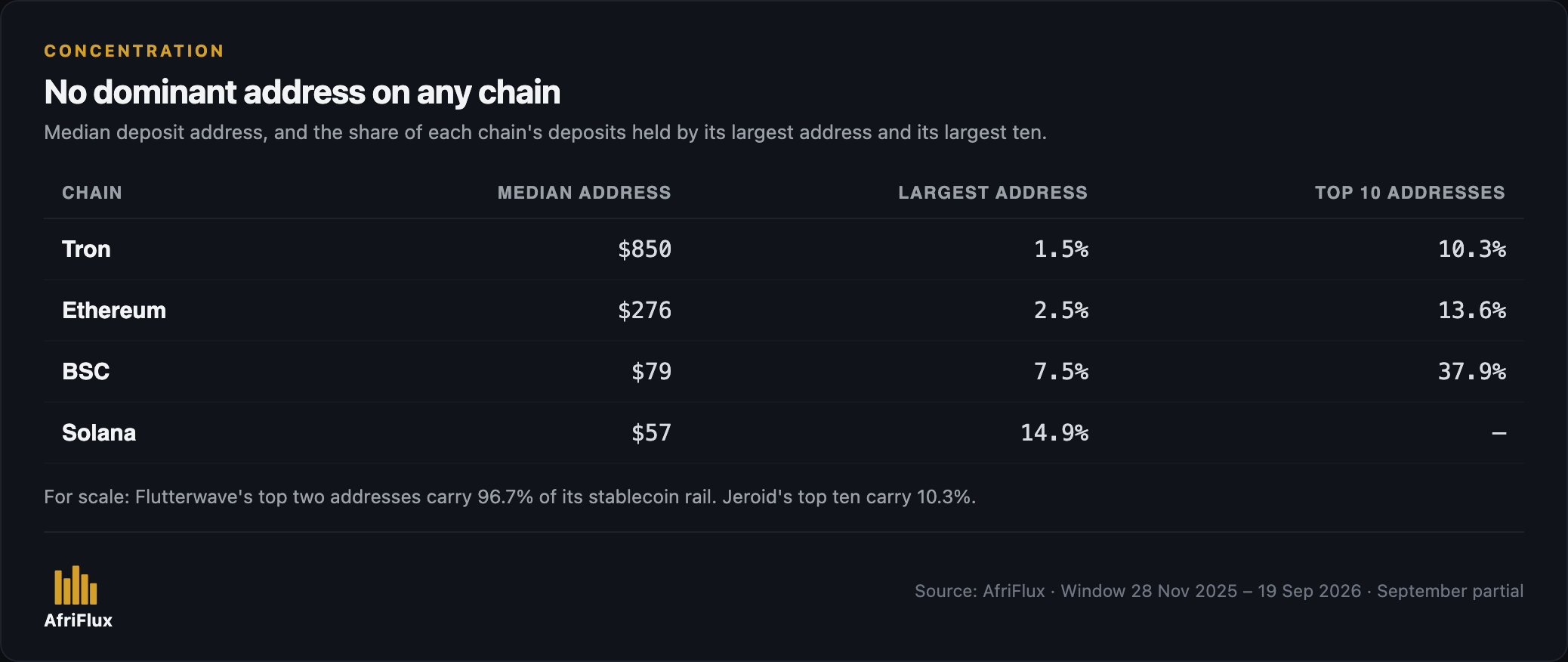
For scale: in the venues we've mapped this year, Flutterwave's top two addresses carry 96.7% of its stablecoin rail. Jeroid's top ten carry 10.3% — the least concentrated distribution in our coverage. The distribution is retail-shaped; it doesn't tell us that each address is one person.
Tracing one hop back from the Tron deposit addresses, the largest single source is a Bybit-labelled hot wallet at $4.26M, about 28% of that chain's deposits, followed by MEXC, KuCoin and Binance-labelled wallets. That's consistent with customers funding their Jeroid deposit addresses from exchanges.
Exchange labels come from third-party wallet-labelling sources. We treat them as a strong indication of which company operates a wallet, never as a claim about who any individual customer is.
Four chains, one rail
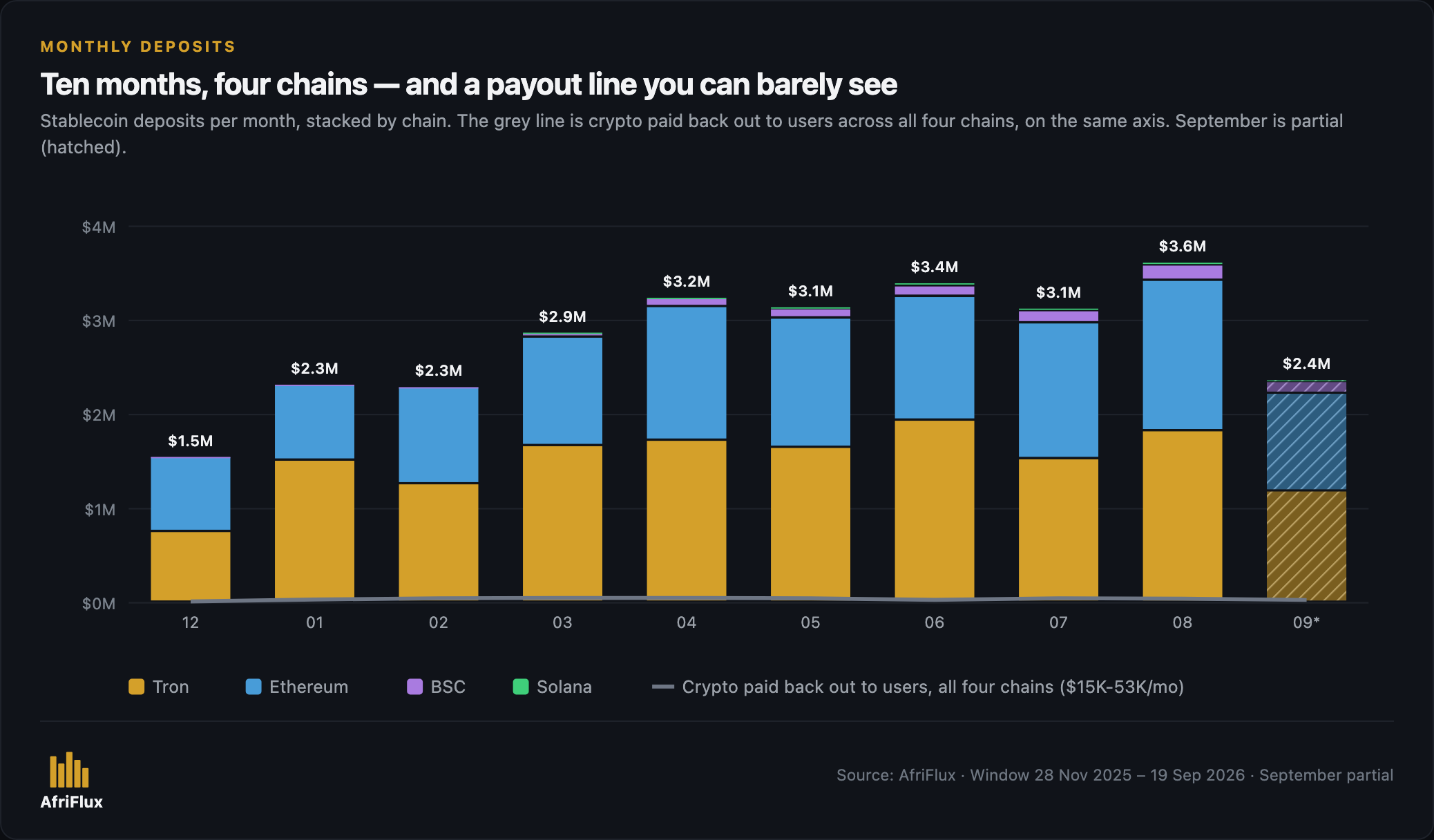
Tron carries 54% of everything we measured. That matches what Jeroid sells: its public rate page lists USDT on Tron only, and USDC on Ethereum only. Tron is a dominant rail for the Nigerian retail stablecoin activity we observe across our coverage, and Jeroid's book reflects that pattern.
Tron and Ethereum went live on the same day — 28 November 2025. This generation of infrastructure was a coordinated multi-chain launch, not an Ethereum system that later grew a Tron arm. BSC stayed near-dormant until March 2026, then went from $39,752 that month to $162,867 in August. Solana is the smallest rail and behaves the same way, at a smaller scale.
The grey line is crypto paid back out to users: $15,000 to $53,000 a month, against deposits reaching $3.6M. It stays close to the axis in every month of the window.
Deposit address, sweep, master, settlement
Jeroid provisions a separate deposit address for each deposit flow. When money arrives, Jeroid pays for the transaction that moves it — then the address itself signs a transfer sending the balance to a collection wallet. From there it moves to a treasury, and out to settlement.
That detail matters for what follows: because the address signs its own sweep, and because Jeroid pays the fee, we have strong attribution to Jeroid rather than merely an association with it.
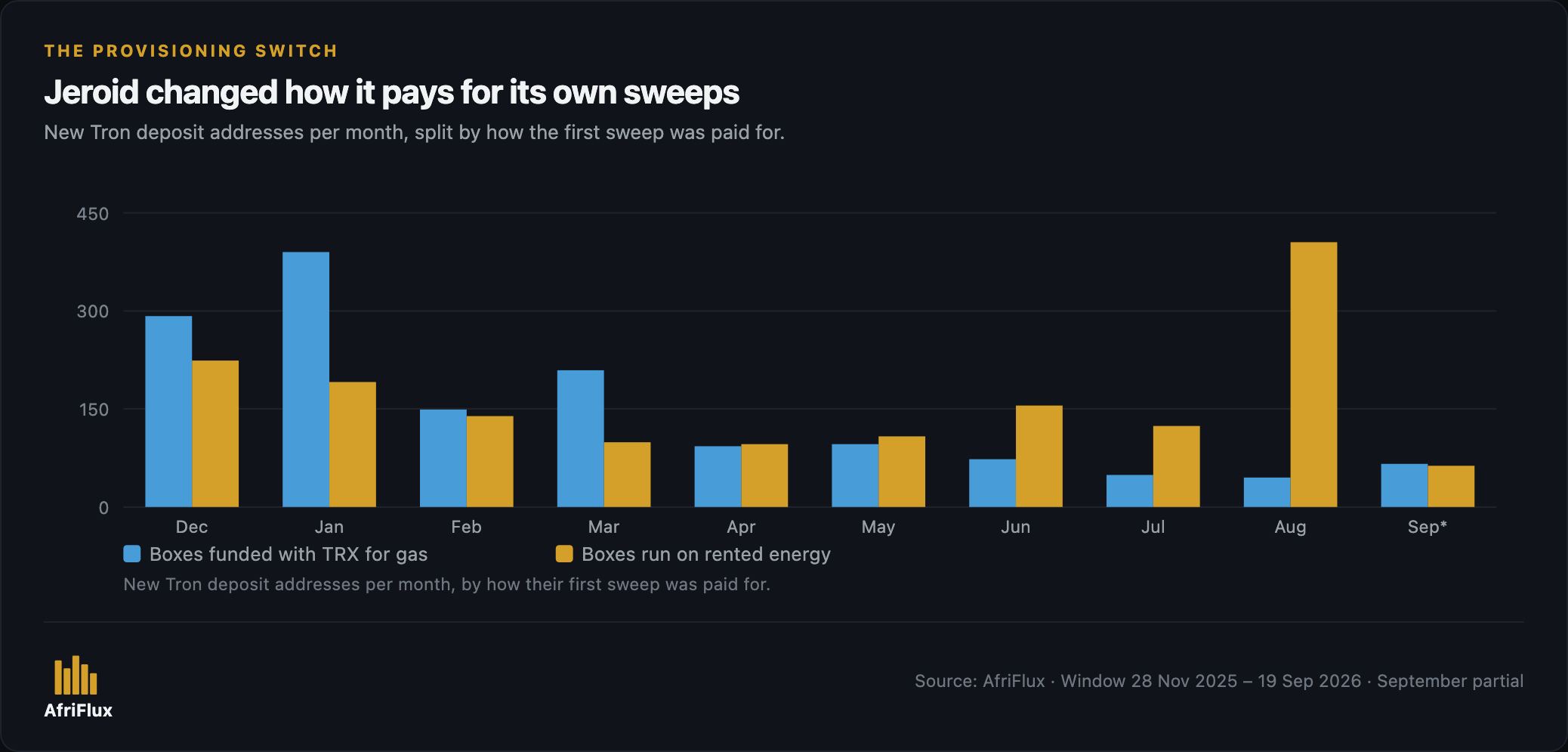
On Tron there are two ways to pay for that sweep, and Jeroid switched between them inside our window. In December 2025 most new addresses were funded with TRX for gas. By August 2026, 405 of 450 new addresses were instead run on rented energy — energy delegated to the address for about a minute, used for the sweep, then returned. Renting energy avoids burning TRX on every sweep; the change in mechanism is observable, the reason for it is not.
The energy is rented from a third-party service, not supplied by Jeroid. That service works for many customers and tells us nothing about who Jeroid is — which is why membership here rests on the sweep destination, not on who paid the fee.
Most of Jeroid's collected stablecoins leave its own infrastructure
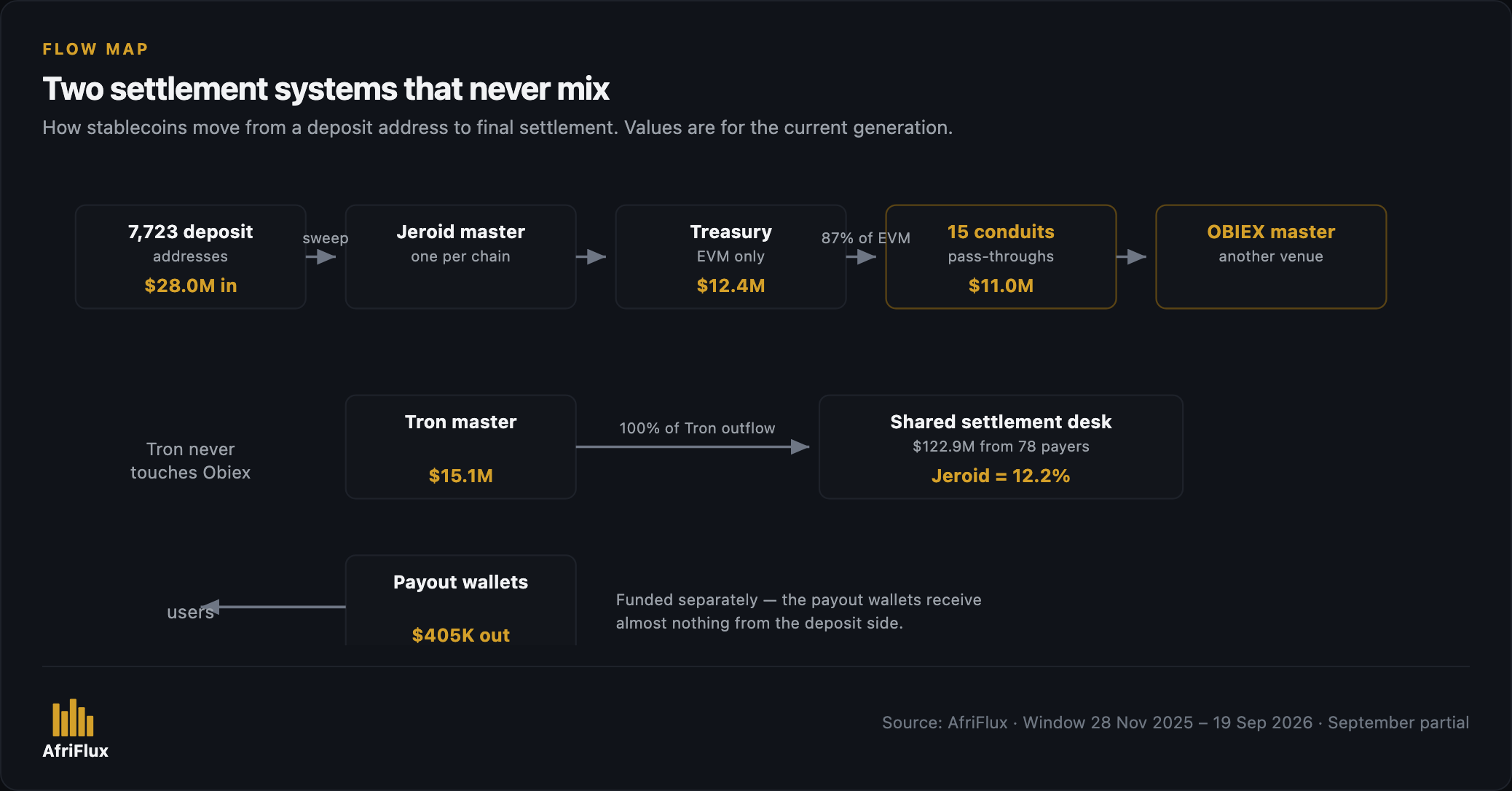
On the EVM side the path is unbroken: deposit address, collection master, treasury, then a set of 15 conduit addresses — wallets that receive and forward the same amount, retaining nothing — and onward. $11.0M, or 87% of this generation's EVM deposits, eventually settle through addresses attributable to Obiex, another Nigerian venue. That flow has grown from about $780K a month at the start of the window to $1.27M in August.
Tron is a different system entirely. Jeroid's Tron master sends 100% of its outflow — $15.0M — to a single shared settlement desk. That desk has taken $122.9M from 78 payers; Jeroid is 12.2% of it, and most of the rest arrives from exchange-labelled wallets. Tron never touches Obiex.
The conduits and the desk are shared infrastructure, not Jeroid's. Jeroid is 18% of what flows through the conduits and 12.2% of the desk. We quote only the money leaving Jeroid's own wallets, never the totals of infrastructure it shares with others.
We couldn't find a separate onchain treasury
Jeroid runs an over-the-counter desk it calls Trade Chat, for what its own site describes as "large settlements". We went looking for the treasury behind it — a wallet whose money arrives from somewhere other than the retail deposit addresses. We didn't find one.
Jeroid's Ethereum treasury received $12.36M from exactly three senders — 97.1% of it from the retail collection master, the rest from two exchange-labelled wallets. It sends 79% straight into the Obiex conduits. On BSC the pattern is identical. We could not identify a separate on-chain treasury for Jeroid's OTC operation.
That's worth stating plainly rather than leaving out. If the desk settles in naira, or inside another company's infrastructure, it wouldn't appear on any chain we can read.
A one-way door
Put the two halves together. Thousands of small addresses feed stablecoins in. The money is swept, pooled, and settled onward into other companies' infrastructure. And 1.4% of it returns to users as crypto.
Jeroid's crypto rail appears built for conversion, not custody. Customers send crypto in; almost none of the measured value comes back to them the same way. What happens next — naira, gift card value, or another off-chain settlement — is outside the blockchain data, and we're not going to pretend otherwise.
We can see that crypto arrived, that it was swept, and where it settled. We can't see what any customer received in exchange. Every statement here stops at that boundary.
The money nobody collected
Not everything gets swept. $166,876 sits across 372 deposit addresses, mostly in tiny balances. On BSC, 311 addresses still hold an average of $74 each. Even at this scale, the chain leaves behind the operational residue of the system.
A field note: we funded one of those deposit addresses ourselves to test the rail. $26 of that test balance is still sitting in it.
Why this isn't Jeroid's $1 billion
Jeroid says publicly that it has processed more than $1 billion since 2017, with 500,000+ users and over a million monthly transactions (TechCabal, 26 May 2026). Its own website, read on 19 September 2026, says 300,000+ users and $30M+ in monthly volume.
AfriFlux measures $28.04M across ten months, four chains, in USDT and USDC deposits. These aren't measuring the same thing, and we're not going to try to reconcile them. What's missing from our figure includes gift cards, bitcoin and litecoin, the naira leg of every trade, internal transfers, OTC activity that never touches a deposit address, other chains, and everything before this generation of infrastructure launched in November 2025.
A conversion layer, not a destination
Jeroid's observable stablecoin rail looks less like a place where crypto is held and more like a layer where crypto is converted. Thousands of relatively small addresses feed value in. Very little comes back out as crypto.
The blockchain doesn't show us what customers ultimately receive. It does show us the machinery sitting underneath the conversion — and that machinery connects Jeroid to other African financial infrastructure: Obiex on the EVM chains, a shared settlement desk on Tron.
Methodology
How we identified Jeroid's addresses
- Ground truth first. We funded a deposit address on each chain from our own accounts and watched where the money went. Every wallet in this piece traces back to one of those sweeps.
- Structural membership, not size. An address counts as Jeroid's if Jeroid's own key provisioned it (gas or rented energy) or if it swept into Jeroid's collection wallet — then only if at least 95% of everything it ever sent went to Jeroid's infrastructure.
- Deposits include money never collected — an address funded but never swept still counts.
- Payouts measured independently from the payout wallets, and checked for completeness: no other Jeroid-attributed wallet pays out in that pattern.
- Dust and poisoning filtered. Transfers below $1 and impossible values are excluded.
Limitations
- USDT and USDC only, on Tron, Ethereum, BSC and Solana. Bitcoin and litecoin, which Jeroid also sells, are not measured. Native TRX was tested on Tron and is negligible ($2–3K).
- No fiat. No gift cards. No internal transfers between customer accounts.
- This generation of infrastructure only — launched 28 November 2025. Earlier generations stopped taking deposits as it came online.
- Exchange and venue labels come from third-party sources and describe wallet operators, not customers.
- September 2026 is a partial month in every chart.
- Scope. This is one venue inside AfriFlux's coverage, measured the same way we measure the rest — not a census of the Nigerian market.
Figures as of 19–20 September 2026. Every number in this piece is reproducible from public chain data.