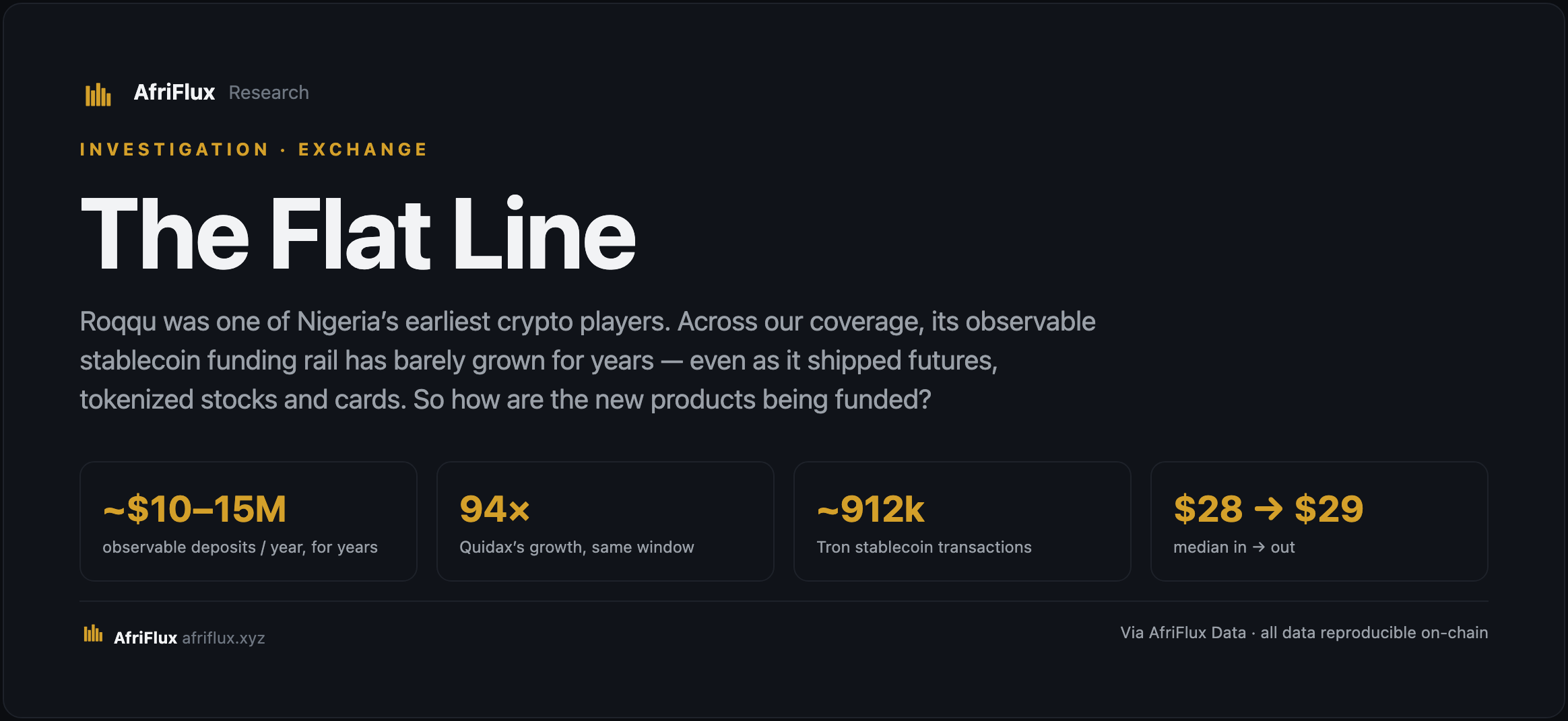
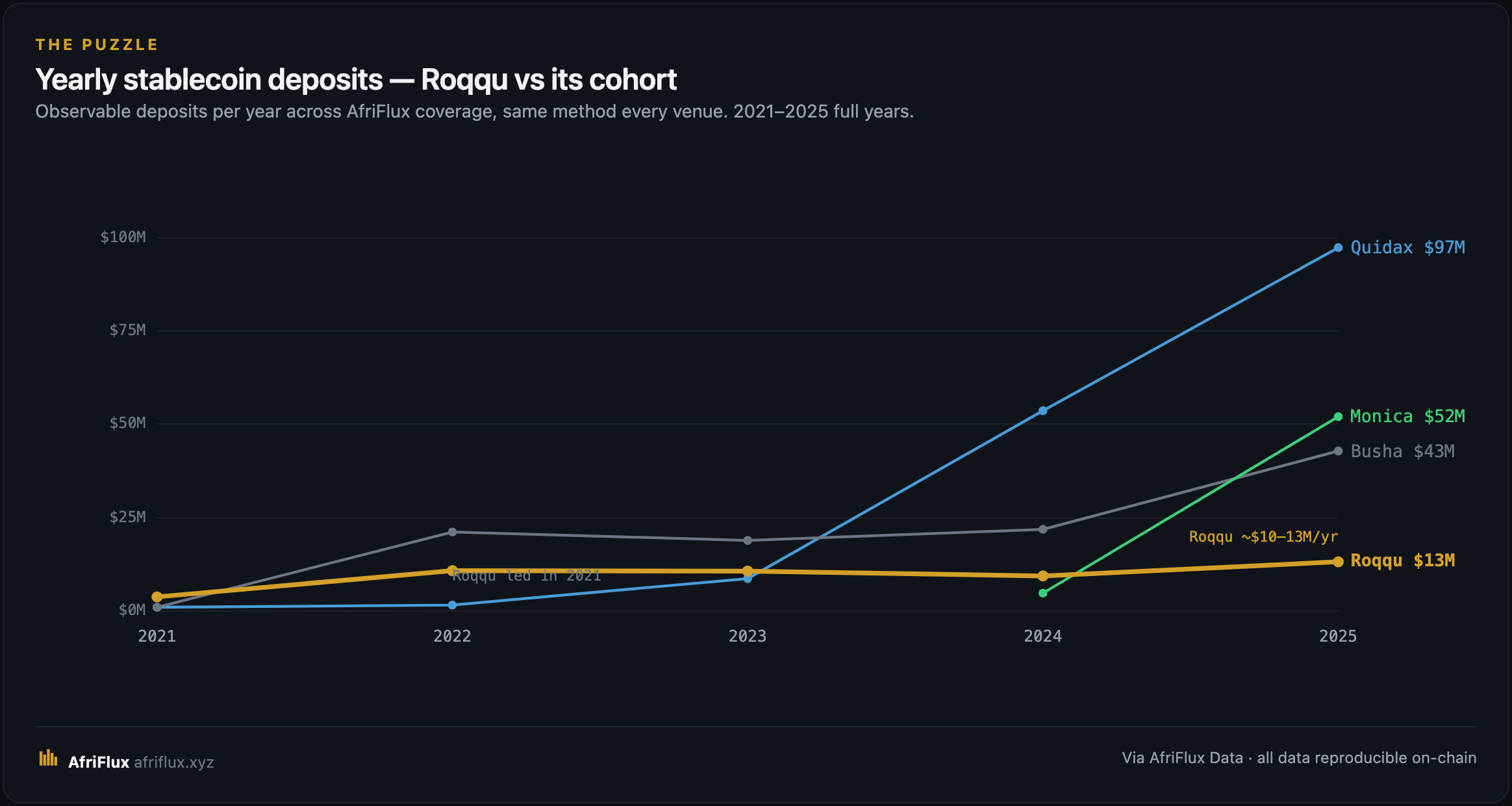
Roqqu, founded in 2018, was one of Nigeria's earliest crypto players; its observable on-chain funding infrastructure begins in 2020. And for a while it led the pack. In 2021, across AfriFlux coverage, it took in more observable stablecoin deposits than Quidax or Busha. Then something unusual happened: while those venues grew 40- to 95-fold over the next four years, Roqqu's observable funding rail settled into a band of roughly $10–15 million a year and stayed there.
That would be a simple story of a company falling behind — except Roqqu did not stand still. It added futures, tokenized stocks, a prediction market, cards, a European licence and a Kenyan acquisition. Which raises the question this piece investigates: if Roqqu keeps shipping products, how are those products being funded, when the observable stablecoin rail that could feed them barely moved?
The flat line
We measure every venue the same way: stablecoin deposits into addresses the venue issued, each validated, summed. On that basis Roqqu's observable deposits sit at $59.8M lifetime — and the yearly shape is the whole story.
Why this is surprising
Read the gold line against the others. Roqqu's observable on-chain rail started ahead of Quidax and Busha in 2021, then held roughly $10–13M a year while its peers climbed. By 2025 its share of the Nigerian retail deposits we track had fallen from about 65% to about 4%.
Roqqu is one of the most product-active exchanges in the market. An early leader that keeps launching products while its observable customer-funding rail stays flat is unusual. The careful phrasing, which we hold to: Roqqu's observable stablecoin funding rail — measured the same way across AfriFlux coverage — has stayed remarkably flat while its peers and the market expanded rapidly.
We checked whether the flat line was ours. It wasn't.
Before reading anything into a flat line, we had to rule out the boring explanation: that we were missing Roqqu's growth — a wallet system, a newer master, a chain we hadn't mapped. We looked, hard, and the flat line survived every check.
The rail traces cleanly to 2020. Roqqu's Tron master wallet was created on-chain on 18 August 2020 and received its first real USDT on 25 September 2020. Every year since, its deposit curve is continuous — no gap, no sudden jump that would betray a migration from an older system we'd failed to capture.
There is no hidden second master. We traced the wallet that first funded the master in 2020; it turned out to be a shared third-party desk (its largest single funder is another venue entirely), not an earlier Roqqu generation. We enumerated every address that has ever funded the master — about 111,000 of them — and all are accounted for as deposit boxes, exchanges or that desk. No parallel Roqqu master, on Tron or elsewhere, absorbs the "missing" growth.
And no other chain hides it — every one runs into a single collection wallet. On each chain, the deposit addresses sweep into exactly one master collection wallet, and essentially all of the money does:
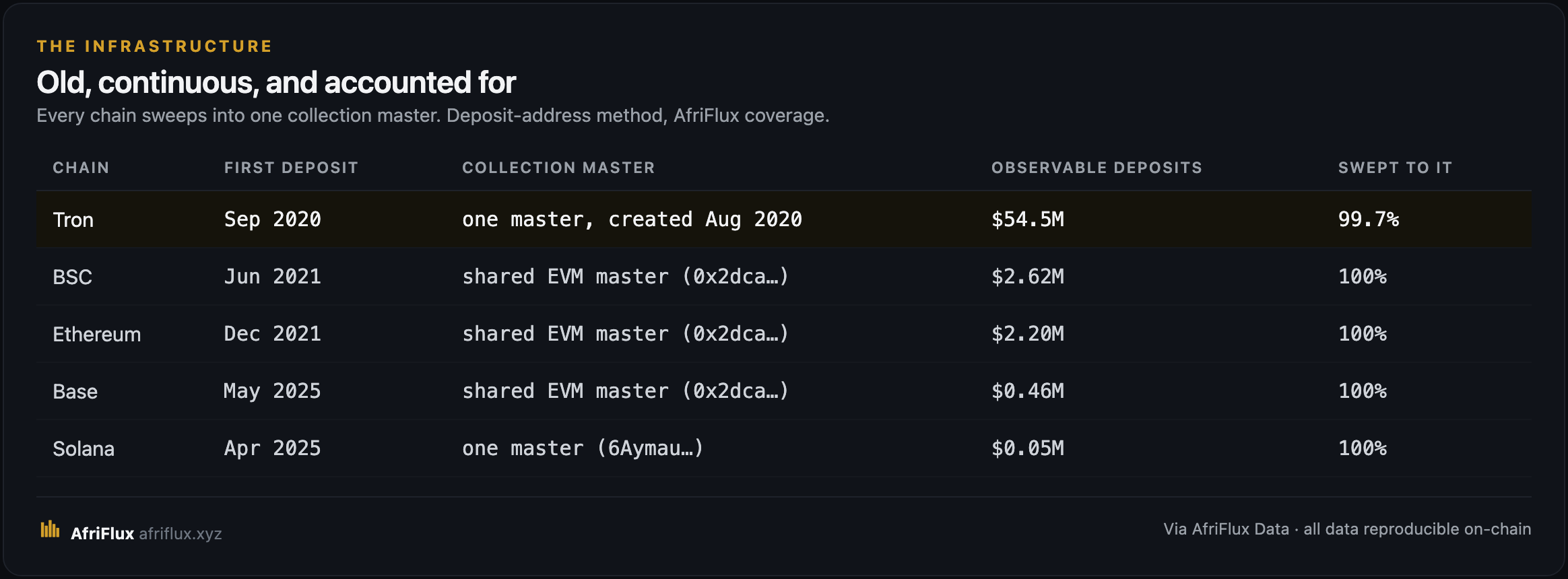
The infrastructure is old, continuous and accounted for: the Tron master — 91% of the rail — was created in August 2020 and has run without a break since; the EVM chains share a single collection address; every chain sweeps into exactly one master. There is no second collection wallet and no unmapped sink absorbing the "missing" growth — on Tron, 99.7% of every dollar the boxes sweep goes to that one 2020-era master, and the rest is dust.
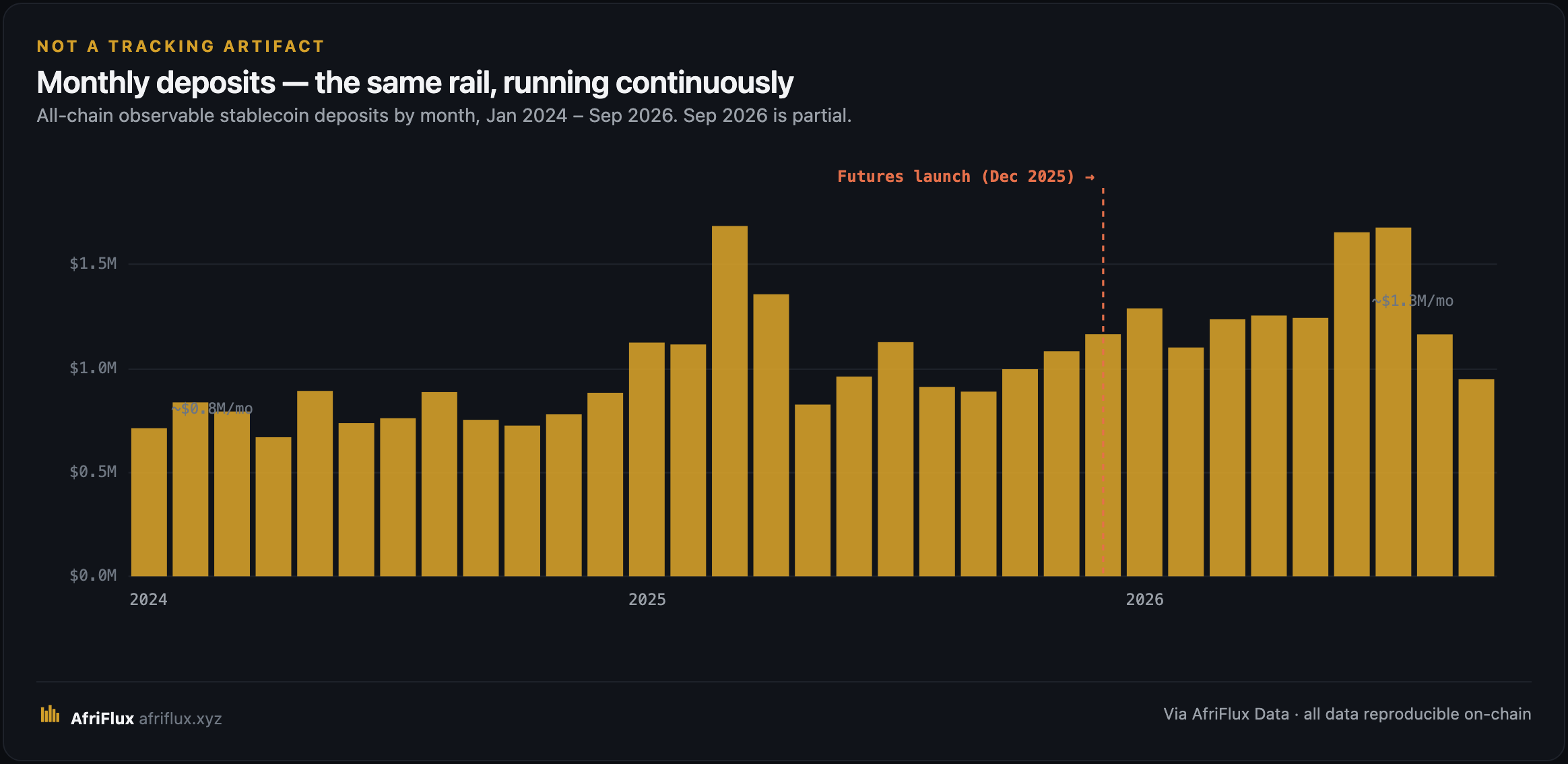
The flat line is not a gap in our coverage. It is a real feature of the observable rail: continuous since 2020, one master, mildly rising, with no on-chain surge to be found.
What the stablecoin rail actually looks like
A $60M book across ~912,000 transactions at a $28 median describes a high-frequency, small-ticket rail. And its defining feature is symmetry: money comes in small and goes back out at almost exactly the same size.
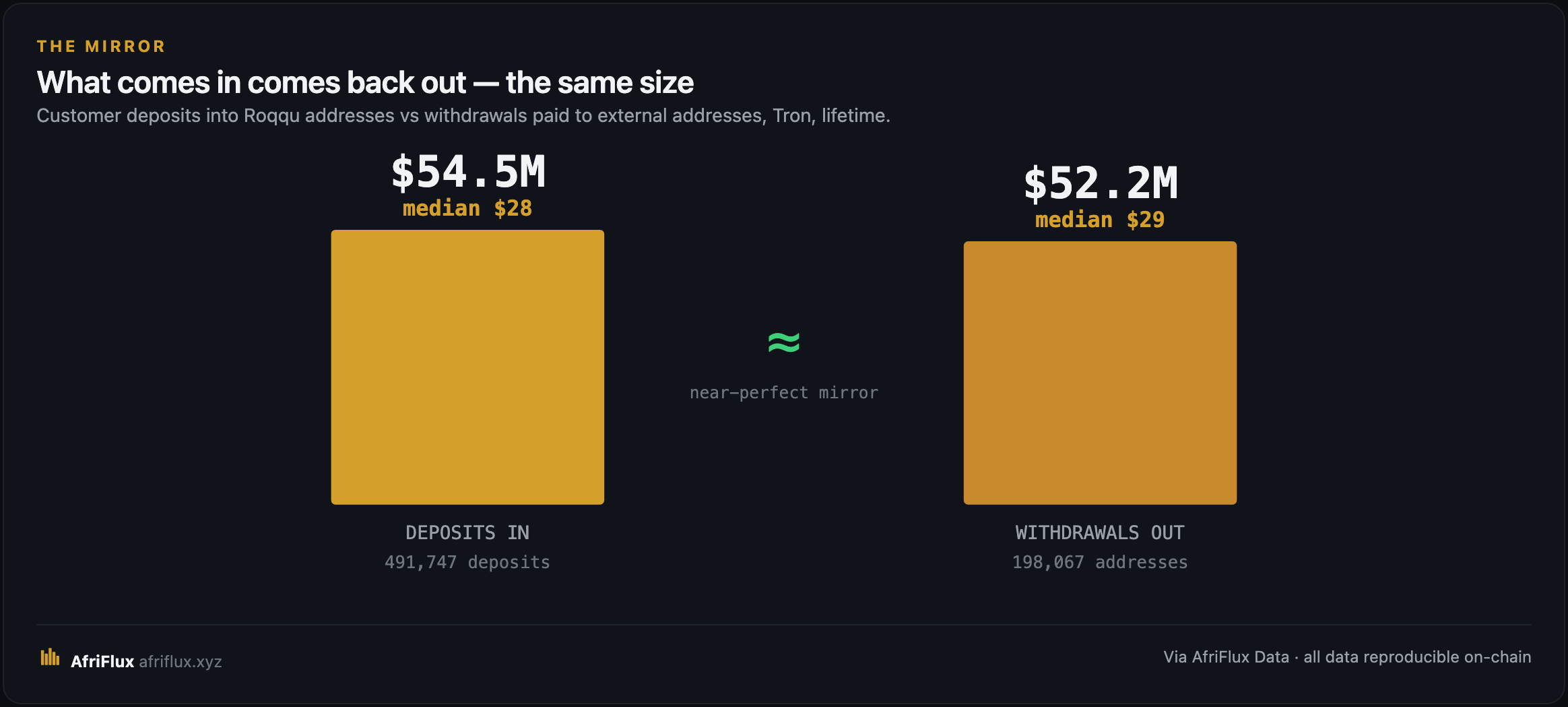
$54M in, $52M out; median $28 in, $29 out, across ~198,000 withdrawal addresses. About half the deposits arrive from other exchanges (Binance most of all), half from self-custody wallets. The master runs two overlapping loops at once: this customer clearing, and a separate liquidity loop where Roqqu sources ~$78M of inventory from exchanges and settles ~$82M back out through desks it rents, not owns. One discipline throughout: addresses are not people — Roqqu issues fresh deposit addresses.
So how are the newer products being funded?
This is the heart of the investigation, and we treat it as a question, not a conclusion. Roqqu's futures product launched in December 2025 and reportedly reached 30,000+ users by March 2026. If those users are funding positions, where does the money enter?
Not, visibly, through a new wave of on-chain stablecoin deposits. The monthly rail shows no step-change at the futures launch: deposits continue in the same ~$1.2M/month band. The new chains added alongside the product push — Ethereum and Solana — carry tiny observable deposits ($2.2M and $45k lifetime). Non-stablecoin crypto is negligible too. On-chain, no new large funding channel opens up for the new products.
So the corresponding funding is not showing up on the stablecoin rail we can observe. The candidate explanations — and they are candidates to investigate, not answers — are:
- Fiat / naira deposits — off-chain entirely.
- Existing internal balances (already-deposited USDT, recycled) — ledger-internal, no new deposit.
- Non-stablecoin crypto deposits (BTC / ETH / TRX) — partly visible, and observed to be small.
- Products that simply don't generate large on-chain funding — futures margin drawn from balance, tokenized-stock custody.
Each of these could keep the observable stablecoin rail flat even if product activity is happening elsewhere. We cannot say which dominates — but the fact that a 30,000-user futures product left no corresponding stablecoin funding footprint in our coverage is itself a finding: whatever is funding Roqqu's newer products is largely not arriving on the stablecoin rail we can measure.
Where the blockchain goes dark
That is the constraint this investigation runs into. The moment a customer's USDT enters a Roqqu-controlled address, the public chain stops showing what that customer does.
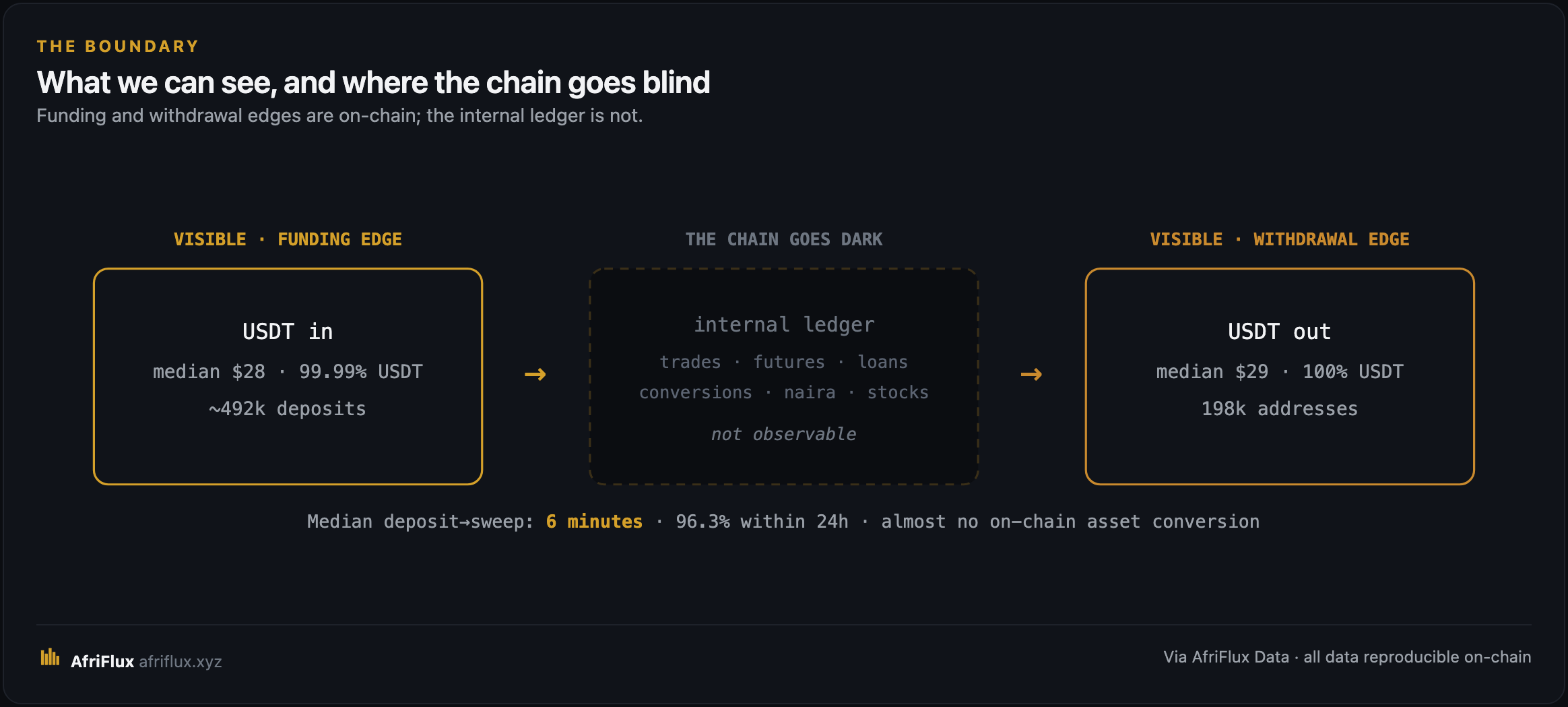
Two edge facts sharpen it. First, the rail is ~100% USDT on both sides — almost no on-chain asset conversion — so any trades, futures P&L or naira settlement that does not create another public-chain transaction sits beyond this dataset. Second, deposits are swept out in a median of six minutes; the money clears almost instantly. These tell us the rail is fast and dollar-denominated. They do not tell us what product a customer used after custody — and no amount of this on-chain funding data will. That is why some of the funding question above may stay partly unresolved, and we say so rather than guess.
What the evidence supports — and what remains open
Supported.
- Roqqu's observable stablecoin funding is remarkably flat — roughly $10–15M a year for years — while comparable venues grew 40–95×.
- The flat line is not obviously an AfriFlux tracking artifact: the infrastructure traces continuously to 2020, runs through one collection master per chain, and hides no growth on another chain or generation.
- The customer-facing rail is active, high-frequency and small-ticket — dollar-in, dollar-out at a $28/$29 median; a separate liquidity loop sources inventory from exchanges and settles through rented desks.
- The observable funding did not materially change around the newer product launches.
Open.
- How much of the newer product activity is funded through fiat / naira?
- How much comes from existing internal balances already in custody?
- How much runs through other mechanisms we cannot observe?
- And how much product activity is actually happening?
Roqqu didn't stop building. Its observable stablecoin rail barely did. The question is where the activity behind its newer products is being funded — and that is exactly where the blockchain runs out of visibility.
Get the next investigation in your inbox. The Sweep is our Monday newsletter — one attributed on-chain number a week, with the method attached. Subscribe →
Methodology & limits
Every figure is drawn from stablecoin transfers on public chains: deposits into Roqqu-issued deposit addresses, withdrawals from Roqqu's master to external addresses. It's the same validated deposit-address method we run across every venue in AfriFlux coverage — which is what lets a comparative claim like "remarkably flat" mean something, rather than reading as an anecdote. Coverage runs from Roqqu's first on-chain USDT deposit in September 2020 to 24 September 2026. This is the flow across the venues in our coverage — not a census of the whole market.
We label claims Observed (measured on-chain), Documented (stated by Roqqu or credible reporting) and Inferred (a hypothesis from behaviour), and never collapse them. On-chain data shows the funding edge and the withdrawal edge of a custodial platform; it cannot show the internal ledger — trades, futures, loans, tokenized-stock and fiat/naira activity that occur after custody. Addresses are not users. Settlement desks are rented, not owned. Exchange labels are third-party seed labels, described rather than asserted. Product timeline per Cointelegraph and TechCabal; company metrics per roqqu.io.