Every crypto exchange makes the same promise: send us your coins, we'll give you money. In these markets, that promise is the whole business — the point of holding a stablecoin is being able to turn it back into cash. But the promise has a hidden half. For an exchange to hand you money, someone has to supply that money — take the stablecoins off its hands and pay real cash in return. Who is that someone? Where does the cash come from? And how big is that market?
That's the question this series chases. We started by reconstructing one exchange's on-chain economy in full — Quidax — and following its money until the trail ran out. This is Part 1: what we can prove, where the settlement goes, and the shared infrastructure it exposed. Part 2 will go after the names.
The setup
We pulled every transaction across every Quidax master wallet and gas funder, on all nine chains it runs, stablecoins and native tokens, one row at a time, each priced at its close on the day it moved. Then we classified every counterparty.
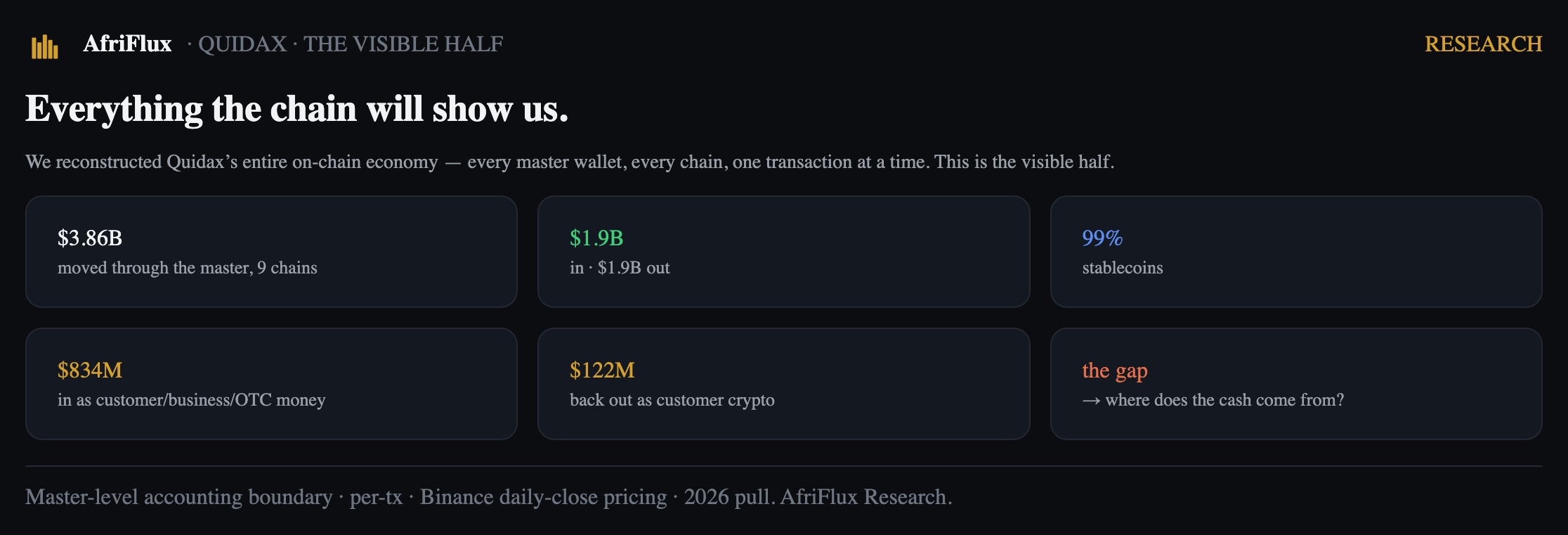
The scale: ~$3.86B moved through Quidax's master boundary — roughly $1.93B in and $1.92B out — and 99% of it is stablecoins. One discipline makes that number trustworthy. The master wallet is a single accounting boundary: every dollar of the business crosses it exactly once. The wallets downstream are routing nodes carrying money already counted, so we bucket at the master and never add a hop — which keeps $3.86B a real figure instead of an inflated one.
But $3.86B isn't the story. The interesting part is what the money represents.
The crux: money comes in, cash goes out — but where from?
Here is the whole economy in one picture.
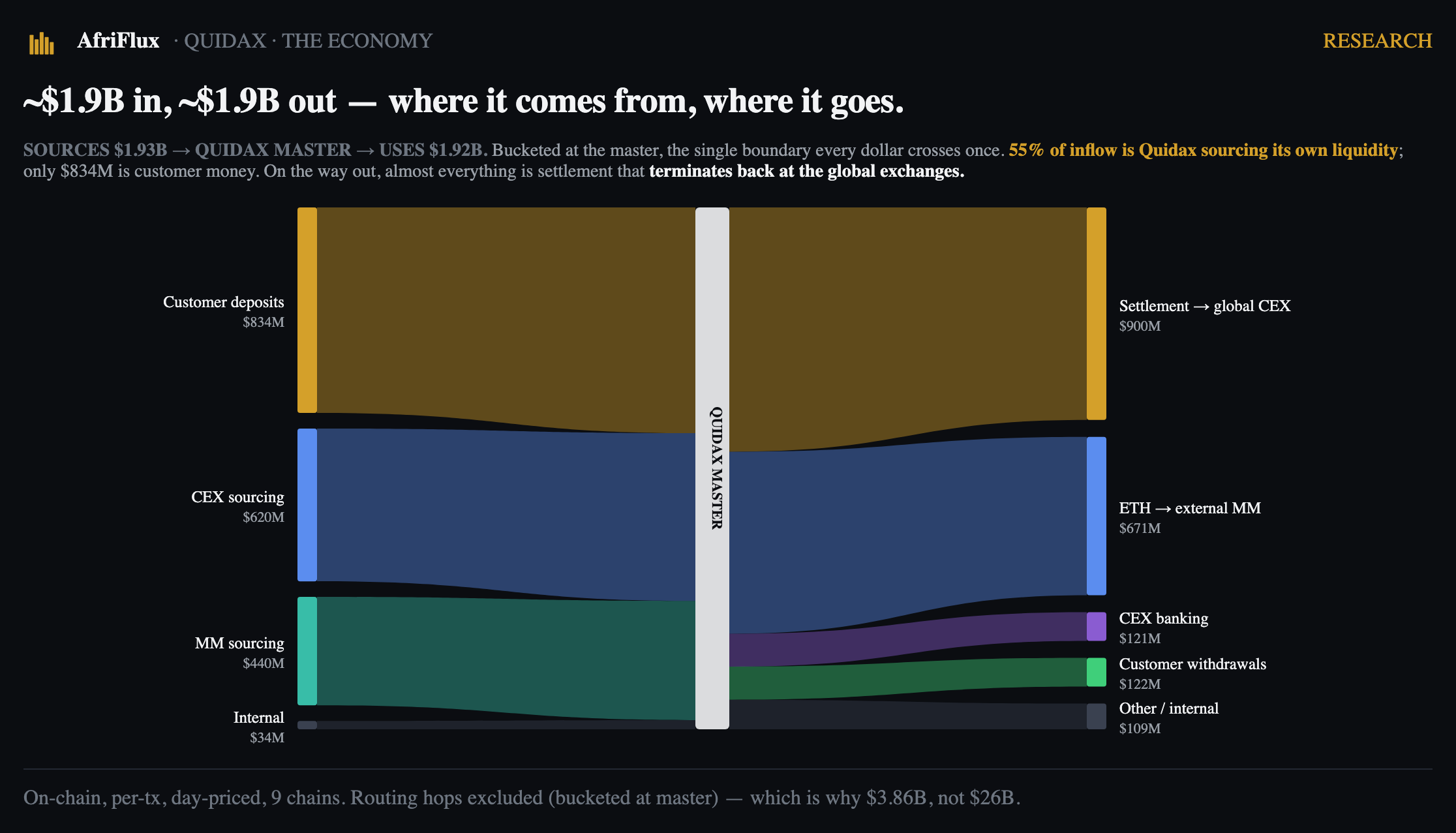
Of the $1.93B in, only ~$834M is customer, business and OTC money — real demand from people and firms using Quidax, split 72% business/OTC, 28% retail. These users generally aren't depositing stablecoins to withdraw the same stablecoins; they're using Quidax to reach cash.
Now the signal that sets up everything else. That ~$834M comes in as customer money — but only ~$122M leaves as identifiable customer crypto withdrawals. Customers deposit coins and take almost none back out as coins. The difference didn't vanish; it left as cash, off-chain, in a bank. Which forces the question: where does that cash come from?
The $1.92B outflow, lined out
Quidax sends roughly $1.9B back out in five distinct flows — and only one of them is where cash is actually sourced.
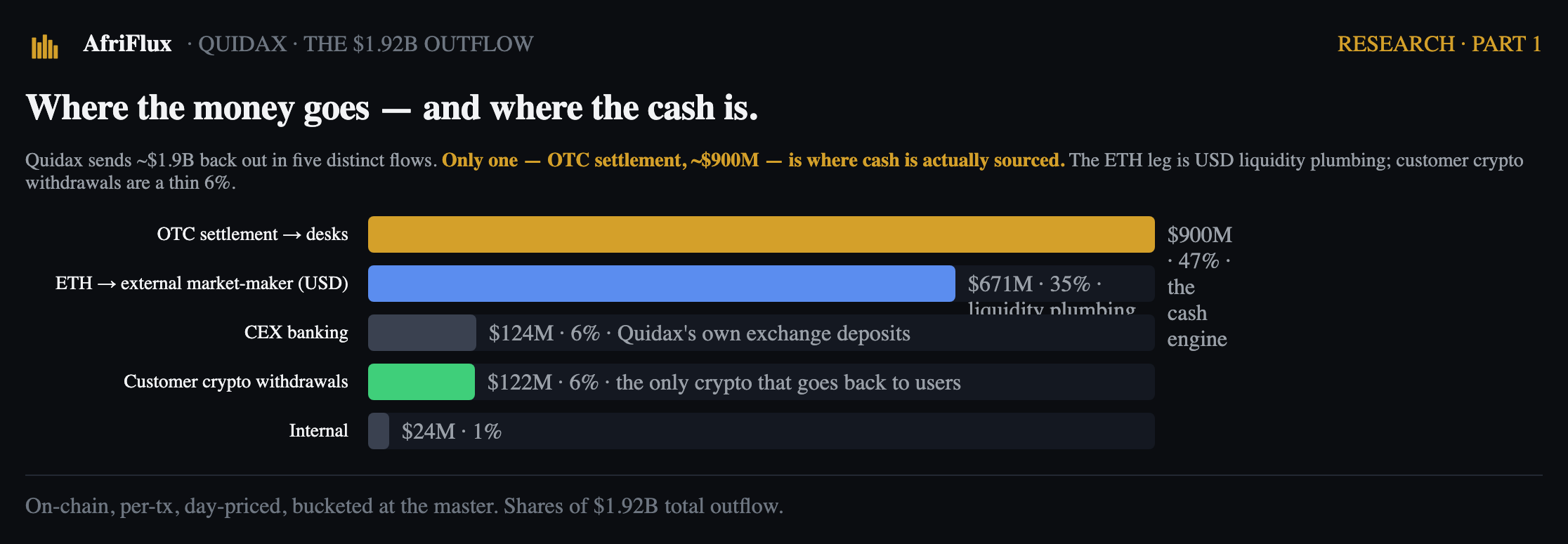
Customer withdrawals are a thin 6%. Exchange banking is another 6%. A large $671M leg on Ethereum is USD liquidity plumbing, not the cash question (more on it below). The heart of the matter is the **$900M of OTC settlement** — the leg where Quidax sells stablecoins to a network of desks. That is the cash engine, and it's where the investigation lives.
The cash engine: the desks
The ~$900M isn't one counterparty; it's a dispersed dealer network — about 700 recipients on Tron alone, the top five only 33% of the flow. We can sort the largest by behaviour and address, and every one of them terminates at a global exchange.
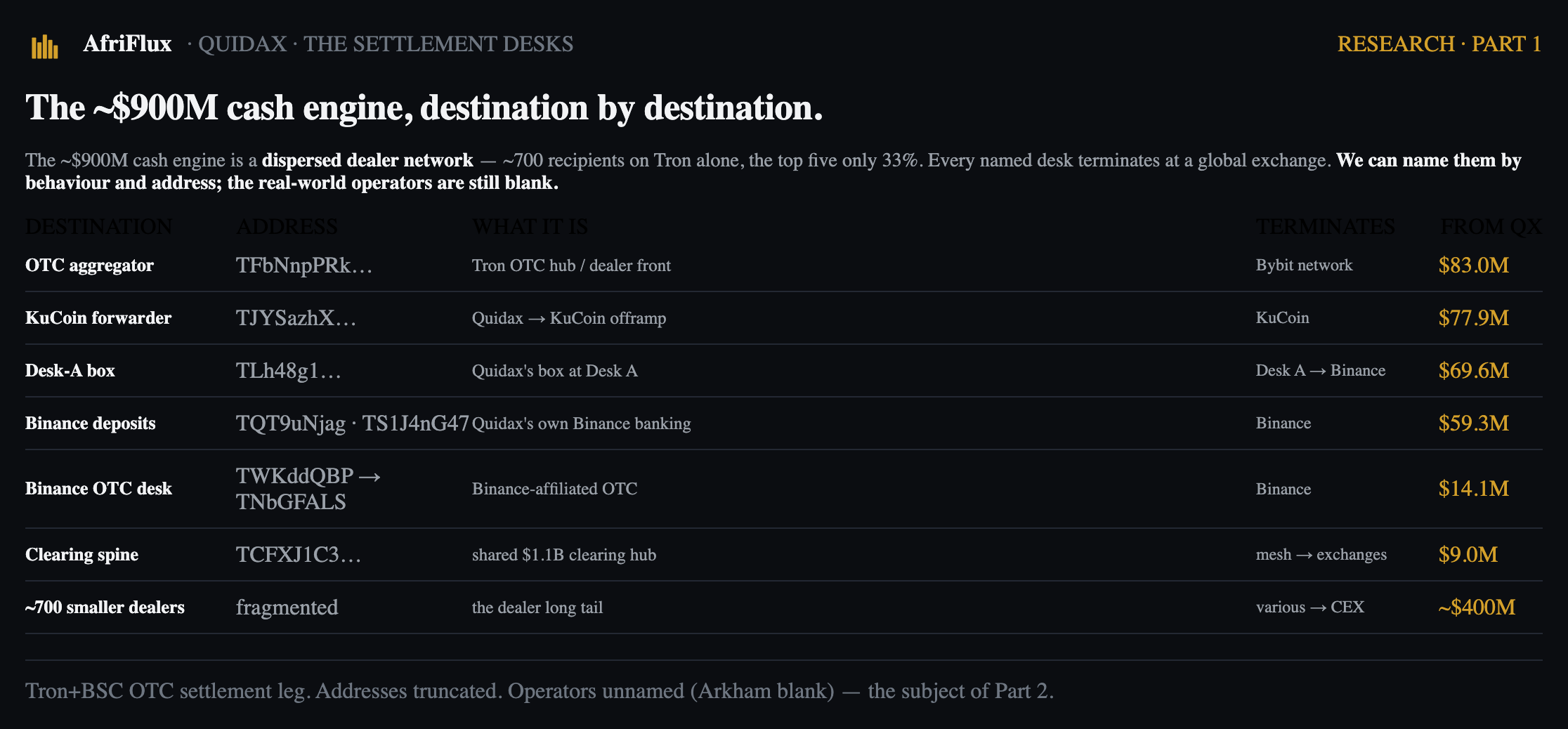
This is the key honesty line of Part 1: we can name these desks by what they do and where they sit on-chain — an OTC aggregator, a KuCoin forwarder, a box at "Desk A," a clearing spine — but the real-world operators behind them are still blank. The chain shows the role; it doesn't show the person. Holding that line is the difference between analysis and guesswork.
One desk, two venues
Look closely at one of them — the entry labelled "Desk A."
Desk A is a wholesale OTC desk: $3.79B lifetime, 96% of it shipped straight to Binance. It mints a gassed deposit box for each client and moves funds in bulk. Quidax settles about $70M through its box there — and so does Breet, another African venue, through its own Desk-A box. Two venues we track, quietly using the same desk. That was the thread that unravelled the real finding.
The shared backbone
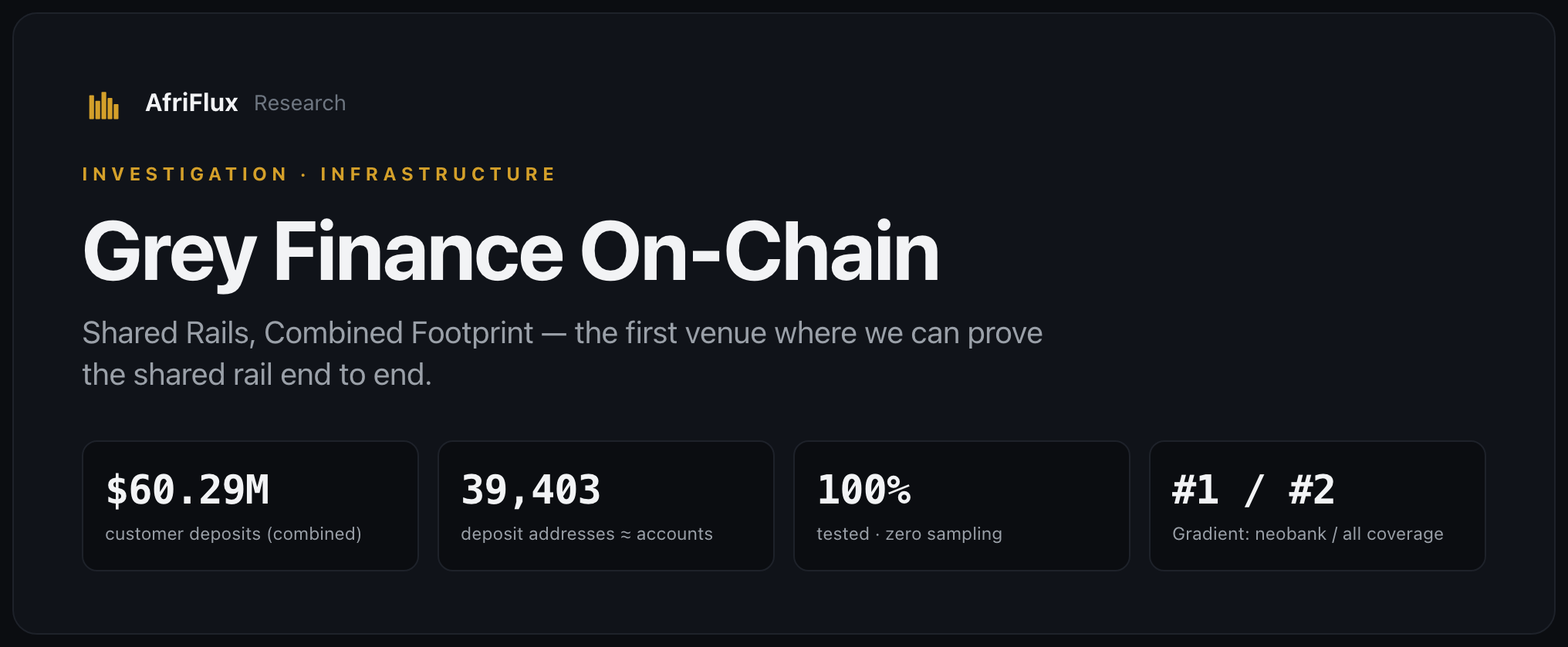
The desks aren't Quidax-specific. Trace the settlement out from several venues at once and they converge on the same place.
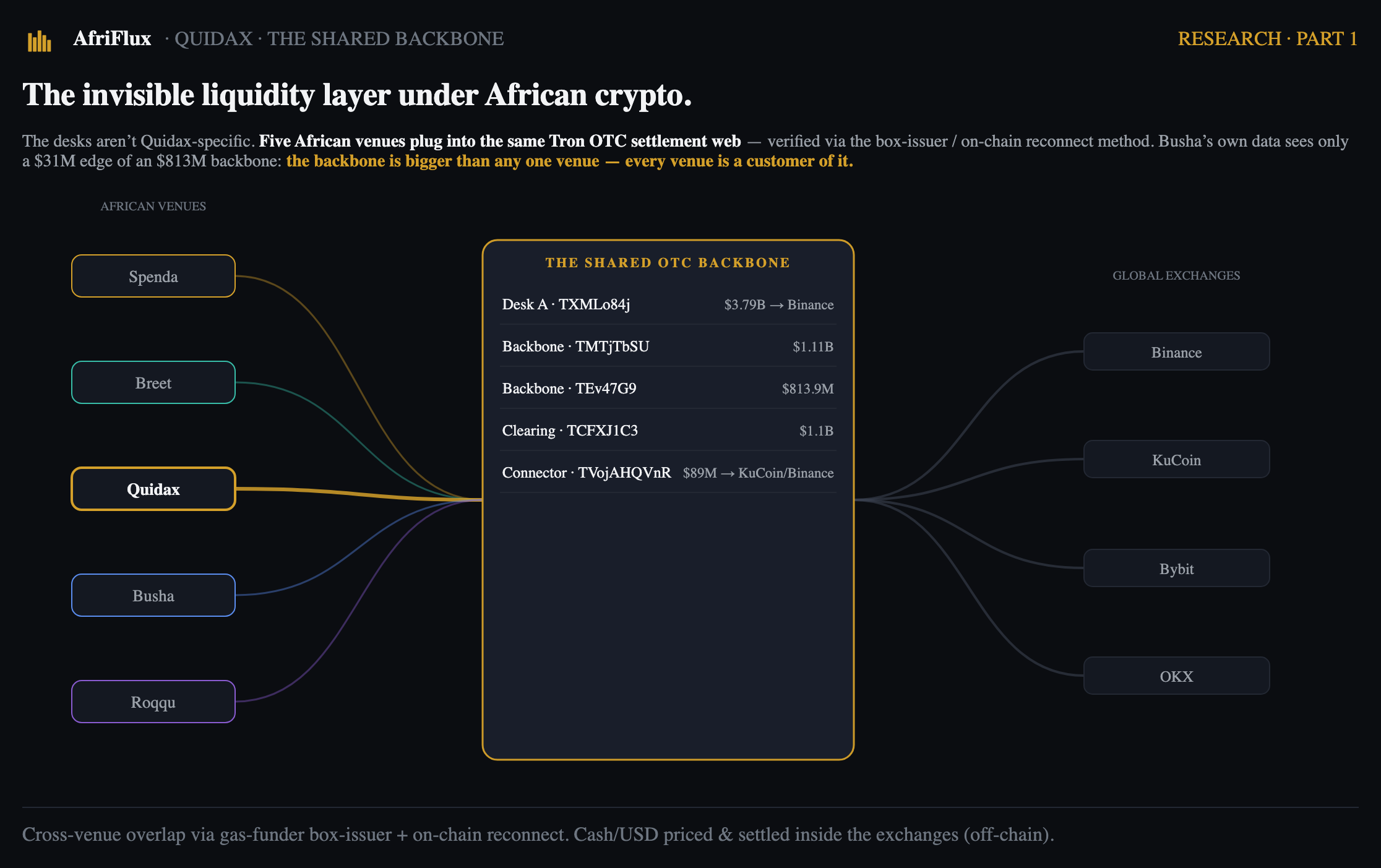
Five African venues — Spenda, Breet, Quidax, Busha, Roqqu — plug into the same OTC settlement web, verified via the box-issuer (gas-funder) method and on-chain reconnection. Underneath them sits a handful of billion-dollar hubs — Desk A, two backbone wallets, a $1.1B clearing spine, a connector wiring it all to KuCoin and Binance — that drain into the global exchanges.
The scale tell is the sharpest part: Busha's own on-chain footprint sees only a $31M edge of an $813M backbone. In other words, the backbone is far bigger than any single venue — every venue is just a customer of it. This is the invisible liquidity layer underneath African crypto, and it's the real subject of the series.
Ethereum — a different animal
One clarification so the picture is honest. The ~$671M that leaves on Ethereum is not the cash engine — it's Quidax's institutional USD liquidity book, routing to an external market-maker (the settlement hub it uses was first funded by that market-maker, never by Quidax, so it isn't Quidax's own wallet). Different chain, different currency, different purpose. The cash question is the ~$900M OTC leg, not this.
What we can prove, and what we can't
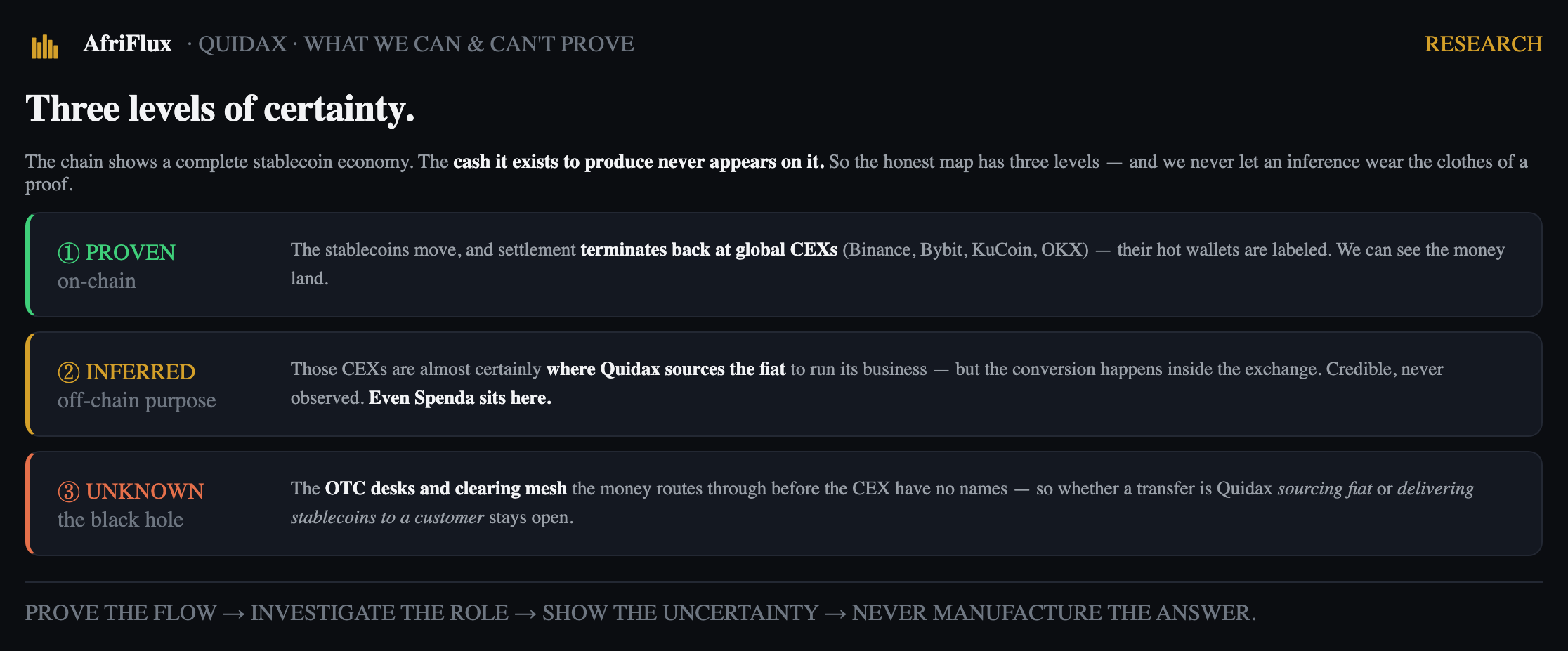
We hold a hard line. We can prove: Quidax sends ~$900M of stablecoins to a dispersed OTC-desk network that terminates at Binance and KuCoin, and that the same desks also settle for Spenda, Breet, Busha and Roqqu. We infer: that the cash returns off-chain — the blockchain can't show a fiat payment, so even for Spenda, where we know the relationship exists, the cash leg is believed, not observed. And we cannot yet see: who the desk operators actually are. Where a role can't be established it stays in an explicit unresolved band. We never let an inference wear the clothes of a proof.
How we measured it
Quidax's master outflow pulled on-chain (TronGrid full history, EVM via HyperSync, day-priced), bucketed by counterparty against the exchange registry, Quidax's own wallets, and known OTC-desk roles, with a leak-back test to separate settlement from internal routing. Cross-venue overlap was established via the box-issuer / gas-funder method plus on-chain reconnection across Spenda, Breet, Busha and Roqqu. The "~$400M smaller dealers" figure and the exact cross-venue shares are directional, pending per-desk deep traces. This is the flow across the venues in our coverage, not a census of the whole market. Figures are lifetime through 2026-09.
Where this leaves us
We started with a simple question: where does an exchange get its cash?
Following Quidax's money gets us surprisingly close to the answer. But it also reveals something bigger. African crypto doesn't run on exchanges alone — it runs on a largely invisible network of liquidity providers, desks and settlement counterparties sitting underneath them, shared across venues, and almost entirely unnamed. Someone provides the cash. Someone prices it. Someone settles it. Someone takes the stablecoins. Those people are, in effect, what makes African crypto spendable.
We can see the crypto. Now we're trying to name the people behind the cash.
— Part 2, next: naming the desks behind the backbone.
Coverage note: AfriFlux reconstructs the on-chain activity of Quidax's wallets across nine networks, bucketed at the master accounting boundary. Figures current to 2026-09 and update as we re-scan. This measures the stablecoin flow we can see on-chain; the cash settlement it produces is off-chain and inferred, not observed. Desk operators are unnamed pending Part 2.