Flutterwave has spent the past year building stablecoins into its payments network. As its stablecoin lead described it to TechCabal this week, the stablecoin sits underneath the payment, while customers keep seeing dollars, naira and other local currencies. The rail, not the product.
Flutterwave told us what it's building. We went onchain to see what the machine underneath looks like, and to answer one question: what is this rail actually being used for? Who funds it, who uses it, where does the money go, and what role does each chain play?
How to read the tags in this piece: OBSERVED means we see it directly in the transactions. BEHAVES LIKE means an address's pattern strongly supports it. CONSISTENT WITH marks an inference that fits the data but isn't proven.
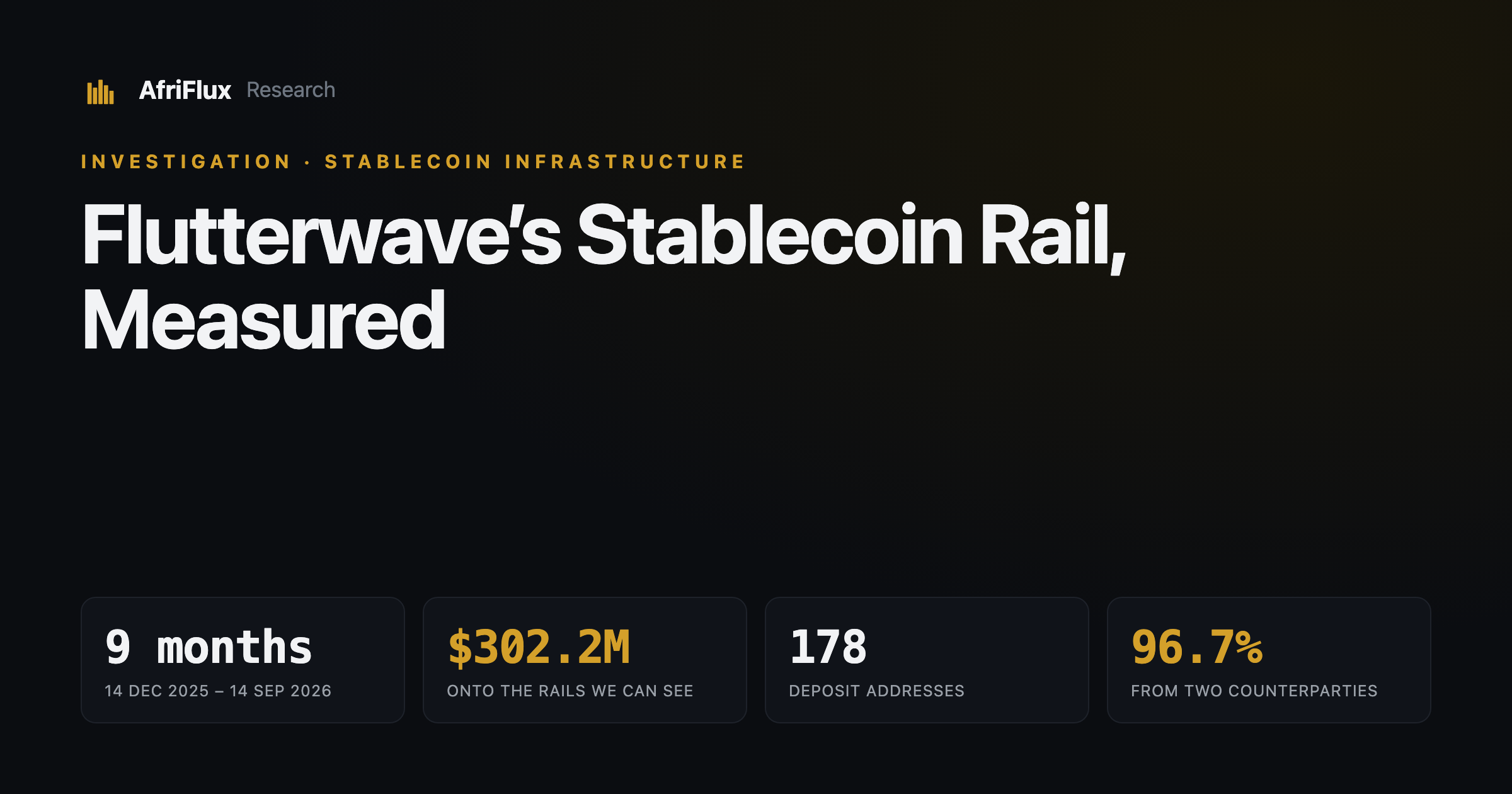
The rail: $302M, nine months, 178 addresses
Start with what we can see, and when. Flutterwave issues deposit addresses on Ethereum, Polygon and Base. Money sent to them is swept into a single master wallet, and a separate payout wallet pays out on the same chains. On Solana there are no deposit addresses, only a payout wallet. OBSERVED
Every wallet in that system was created from December 2025 onward. Flutterwave's stablecoin work is older than that: USDC on Stellar in 2021, a Circle design partnership in April 2025, Polygon as its default chain from October 2025. That earlier history ran on infrastructure we can't reconstruct from these rails.
| Rail | First activity we see | Months covered |
|---|---|---|
| Ethereum — deposits + settlement | 14 Dec 2025 | Dec 2025 → Sep 2026 |
| Polygon — deposits + payouts | 9 Dec 2025 | Dec 2025 → Sep 2026 |
| Solana — payouts only | 5 Mar 2026 | Mar → Sep 2026 |
| RLUSD — payout-side asset | 16 Mar 2026 | Mar → Sep 2026 |
| Base — deposits + payouts | 7 May 2026 | May → Sep 2026 |
Everything here covers 14 December 2025 to 14 September 2026 — the lifetime of the rails we can see, not the lifetime of Flutterwave's stablecoin strategy.
Within that window, AfriFlux sees $302.2M of stablecoin flow onto the rail, across 178 deposit addresses. We count an address only if its money provably sweeps into Flutterwave's master. The assets are the ones the TechCabal piece lists, USDC, USDT and RLUSD, and so are the chains; no Tron, BSC or Arbitrum rail shows up.
This is the stablecoin leg we can independently observe on public blockchains. It isn't Flutterwave's total payment volume or its total stablecoin volume. The fiat side of each payment moves off-chain, and Tempo, the settlement network Flutterwave says it added in June, isn't measured here. Flutterwave says it has processed more than $40bn in payments since 2016; that's the entire payments business, and it measures something different.
But there's a catch: 96.7% comes from two counterparties
$302.2M sounds huge. It isn't hundreds of millions of dollars of evenly spread activity. Two counterparties account for 96.7% of it, and they look nothing alike.
| Deposited | Funded by | Active since | |
|---|---|---|---|
| Client A | $122.4M | exactly five firms, all running the same hosted-wallet software | Feb 2026 |
| Client B | $169.9M | 30 sources, ~57% directly from wallets labelled Binance and Bybit | 29 Jun 2026 |
| Everyone else | $9.9M | 176 addresses, median deposit $54.95 | — |
Client A looks like a business corridor: five companies settling through one Flutterwave address. Client B looks like an on-ramp corridor, with dollars withdrawn from exchanges flowing onto the rail. BEHAVES LIKE Everything else, 176 addresses, adds up to under $10M.
We don't name either counterparty. Nothing in the data identifies them, so we describe what they do rather than who they are.
One corridor changes everything
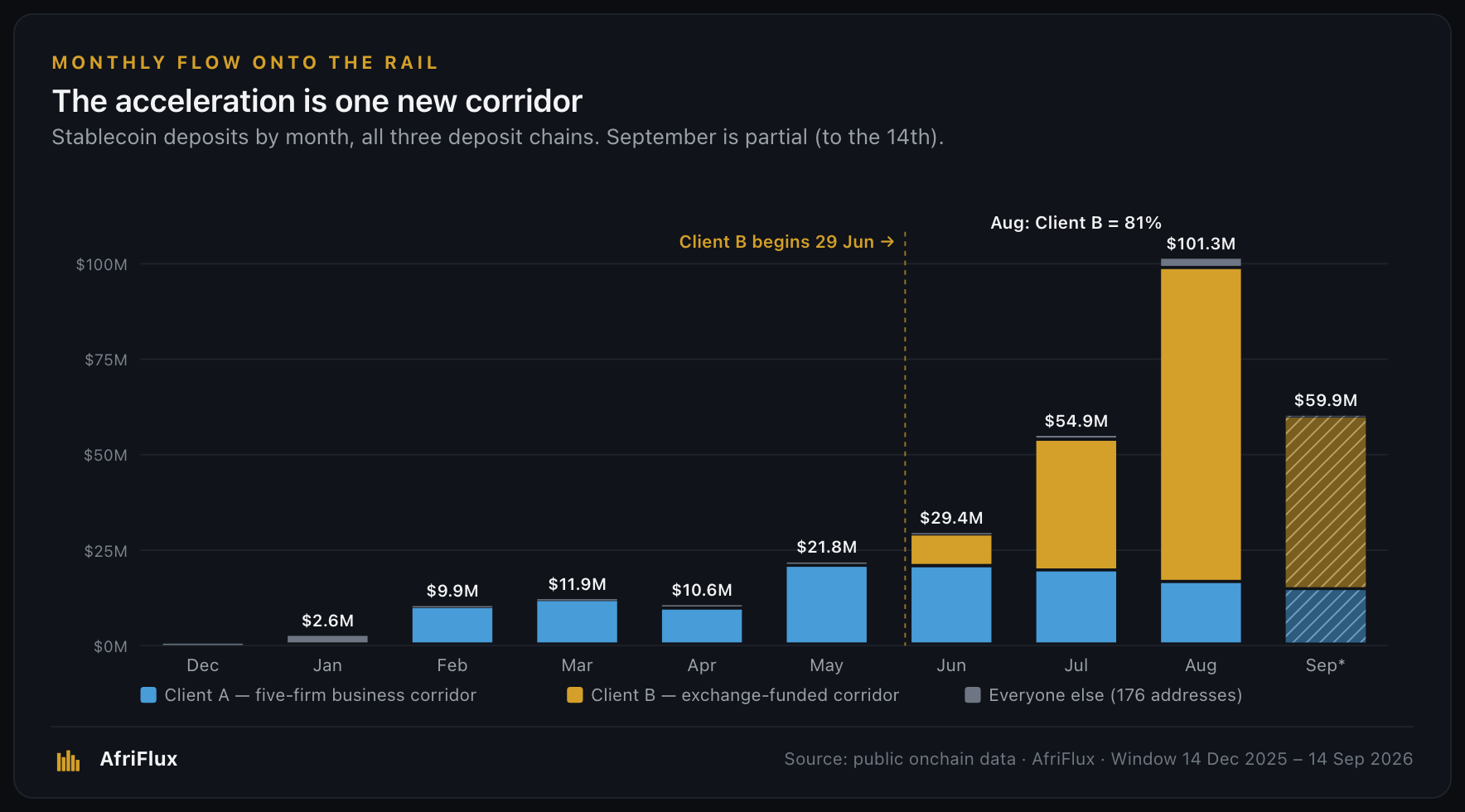
Through May, the rail is essentially Client A: $10–21M a month. Then Client B arrives on 29 June. July reaches $54.9M. August reaches $101.3M, a third of everything the rail has ever done, in a single month.
But Client B was 81% of August. The acceleration is real, and it's overwhelmingly driven by one new corridor. OBSERVED
Who is funding this?
Tracing each deposit one hop back shows who funds the rail. OBSERVED
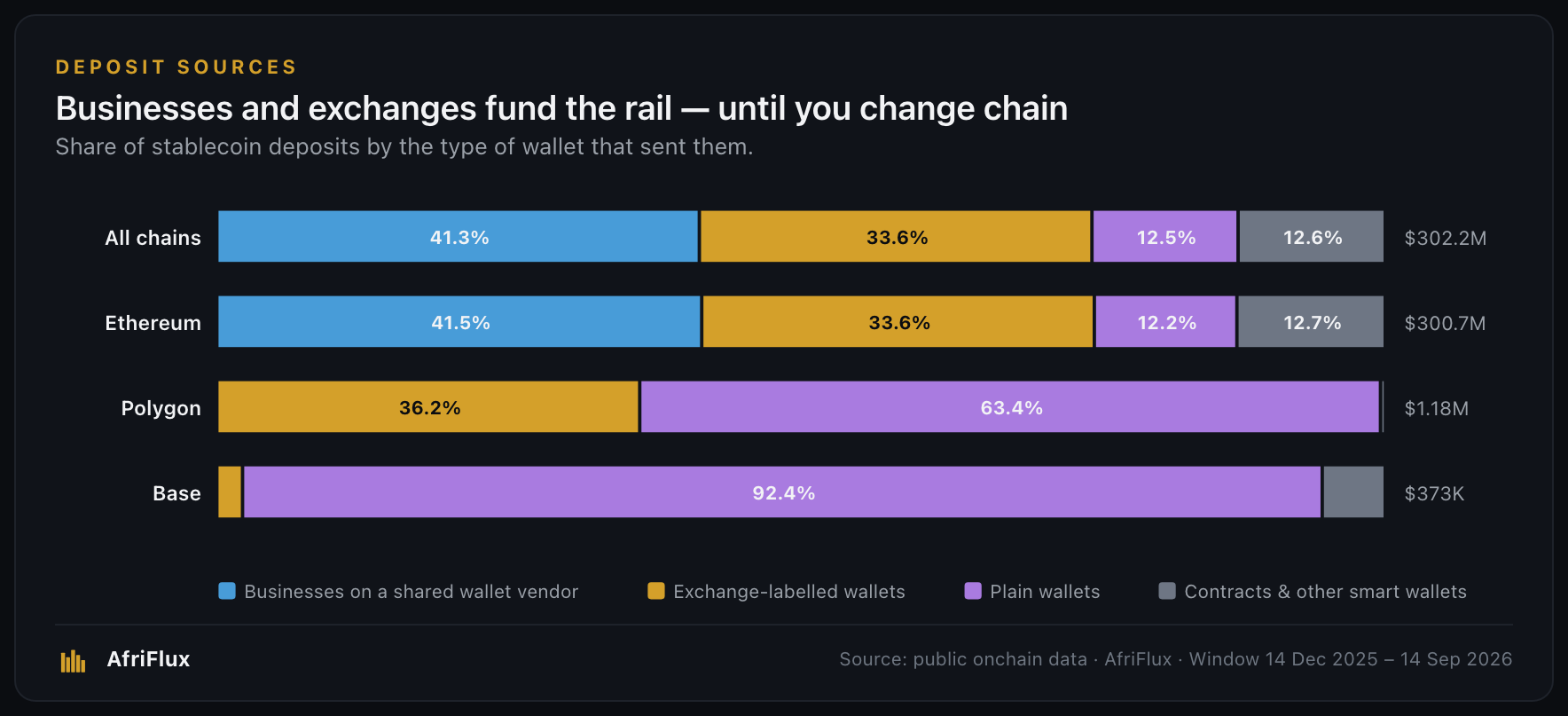
41.3% comes from businesses sharing a hosted-wallet vendor and 33.6% from exchange-labelled wallets (Bybit $51.8M, Binance $49.4M). Plain wallets add 12.5% and contracts 11.4%.
The mix flips by chain. Ethereum is businesses and exchanges. Polygon is 63% plain wallets; Base is 92%. That's where the smaller-ticket wallets show up.
Exchange names come from third-party wallet labels, which we treat as a strong indication rather than an identification. And we observe wallet behaviour, not customer type — a plain wallet isn't necessarily a retail customer.
The strange part: deposit addresses almost never cross chains
The TechCabal piece describes a system where customers don't pick a blockchain, and Flutterwave decides which asset and network each payment uses. The address data shows something that fits it.
Across 178 deposit addresses, only three ever appear on more than one chain.
Each deposit address stays on one chain. Addresses aren't hopping between networks for the cheapest route; whatever routing happens isn't done at the address level. The pattern is consistent with a system where the complexity is abstracted away from the depositor. CONSISTENT WITH
We can't see Flutterwave's routing logic itself. What we observe is its footprint: deposit addresses that stay put. We see addresses, not the people or businesses behind them.
Follow the money: $268M routes toward Circle infrastructure
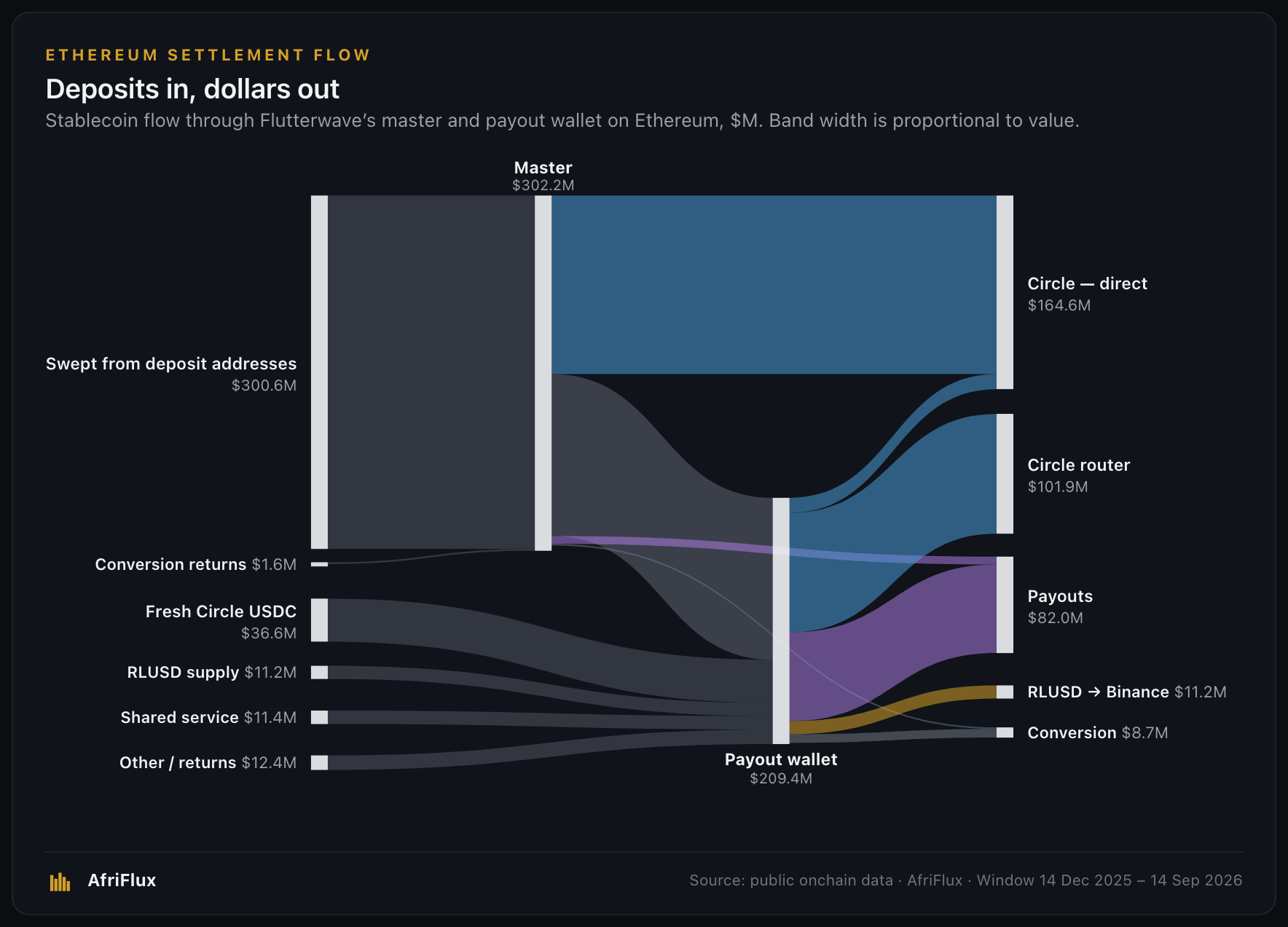
Following every dollar that leaves Flutterwave's master and payout wallet shows how the rail settles.
| Where Ethereum outflow goes | USD | Share |
|---|---|---|
| USDC redeemed at Circle — direct | $164.6M | 44.7% |
| USDC into a Circle redemption router | $101.9M | 27.7% |
| Payouts to other counterparties | $43.9M | 11.9% |
| Payouts to two-way clients | $38.1M | 10.3% |
| RLUSD → Binance deposit account | $11.2M | 3.0% |
| Conversion (Uniswap, LI.FI) | $8.7M | 2.4% |
| Total leaving Flutterwave's wallets | $368.4M | 100% |
Why $300.6M in the chart and $302.2M in the headline: the headline counts deposits on all three chains. Ethereum's share is $300.7M; by 14 September, $300.6M of it had been swept into the master, with about $60K still sitting in deposit addresses. The master also received $1.6M that isn't customer money, mostly returns from currency conversion, which the chart shows separately. Every figure in this piece is taken at the same point: 14 September 2026.
About $268M of flow across the rail routes toward Circle redemption infrastructure, by two paths:
- Direct — $164.6M. USDC goes to a Circle deposit address that forwards every dollar to Circle's hot wallet.
OBSERVED - Via a router — $101.9M. USDC passes through a conduit into a redemption router whose only destination is Circle.
OBSERVEDThe router also carries other clients' money, so this path routes into Circle redemption rather than being redeemed dollar-for-dollar.
This establishes a Circle redemption path. It doesn't establish Circle Payments Network membership, which isn't something the chain can show. Most of the direct address's inflow is Flutterwave's; the rest comes from another sender.
In the African venues we've mapped so far, we've generally seen stablecoins settle into exchanges. Flutterwave is different: a large share of its USDC flow routes back toward the issuer.
Deposits and payouts aren't the same pool of money. $368.4M leaves Flutterwave's wallets on Ethereum, more than customers deposited, because the payout wallet isn't funded only by customers. 28% of the payout wallet's funding — $59.3M of $209.4M — arrives from elsewhere: $36.6M of freshly minted Circle USDC, $11.2M of RLUSD and $11.4M from a shared provisioning service. OBSERVED
So the rail runs two pools. Customer deposits flow into the master and largely back toward Circle. Payouts go out from a wallet that's partly prefunded with new dollars. That appears to be how the rail pays out without waiting on the deposit it's settling. CONSISTENT WITH
Then we found the RLUSD rail
Flutterwave also runs a rail in RLUSD, Ripple's stablecoin; the TechCabal piece names Ripple as a strategic investor and liquidity provider. We followed it. About $12M of RLUSD enters through the payout side, and $11.2M of it reaches one address.
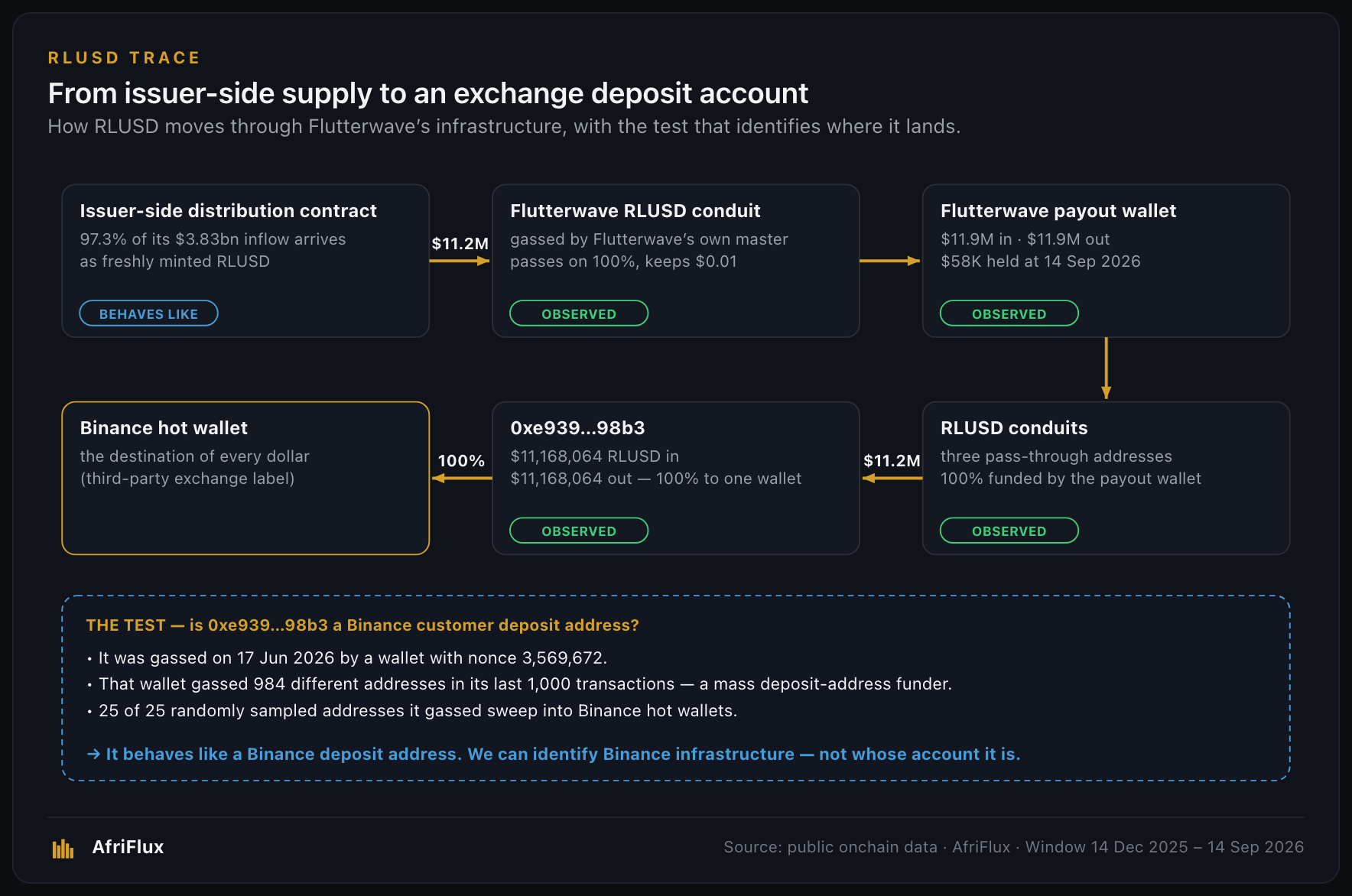
The supply end arrives through a conduit that Flutterwave's own master gassed, so we know it's Flutterwave's. The contract feeding that conduit receives 97.3% of its inflow as freshly minted RLUSD, which is how issuer-side distribution behaves. BEHAVES LIKE
The destination is where it gets interesting. The address receiving $11.2M passes every dollar to a Binance hot wallet. But nobody sends to an exchange hot wallet directly; users send to a deposit address, and the exchange sweeps it. So we tested the address's funding pattern. The wallet that gassed it has signed more than 3.5 million transactions and funded 984 different addresses in its last thousand. All 25 addresses we sampled from it sweep into Binance hot wallets. BEHAVES LIKE
Flutterwave's RLUSD lands in a Binance deposit account. We can identify the account as Binance infrastructure, but not the account owner.
USDC routes back toward its issuer; RLUSD takes an exchange route.
Four chains, four jobs
Flutterwave isn't just using several chains. Different chains are doing different jobs.
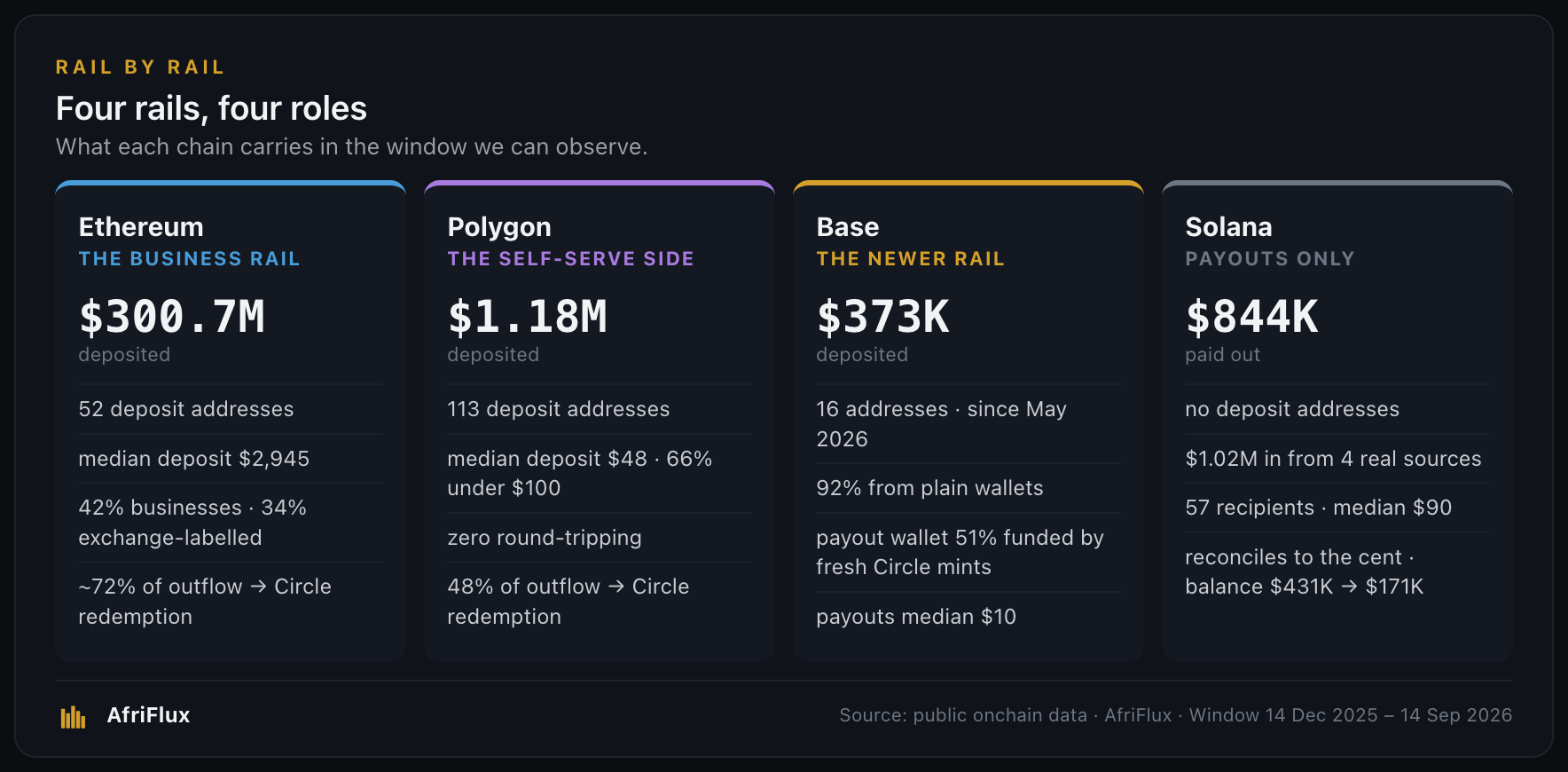
Ethereum carries the business money: 99.5% of all dollars, a median deposit near $3,000, most of it headed toward Circle. Polygon carries the smaller-ticket wallets: 113 addresses, a median deposit of $48, two-thirds under $100, and no address that both deposits and gets paid. Base is the newest rail, live since May, with a payout wallet funded mostly by fresh Circle mints. Solana only pays out: $1.02M in from four real sources, $844K out to 57 recipients, reconciled to the cent, with the balance drawn down from $431K to $171K. OBSERVED
What we actually know
From public chain data alone, Flutterwave's stablecoin rail is:
- Measurable — $302.2M onto the rail, 14 Dec 2025 – 14 Sep 2026.
- Young — nine months of observable infrastructure behind a strategy that's years older.
- Business-led and concentrated — two corridors are 96.7%; the smaller-ticket, user-facing layer is small.
- Accelerating on one corridor — Client B, live since late June, was 81% of August.
- Genuinely multi-chain — four rails with four different jobs.
- Largely routed toward issuer redemption infrastructure — about $268M toward Circle; RLUSD exits through a Binance deposit account.
- Running on prefunded payouts — 28% of the Ethereum payout wallet's funding is new Circle USDC, RLUSD and shared provisioning, not customer deposits.
What we can't see: the fiat side of every payment; anything before December 2025; Tempo; who owns the Binance deposit account; whether Flutterwave is a Circle Payments Network member, which redemption doesn't prove; and who the two major counterparties are.
The stablecoin infrastructure Flutterwave has described is already moving measurable volume. In the nine months of infrastructure we can see, $302.2M has moved through the rail.
But it's still early. Most of that flow sits with two corridors. The smaller-ticket, user-facing layer is much smaller. Different chains are doing different jobs. And the stablecoin leg ultimately connects into traditional liquidity infrastructure: Circle, Binance and settlement paths that leave the chain.
The next question isn't whether stablecoins are being used. They are. It's how large this rail becomes — and how much of Flutterwave's broader payments network eventually runs through it.
Method. Deposit addresses were identified from Flutterwave's master wallet: an address counts only if its stablecoin provably sweeps there. Volumes use real token contracts only (counterfeit look-alike tokens excluded) and exclude dust and address-poisoning transfers. Outflow is classified by destination; internal moves between Flutterwave's own wallets are excluded so nothing is counted twice. Solana is measured on the payout wallet's token accounts and reconciled to its live balance. Wallet types describe behaviour, not customer identity. Exchange and issuer identifications are behavioural or from third-party labels, as marked. All figures are taken at a single snapshot, 14 September 2026 (Solana to its last activity, 11 September). This is the stablecoin rail as public chain data shows it, not a census of Flutterwave's business.