If you own Nigerian stocks, you already believe in the idea. Buy a piece of a good company, hold it, receive dividends and let the country's growth become your growth.
So here's the uncomfortable question. Nigerian equities on the Exchange are worth about ₦164 trillion as of late September 2026. Why hasn't that made more ordinary Nigerians wealthy?
The problem was never only the companies. It was the pipes: how money gets in, how it trades, and how it gets out.
The pipes are narrow
Getting in isn't the hard part anymore. Apps like Bamboo let you buy Nigerian shares from your phone in minutes. The hard part is what happens after you buy.
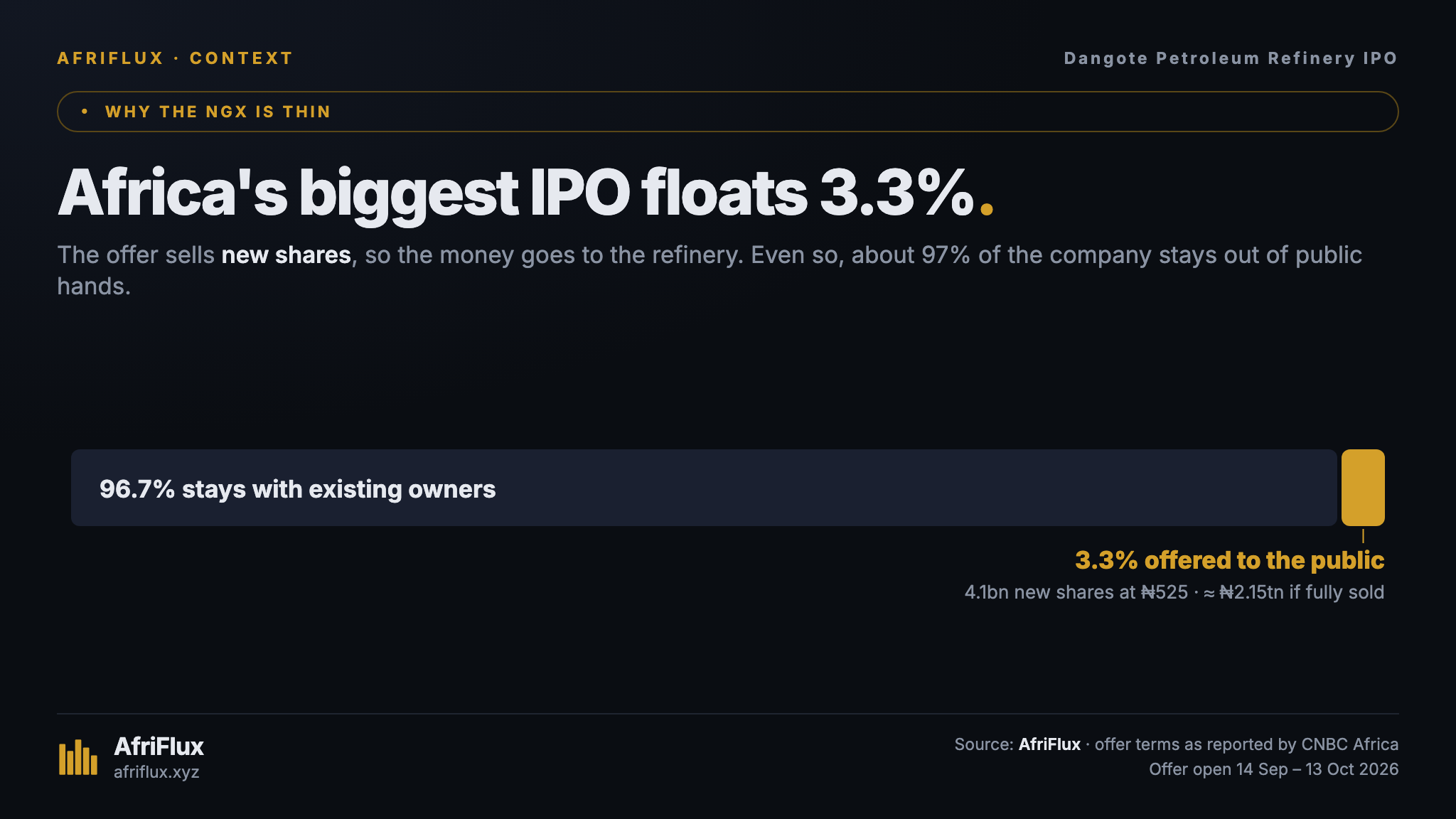
- It's illiquid. A small group of founders and pension funds holds most of the market's value. Their shares rarely change hands. After the Dangote Refinery IPO, Africa's largest, only 3.3% of the expanded company is open to the public. A cornerstone investor has already secured part of that. Outside a few large companies, stocks can go days with few trades. That makes it hard to buy in, and harder to sell when you need the money.
- The exit has been tricky for foreigners. This is especially important for money coming from outside Nigeria. Foreign investors once supplied a much larger share of NGX trading. Then many found they could sell their shares but struggled to get their dollars home. Once the exit door jams, they don't come back. In 2025 they accounted for about 22% of transactions. In the first eight months of 2026 that fell to about 10%. In some recent months it has been closer to 5–6%.
These two problems are connected. Nigerian stocks have too few buyers. The market needs money from other countries. The old systems made it hard to bring that money in, and even harder to take it back out.
What a tokenized stock actually is
A tokenized stock is a share, or a claim on a share, that lives in a crypto wallet instead of a broker's account. You can buy it with a stablecoin, like a digital dollar or a digital naira. You can do this at any time of day, for any amount, from any place with internet.
That's all it is. It isn't a new asset. It's a new pipe.
It can also be cheaper to trade. On venues that list tokenized stocks, headline fees often run from about 0.05% to 0.25% a trade, before spread. That's not a big deal on ₦10,000. It matters to someone trading often, or to a foreign fund moving millions.
The question is whether the new pipe changes anything. We don't have to guess, because in September Nigeria ran the experiment.
The experiment: Dangote Refinery, onchain
The Dangote Petroleum Refinery IPO opened on 14 September. Some investors subscribed through tokens on two blockchains. On Solana, people bought through the NectarFi app. On Base, people bought directly through GetEquity. AfriFlux has kept track of every on-chain buy and sell-back. Here is what the first 12 days show, from the opening on 14 September to 26 September at 18:05 Lagos time. The offer stays open until 13 October, so these numbers will keep changing.
This is not yet a free secondary market. During the offer, DPRI is sold from a vault at the IPO price of ₦525 a share. The same vault can buy it back. The tokens record an on-chain subscription. The interesting test is what happens after the offer closes and the shares are meant to trade.
1. Small tickets from lots of people. Buyers put in ₦22.48 million net (about $16,500) from 226 wallets. The median buyer spent ₦24,934, about $18.
2. They bought whenever they wanted. Most of the buying happened outside NGX continuous trading hours. 88% of the money spent came in at night, on weekends, or before the market opened, on the clock used for that snapshot. The single largest purchase, ₦5.3 million, came on a Sunday.
That still matters. NGX extended its session in April 2026 to 9:00 a.m.–4:00 p.m. WAT, with continuous trading roughly 9:30 a.m.–3:30 p.m. That is longer than the old four-and-a-half-hour day. It is still closed most of the week. Tokenized US stocks have some volume even when Wall Street is closed. It's enough to be significant, but not enough to replace the home market.
3. It pulled in new people, not just crypto regulars. Of the 150 wallets that bought through NectarFi, 128 were less than 48 hours old when they first bought. Most were created just to buy this share. Those wallets have sold back 0.2% of what they bought. The 76 wallets buying directly on Base were all older, and they have sold back 42%.
4. Every NectarFi purchase started as dollars. All 200 buys on NectarFi were paid in USDC, a digital dollar. These made up 82% of all the buying. Each buy turned the dollars into naira and then into Dangote subscription tokens in one step.
In total, $14,803 became ₦19.94 million worth of Nigerian shares. The buyer did not need a Nigerian bank account or a traditional brokerage app. The structure still involves a Nigerian intermediary. GetEquity acts as a sub-broker and custodian. The subscription will settle into the official offer.
That's the part that matters for money from outside Nigeria. We can't see where these buyers live. A wallet has no passport, and many of them are surely in Lagos. But the pipe itself doesn't care. Someone in London, Nairobi or Houston holding USDC could have made exactly the same trade. For the first time, people can subscribe to a Nigerian stock with dollars in a new way. This way skips some of the old problems that made it hard for foreign investors to put money in.
The usual tokenization story is an African buying Nvidia on a Sunday. Dangote ran it in reverse.
The honest part
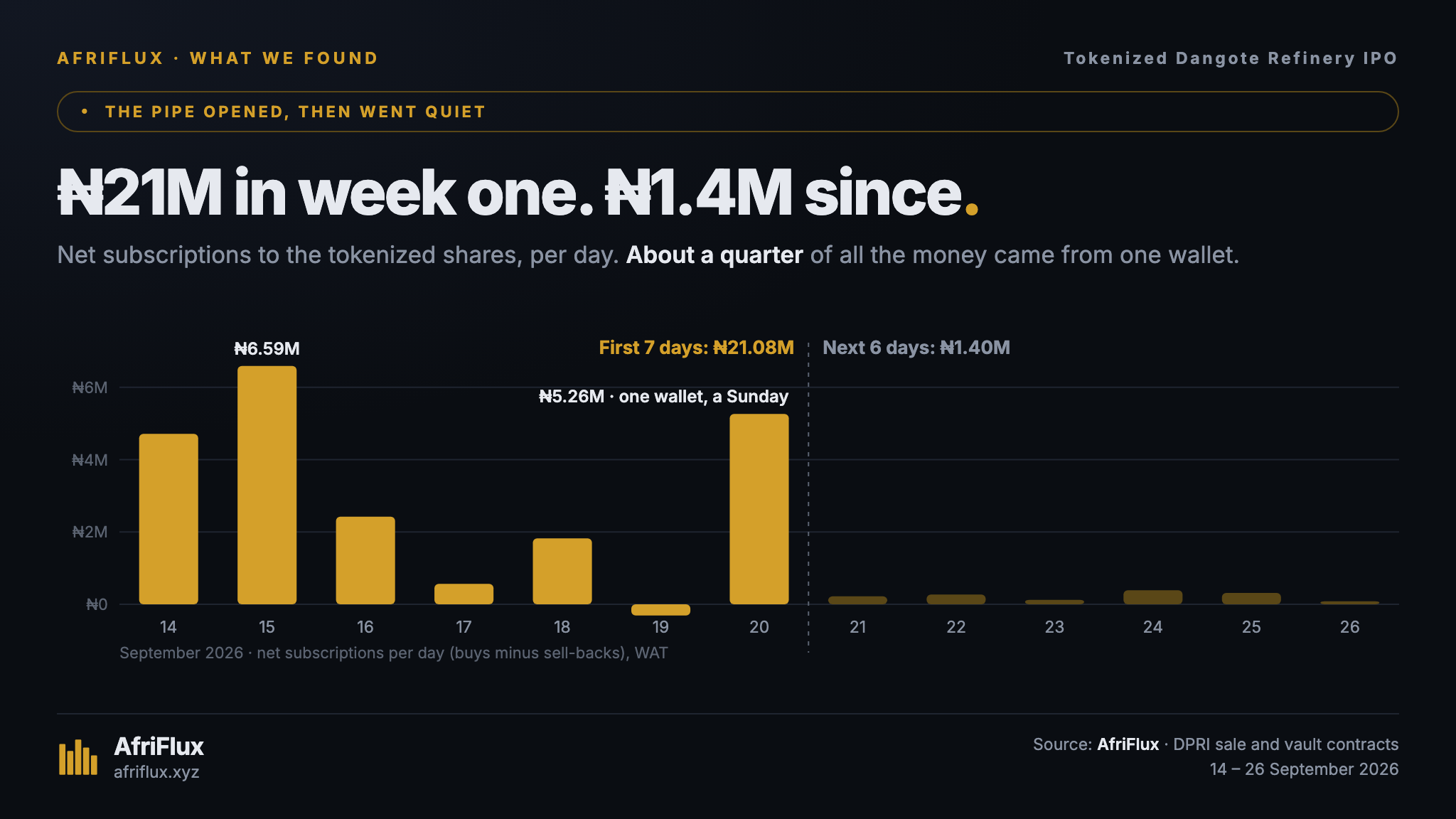
The pipe is open, but almost nothing is flowing through it yet. Of the ₦22.48 million, ₦21.08 million came in the first seven days. The six days since added ₦1.40 million. About a quarter of all the money came from one wallet.
This is a pattern, not a Nigerian quirk. Tokenized stock trading often spikes after a launch or reward. Then, it usually fades as the novelty wears off. People turn up for something new, and most don't come back.
Compare that with the dollars sitting next to it. AfriFlux's venue data reveals that Nigeria-facing apps like Quidax, Busha, Spenda, and Grey see a lot of stablecoin flow. Those dollars are already onchain. They just haven't moved into Nigerian stocks in any size. Against that backdrop, the tokenized Dangote IPO took about $1,400 a day.
More buyers can also mean more people to sell to. Most of the NGX's value belongs to a few founders and pension funds. A wider pipe gives those big holders more people to sell to. That's not what happened here. The Dangote IPO sells new shares. The money goes to the refinery to expand capacity. Not every offer will work that way, so check who receives your money.
Tokenization changes the pipe, not the risks. A token of a thinly traded stock is still thinly traded. Most tokenized stocks today offer a price to new buyers; they don't replicate the home market. They widen who can buy. They don't automatically create buyers.
Prices can also drift when the home market is shut. Weekend and overnight traders in tokenized US stocks are often small and one-sided. Market-makers who keep prices tight tend to step back. Nigerian shares trading onchain would face that for most of the week.
And you don't escape rules. You trade one set of risks for a new set. Now you have to ask: Who holds the real shares? Do you still get dividends and a vote? What happens if the company that made the token goes under? And which country's regulator do you complain to if something goes wrong? Before you buy a tokenized stock, you should be able to answer each of those questions.
So why should you care?
This is important because you want to own shares in Nigerian companies that have real value. That depends on how many people can buy and sell what you own.
For decades, the NGX had too few buyers and an exit that jammed for anyone from outside. Tokenized stocks link a digital dollar wallet to a Nigerian share. This is a direct path available anywhere in the world. And it's open 24 hours a day.
In September, the path worked. It also showed how far there is to go: $16,500went through this pipe in 12 days. That is a rounding error next to Nigeria's on-chain dollar activity, and next to tokenized US equity markets. The next step is for Nigerian shares to trade freely onchain after the offer closes. That's where lower costs and extra buyers would show up — if they show up at all.
You don't have to buy a tokenized stock. If you own Nigerian stocks, you should want lots of people to use this path. The next person who buys your shares might come through it.
You can claim your spot in the newsletter here.
Dangote's on-chain figures come from AfriFlux's tracker of the tokenized DPRI sale and vault contracts on Solana and Base. Data in this piece is current as of 26 September 2026, 18:05 WAT. Live figures: afriflux.xyz/venues/ipo/dangote-refinery. NGX market-cap and foreign-participation figures are from NGX and contemporary market reports. Tokenized stock fee ranges and after-hours patterns come from public venue schedules and 2026 market research on tokenized US equities.