Most stablecoin explainers start the same way. First comes a chart of total supply. Then a number in the hundreds of billions. Then a line about "the future of money." Then a paragraph on how blockchains work, and by sentence three most readers have gone.
We're starting somewhere smaller: forty-one dollars.
That's the average deposit at Spenda, a Nigerian payout desk. People send it stablecoins and get naira back. We've watched 2.3 million of those deposits arrive onchain. Together they come to $94.7 million, about $41 each.
We don't know who sent any of them. We do know where they came from, which road they took, what time they arrived, and what happened next. Follow that dollar and you'll understand stablecoins better than any whitepaper can explain them.
First, what is it?
A stablecoin is a digital dollar.
It's a token on a blockchain, a public ledger anyone can read. A company promises each token is worth exactly one US dollar. To back that promise, the company holds reserves of cash and short-term US government debt. There is one dollar of reserves for every token. The two big ones are USDT, from Tether, and USDC, from Circle.
That's the whole idea. It doesn't rise like Bitcoin or crash like a meme coin. Its only job is to stay boring.
What makes it useful is that it acts like a dollar but moves like a text message. You can send it from any phone to any other phone, in minutes, at any hour, with no bank in the middle. For someone in Lagos, Nairobi or Accra, that's what matters: dollars you can actually reach.
Why forty-one dollars, and not the average?
AfriFlux tracks 24 venues across Africa. Under them sit 4 infrastructure providers. Twenty-three of the venues serve individuals. The 24th, Flutterwave, serves only businesses. Across the 23 consumer venues, we've measured 10.5 million retail deposits. They add up to $3.75 billion. The simple average is about $359.
That number misleads. Most deposits are small, and a few huge ones pull the average up.
Line the venues up by their typical deposit and the picture splits in two:
- 79% of all deposits happen at venues where the average deposit is under $260. Together they carry only 29% of the money.
- The other 21% of deposits happen at four venues where the average is over $1,000. They carry 71% of the money.
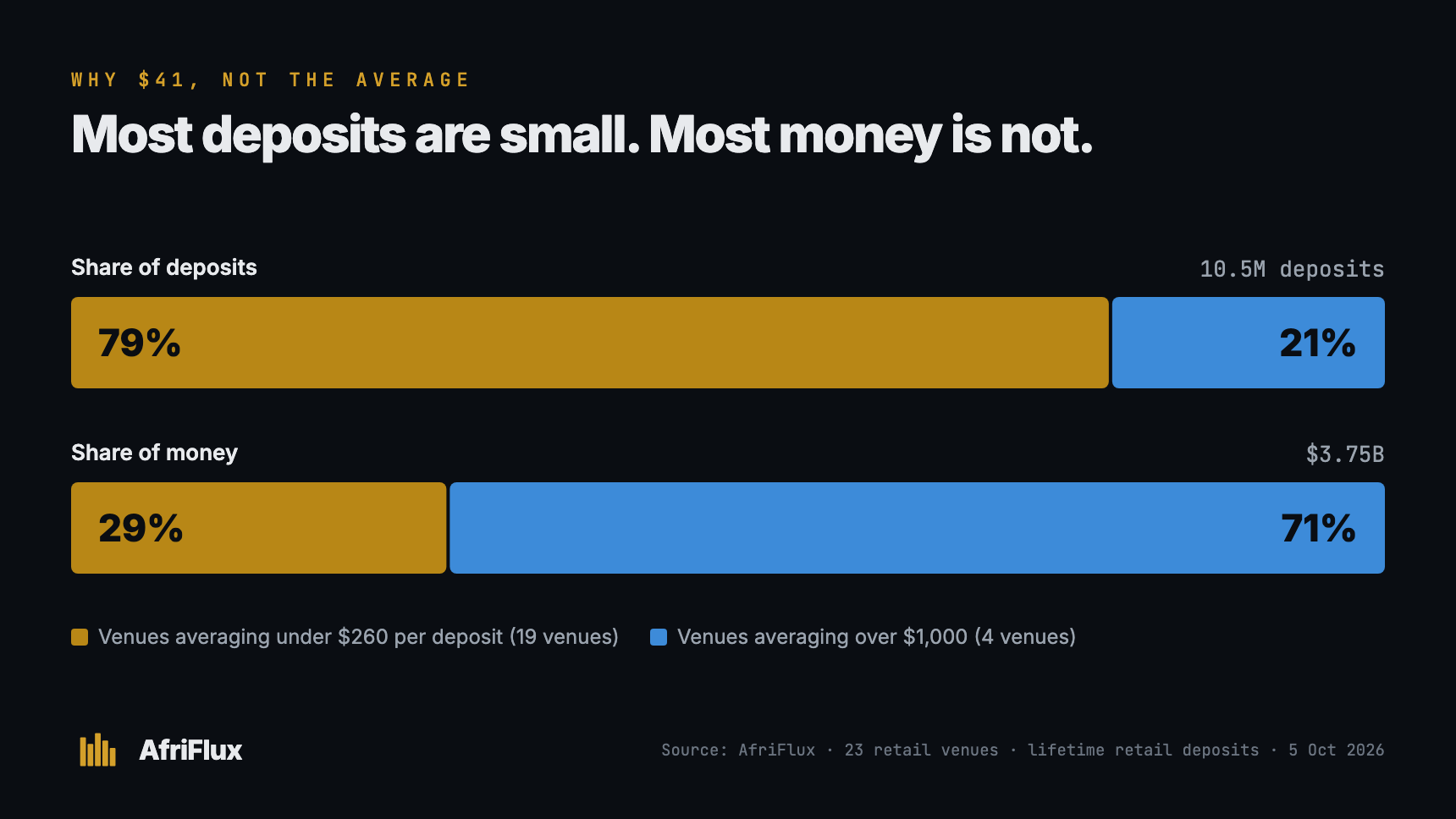
The headline stablecoin economy is measured in billions. It's mostly a few exchanges moving large sums. The economy most people use looks like Spenda: millions of transfers worth a few tens of dollars each. Nearly half of all the deposits we track (48%) land at venues averaging $150 or less.
That's the dollar we're following.
Where it came from
A stablecoin doesn't appear from nowhere. Before it reached Spenda, it sat somewhere else. The wallet that sent it tells us where.
In Q3 2026, retail deposits into African venues came from:
- 48%: a big global exchange, the kind where you buy crypto with a card
- 38%: a self-custody wallet, an app on someone's phone where they hold their own coins
- 4%: another local African platform
- 10%: wallets we couldn't classify
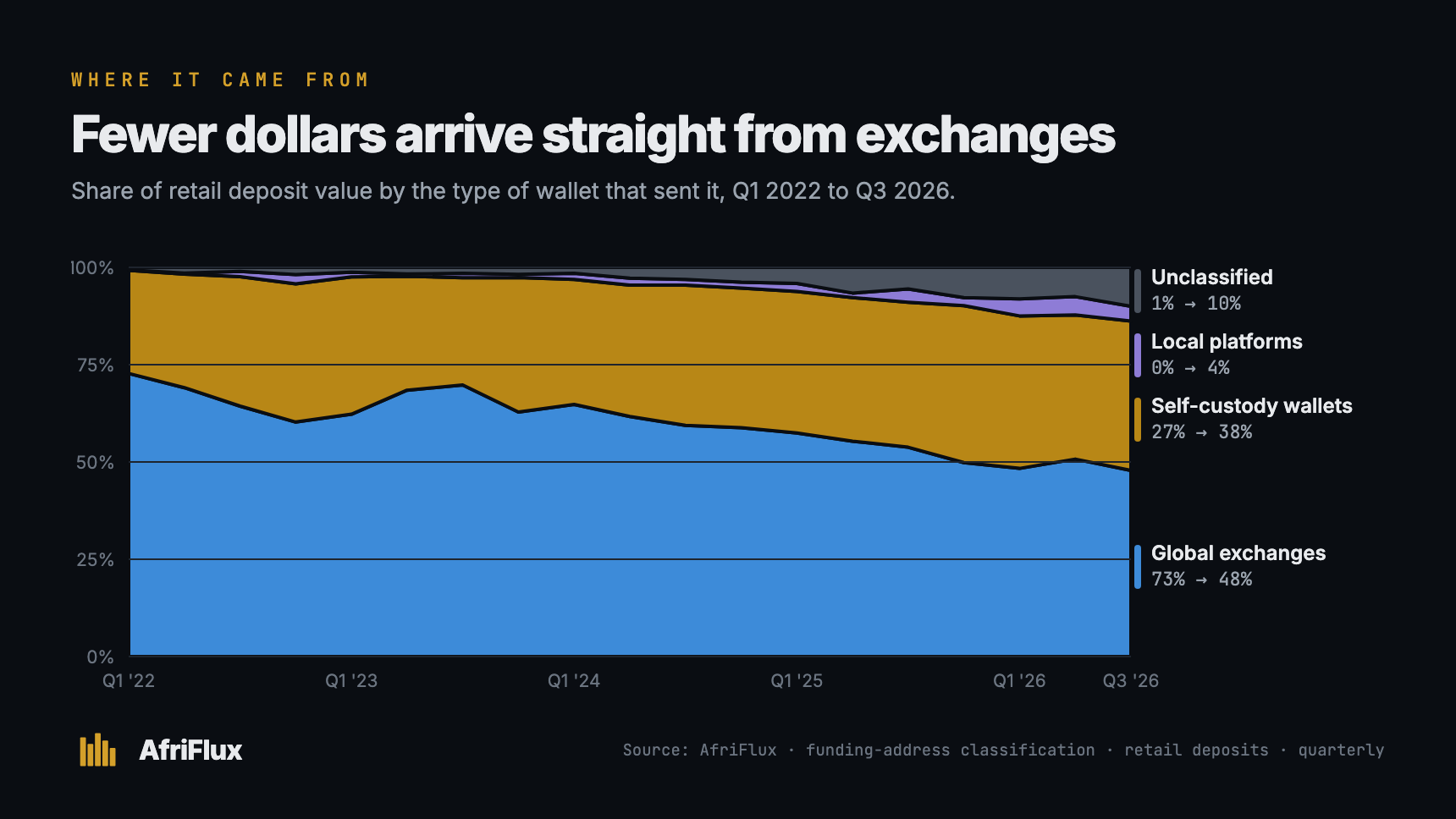
The trend is the story. In early 2022, nearly three-quarters of the money came straight from global exchanges. Today it's under half. The self-custody share has grown from about a quarter to almost two-fifths.
More people now keep digital dollars in a wallet on their own phone. They send from there. They no longer buy on an exchange and pass the money straight through. The stablecoin is becoming something people keep, not only a way to move money.
The road it took
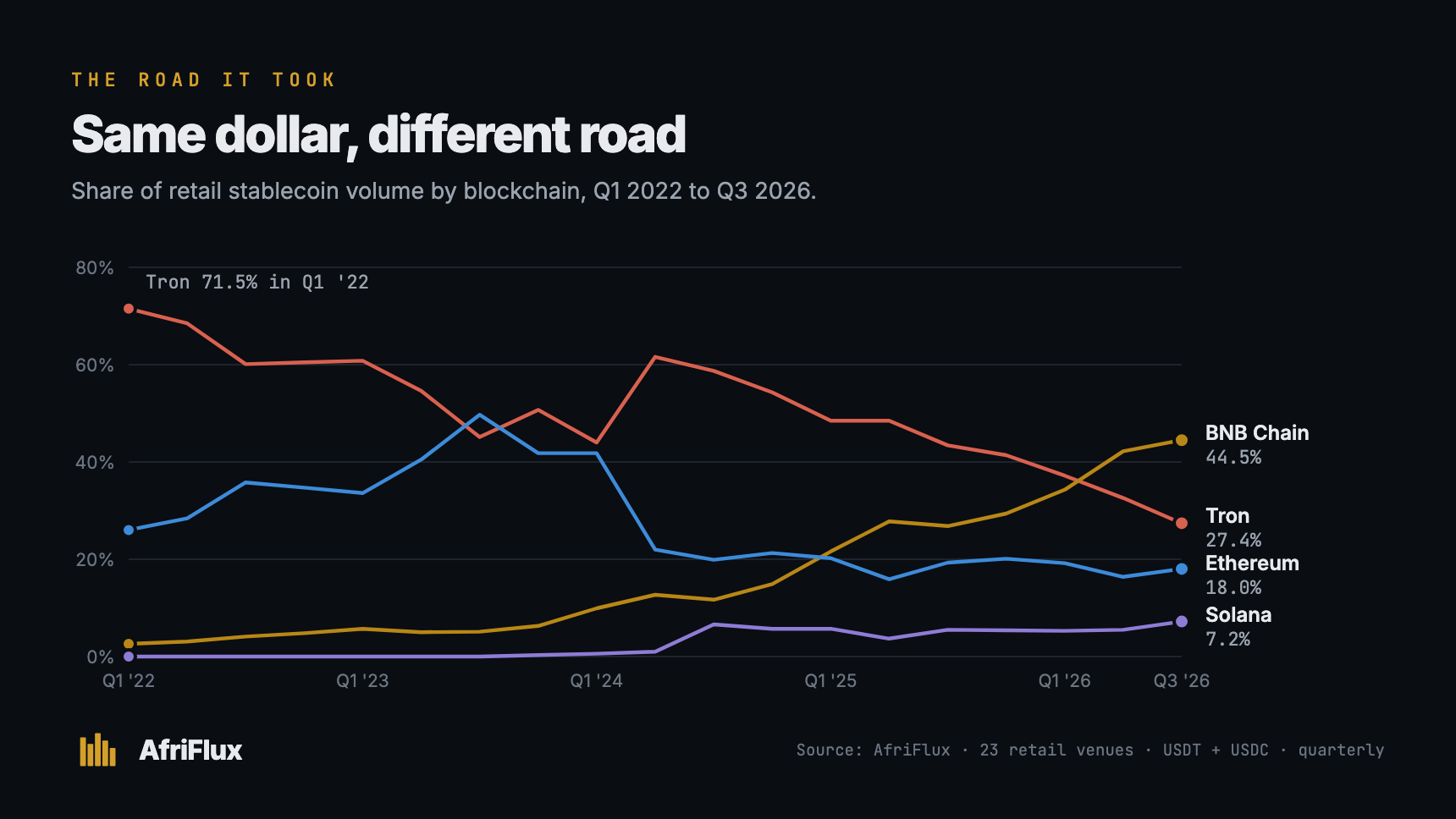
Few beginner's guides mention this: a stablecoin can travel on many blockchains. The same USDT exists on Tron, BNB Chain, Ethereum and Solana. Think of them as different roads to the same city. Each has its own tolls and speeds.
Our dollar is almost certainly USDT. Tether's coin carries 88.6% of retail volume on African venues. USDC carries nearly all the rest. That split has barely moved since 2024.
But the road keeps changing:
| Quarter | Tron | BNB Chain | Ethereum | Solana |
|---|---|---|---|---|
| Q1 2022 | 71.5% | 2.6% | 26.0% | — |
| Q1 2024 | 44.0% | 9.9% | 41.8% | — |
| Q1 2026 | 37.2% | 34.3% | 19.2% | 5.3% |
| Q3 2026 | 27.4% | 44.5% | 18.0% | 7.2% |
Four years ago, Tron carried seven of every ten retail dollars. Today BNB Chain carries the most. Tron's share has fallen by more than half.
Nobody announced this. No regulator ordered it. Millions of people switched roads on their own. The dollar is the same on every road. Only the cost and convenience differ. That's the key lesson: the token is the product, and the blockchain is plumbing.
When it moved
Crypto markets never close. If stablecoins were a speculative toy, activity would run around the clock. You'd see late-night trading, weekend spikes, and a 3am rush whenever Bitcoin moves.
The data shows something else. We looked at 6.4 million deposits from the last twelve months, in Lagos time:
- From 11am to 7pm, about 6% of the day's deposits arrive each hour. It's a flat, steady working-day plateau.
- At 4am it drops to 1.1%.
- Sunday is the quietest day (12.3% of the week's deposits). Friday is the busiest (15.1%).
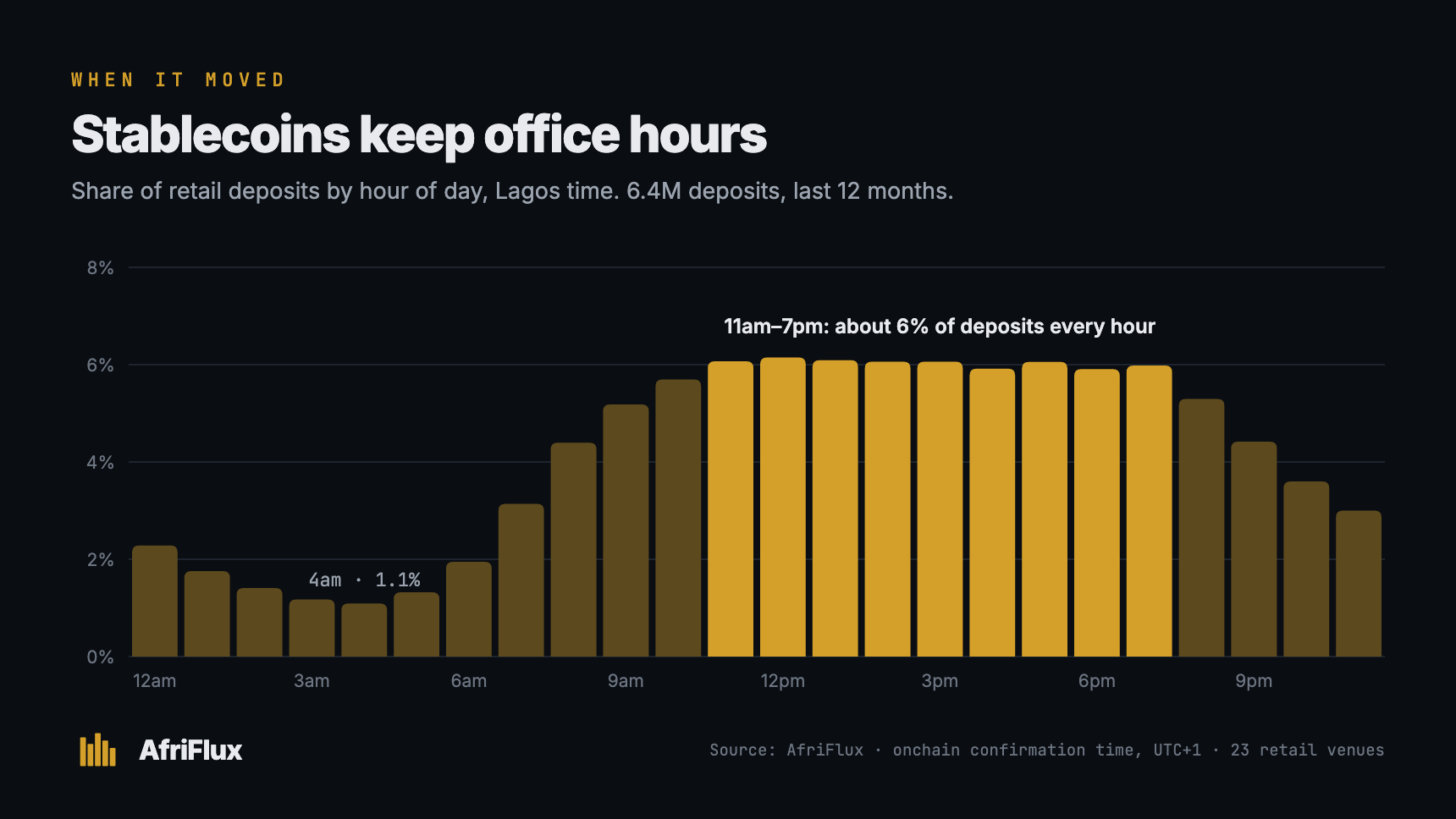
That's the rhythm of a payments tool, not a casino. People send stablecoins while they're awake, working, paying and being paid. It looks less like a trading floor and more like a bank branch that never locks its doors.
Where it was going
This is where our $41 dollar ends its trip. Spenda swaps it for naira and pays it into a local bank account. The stablecoin was never the destination. It was the vehicle.
Most people are doing the same. In Q3 2026:
- Off-ramps turn stablecoins into local currency. They served 61% of all active wallets (149,963 of 243,971). But they handled only 19% of the money.
- Exchanges, where people trade, handled 75% of the money with 22% of the wallets.
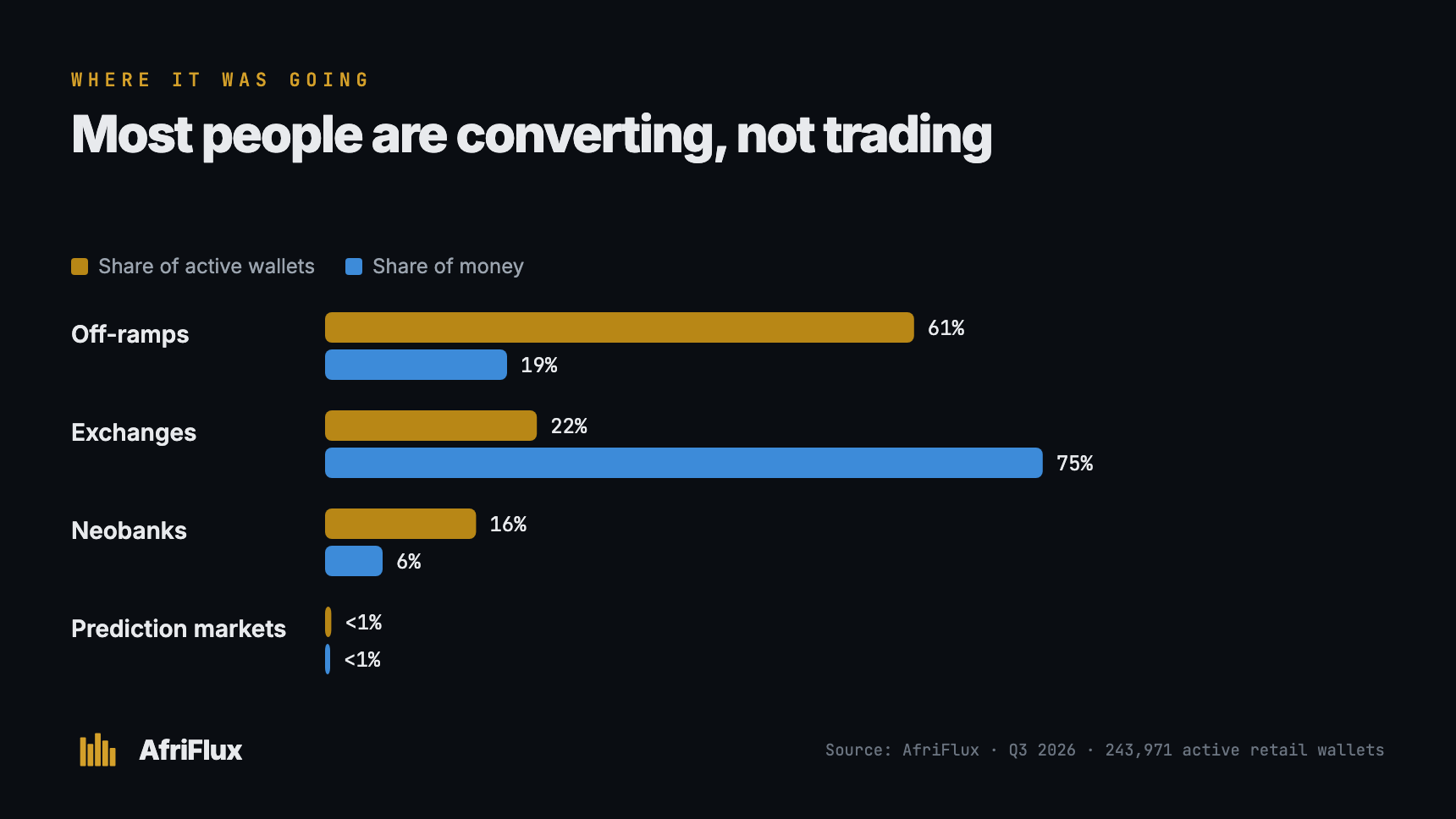
The typical user on an African venue isn't trading. They're converting. Someone was paid in digital dollars. Now they turn some into naira for rent, school fees or shop stock.
And this use is growing fast. Spenda served 1,518 wallets in the second quarter of 2025. Five quarters later it served 105,907. The average deposit stayed small.
The pipes underneath
The app our dollar landed in isn't the whole system. Below the venues sit infrastructure companies most users never see. Think of the card networks behind your bank card.
Two of the four we track show the same pattern as our $41 dollar:
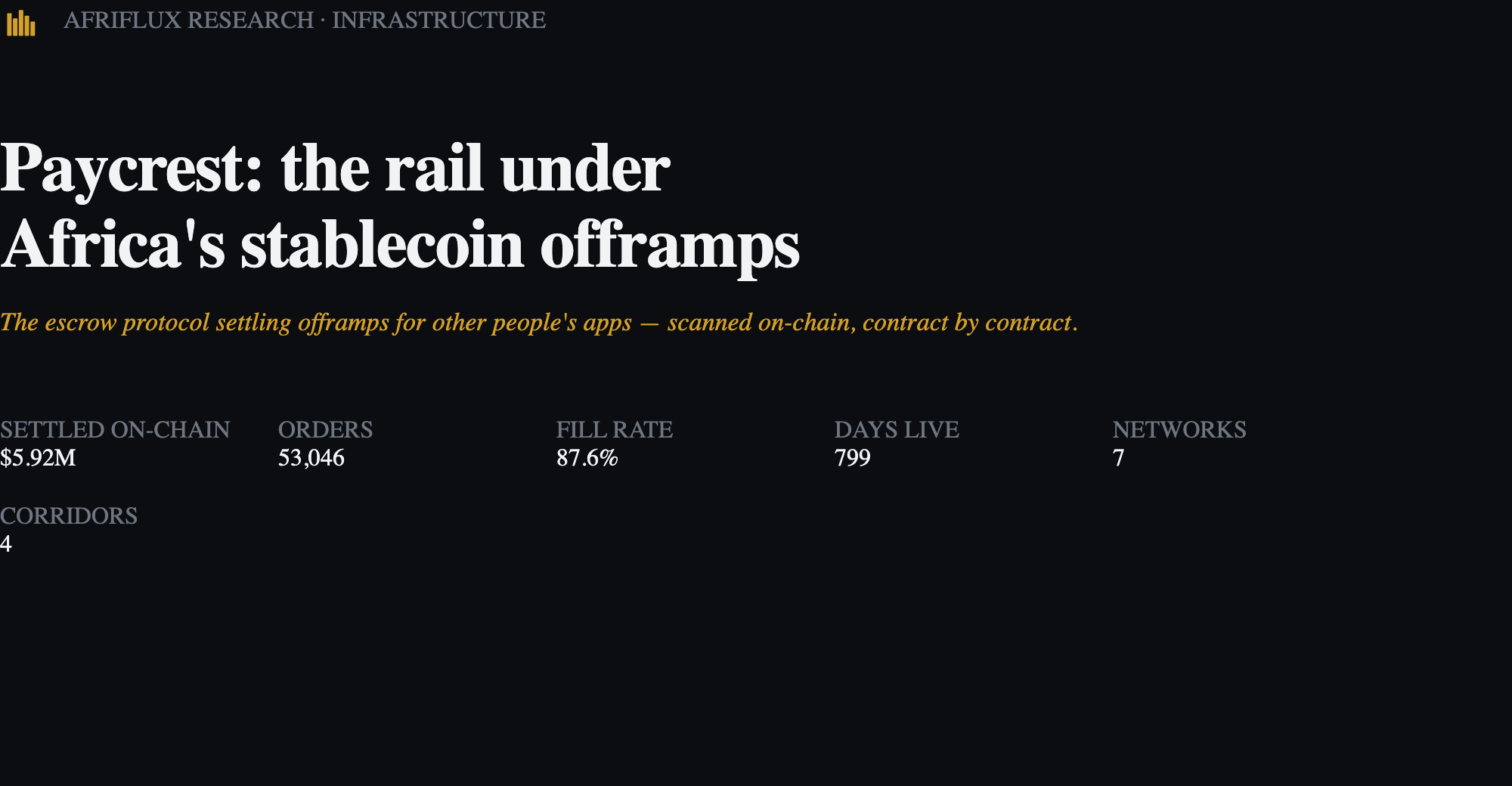
- Paycrest is a rail other apps use to turn stablecoins into local currency. It has settled $7.4 million across 50,248 orders. The average order is $148, and 93% of the value went into naira.
- Blockradar provides wallets that businesses build on. 125 businesses run 41,472 customer addresses through it. Those addresses took in $719 million. They sent out $715 million. Money arrives and leaves almost dollar for dollar.
That second number is the stablecoin in miniature. It rarely stays where it lands. It comes in, does its job and moves on.
The other two, HyperFX and TextileFX, are trading and currency-exchange rails. They matter more to businesses than to someone sending $41. We'll cover them in another piece.
What a stablecoin isn't
A stablecoin is only as good as the promise behind it. If the issuer lacks the reserves, or a government freezes them, the "one dollar" can wobble. That has happened to smaller stablecoins. USDT and USDC have mostly held their peg. But "mostly" isn't a guarantee. Both issuers can also freeze a wallet when ordered to.
It also isn't a bank account. There's no deposit insurance. Send it to the wrong address and there's no one to call. And the rules on converting it to local currency vary by country and keep changing.
None of that cancels the usefulness. It's the fine print, and you should know it.
What this data can and can't see
We measure everything above onchain, wallet by wallet. That covers 24 venues and 4 infrastructure providers. The retail figures come from the 23 venues that serve individuals. Flutterwave serves only businesses, so we count it separately. Our method page explains how we tell a customer's wallet from a platform's own internal wallets.
There are two limits. First, blockchains don't record nationality. Geography here means the venue's home market, not the sender's passport. Second, these are the venues we track, not every stablecoin dollar in Africa. Our numbers miss peer-to-peer trades, informal desks, and money that never touches a tracked venue.
So, why does it matter?
Not because it's revolutionary technology. Most users don't care which blockchain it runs on. The data shows they'll switch roads without a second thought.
It matters because of the $41 dollar. At one payout desk alone, 2.3 million times, someone needed dollars they could reach. Those dollars arrived during working hours, most likely in USDT. More and more often they came from a wallet on the sender's own phone. Then they became naira and paid for something real.
The billion-dollar headlines describe a few people moving large sums. The forty-one-dollar deposit describes everyone else, and there are far more of them.