Most of the apps letting Africans cash out a stablecoin don't run the cash-out themselves. Somewhere behind the "withdraw to bank" button, a contract holds the crypto in escrow while a liquidity provider on the other side of the transaction wires the naira. That contract is Paycrest — and it isn't another offramp competing with the apps. It's the infrastructure sitting underneath them.
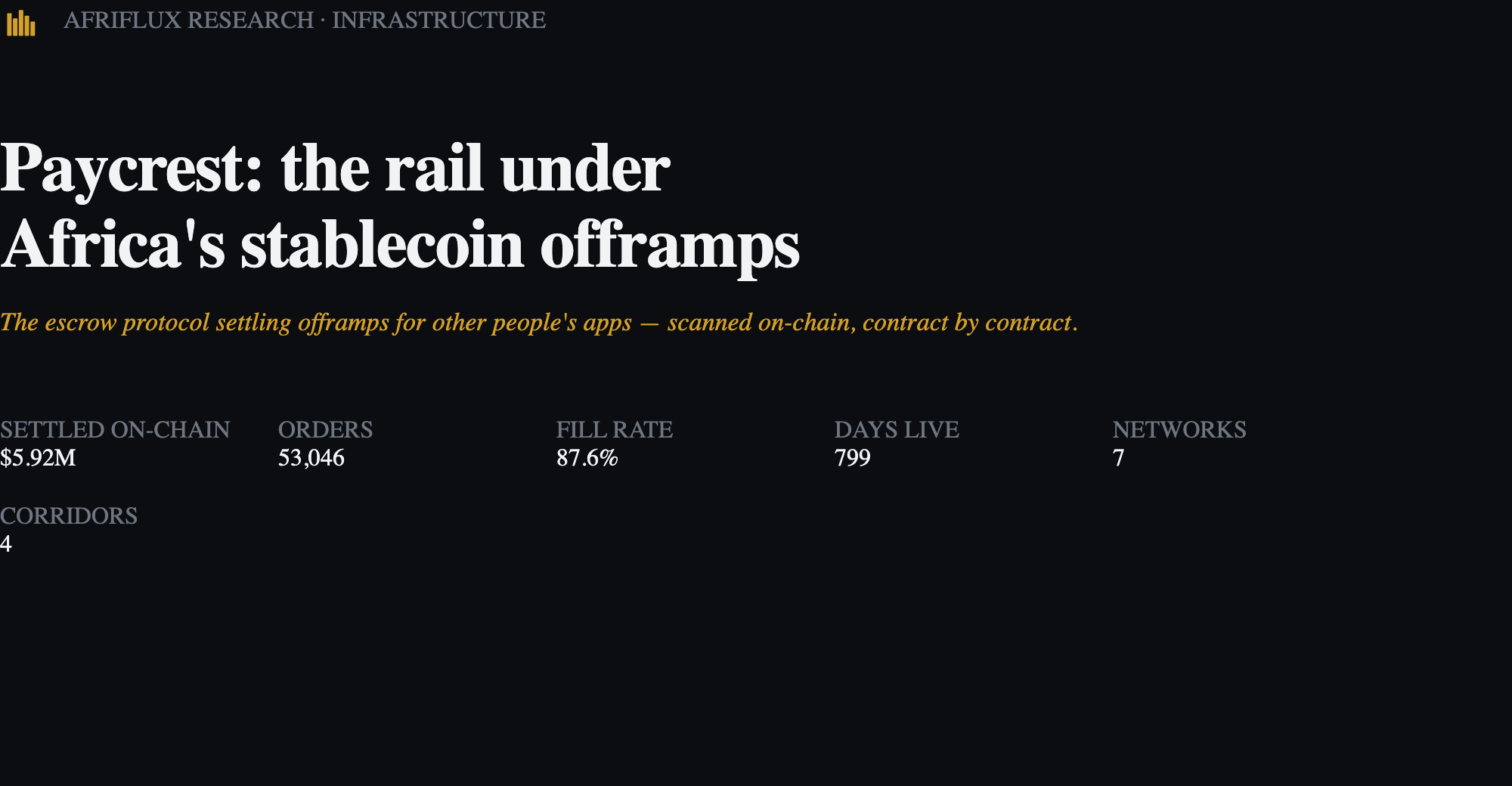
Until now nobody was counting it. We are — not through an API or a press deck, but by scanning the Gateway contracts on all seven chains they run on, decoding every order, and polling each one to its final state. What follows is the first AfriFlux measurement of the protocol: $5.92M released to liquidity providers across 53,046 orders over 799 days, from June 2024 to today.
One honesty note before any number lands. We see the on-chain leg only. When we say an order "settled," we mean the Gateway released the escrowed stablecoin to a provider. Whether the recipient actually got their naira happens off-chain, in a bank app we can't see. So read every figure here as the crypto side of a fiat promise — which is exactly the side that tells you whether the rail works.
What Paycrest actually is
Paycrest calls itself an open protocol for "unifying fiat and stablecoin payments globally." Strip the tagline and it's a matching engine with escrow. An app that wants to offramp — a wallet, a payroll tool, an exchange — drops stablecoin into a permissionless Gateway contract and names a price. A distributed network of liquidity providers watches for those orders, and one of them pays the recipient in local fiat off-chain. The moment they prove it, the Gateway hands them the escrowed crypto. If nobody fills it, the sender gets refunded.
The point of the design is that none of it needs permission. The app doesn't sign a deal with Paycrest. The provider isn't onboarded by anyone. Both just transact with the same contract. That's why it can sit underneath dozens of consumer apps at once without any of them appearing to share a rail — which, as we'll show, is exactly what's happening.
Paycrest holds no accounts and takes no custody. It's the layer other venues stand on. Its volume is not "the market" — it's the plumbing beneath a slice of it.
What it moves
Two years in, the footprint is real but early-stage: 53,046 orders, 87.6% filled, a $127 average ticket, over 799 days, across 7 networks, 4 corridors and 3 stablecoins.
The money splits cleanly, and the split is the story:
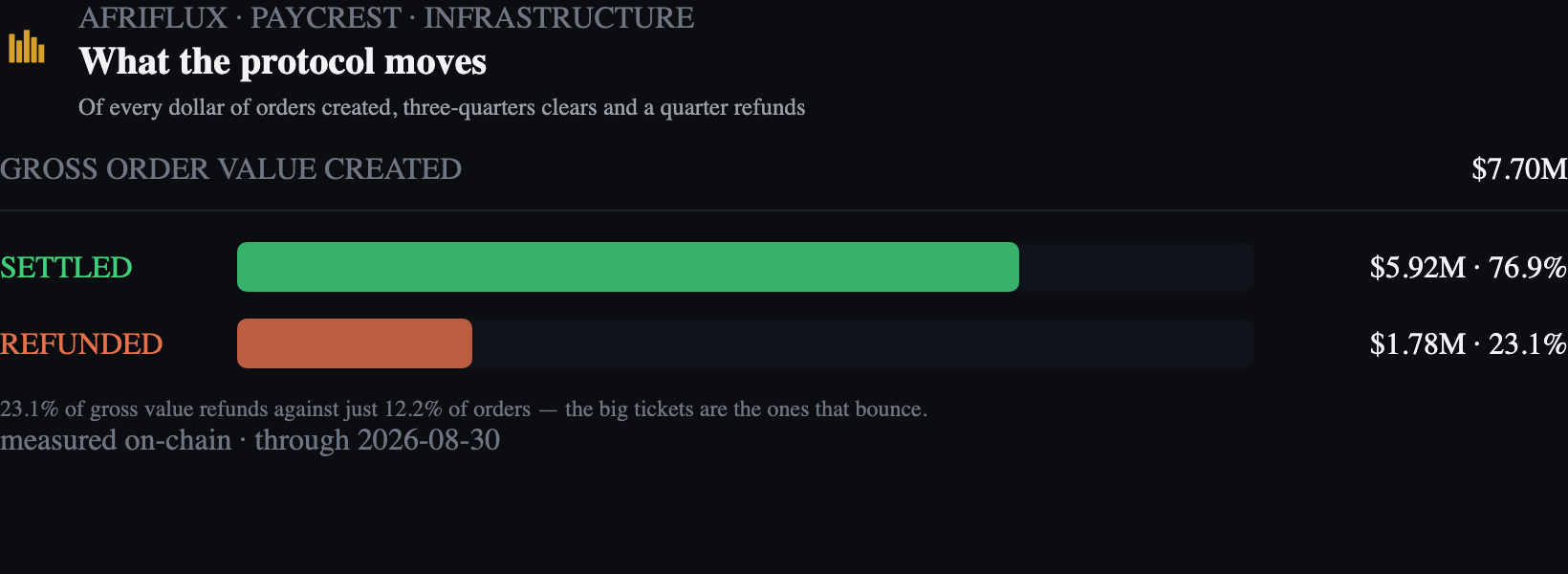
Of every dollar of orders created, roughly three-quarters clears and a quarter bounces back. That refund rate is the first crack of light: 23.1% of gross value refunds, against only 12.2% of order count. Small orders clear; big ones bounce. So 87.6% of orders fill, but that headline hides a much weaker market for larger tickets — and the gap between value and count is the thread we'll pull for the rest of this piece.
The two sides of the market
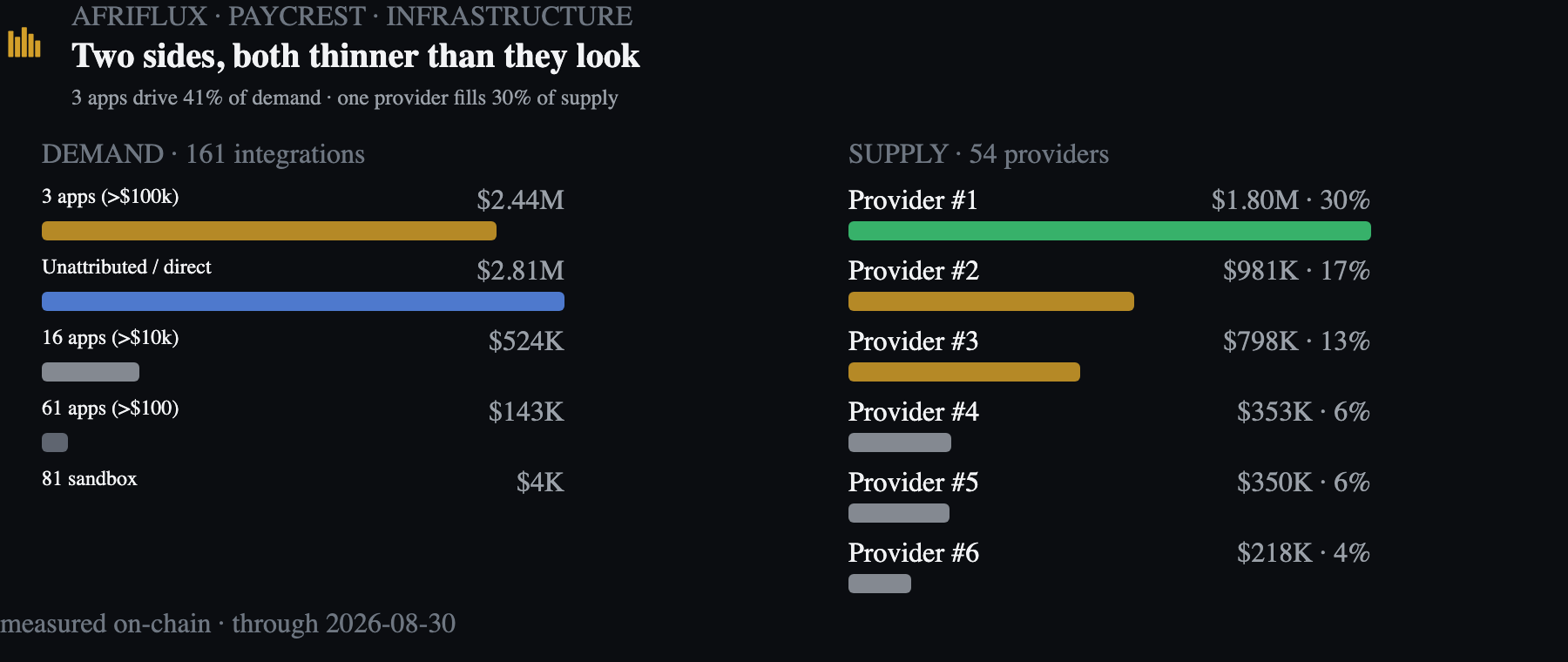
Every Paycrest order has an app on one end and a liquidity provider on the other. Both sides are thinner than the raw counts suggest.
The demand side contains 161 labelled integrators, but that number needs unpacking. 81 are sandbox accounts moving dust. Three apps account for $2.44M — 41% of everything settled. And the single largest bucket, $2.81M (47%), is unattributed: 19,658 orders from 1,192 wallets that called the contract directly, with no app in the middle. That's a permissionless protocol working as designed.
The supply side is 54 providers, but one address filled $1.80M — 30% of all settlement. The top three cover 60%; the top five, 72%.
And the end users behind the apps concentrate hardest of all. 30,704 wallets have placed exactly one order in the protocol's life. Meanwhile 56 wallets have placed 100+ orders each, and those 56 alone moved $2.49M — 42% of all settled value. Most people try Paycrest once. A few run their business on it.
Where the money goes
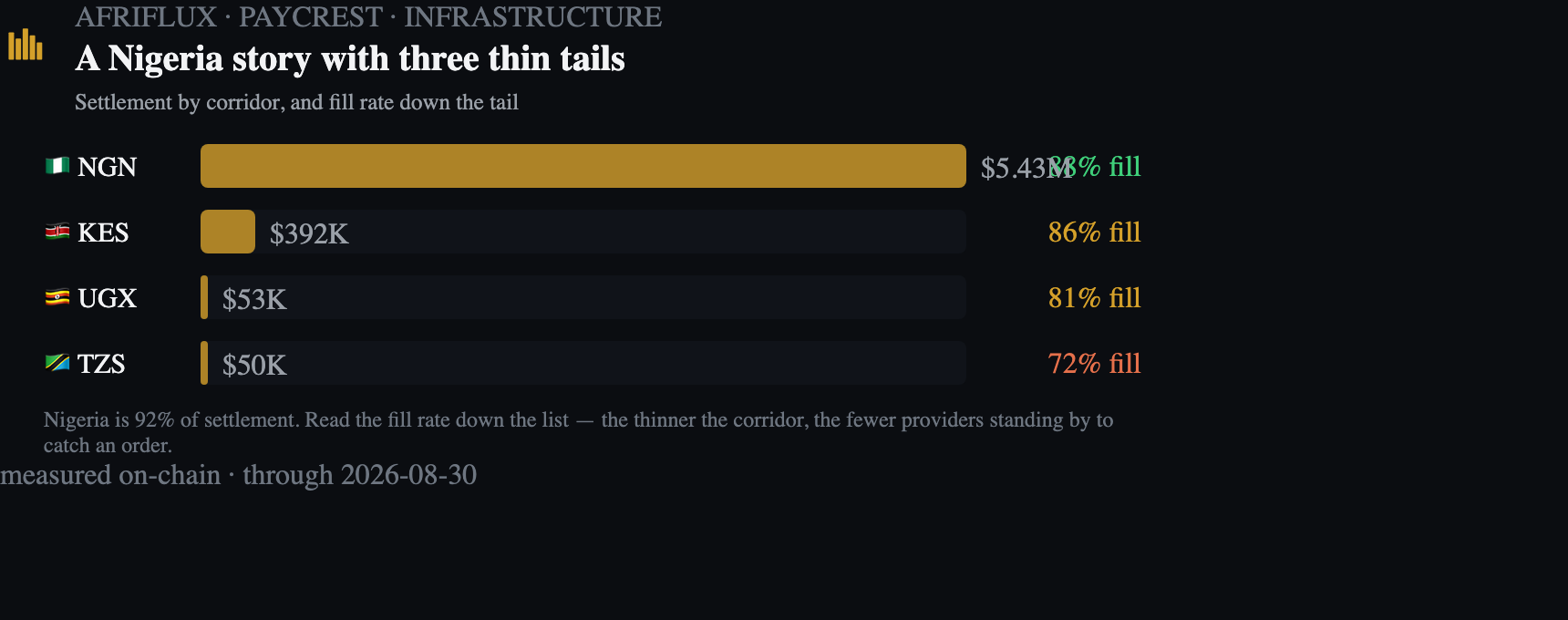
Paycrest is a Nigeria story with three smaller tails:
- 🇳🇬 NGN — $5.43M settled (92%), 88.4% fill
- 🇰🇪 KES — $392k, 86.3% fill
- 🇺🇬 UGX — $53k, 80.8% fill
- 🇹🇿 TZS — $50k, 71.9% fill
Read the fill rates down the list and a pattern shows up: the bigger the corridor, the higher the fill. The pattern looks more like a liquidity-depth constraint than a demand problem. Tanzania probably doesn't fill worse because Tanzanians want it less — it fills worse because fewer providers are standing by to catch a TZS order. The ticket-size data next tests that directly.
The rails underneath
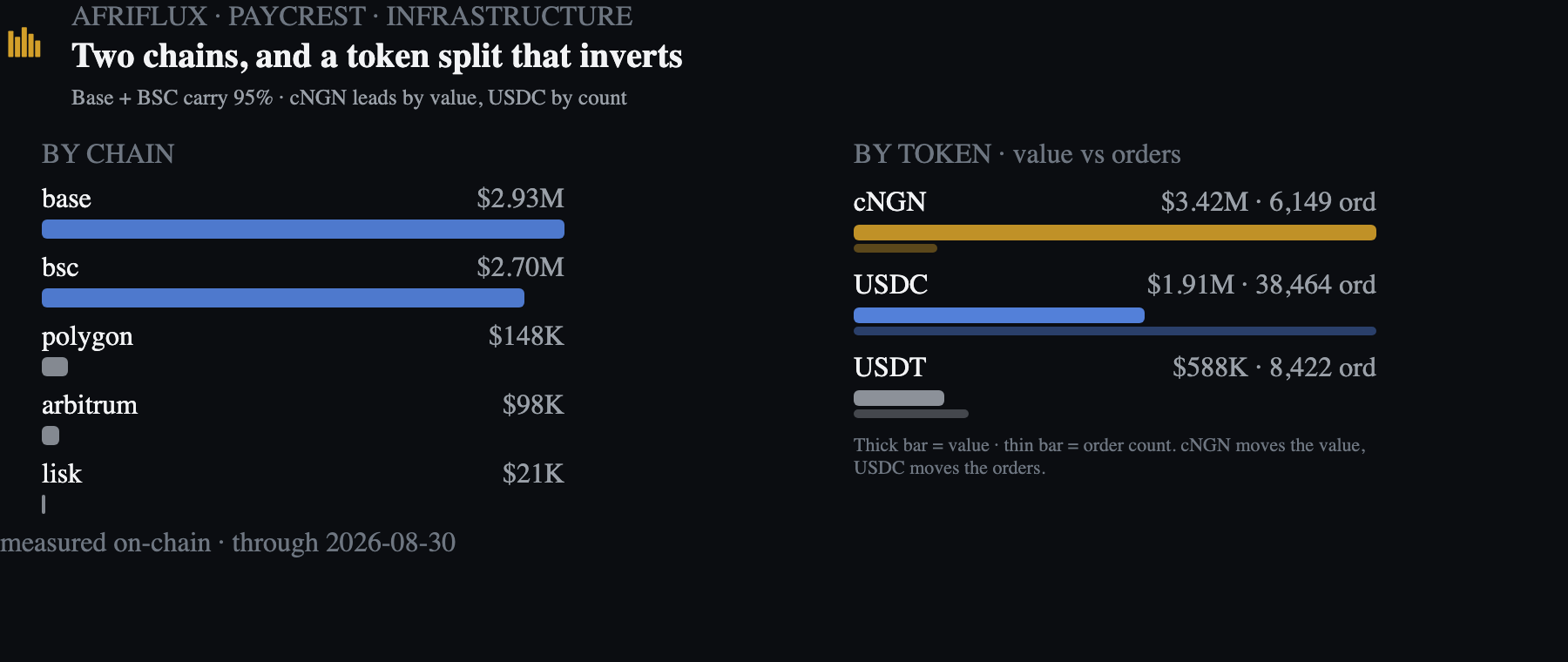
The flow lives on two chains. Base ($2.93M) and BSC ($2.70M) carry 95% of settlement. Wherever the cheap, fast stablecoin rails already run, Paycrest runs.
The token mix is where it gets interesting. By value, the biggest stablecoin isn't USDC or USDT — it's cNGN, the native naira stablecoin, at $3.42M (58%). USDC is $1.91M (32%); USDT $588k (10%). Flip the axis to order count and it inverts: USDC clears 38,464 orders to cNGN's 6,149.
cNGN moves the value. USDC moves the orders. One runs about $556 an order, the other about $50. People move small amounts of dollars and large amounts of naira.
Why the big orders break
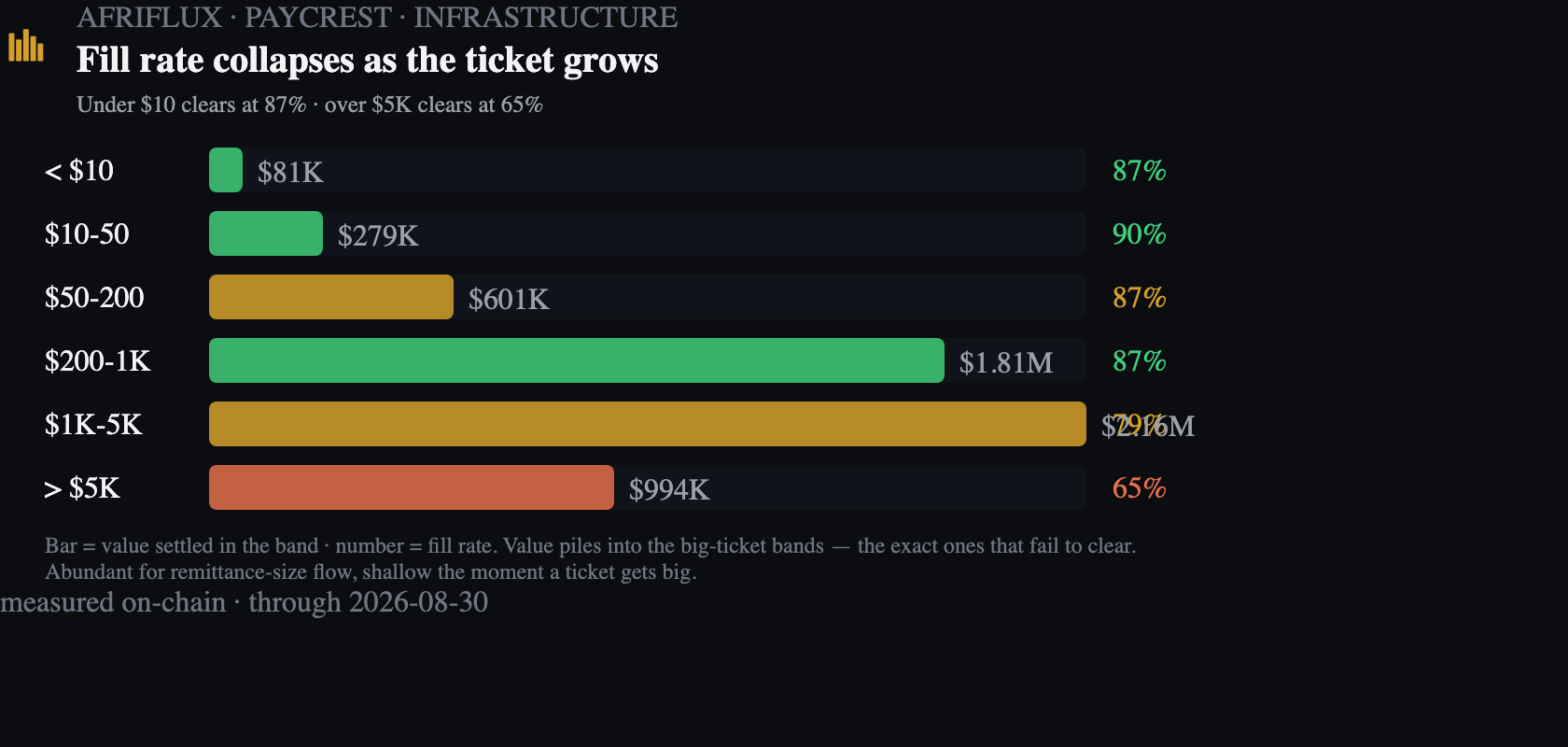
This is the heart of it. Sort the fills by ticket size and the constraint is plain:
- under $10 — 87% fill
- $10–50 — 90%
- $200–1K — 87%
- $1K–5K — 80%
- over $5K — 65%
Paycrest clears small orders all day. The trouble starts when the ticket gets large. Below a few hundred dollars almost any provider can front you; above $5k you need a desk with real naira liquidity ready to move, and often there isn't one — so the order times out and refunds. The value sits in exactly the bands that struggle: the $1K+ orders hold most of the gross yet fill the worst.
That's the finding that matters beyond Paycrest. It's a live readout of how deep the fiat liquidity available to a permissionless African settlement rail actually is: abundant for remittance-sized flow, shallow the moment a ticket gets big.
The shape of today
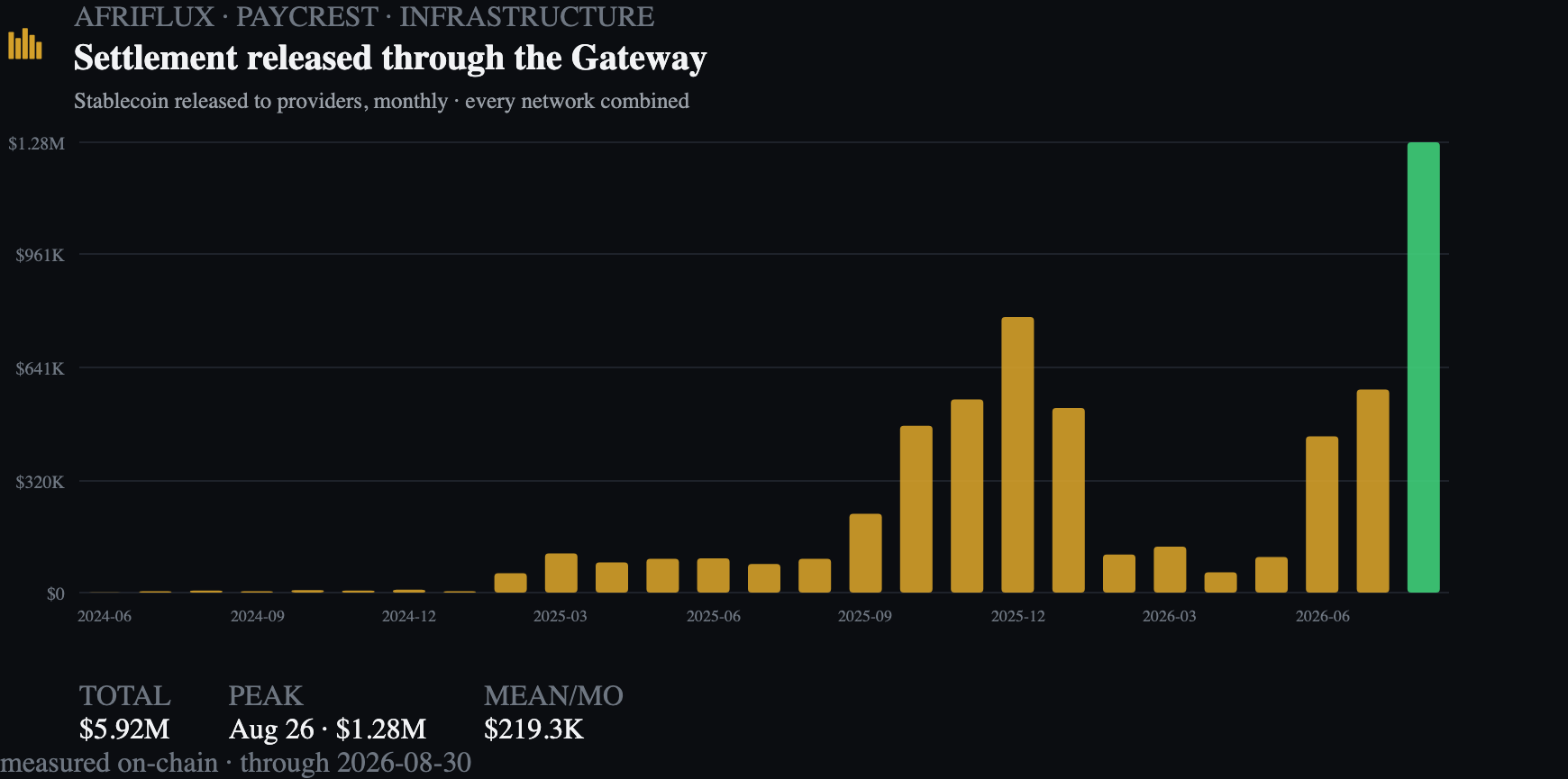
The most recent month is the largest the protocol has ever had — $1.28M settled in August 2026, against a lifetime average near $219k. And a single provider sits at the center of it: one that came online in June, filled more than a quarter of August's settlements, and has moved $980k across seven chains since — already the second-largest in Paycrest's history in ten weeks. Growth that real is also that fragile: a market that scales because one desk showed up can shrink when one desk leaves.
Where Paycrest sits in the stack
Here's the part only an on-chain scan can show you. Some of those "unattributed" wallets and named integrators aren't anonymous — they're apps we already track by other names, and some of them route their withdrawals directly through this Gateway. When a consumer app advertises "instant cash-out to your bank," the settlement underneath may well be a Paycrest order.
A consumer sees one app. What the on-chain view reveals is that several apps may ultimately depend on the very same settlement infrastructure — a dependency none of their front doors would ever tell you about. That's the real discovery here, and the reason to measure the layer at all.
The venue's headline volume tells you how big its front door is. The rail underneath tells you whose plumbing it actually rents.
We keep this scan current, the same way we keep the rest of our coverage current, so the two can be read against each other: the app you can see, and the infrastructure you usually can't.
What it all adds up to
Pull the threads together and the picture is coherent. Paycrest serves broad demand for small-ticket cash-outs, but its liquidity thins meaningfully as the ticket grows — and because the same rail sits under multiple apps, that constraint doesn't stay contained to one of them. A shortage of deep-pocketed providers can throttle large withdrawals across several consumer-facing venues at once, none of which would show it on their own dashboard. Ticket size, provider concentration, corridor depth and shared infrastructure are the same story told four ways.
How we measured it, and what we can't
Everything here comes from an era-aware log scan of the Gateway contracts — every order event decoded against the right implementation ABI, each order polled through Multicall until its state resolved, and the destination currency inferred from the on-chain rate band. Refunds are guarded so they can't be double-subtracted, and settled can never exceed gross.
The limits are honest ones. We measure the on-chain leg only — the fiat delivery is off-chain and invisible, so "settled" is a released escrow, not a confirmed naira payment. A large share of demand is unattributed by design. And this is the flow across the Gateway contracts we scan, not a census of every offramp in Africa. That scoping is what lets every number above be exact rather than estimated.
Paycrest is still small, concentrated, overwhelmingly Nigerian, and growing fast — with liquidity depth still held by a relatively small provider base. But it gives us a view of the plumbing underneath Africa's offramps that no front-end ever could. That's what one important layer of the continent's offramp infrastructure looks like right now — one permissionless contract, a few dozen desks, and a lot of people cashing out once.
Coverage note: AfriFlux measures the on-chain activity of the Paycrest Gateway contracts across seven networks. Figures are current to 2026-08-30 and update as we re-scan. This is the settlement we can see on-chain, not a measure of Paycrest's total business.