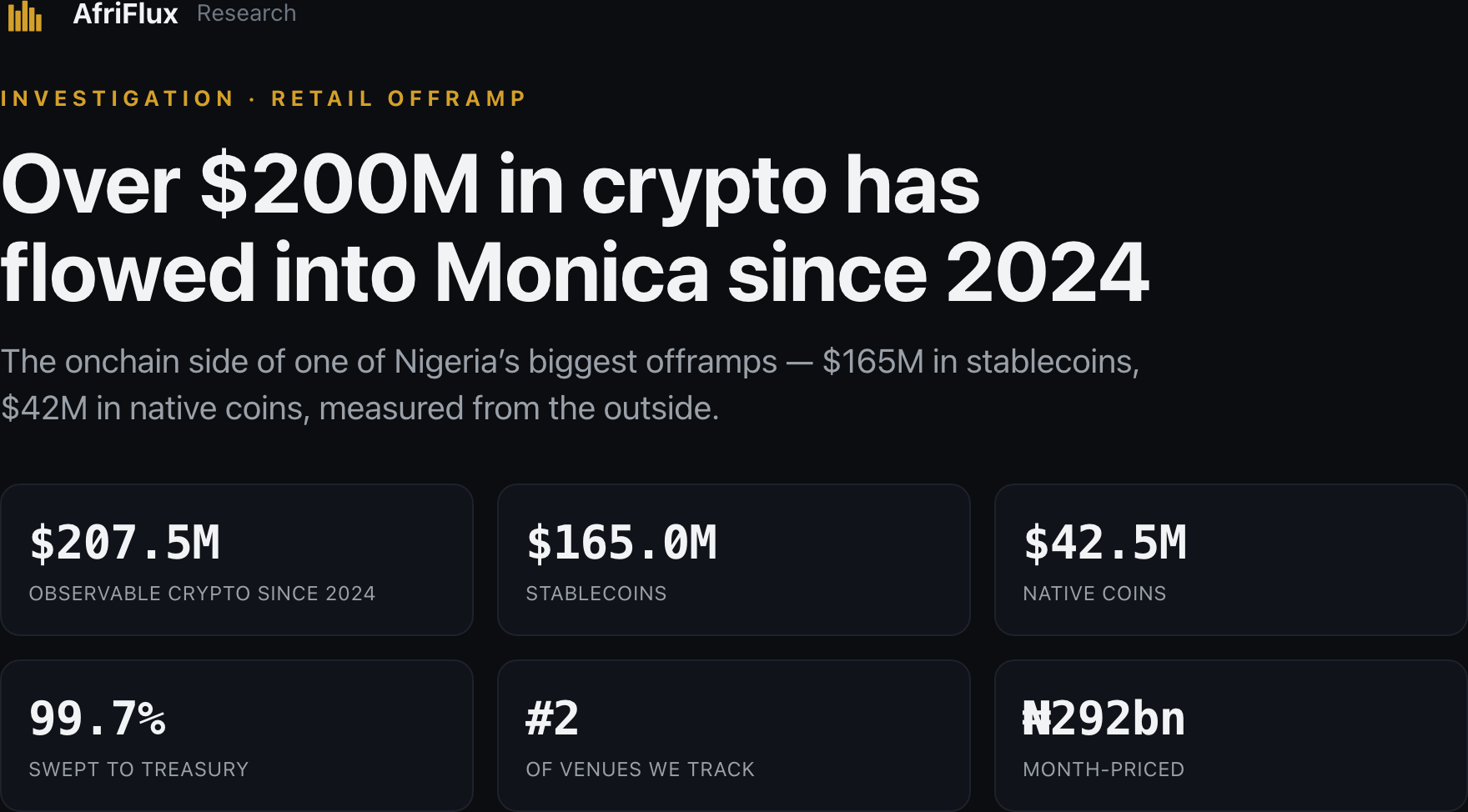
Monica put a number on its business this year: ₦500 billion processed, 500,000 users, three years in. The number traveled. Nobody asked the obvious follow-up — how much of that is crypto we can actually see?
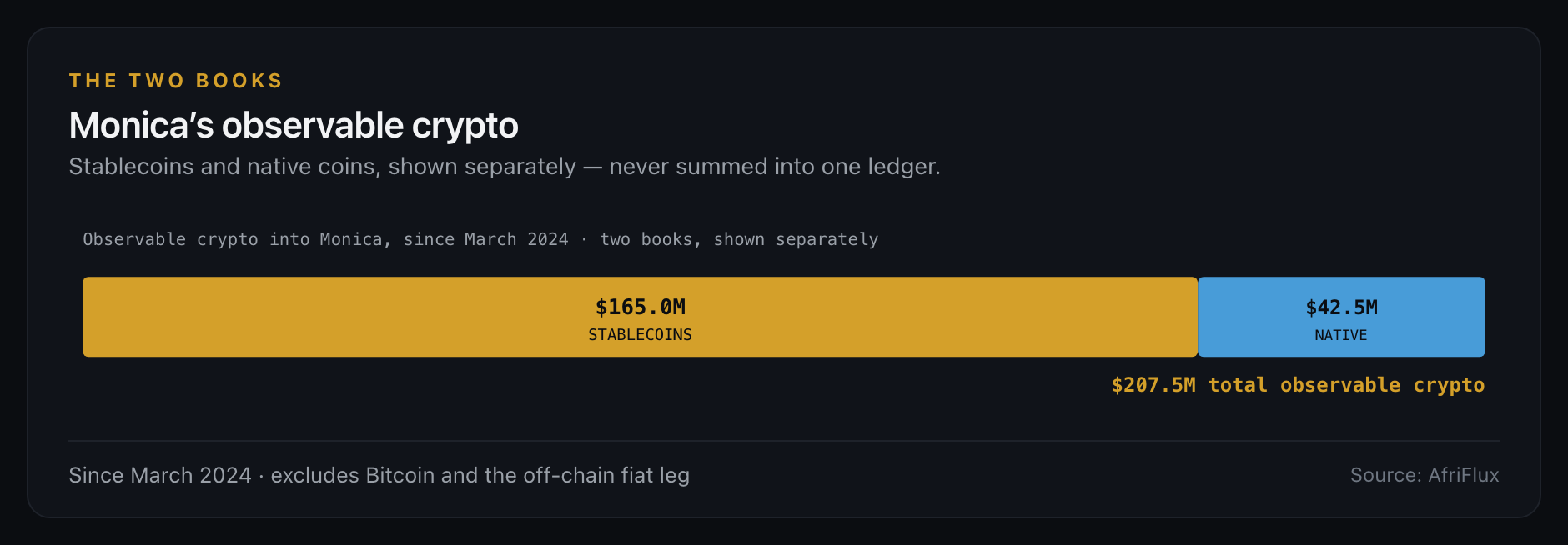
So we looked. Since 2024, AfriFlux can independently observe more than $200M in crypto flowing into Monica — $165M in stablecoins, another $42M in native coins. That's the onchain side of one of Nigeria's biggest offramps, measured from the outside.
What an offramp is, and what we count
An offramp is simple: crypto in, naira out. You send stablecoin or coins to an address Monica controls, Monica sweeps it to treasury, you get a bank alert. We measure the part that happens onchain. We count two books — stablecoins (USDT, USDC) and native coins (ETH, SOL, BNB, TRX). We don't count Bitcoin: Monica takes it, but it settles on a chain we don't index, so it sits on top of our number, not inside it. And nothing before March 2024, where our coverage starts. So $200M is a floor — no BTC, nothing before March 2024, crypto-in only.
The stablecoin book: $165M, running on Tron
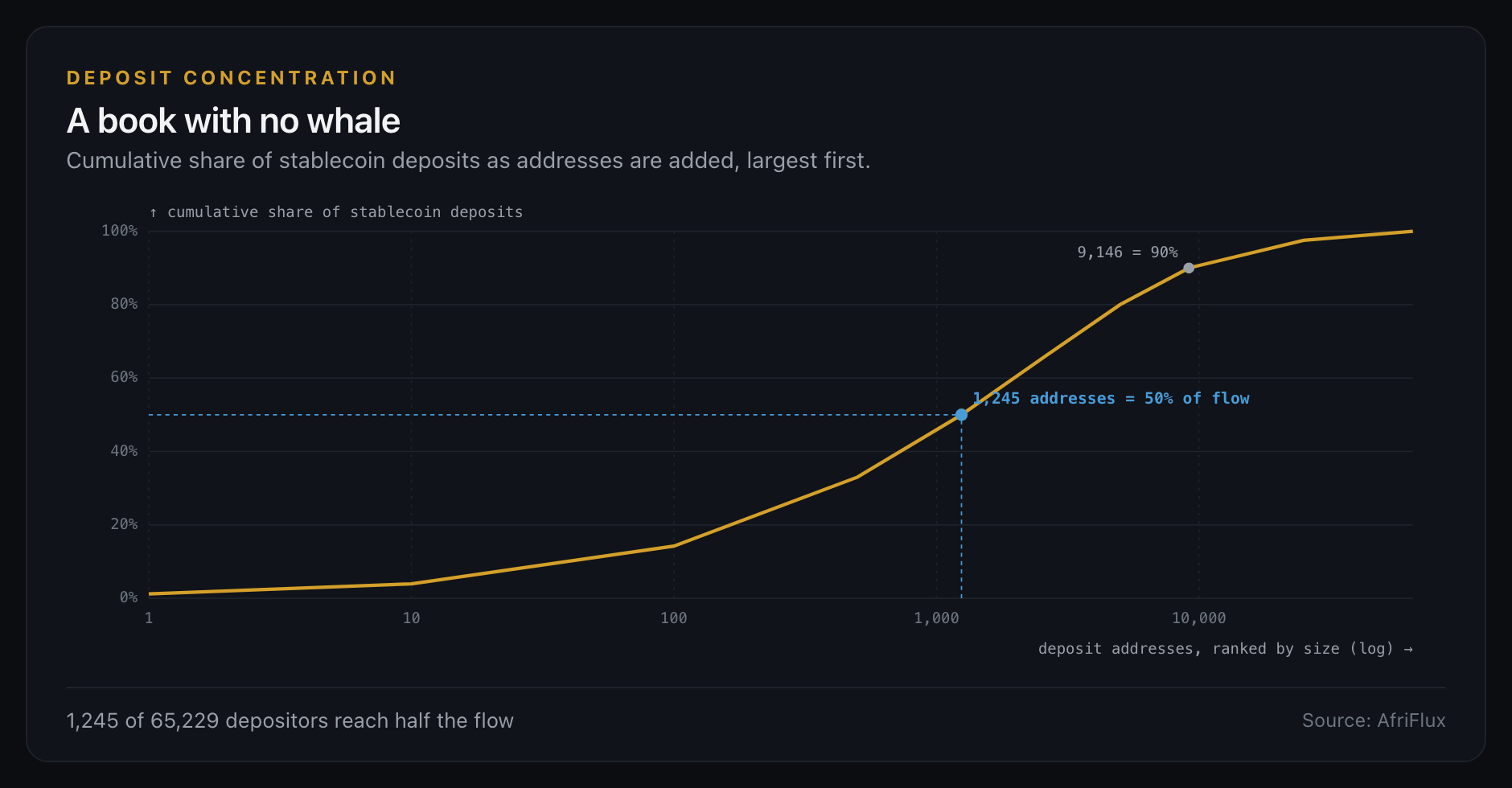
Start where the money is. $165M in stablecoin deposits, and the shape says retail before you read a single label. The median deposit is $102. The largest single depositor is 1.2% of the whole book — no whale. It takes 1,245 addresses to reach the first half of the flow, over 9,146 to reach 90%. This is $165M built from a lot of small customers.
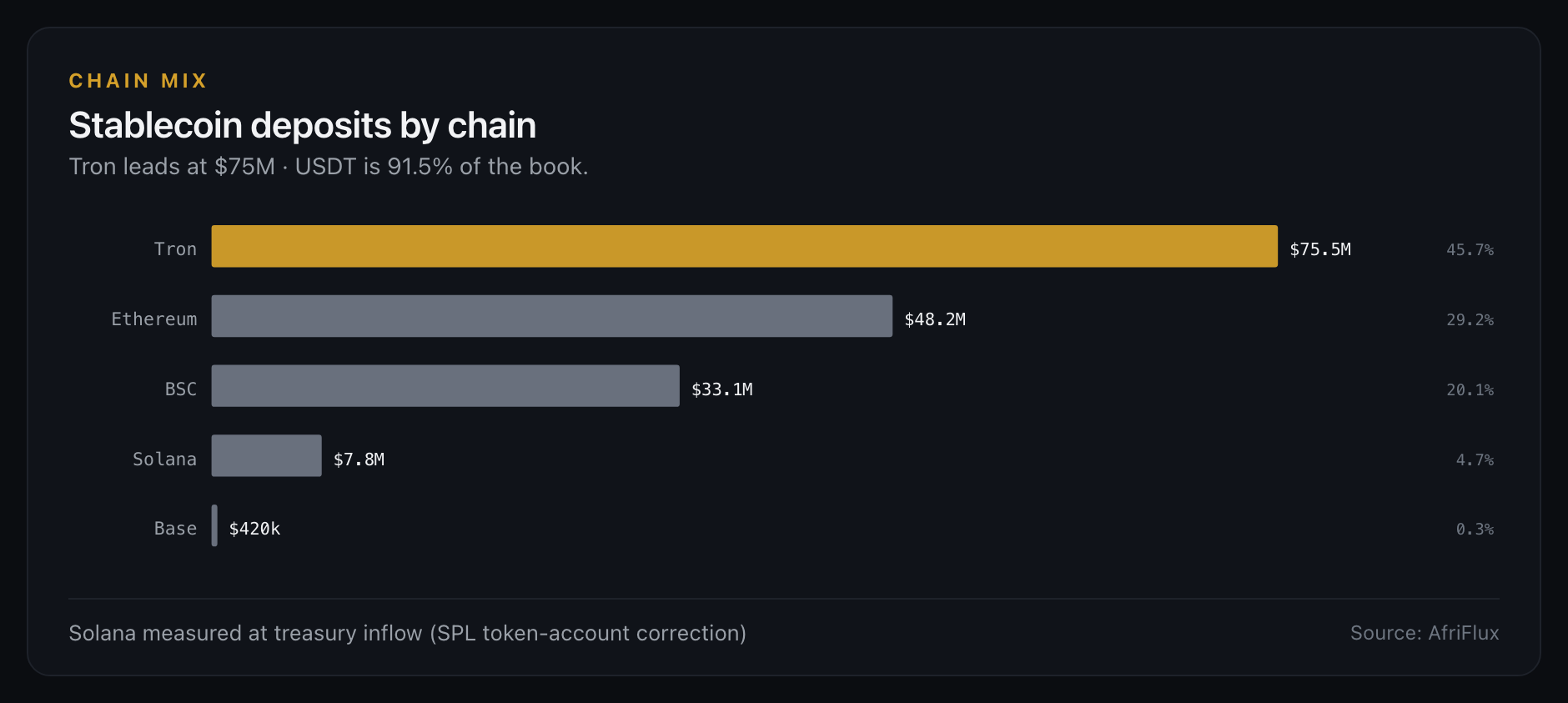
The chain mix is the surprise. Monica's stablecoins are Tron-first — $75M, 46% — with Ethereum and BSC behind it. And it's almost all USDT: 91.5% of the book. This is the USDT-on-Tron rail that became Nigeria's default dollar, showing up at the offramp.
Almost none of it sits still
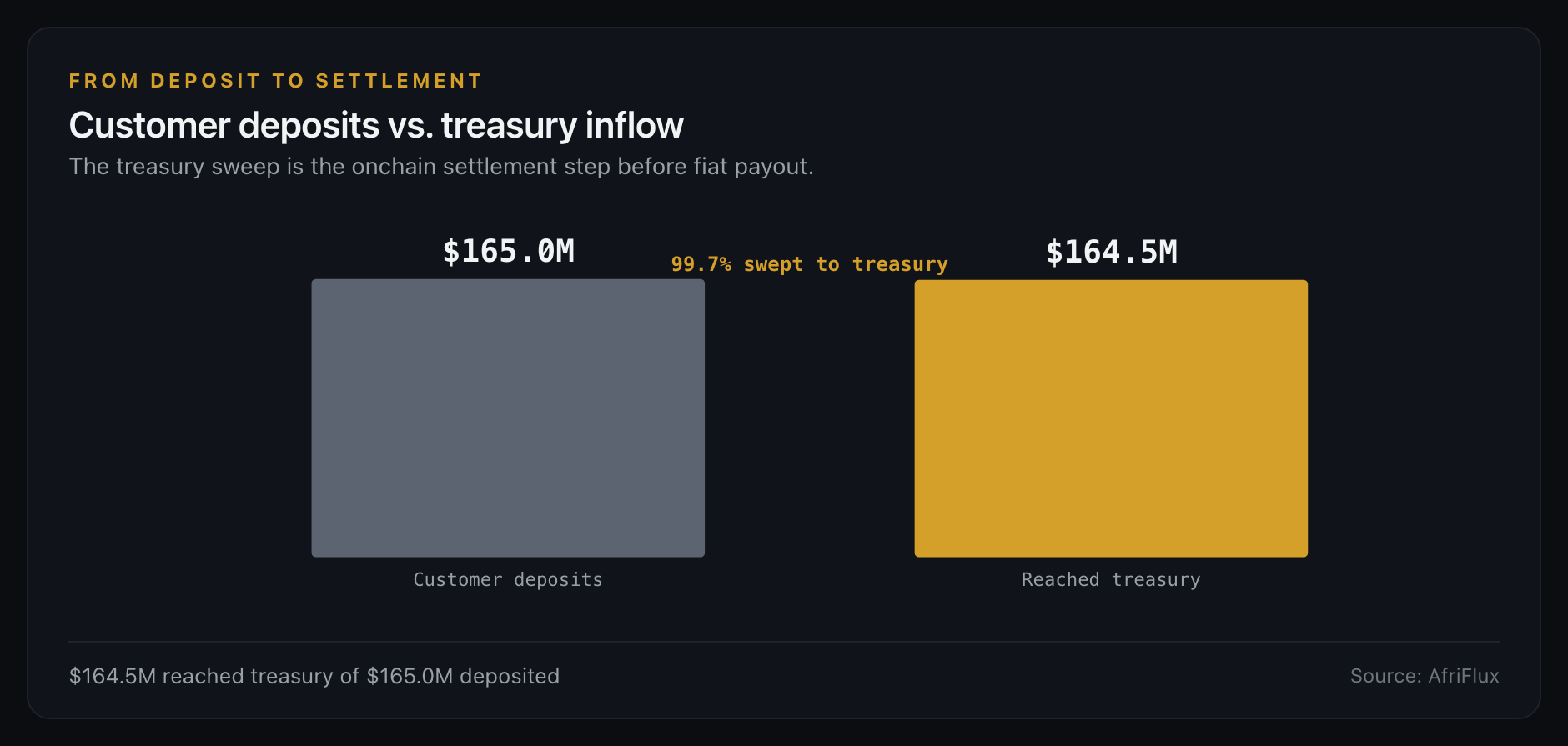
An offramp's job is to move crypto through to fiat, not hold it. So we checked how much of the $165M reaches treasury. 99.7%. Of the $165.0M that came in, $164.5M has moved to treasury. No idle balance — money arrives, sweeps within minutes, leaves as naira. That's the proof this is offramp flow, not capital parked onchain.
And it's accelerating
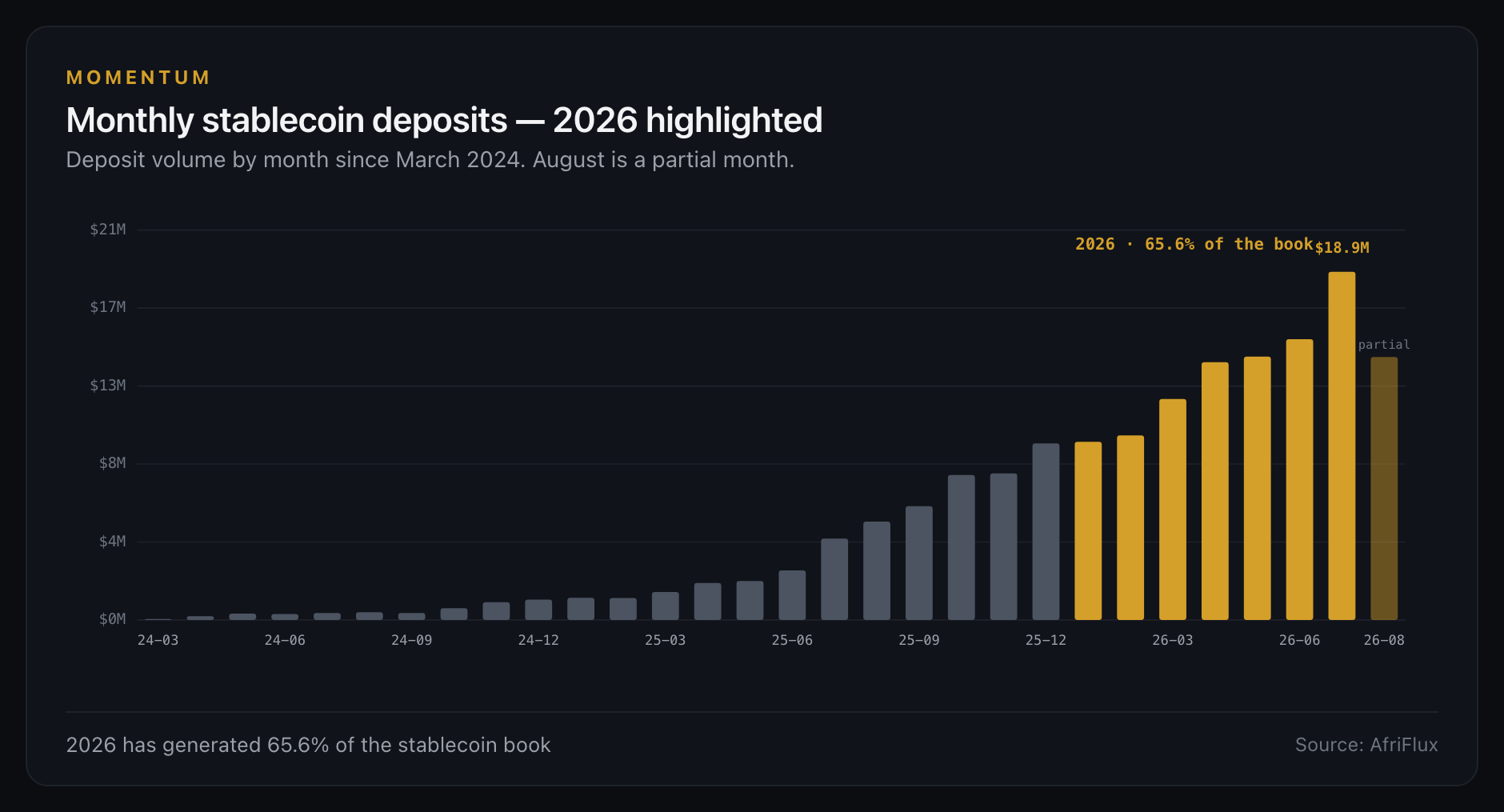
Most of what we see happened this year. 66% of Monica's entire stablecoin book landed in 2026 — the first eight months of it. The monthly pace went from about $4.3M through 2025 to $13.4M in 2026, more than triple. July did $18.9M, the biggest month yet. (August reads lower only because it's partial.) Spenda, another offramp we track, has $77.5M of lifetime volume. Monica did more than that in 2026 alone — with four months left in the year.
Where the crypto comes from
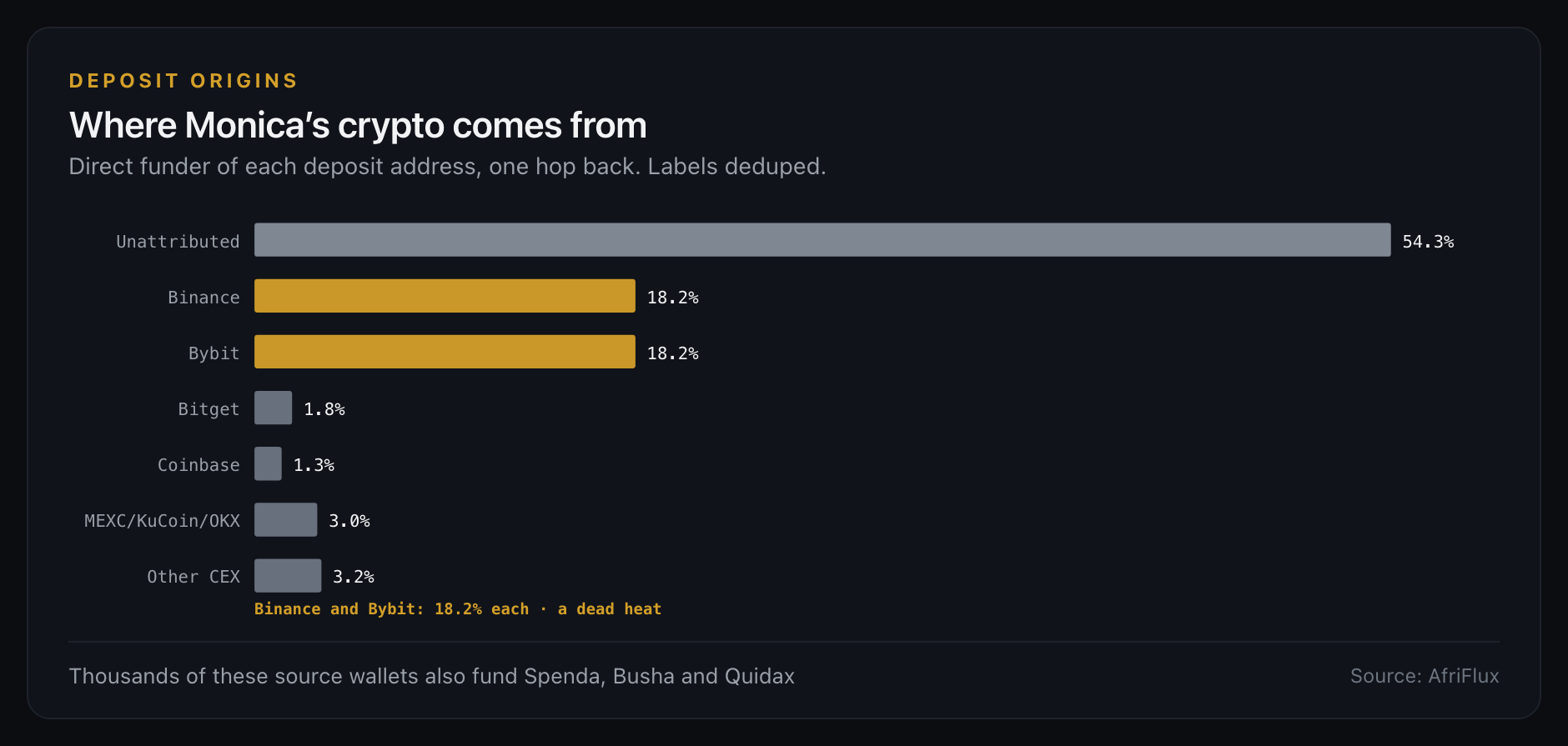
Trace the wallet that funds each deposit, one hop back, and the supply side shows up. About 46% of Monica's deposits come from exchanges we can name. The top is a dead heat: Binance 18.2%, Bybit 18.2% — two exchanges funding better than a third of the inflow, in a near-perfect tie. The other 54% is unattributed — self-custody, OTC, DEX, venues we haven't tagged. We're not calling it retail; we just can't yet name where it came from. And the wallets aren't Monica's alone: strip out the exchanges and thousands of them also fund deposits at other Nigerian offramps — over 3,200 shared with Spenda, 2,600 with Busha, 2,400 with Quidax. Monica sits inside that graph, not off to the side of it.
The other $42M: the native book
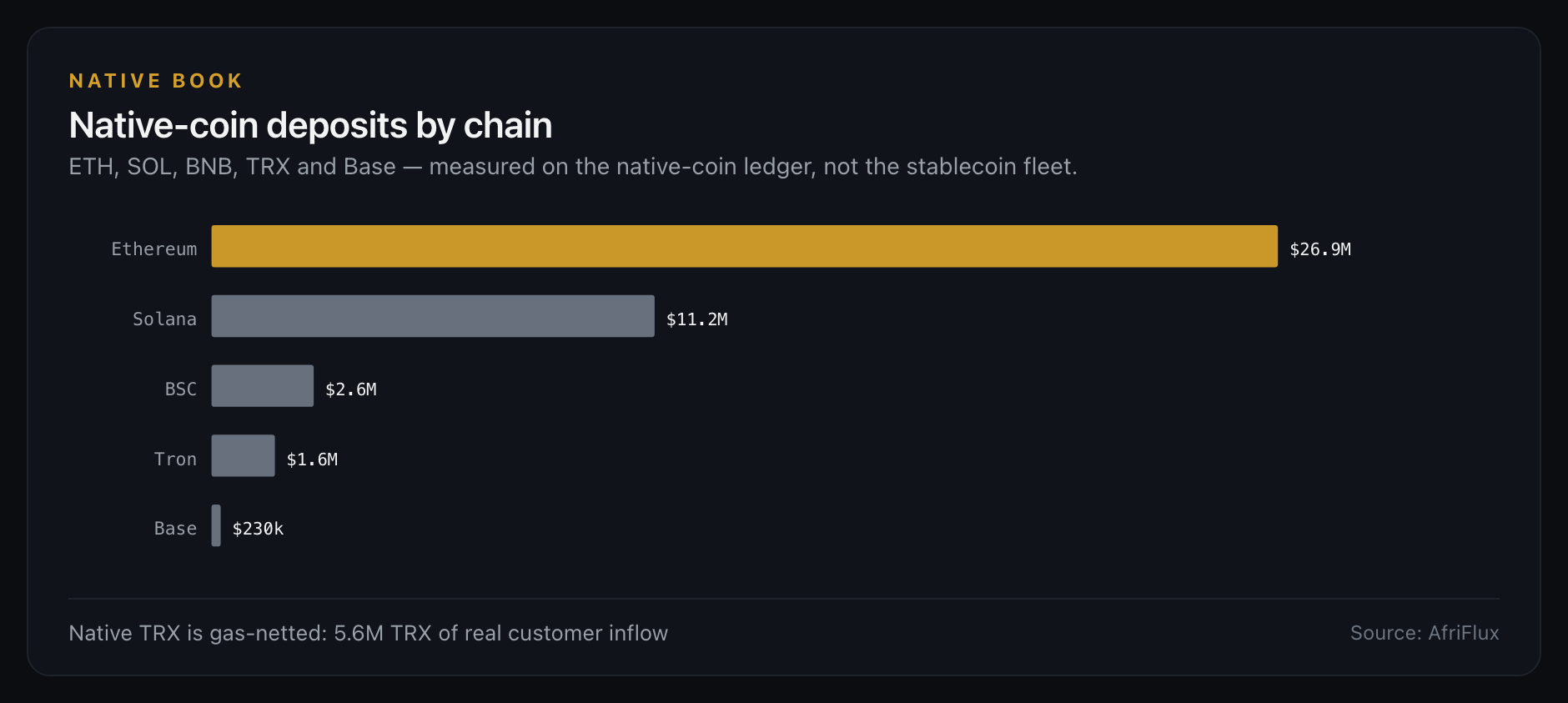
Past the dollar tokens, people bring Monica the coins themselves — and that book is worth about $42M. Ethereum leads it: $26.9M, roughly 65% of native volume. Solana is second at $11.2M; it arrived later — February 2025 — and has already become Monica's second-largest native rail. BNB adds $2.6M, Tron about $1.6M in native TRX, Base a little more. Measure Monica on stablecoins alone and you'd miss all of it.
Where a $165M offramp sits
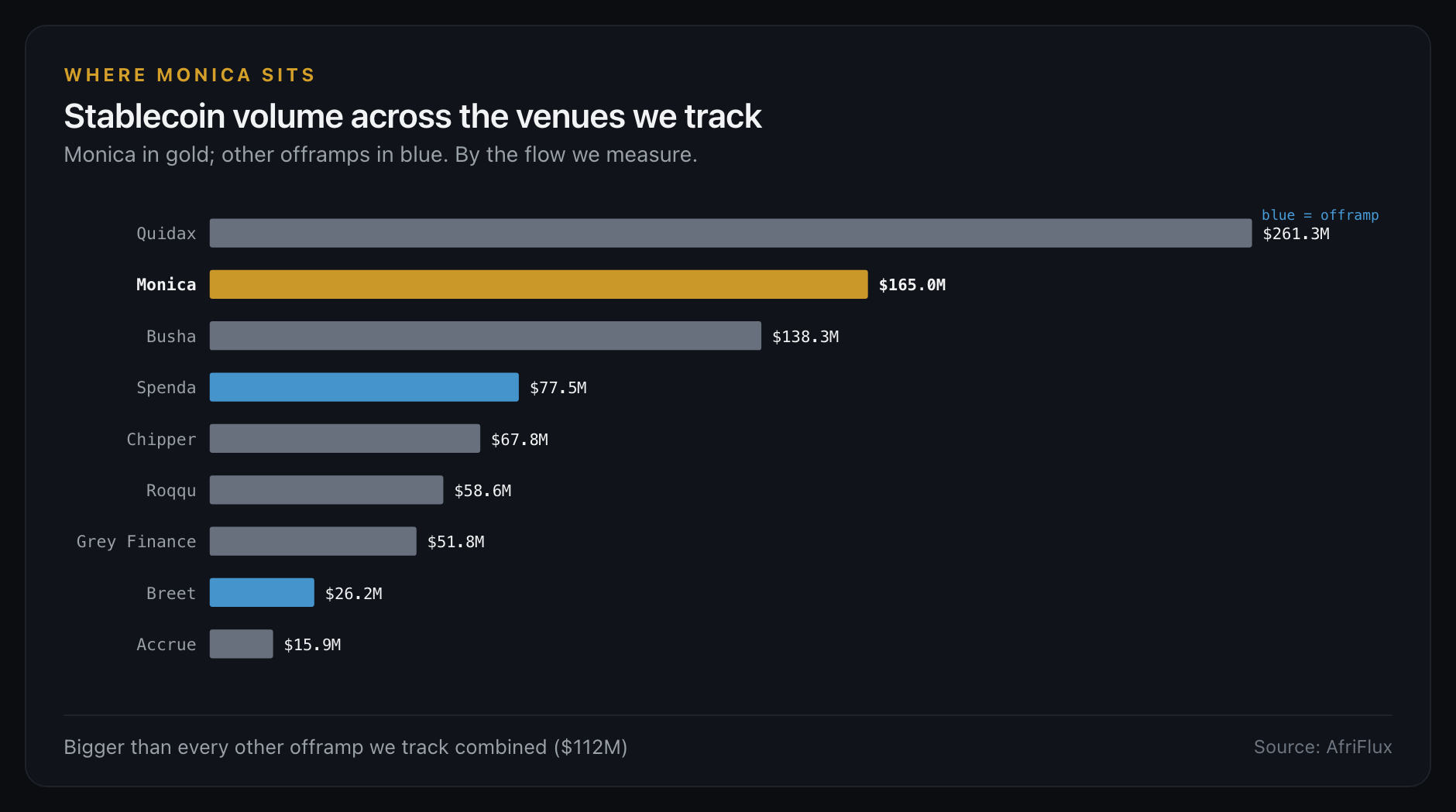
Inside its own category it isn't close. Add up every other offramp we track — Spenda, Breet, Azza, Paj Cash — and you get $112M. Monica alone is $165M in stablecoins, bigger than the rest of the offramp category combined by the flow we measure, and twice the next-largest. Step outside the category and it still holds: by the stablecoin flow we measure, only Quidax is bigger. The big exchanges do plenty we don't capture, so that ranks measured flow, not their full size — but even so, an offramp is sitting up with the exchanges. That placement re-scores every quarter as the AfriFlux Gradient, so it's a standing read, not a one-off screenshot.
The ₦500bn, handled straight
We're not reconciling ₦500bn, and not disputing it — we're measuring a different layer of the business. Monica's figure is company-level: Bitcoin, fiat rails, the pre-2024 years, all outside our lens. Ours is the crypto we can independently see onchain, since March 2024. Monica says it has processed ₦500bn. We looked at the crypto side and can already see more than $200M of it — about ₦292 billion, priced at each month's actual naira rate (a blend near ₦1,417/$). Not a smaller version of their claim. Independent confirmation of its shape, from data nobody has to take on faith.
The headline is $200M. The point is what's underneath it — two books, two rails, most of it in 2026. Monica told the market ₦500bn; the milestone was the easy part to announce. This is what it looks like onchain.
How we measure it
Monica is in our coverage because its deposit infrastructure is discovered and traced — stablecoins into addresses Monica controls, swept to treasury, kept separate from the fiat leg. Solana is measured at treasury inflow, because a plain address match undercounts SPL there. Native TRX is gas-netted — the funder's inflow minus the gas it handed out — to isolate real customer deposits. Every naira figure is priced at the month it happened. This is the flow across the venues we track, not a census of the whole market. Every figure is reproducible from public chain data; the placement re-scores each quarter in the AfriFlux Gradient.