Ask a venue how it's doing and it will tell you what came in: deposits, active users, volume. All three are real numbers. None of them answers the question that matters most.
Of all the money my customers moved this quarter, how much came to me?
A venue can't answer this alone. It knows what its customers deposited with it. It can't see what those same people sent to a rival, a payout app or a neobank. So from the inside, every customer looks loyal. The venue only sees the part of them that showed up.
Stablecoins change this, because they move on public blockchains. Here's how we follow a wallet across venues, what we found, and where the method falls short.
Step one: every transfer has a "from"
When you buy USDT on a Nigerian venue, it gives you a deposit address. It looks like TRf5bV… or 0xf441…. The venue owns it, but it's yours to use. Send money there and the venue adds it to your account.
Every transfer on a blockchain is a public record with three parts: how much, to where, and from where.
Most stablecoin data looks at the to. We find a venue's deposit addresses and add up what lands in them. That's how we measure deposit volume. Every venue page on AfriFlux works this way.
The from is the interesting part. Say you top up your account on a venue from your own wallet. That might be Trust Wallet, MetaMask or Phantom. The blockchain records that wallet's address as the sender. You have a different account at every venue. But your own wallet stays the same wherever you send from it.
Step two: the same sender, twice
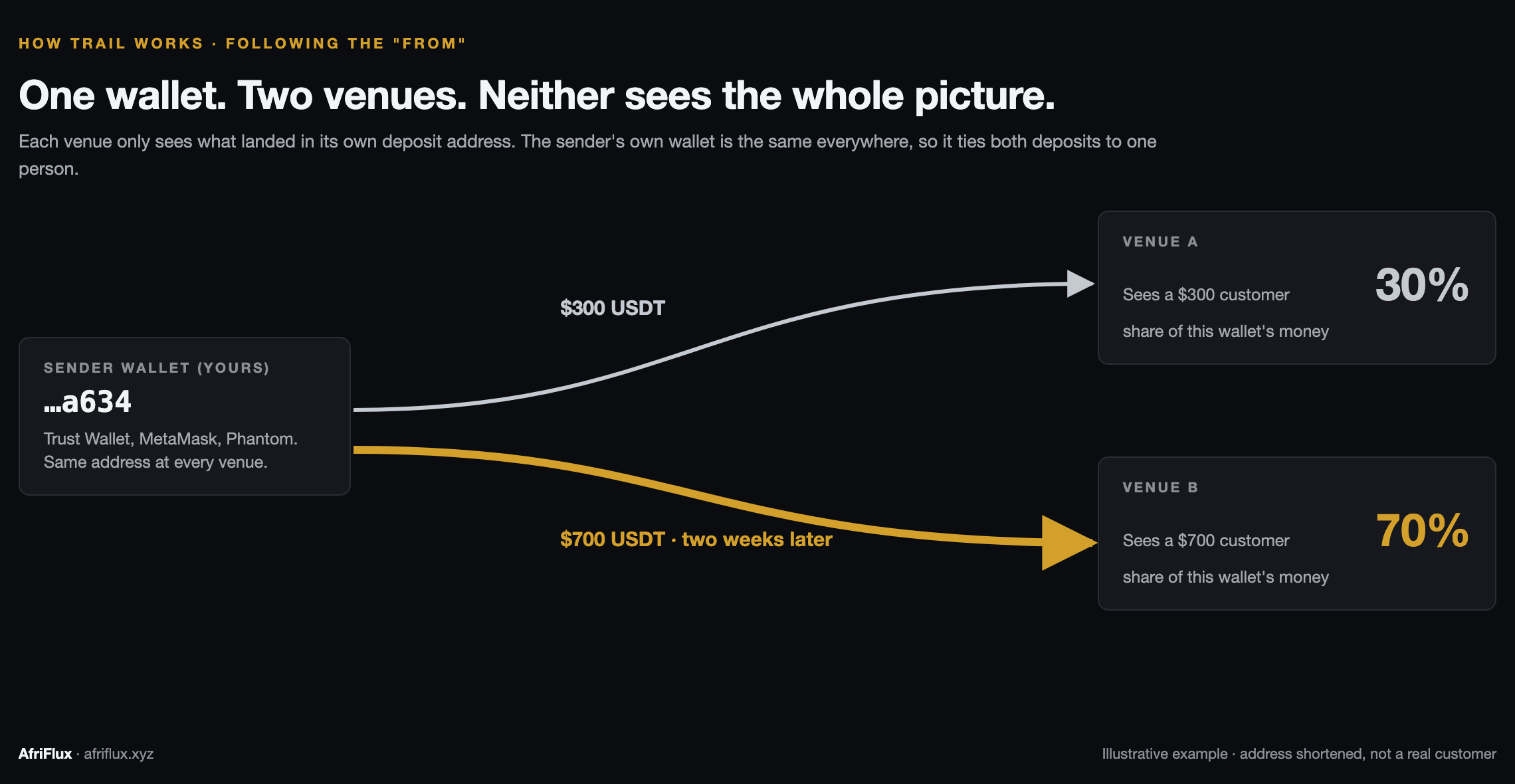
Picture a wallet ending in …a634. It sends $300 of USDT to an address we know belongs to Venue A. Two weeks later, it sends $700 to an address belonging to Venue B.
Venue A sees a $300 customer. Venue B sees a $700 customer. Neither knows about the other.
We see one wallet that moved $1,000. It sent 30% to A and 70% to B. That 30% is A's share of wallet: the part of this person's money that A won.
Now repeat that for every wallet, at every venue we track, every quarter. You get a map of how money moves between venues, not only into them. We call that map Trail.
What the map shows
These figures cover July to September 2026. They include the retail venues AfriFlux tracks in Nigeria and South Africa: exchanges, payout desks and neobanks. This isn't all of Africa, and it isn't every venue.
About $290 million reached those venues from outside wallets we could trace.
Most wallets pick one venue
Across every wallet we saw, at most about 1 in 13 sent money to more than one venue that quarter. The rest used one place.
The overlap looks bigger from inside a single venue. That's because a wallet using three venues shows up in three places. At the typical venue, about 1 in 4 depositors also sent money to a rival.
Most of the money doesn't
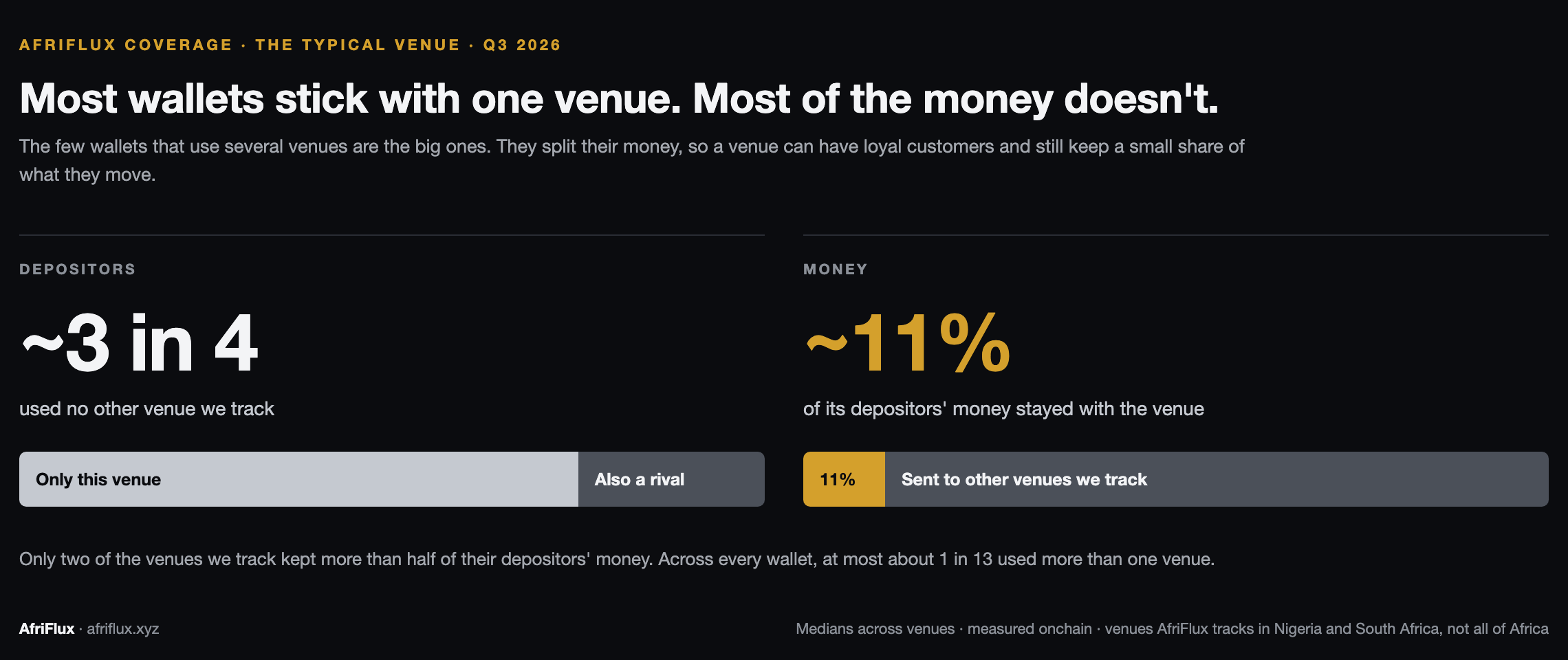
Here's the surprise. At the typical venue, about three in four depositors used no other venue. Yet that venue kept only about 11% of the money its depositors moved.
How can both be true? The wallets that use several venues are the big ones. Someone sending $50 a month picks one app and stays. Someone moving $50,000 spreads it across three or four, compares rates and splits it up.
So "how many of my customers are loyal?" and "how much of their money do I get?" have different answers. Of the two dozen or so venues we track, only two kept more than half of their depositors' money in Q3.
When people leave, they rarely leave for a rival
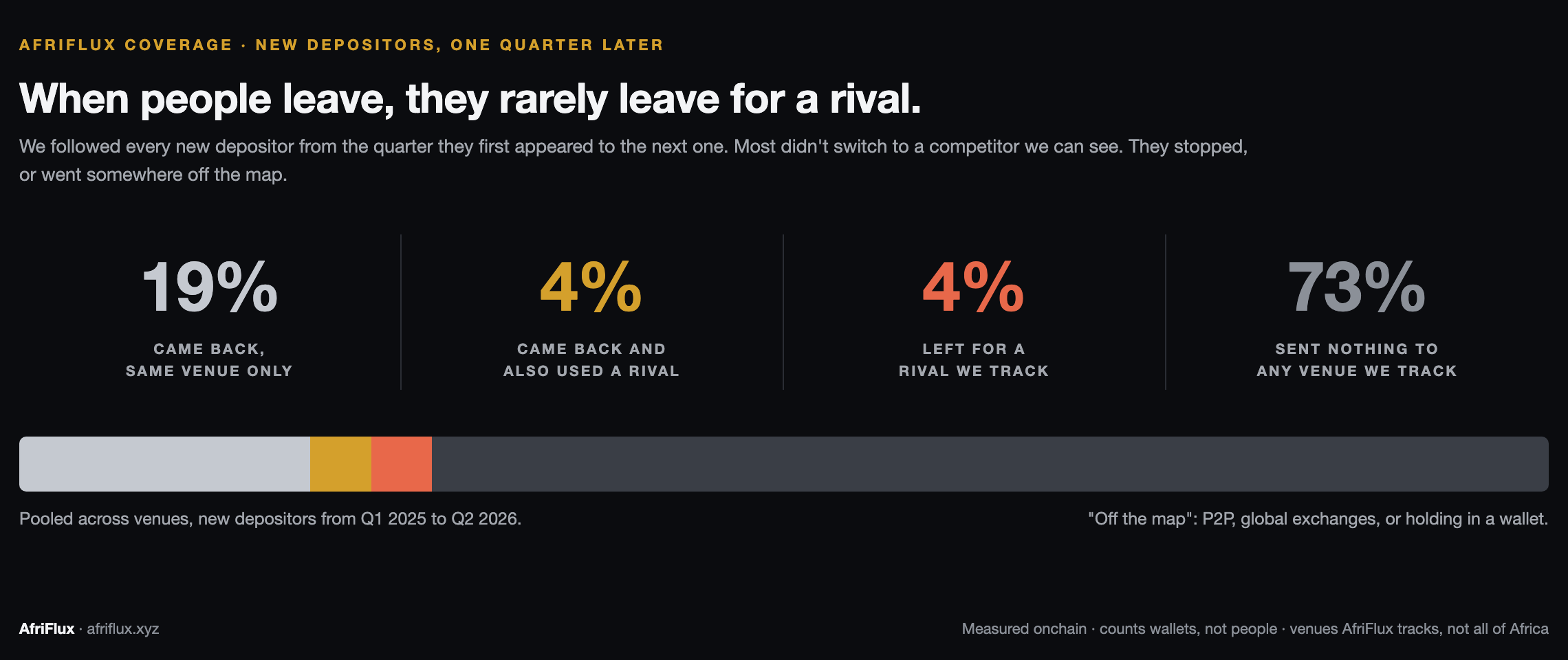
We also tracked new depositors from their first quarter to the next. We pooled every venue from early 2025 to mid-2026. One quarter later:
- 23% sent money to the same venue again. About 4% also used a rival.
- 4% left for a competitor we track.
- 73% sent nothing to any venue we track.
That last number matters. People often tell venue churn as a story about rivals stealing customers. Our data says otherwise. Most people who leave don't go to a rival we can see. They stop, or they go somewhere off the map: a P2P trade, a global exchange, or a wallet they hold in.
Where this method falls short
Following a sender address gives a strong signal. It still has limits.
One wallet isn't always one person. A person with three wallets counts as three. Some people share a wallet, though that's rare for small personal transfers. So read these numbers as wallets, not people.
Not every sender is a person. When one venue pays another, the "from" is a venue, not a customer. We remove those transfers and keep small payments into personal deposit addresses. No filter catches everything.
We only see venues we track. If someone sends half their money to a venue we don't cover, we miss it. So share of wallet means share of the money we can see. The real share is probably lower.
We undercount Solana. On Solana, a token transfer lands in a separate token account, not the owner's main address. That hides the same sender across venues. As a result, Solana wallets look more loyal than they are.
We see addresses, not names. None of this identifies anyone. A sender address is a public string on a public ledger. We don't know who owns …a634, and we don't try to find out.
Why it matters
If you run a stablecoin business in Nigeria or South Africa, "how big is my volume?" isn't the useful question. These are:
- What share of my customers' money do I capture?
- Which competitor takes the rest?
- Which of my biggest depositors started splitting their money last month, and where did it go?
No company can answer these from the inside. The public record can, if you follow the from as well as the to.
That's what Trail does inside the AfriFlux workspace. For each venue, every month and quarter, it shows how much of its depositors' money the venue kept, where the rest went, which rivals it wins wallets from and loses them to, and which large wallets have started to drift.
AfriFlux coverage: retail venues in Nigeria and South Africa. Figures cover Q3 2026 and include only money sent from outside wallets to venues we track. Trail is available to enterprise customers. Talk to us.