On 2 November, the Governor of the Bank of Ghana spoke at a summit in Accra. He said his bank is writing a rulebook for stablecoins with Ghana's securities regulator and its anti-money-laundering agency. Ghana passed its crypto law last December. Licences are not open yet. Even so, Ghana now joins the other big crypto markets on the continent in treating stablecoins as a central bank matter.
Three days later, on 5 November, Nigeria's central bank put its own stablecoin rules into force. Kenya's rules came out in July. South Africa has licensed crypto firms since 2023, but it still has no rules for the coins themselves.
If you work in a bank, an asset manager or a payments company, much of this will look familiar. Regulators have taken tools they already use on banks and money market funds and pointed them at a new kind of firm. This essay compares the four countries on the seven questions that matter most about a stablecoin. It also brings in the United States. The coins most Africans hold are US dollar coins, and in January the first part of the US rulebook for them takes effect.
What a stablecoin is, in banking terms
A stablecoin is a token on a blockchain that promises to be worth one unit of a real currency, usually one US dollar. The company that issues it takes your money, holds it in safe assets and gives you a token. When you hand the token back, you get your money back.
That makes the issuer look like three businesses you already know. It takes in money like a bank, but it does not lend it out. It holds short-term government paper like a money market fund. It moves value like a payment company. Each country had to decide which of these the issuer really is, and that choice drives most of the other rules.
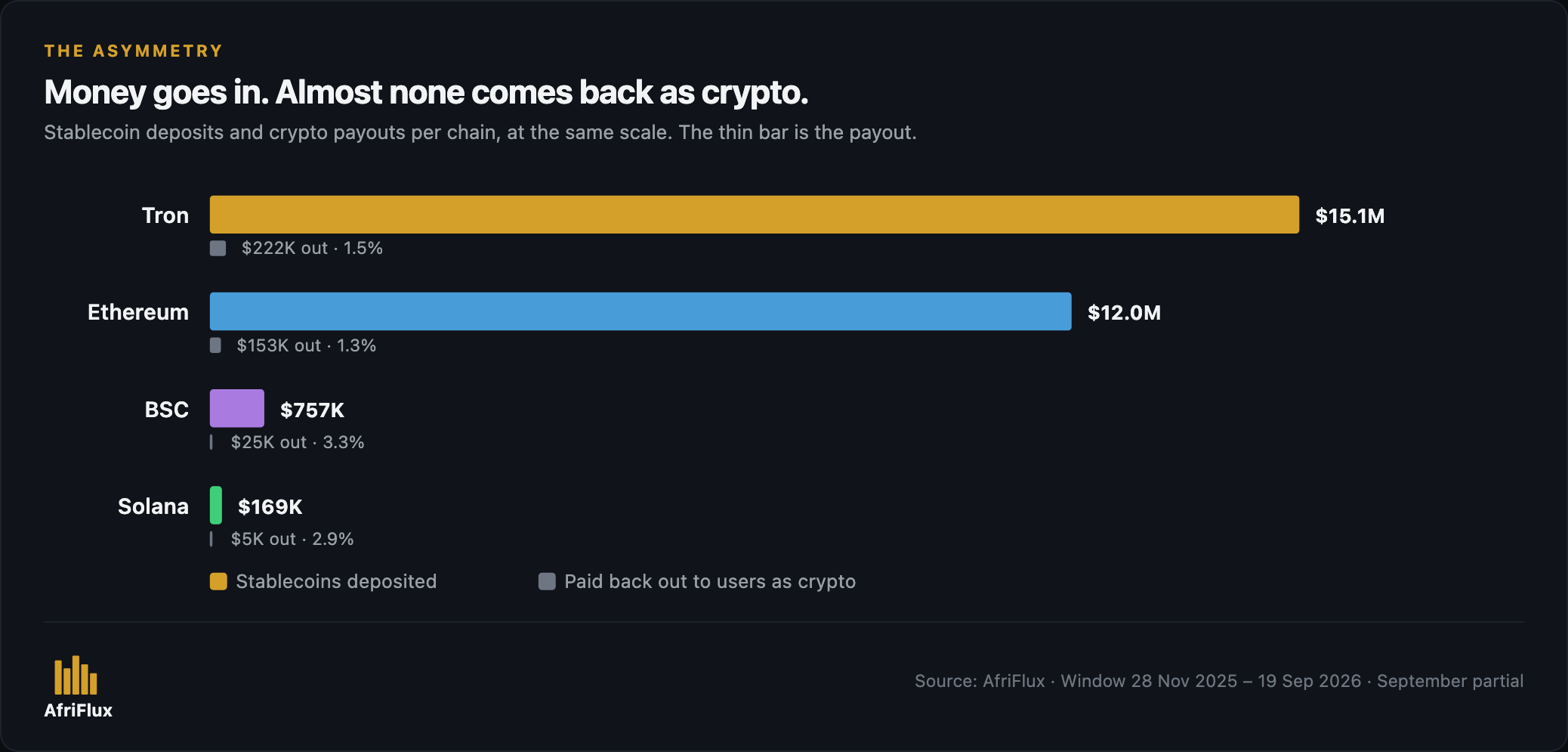
For scale: in the third quarter of 2026, about $607.7 million in stablecoins moved through the consumer apps AfriFlux tracks in Nigeria, South Africa and Kenya. Businesses moved another $2.21 billion. Of the consumer money, 88.7% was USDT and 11.2% was USDC. Coins tied to the naira or the rand didn't register at all.¹
Why the US belongs in this comparison
The US signed the GENIUS Act into law in July 2025. Its national bank regulator, the OCC (Office of the Comptroller of the Currency), published its detailed rules on 21 October 2026. They take effect on 18 January 2027. The Federal Reserve, the FDIC and the NCUA, which supervises credit unions, have so far only proposed rules for the issuers they oversee.
The US comes at this from the other side. The four African countries are managing a foreign currency coming into their economies. The US is writing rules for its own currency going out. A dollar coin backed by Treasury bills creates demand for US government debt and takes the dollar into places US banks don't reach. So Washington and the African capitals use many of the same tools for opposite reasons.
1. Who is in charge
Nigeria splits the work between two regulators. The Investments and Securities Act 2025 made virtual assets securities by default, which puts them under the SEC. The central bank's new rules then carve out the ones used to pay, send money, exchange currency or settle trades, and stablecoins fall into that group. A firm that does both needs approval from both.
Kenya draws the same line by law. The Central Bank of Kenya licenses stablecoin issuers and payment token firms. The Capital Markets Authority licenses exchanges, brokers and custodians.
South Africa started from the markets side. In October 2022 its markets conduct regulator, the FSCA, declared crypto assets a financial product. By the end of March 2026 it had approved 310 licences for crypto firms. The Reserve Bank looks after payments and exchange control, and the Financial Intelligence Centre handles money laundering.
Ghana's Virtual Asset Service Providers Act 2025 gives joint oversight to the Bank of Ghana and the SEC. The coming stablecoin rules are being written by the central bank.
The United States gives stablecoins to its bank regulators, not to the SEC. The law says a payment stablecoin is not a security. An issuer can take one of three routes. It can be a subsidiary of an insured bank, supervised by that bank's regulator. It can be a non-bank firm licensed by the OCC. Or, while it has $10 billion or less in circulation, it can hold a state licence.
So four of the five give issuers to the central bank or the bank regulators. Once a regulator sees a stablecoin as money rather than as an investment, the banking side takes charge. South Africa has not made that call yet.
2. Who can issue a coin
Nigeria has two issuer licences. Class 1 is for coins tied to the naira and needs ₦10 billion in paid-up capital, about $7.4 million. Class 2 is for coins tied to a foreign currency and needs ₦15 billion, about $11.0 million. For comparison, the central bank's 2024 bank recapitalisation moved regional banks from ₦5 billion to ₦10 billion. A naira-coin issuer needs as much capital as a regional bank. The issuer must be a Nigerian company with a compliance officer who lives in Nigeria. Every coin also needs its own approval, which covers its name, ticker, reserves and the blockchains it runs on. A coin counts as "systemic", with tighter rules, once more than ₦500 billion (about $368 million) is in circulation or more than five million Nigerians hold it.
Kenya asks for Ksh 300 million in paid-up capital, about $2.3 million. On top of that, the issuer must keep liquid capital of Ksh 60 million or enough to cover 30 days of its current liabilities, whichever is higher. The issuer must file its white paper with the central bank 90 days before publishing it. Like every licensed crypto firm in Kenya, it needs a chief executive who lives in the country.
South Africa has no issuer licence. Ghana has not set one yet.
The United States has no single capital number. The OCC sets each issuer's capital itself, with a floor of $5 million for new issuers. Separately, every issuer must hold liquid assets that cover 12 months of its running costs, kept apart from the reserves.
Bankers will see the difference at once. Nigeria and Kenya set one figure for everyone. The US sizes capital to the firm, the same way it treats banks.
3. What backs the coin
This is where the rules look most like banking. Nigeria's rules here are the most detailed of the five, and they treat naira coins and dollar coins very differently.
Nigeria's naira coins must be backed one to one, plus an extra 2% buffer paid from the issuer's own money. At least 20% of the reserves must sit as cash at the central bank. That deposit earns no interest and can be touched only in a crisis. Bankers will recognise it as a cash reserve requirement under a new name. At least another 40% must be cash or government paper that matures within six months. The rest can be Treasury bills, short bonds, bank deposits and repos. Money market funds can make up no more than 10%. No single bank can hold more than 30% of the reserves, and the issuer must use at least three banks. An approved auditor checks the reserves every month. Reserves cannot be lent, staked or pledged.
Nigeria's dollar coins follow a different rule. Their reserves are held in the coin's own currency: cash, government bills of that country maturing within 93 days, and overnight repos on those bills. The rules state that no fixed share has to be held in Nigeria. A dollar coin licensed in Nigeria can therefore keep its reserves in US Treasury bills, like a US coin. What Nigeria asks for instead is a separate cash buffer for Nigerian holders. The issuer must keep at least $10 million on top of its reserves, and more for bigger coins: 15% of what it owes Nigerian holders, or enough to cover 30 days of heavy redemptions. That money sits with Nigerian banks, spread across at least two, with no more than half in any one. A Nigerian bank must act as its redemption agent.
Kenya requires reserves worth at least the value of every coin in circulation at all times. They can be cash, government securities that mature within 90 days, or repos of up to seven days. Reserves must be kept apart from the issuer's own assets and held by a custodian the central bank has approved. They are stress-tested every quarter. At least 30% of the money paid in must sit in trust accounts at Kenyan banks, and the rest must be invested in Kenya.
South Africa and Ghana have no reserve rules for issuers yet.
The United States requires one-to-one backing in cash, balances at the Federal Reserve, insured bank deposits, Treasury bills maturing within 93 days, repos backed by Treasuries, and government money market funds that hold only these. At least 5% must be available on demand. No more than 40% can sit with any one counterparty. US government debt, custodians holding the reserves and centrally cleared repos don't count toward that limit. Every month the issuer publishes a reserve report, checked by a registered accounting firm and signed by the chief executive and finance chief. Nothing has to be held at the central bank.
All of these rulebooks turn issuers into narrow banks: firms that take in money and keep all of it in safe, short-term assets. The difference is where the money ends up. Kenya and Nigeria's naira coins keep it at home, in local banks and local government debt. The US puts it into Treasury bills. Nigeria's dollar coins can do the same, as long as a local cash buffer stays behind for Nigerian holders.
4. Getting your money back
Nigeria gives every holder a legal right to swap the coin back for one naira (or one dollar) at any time. The issuer must pay by the end of the next business day. In a crisis the central bank can allow up to five business days. A normal redemption cannot carry a fee.
Kenya also requires redemption at full value at any time, paid within two working days. The central bank must approve the redemption terms.
The United States requires issuers to pay within two business days. Any change to redemption fees needs seven days' notice to holders. The issuer must tell the OCC if redemption requests for any one of its coins pass 10% of that coin's supply within 24 hours. Holders must be told plainly that the coin is not a deposit, is not covered by deposit insurance and is not backed by the US government. If an issuer goes bust, holders are paid before the issuer's other creditors.
This is the withdrawal promise a bank makes on a deposit, without deposit insurance behind it. Nigeria is the fastest of the three, at the next business day.
5. Can holders earn interest?
Nigeria bars issuers from paying interest, yield, dividends or any other reward for holding the coin. It also bars using a partner firm to get around the ban. Kenya treats any benefit linked to how long you hold the coin as interest, and bans that too.
The United States bans issuers from paying interest or yield for simply holding the coin. The OCC dropped a proposed rule that would have treated yield paid by an issuer's affiliate or partner as a way around the ban. It kept its power to act against workarounds, and it says it will look at such arrangements case by case when it reviews applications and supervises issuers. That leaves an exchange paying "rewards" on dollar coins it holds for customers not clearly barred. US banks see this as a threat to their deposits and pushed Congress to close it in a second crypto bill, the CLARITY Act. On 15 September the Senate fell one vote short of taking the bill up, 49 to 50. It is not law.
On this point, Nigeria and Kenya have written firmer rules than the US. Both African rulebooks close the partner route in plain words.
Whatever the rules on rewards, the business model is the same. The issuer earns interest on the Treasury bills behind the coin, and the holder earns nothing from the issuer. For a Nigerian naira coin, a fifth of the reserves earns nothing either.
6. The dollar question
This is the part that matters most.
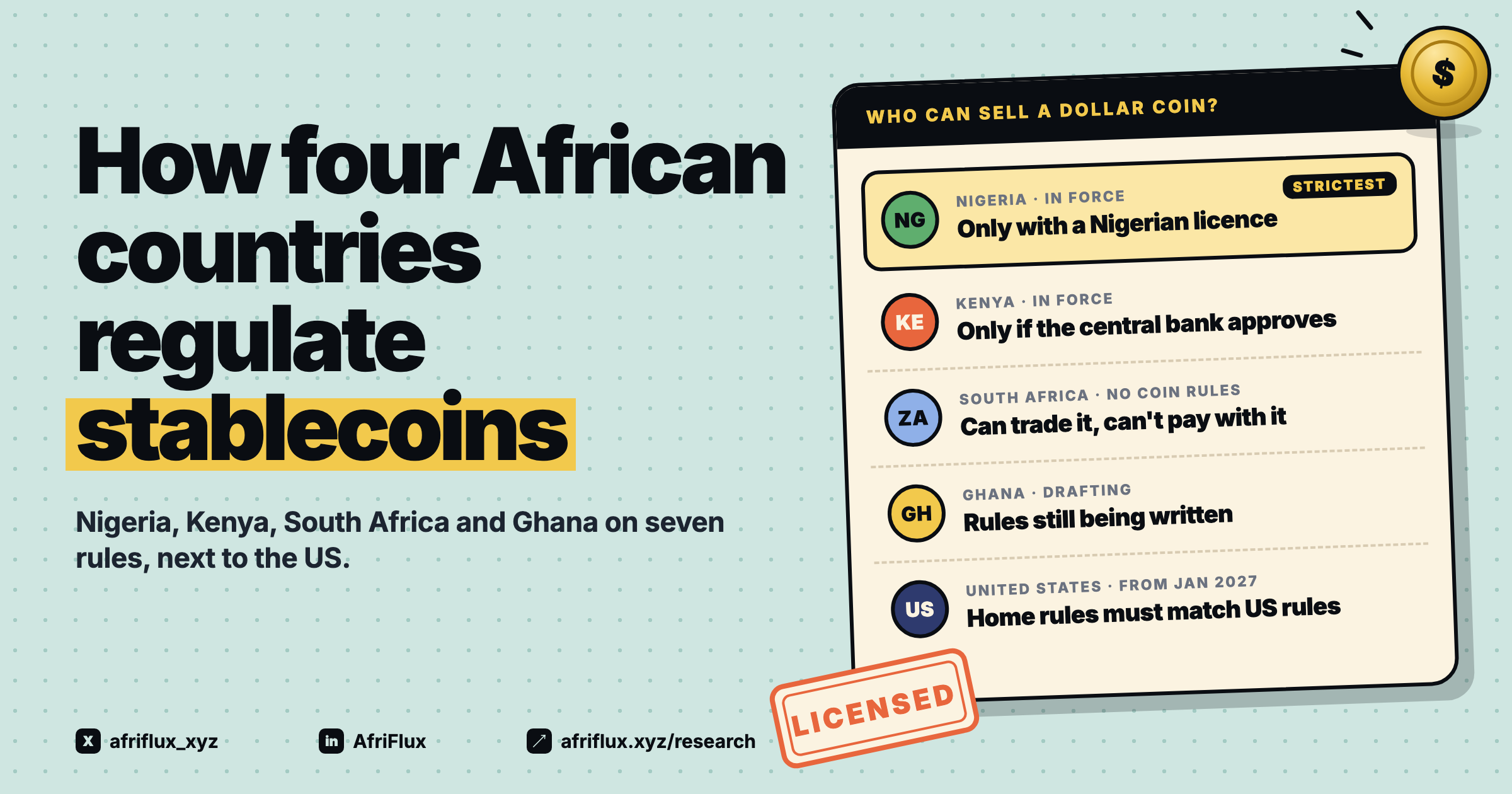
Nigeria's rule is the strictest of the five. A foreign-currency coin can be offered to people in Nigeria only as a Class 2 coin issued through a Nigerian company that holds a Class 2 licence. A licence from another country does not count, and neither does a deal with a Nigerian partner. Licensed firms may not offer any coin that lacks approval. Even an approved dollar coin cannot be used to settle a naira debt inside Nigeria. Peer-to-peer trading between naira and dollar coins needs separate approval, and the naira side must go through an authorised foreign-exchange dealer and be reported. Today's dollar-coin arrangements have until about May 2027 to apply, and the central bank decides case by case whether they can keep running in the meantime.
In plain terms, USDT and USDC in their current form would need a licensed Nigerian issuing company to stay on licensed Nigerian apps. Nigeria cares about who issues the coin and who answers to Nigerian holders. It does not demand that the reserves come home.
Kenya takes a similar path. Exchanges can list only stablecoins that the central bank has approved and a licensed issuer has issued. The central bank can also tell local firms to restrict access to any coin issued abroad. The rules do not yet make clear whether an issuer licensed abroad counts.
South Africa took a different approach. In late May 2026, the Reserve Bank and the FSCA said crypto assets, stablecoins included, are not money. They said the Reserve Bank is "unlikely to consider" foreign-currency coins as payment tools for local transactions, because of the risk of dollarisation (people dropping the rand for the dollar). Trading dollar coins on licensed exchanges goes on. Rand-pegged coins are being studied. Separately, the Treasury is rewriting South Africa's exchange control rules to cover crypto. After thousands of public comments, the Finance Minister said in October that a second draft would rely less on approval before a transfer. The courts are split too. One High Court ruled in 2025 that the old exchange control rules don't cover crypto, and the Reserve Bank's appeal is still waiting for judgment. In June 2026, the Johannesburg High Court ruled that bitcoin counts as both "money" and "capital".
Ghana's Governor named the risk directly. He said growing use of stablecoins, especially those in foreign currencies, could lead to currency substitution and affect monetary sovereignty, capital flows and how well monetary policy works.
The United States faces a different question: what to do about dollar coins issued outside the country. A foreign issuer can reach US customers through US platforms only if three things hold. The Treasury must judge its home country's rules comparable to the US rules. The issuer must register with the OCC. It must hold enough reserves at US institutions to pay its US holders. US platforms can keep offering coins that don't meet these tests until July 2028. The company behind USDT has already answered with a separate US coin, USAT, launched in January 2026 and issued through Anchorage, a US-chartered bank.
The African four worry that a foreign coin will replace their own currency. The US has no such fear about the dollar. Its concern is narrower: it wants to supervise whoever issues a coin in its currency. The two sides also differ on how a foreign issuer gets in. The US accepts an issuer whose home rules it judges comparable. Nigeria accepts no foreign licence, and the issuer must set up a local company with a local licence. Both, though, ask for money held locally to pay local holders: US reserves in the US, and a cash buffer at Nigerian banks in Nigeria.
7. Paying with it
Nigeria allows naira coins to be used for payments, settlement and treasury work. Dollar coins are allowed for cross-border payments, remittances and trade settlement, but not for paying naira debts at home.
Kenya licenses payment token firms under its central bank, next to the issuers.
South Africa says crypto is not legal tender and not money under its payments law. The payments law will be changed so the Reserve Bank can approve new kinds of payment tools, crypto included, and the Reserve Bank has said it wants to test local stablecoin payments in its sandbox.
Ghana starts with a high bar. Ghanaians made more than a billion mobile money transactions in August 2026, worth about GH¢519 billion. A stablecoin used for local payments would be up against a system people already use every day.
The United States built its whole law around payments; the coins it covers are called "payment stablecoins". They are not legal tender, but nothing stops people paying with them at home, because they are in the home currency. Issuers must be able to freeze and seize coins when a court or regulator orders it.
Where each country stands today
| Nigeria | Kenya | South Africa | Ghana | United States | |
|---|---|---|---|---|---|
| Lead regulator for issuers | Central bank | Central bank | Not decided | Central bank | Bank regulators (OCC, Fed, FDIC) and states |
| Issuer capital | ₦10bn (about $7.4m) naira coin, ₦15bn (about $11.0m) dollar coin | Ksh 300m (about $2.3m) | No rule | Not set | Set per issuer, $5m floor for new issuers, plus 12 months of costs |
| Reserve rules | Naira coins: 20% at central bank, kept at home. Dollar coins: reserves can sit abroad, plus a cash buffer of $10m or more at Nigerian banks | 30% in local bank trust accounts, rest invested in Kenya | None | Not set | Treasuries up to 93 days, 5% on demand |
| Redemption | Next business day, no fee | Two working days | None | Not set | Two business days |
| Interest to holders | Banned, partner route closed | Banned | No rule | Not set | Banned for issuers; partner rewards not clearly barred |
| Foreign coins | Only through a local licensed issuer | Only if central bank approves | Can trade, not for local payments | Named as a risk | Comparable home rules plus US reserves, platforms have until July 2028 |
| Status | In force 5 Nov 2026; apply by about May 2027 | In force; grace period ended 4 Nov 2026 | Crypto firms licensed since 2023; no coin rules | Law passed Dec 2025; rules being drafted | Law July 2025; OCC rules take effect 18 Jan 2027, others proposed |
What this means for people in traditional finance
Stablecoin issuers are being regulated as narrow banks, in Africa and in the US. In Nigeria, Kenya and the US, the rules on capital, reserves and redemption read like liquidity rules for a bank that holds all its deposits as reserves. Banks that already know how to meet those rules have a head start.
Nigeria controls who issues a dollar coin, not where its reserves go. A Nigerian dollar coin can hold its reserves in US Treasury bills, like a US coin. Treasury bills are already where the biggest dollar coins keep their money: at the end of the third quarter, the company behind USDT alone held $132.4 billion in them. The money Nigeria does keep at home is the cash buffer for Nigerian holders, and it has to sit with Nigerian banks. For naira coins and for Kenya the money stays at home: in local banks, local government debt and, for Nigerian naira coins, the central bank. Custody, trust accounts, redemption agents and short-term government debt are all bank products, so a growing stablecoin market is new business for local banks.
One dollar coin may need several licences. A dollar coin that serves both Lagos and New York would need a Nigerian company with a Nigerian licence and a Nigerian cash buffer, plus a separate US setup. USAT shows that the biggest issuer is willing to split its coin by country. Nigeria's rules invite the same move.
Africa is firmer than the US on rewards and on foreign issuers. Nigeria and Kenya closed the partner route for paying yield in plain words. The US left it to case-by-case supervision. Nigeria accepts no foreign licence at all, while the US accepts a foreign one it judges comparable.
South Africa is the outlier. It has the oldest licensing regime for crypto firms and no rules for the coins, so it is open for trading and still undecided on issuing. Its courts have not settled whether exchange control covers crypto.
Ghana's design is still open. It is writing its rules after seeing what Nigeria, Kenya and the US did. The main question is whether it follows Nigeria and Kenya in controlling who can issue dollar coins, or follows South Africa in controlling what the coins can be used for.
¹ AfriFlux data as of 20 November 2026. Business figures cover three business books. Deposits of $1 million or more at Luno and VALR are left out of every figure, because a single deposit that size can't be told apart from a business or treasury move.
Sources
- Central Bank of Nigeria: Regulations for the Operations of Non-Security Virtual Assets in Nigeria
- Kenya: The Virtual Asset Service Providers Regulations, 2026
- TLA Advocates: Unpacking the gazetted VASP Regulations, 2026
- Graphic Online: Bank of Ghana moves to regulate stablecoins
- OCC: Final rule to implement the GENIUS Act
- Mayer Brown: OCC finalizes GENIUS Act rulemaking