A blockchain sees addresses, not businesses. It will show you that one address received $40M of USDT last quarter. It won't tell you who owns it. That address could be a Lagos exchange or a payout desk. It could be a market-maker. It could be a wallet that forwards money for five other firms.
So before we could count anything, we had to decide what to count. Our answer is the venue. Every AfriFlux figure is a sum of venues. That goes for retail volume, depositor counts, market share and growth. This piece explains what a venue is, the shapes venues take, and why our list stops at 26.
A venue is a business that holds customers' stablecoins
Here's our working definition. A venue is a business that holds stablecoins for its customers. Customers send stablecoins to it, and it keeps them, trades them or pays them out.
Every venue like that leaves a footprint onchain. We map that footprint venue by venue. Then we verify each customer address before we count a single dollar. If we can't verify an address, it stays out. Every venue on our list has passed that bar.
What isn't a venue
Plenty of big addresses fail that test. We keep them off the list on purpose:
- Issuers. cNGN's minters move huge sums, but customers don't deposit there. Issuing a coin is supply, not use.
- Payment rails. These route money for other businesses. They don't serve customers of their own.
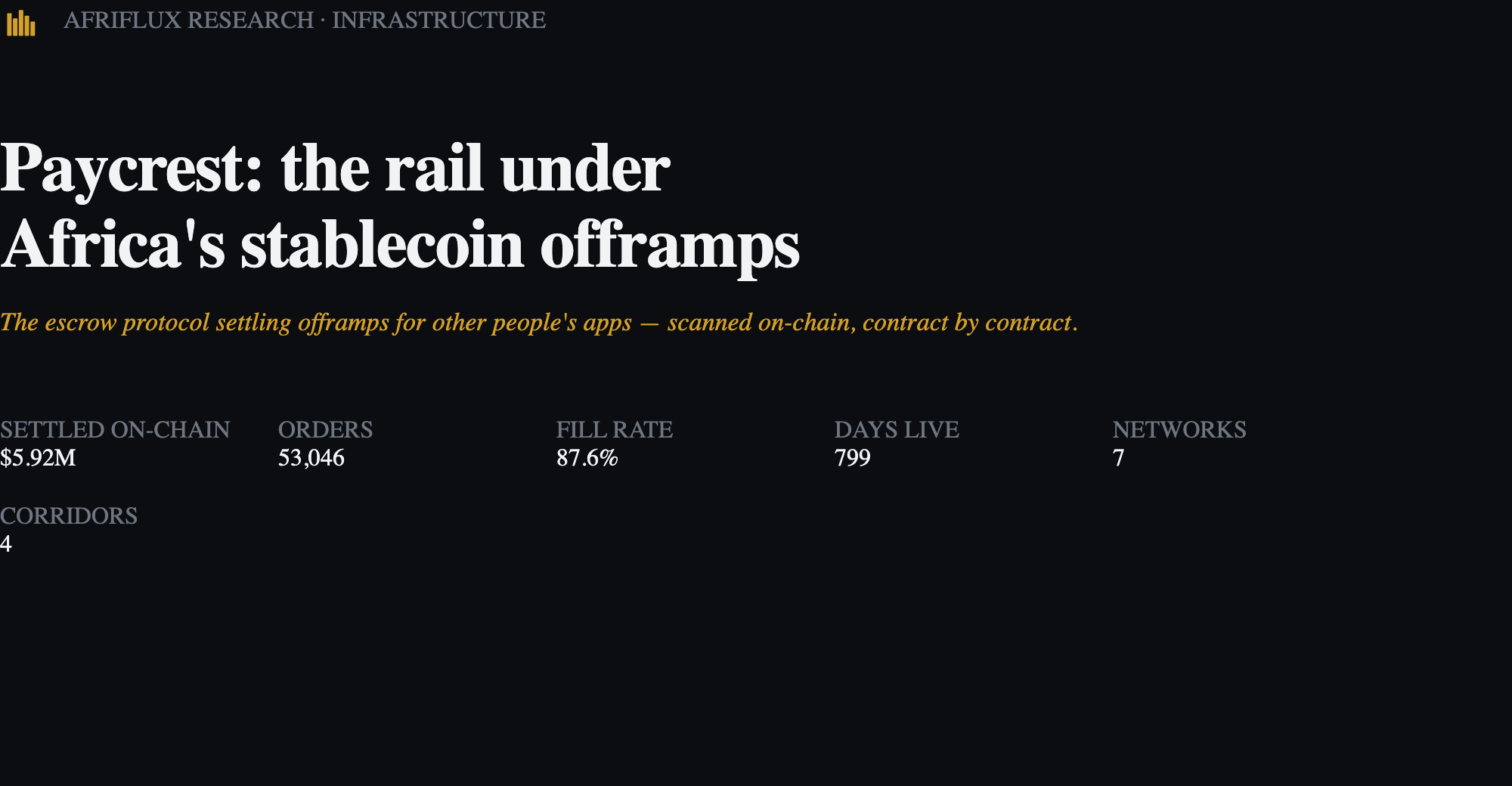
- Infrastructure. Global exchange wallets, liquidity partners and OTC desks sit here. Many venues send money to them.
- DEX pools. A pool is a contract, not a business with customers.
We never add these to venue totals. That would count one dollar twice: once when a customer deposits, and again when the venue moves the money on.
We also credit each dollar to the business that actually controls the address. Being near a venue on the chain doesn't make an address that venue's.
The shapes venues take
Our 26 venues fall into six groups. They behave in different ways, and that matters as much as the totals.
Exchanges (7): Obiex, Quidax, Busha, Roqqu, Daya Pro, VALR and Luno. Customers deposit here to trade or hold. These seven carried 72% of the retail volume we measured in Q3 2026.
Off-ramps, P2P and payout desks (7): Monica, Spenda, Breet, Jeroid, Azza, Paj Cash and Divest. Customers send stablecoins in and get naira or rand out. Each works a bit differently. Breet runs a peer-to-peer model. Spenda is a payout desk. Azza works over WhatsApp. Jeroid started with gift cards. Together they carried 20% of Q3 volume.
Neobanks (9): Chipper Cash, Grey, Accrue, Onboard Global, Timon, Raenest, Evolution, SFx and Payrit. These are banking apps with a stablecoin account built in. Many work across borders. They hold about 8% of volume, but they're the fastest-growing group.
Prediction markets (1): Bayse Markets. Customers fund accounts in stablecoins and trade on outcomes.
Savings and investments (1): Hisa, our newest venue. Customers fund an investment account in stablecoins, in Nigeria and Kenya. It's small for now, but it opens a new kind of venue: money that's put away, not spent or traded.
Business payments (1): Flutterwave. It serves only businesses, so there's no retail side to measure. None of its flow enters the retail total.
Exchanges hold the money; off-ramps hold the people
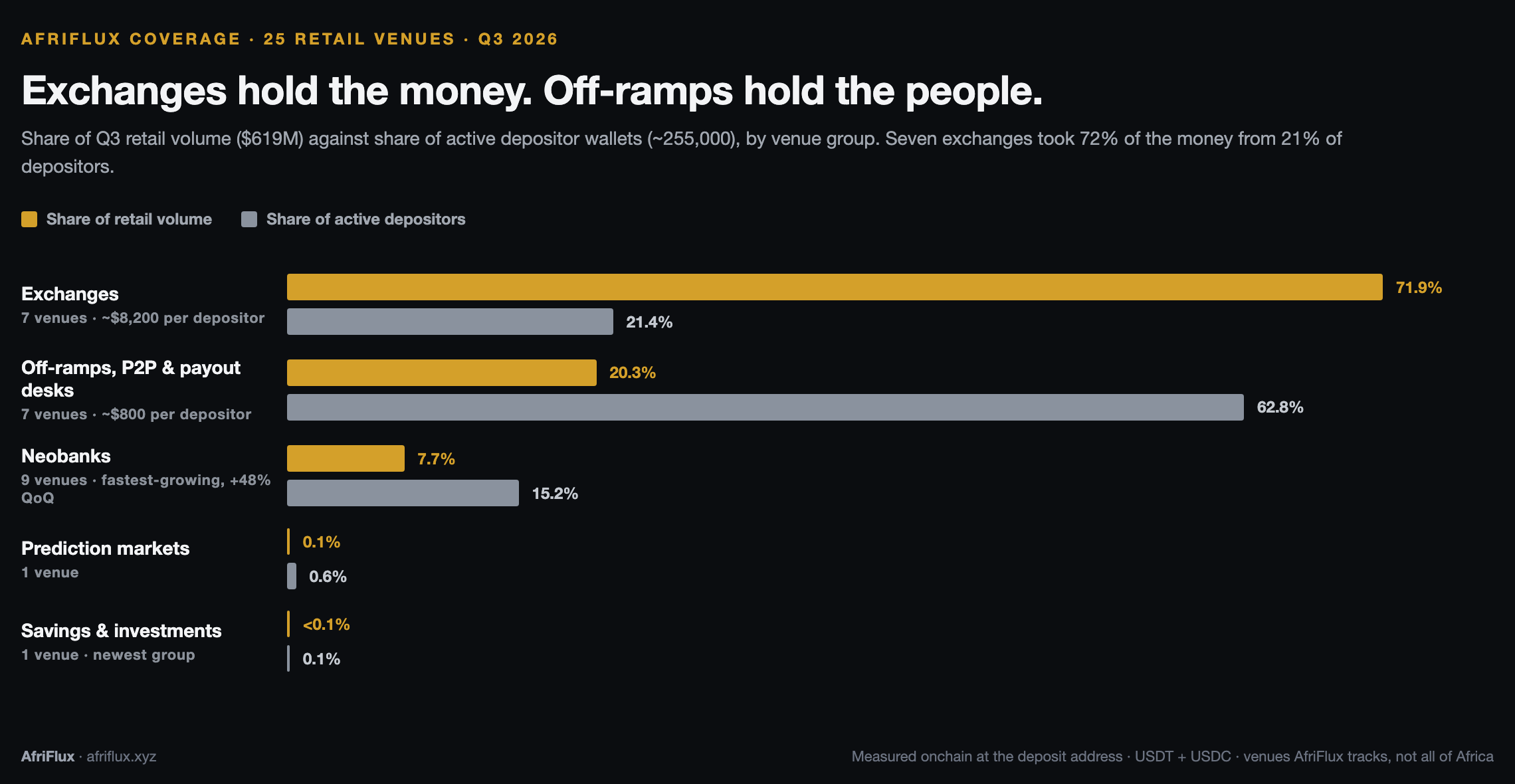
Volume share alone misleads here. In Q3, the seven exchanges took 72% of the money from about 54,000 active depositors. The seven off-ramps took 20% of the money from about 160,000 people. That's nearly three times as many.
Per active depositor, that's about $8,000 at the exchanges and about $800 at the off-ramps. Big balances sit at the exchanges. The off-ramps are where most ordinary users turn stablecoins into spending money. Our largest venue by lifetime depositors isn't an exchange either. It's Spenda.
Judge this market by its biggest volume number and you'd miss most of its users.
Where OTC and P2P marketplaces fit
People expect two kinds of business on this list: OTC desks and P2P marketplaces. Neither appears as a venue. The reasons differ, and we don't hide either one.
OTC flow gets its own line. Desks and market-makers often move money through exchanges. That flow is real, but it isn't retail. Where we can tell it apart, we measure business flow on its own and keep it out of retail totals.
At VALR and Luno, we flag very large deposit addresses that may belong to desks or market-makers rather than customers. About 400 such addresses have moved nearly $25B. That's more than six times the whole retail market we measure. We don't count it as customer deposits, and we don't hide it. It appears as its own line beside both venues on every ranking. Leave it out, and those exchanges look smaller than they are. Fold it in, and South African retail looks many times bigger than it is.
P2P marketplaces mostly happen off-chain. Say two people trade on a global exchange's P2P board. The stablecoins move inside that exchange's own books. There's no transaction for anyone to read. We can't see that market, so we don't guess at it.
We can see where money comes from before it reaches African venues. Here's where Q3 2026 retail deposits to our venues came from:
- 46.7% from global exchanges
- 39.5% from self-custody wallets
- 3.6% from another local venue
- 10.1% from sources we couldn't trace
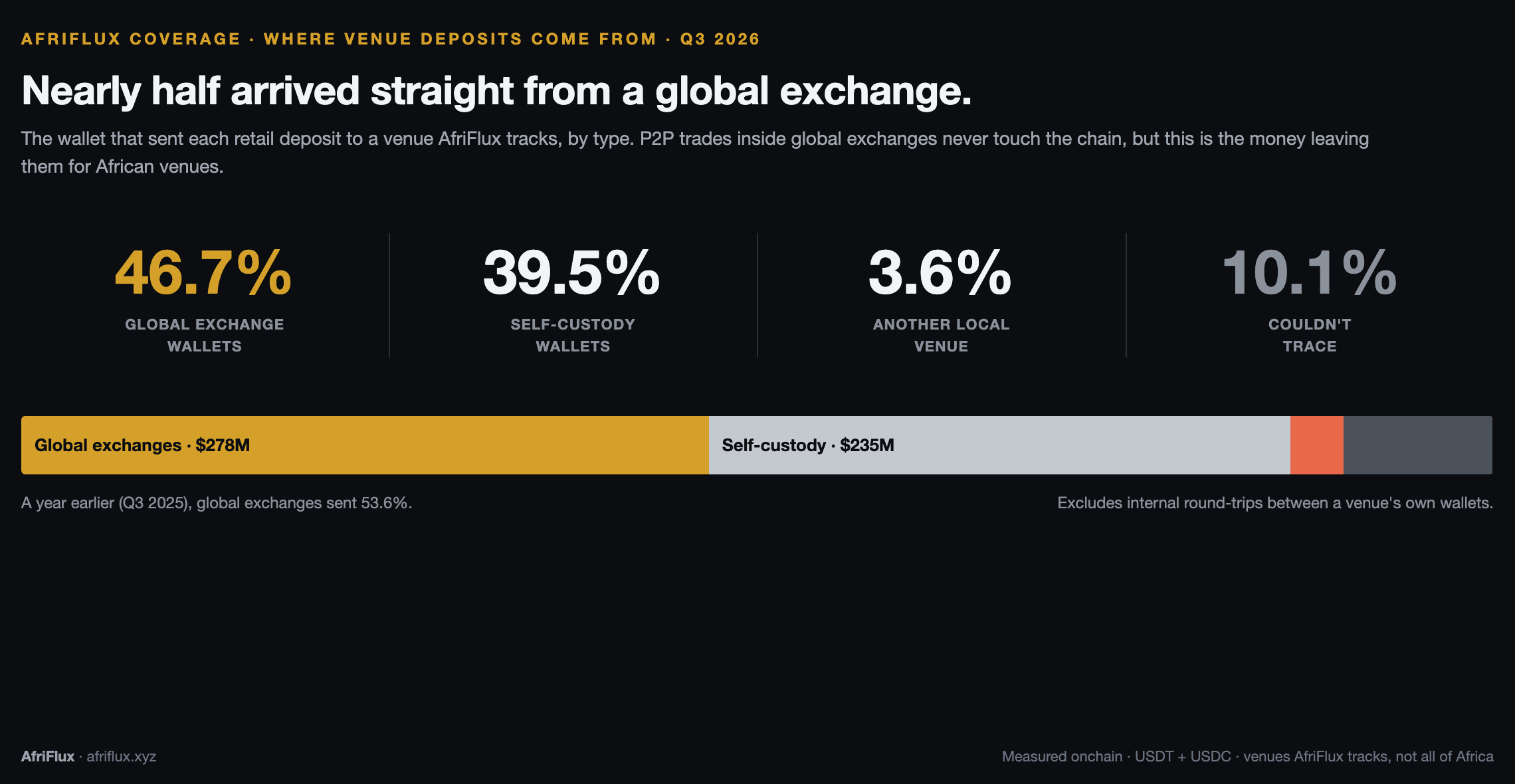
Nearly half the money entering African venues sat on a global exchange just before. That's the clearest sign of how much happens off our list. It's also why we trace money to and from global exchanges, but don't size them as venues.
What "26 venues" does and doesn't mean
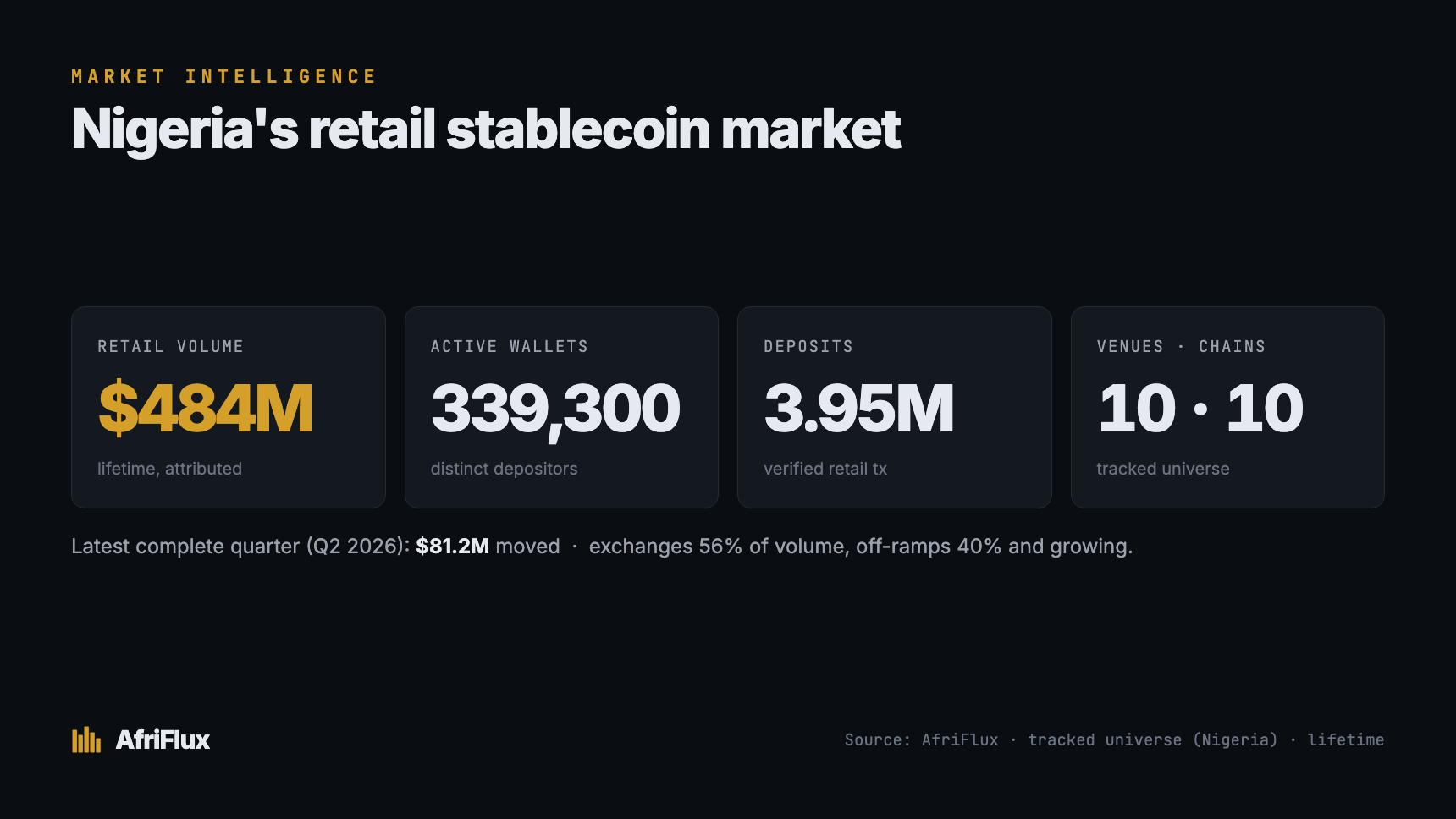
It means we've mapped and verified 26 businesses and measured the flow through them. Since our coverage began, that adds up to $3.9B of retail stablecoin deposits from more than 850,000 depositor wallets. Q3 2026 alone was up 15% on the quarter.
Here's what it doesn't mean. We'd rather say so before someone else does.
It isn't all of Africa. Our venues work in 25 countries, but a wallet carries no passport. We assign each venue's flow to its home market. Today that covers two countries: Nigeria (77%) and South Africa (23%). When a figure says "Africa", read it as "the venues AfriFlux tracks".
It's USDT and USDC. We measure native African stablecoins, such as cNGN and ZARP, on their own.
Wallets aren't people. We count each depositor wallet once. But one person can still hold several wallets.
Some histories start after launch. A few venues were running before our data begins. Their all-time figures start on a "tracked from" date, and we print that date beside the figure.
Some books can't be split. A few neobanks run business and personal accounts on the same rails. Their retail figure may include some business flow, and their pages say so.
Why 26, and not 260
We could publish a much bigger number tomorrow. We'd tag every address that ever touched a known exchange, and call the result "the African stablecoin market". Plenty of reports do roughly that, and nobody can check them.
We add a venue only when we can defend every address in it. That's slow work. It's why our list grew from ten at launch to 26 today, not to a few hundred. The payoff is that every number traces back to a venue, a quarter and a set of depositors. If you think a figure is wrong, you have something specific to argue with.
The count will grow. The definition won't.