On 23 December 2024, someone created ₦10 of cNGN, the naira stablecoin. Not ₦10 million. Ten naira. It looks like a test, and for weeks afterwards almost nothing happened.
Today there are about 3.8 billion cNGN in circulation. Every one of them started the same way. It was minted.
What it means
A stablecoin is a digital token built to hold a fixed value. One cNGN is meant to be worth ₦1. One USDT is meant to be worth $1.
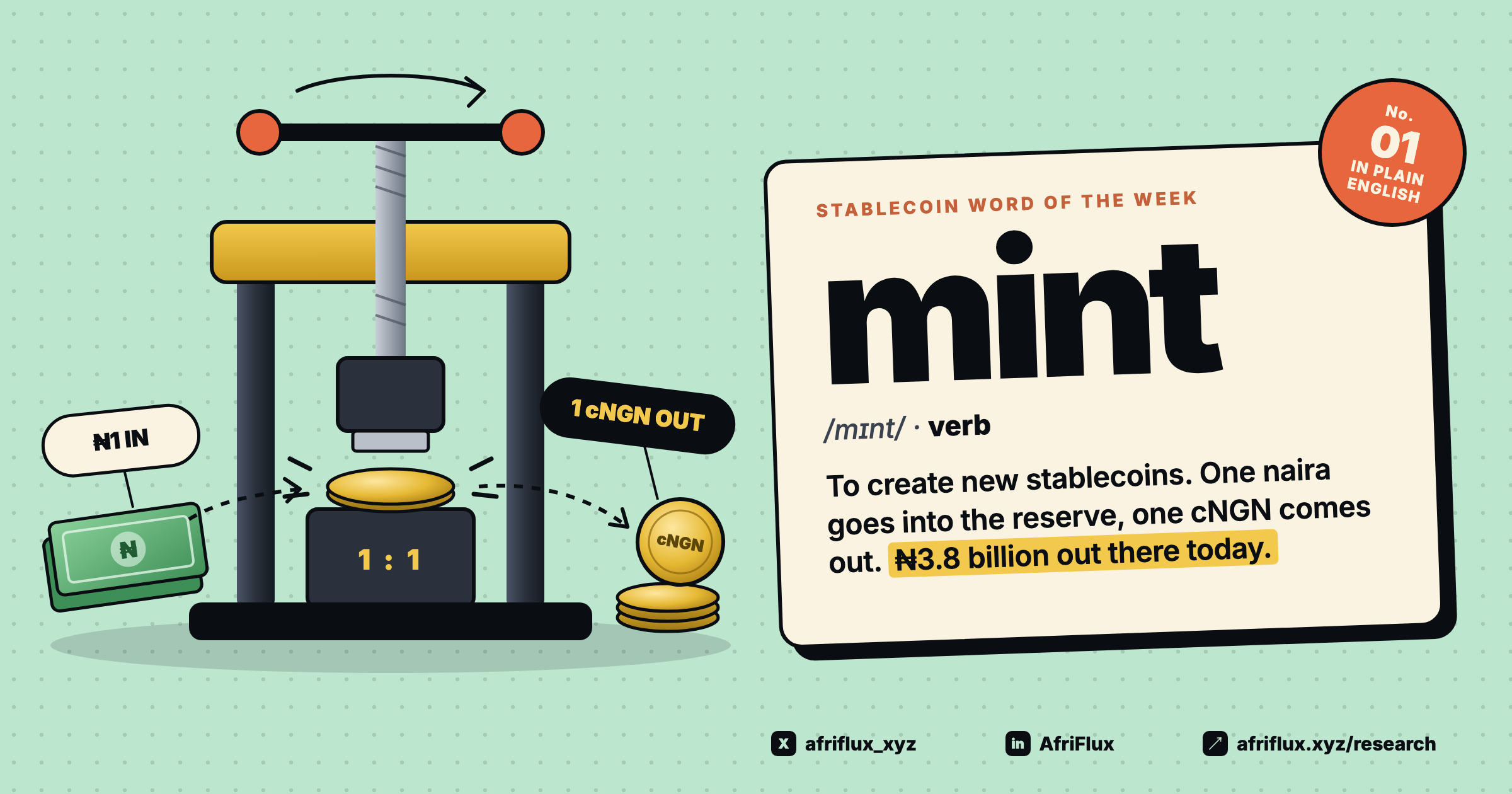
To mint a stablecoin is to create new tokens. For cNGN, it works in three steps:
- A business, usually an exchange or a payment company, sends naira to the company that issues cNGN.
- The issuer keeps that naira in the bank. This pile is called the reserve.
- The issuer creates the same amount of cNGN and sends it to the business's wallet on a blockchain.
₦1 million in, 1 million cNGN out. The token doesn't come from nowhere. Each one stands for a naira sitting in the bank, a bit like a receipt.
That is the difference between minting and printing money. A central bank can print money without anything coming in first. A stablecoin is only minted properly when money comes in first.
Why anyone can count it
Every mint is recorded on a public blockchain. New tokens show up in a transfer with no real sender: they arrive from an empty address that belongs to no one. That makes them easy to spot and impossible to hide.
So anyone can see how much cNGN exists at any moment. We have tracked it from day one.
From ₦10 to ₦3.8 billion
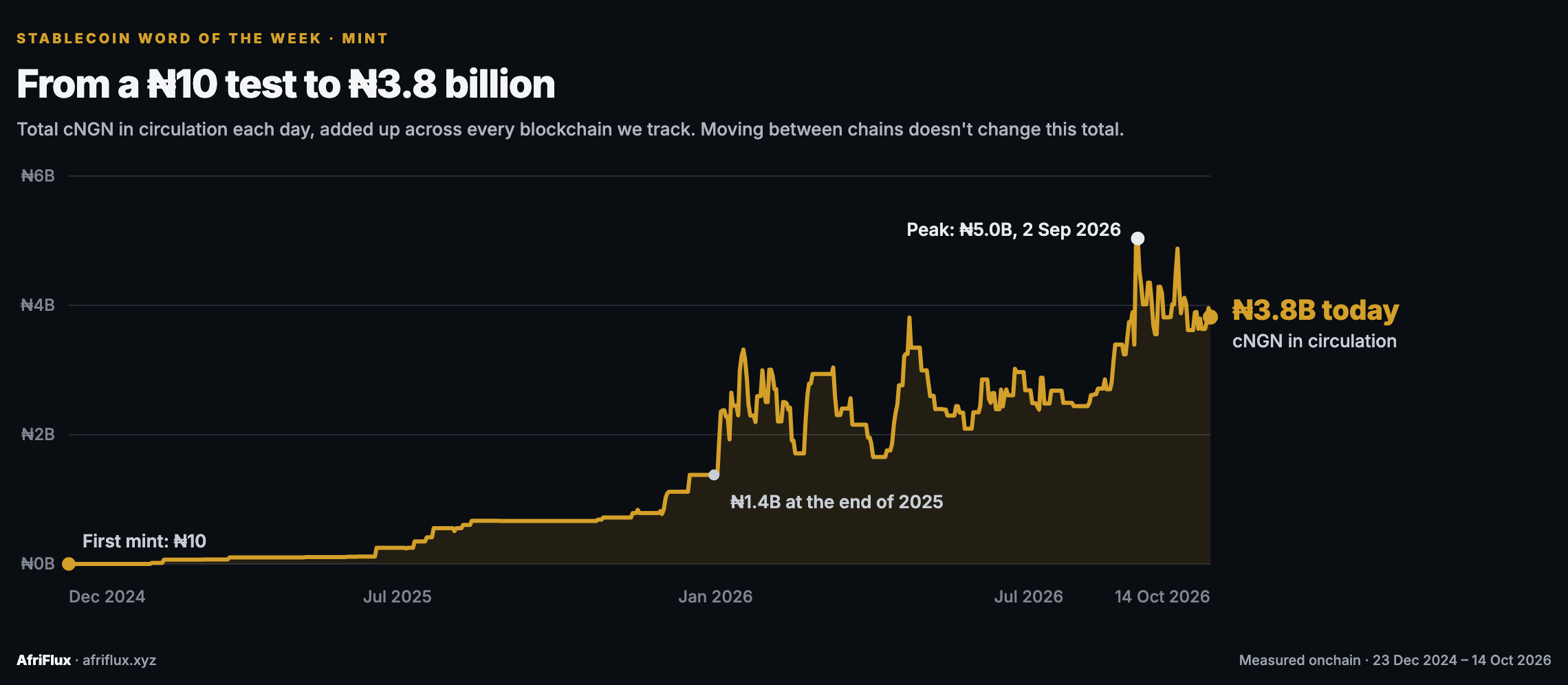
For most of 2025, cNGN stayed small. By the end of February there was ₦65 million of it. By the end of the year, nearly ₦1.4 billion.
2026 is when it took off. Supply reached ₦2.5 billion by the end of January and peaked just above ₦5 billion on 2 September. Today it sits at ₦3.8 billion.
The line doesn't only go up. It drops when businesses hand cNGN back to the issuer and take their naira out. That's the other half of the cycle, and next week's word.
Why we count what exists, not every mint
You might expect us to add up every mint ever made. We don't lead with that number, because it overcounts.
cNGN lives on several blockchains, including Base, BNB Chain and Celo. When it moves from one to another, it can be removed on the first chain and minted again on the second. The money hasn't grown. It has only changed roads. A simple count of mints would add it again every time it moves.
The amount in circulation doesn't have that problem. A token that changes chains leaves one and arrives on the other, so the total stays the same. That's why the chart shows supply.
What to ask when you see the word
When you read that a stablecoin was "minted", two questions cut through most of the noise:
- What came in? Every mint should match money arriving in the reserve. Tokens created with nothing behind them break the promise that one token equals one unit of money.
- Is it new money, or the same money moving? A big "minted" figure can include tokens hopping between blockchains, or the same naira going in and out many times. How much exists today is the steadier number to watch.
Next week: burn, the other half of the cycle.
Figures from AfriFlux's cNGN data, measured onchain on every blockchain we track, 23 December 2024 to 14 October 2026. Stablecoin Word of the Week explains one term at a time, with one chart. Talk to us about the full cNGN data.