Every weekend, millions of fans in Lagos, Accra, Nairobi and Johannesburg do the same thing. After the final whistle, they open the table. Who's top? Who's slipping? Who's going down?
This is a different table, but the drama is the same.
African currencies have started going digital. Each one becomes a token that lives on the internet. It's designed to be worth exactly one unit of the real thing. One cNGN should always equal ₦1. One ZARP should equal R1.
Behind most of these tokens, a company holds the real money in a bank. A few work differently. A shared pool of other digital assets backs them instead. Either way, you can send them from your phone to anyone, anywhere, in seconds, at 3am on a Sunday.
AfriFlux tracks ten of these tokens, across six currencies: the naira, the rand, the Kenyan shilling, the cedi, the Tanzanian shilling and the West African CFA franc. We record every payment, every new wallet and every coin created or retired. So we did what any football fan would do with that much data: we built a table.
How the table works
- Points: money moved in the last 30 days, in US dollars. This is results on the pitch.
- Matches: the number of transfers. In this league the transfer window never closes, because every payment is a transfer.
- Fans: the number of wallets holding the token.
- Squad value: how much of the currency exists right now.
- Form: how much the squad has grown or shrunk since last November. We measure it in each token's own currency, so exchange rates don't get in the way.
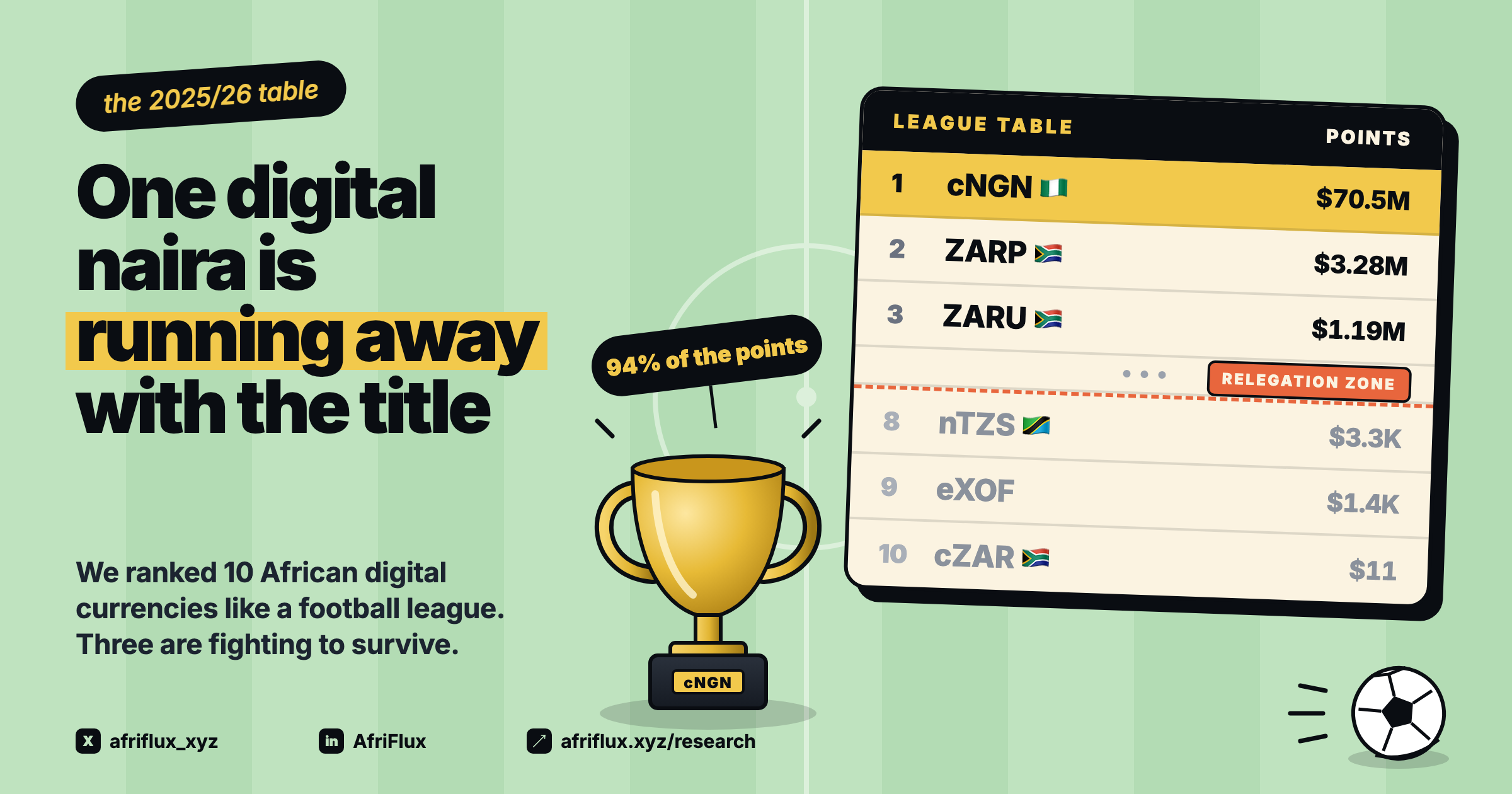
The table, 2025/26 season (as of 17 October)
| Pos | Club | Home | Points | Matches | Fans | Squad value | Form |
|---|---|---|---|---|---|---|---|
| 1 | cNGN | Nigeria | $70.5M | 73,396 | 14,567 | $2.86M | ▲ ×4.7 |
| 2 | ZARP | South Africa | $3.28M | 29,572 | 870 | $3.98M | ▲ +37% |
| 3 | ZARU | South Africa | $1.19M | 211 | 28 | $3.67M | ▲ ×6 (since Jan) |
| 4 | cKES | Kenya | $105K | 6,888 | 8,568 | $68K | ▼ −69% |
| 5 | ZARSC | South Africa | $57K | 1,018 | 722 | $496K | ▲ ×2 |
| 6 | cNGN (Celo) | Nigeria | $42K | 53 | 267 | $51K | ▲ ×3.5 |
| 7 | cGHS | Ghana | $12K | 4,059 | 415 | $24K | ▼ −25% |
| 8 | nTZS | Tanzania | $3.3K | 240 | 507 | $9.2K | ▲ ×89 (since Mar) |
| 9 | eXOF | West Africa | $1.4K | 1,742 | 605 | $9.2K | ▼ −72% |
| 10 | cZAR | South Africa | $11 | 21 | 166 | $669 | ▼ −96% |
Relegation zone: 8 to 10.
The title race is over in October
Some seasons the title goes to the final day. This isn't one of them.
cNGN, a digital naira, has 94% of all the points in the league. It moved $70.5 million in the last 30 days. Second-placed ZARP moved $3.3 million, so the leader scored 21 times as many points as the runner-up.
It also has the biggest fanbase: 14,567 wallets, more than half of all the fans in the league combined. And it plays home games in eight stadiums. cNGN runs on eight different networks, while most clubs in this league play on one.
Its form is frightening too. Last November there were about ₦817 million of cNGN in existence. Today there are ₦3.8 billion, almost five times as much in under a year.
But it isn't the richest club
Here's the twist. Sort the table by squad value instead of points, and cNGN drops to third.
ZARP ($3.98M) and ZARU ($3.67M), both South African rand tokens, hold more money than cNGN does. cNGN wins because of how hard it works its squad, not how big the squad is. Every naira in cNGN changed hands about 25 times in the last month. The rand money mostly sits still.
It's the oldest story in football: the club with the biggest wage bill doesn't always win the league. What matters is what you do with the ball.
The South African derby
South Africa has four clubs in this league, more than any other country. Two are near the top, one is climbing fast, and one is rock bottom.
The headline fixture is ZARP vs ZARU. Same currency. Almost the same size. But they couldn't be more different.
ZARP is the people's club. It has 870 fans and played 29,572 matches in the last 30 days. Its money moves in lots of ordinary-sized payments.
ZARU looks like a club owned by a handful of wealthy backers. It has 28 fans. Each holds about $131,000 on average. It played only 211 matches in the same 30 days. It's also the league's most successful newcomer. It arrived in January with R10 million and now has R60.6 million, six times bigger in nine months.
Same rand, two different lives. One is spending money. The other looks like money for institutions moving large sums. The derby shows what the headline number hides: a currency going digital doesn't decide who uses it.
Further down, ZARSC had the transfer window of its life. It doubled from about R4 million to R8.2 million between July and August. It sits a comfortable fifth.
Big crowd, small budget: Kenya's cKES
Every league has one: a club with a massive, loyal fanbase and not much money in the bank.
cKES has 8,568 fans, the second-biggest following in the league. But its whole squad is worth about $68,000. That works out to roughly $8 per fan. They play a lot of matches (6,888 last month), but for tiny stakes.
And the budget is shrinking. Last November there were KSh28.4 million of cKES. Now there are KSh8.8 million, down 69%. We don't yet know why, and we'd rather tell you that than guess.
Same city, two clubs
Lagos has two clubs in this league.
The giant is cNGN. The other is a second digital naira that runs on a network called Celo. The smaller club has had a good year: it's three and a half times bigger than it was last November. But the main cNGN is still 56 times its size.
Anyone who has followed the smaller club in a two-club city knows how that feels.
The promoted side fighting the drop: Tanzania's nTZS
nTZS has the best form in the entire league. It joined in March with TSh273,000. Now it has TSh24.2 million, 89 times bigger in seven months.
And yet it's still in the relegation zone. Its whole squad is worth $9,180. That's what happens when you start from almost nothing. You can win every week and still look up at everyone else.
The relegation zone
cGHS, Ghana (7th, just above the line): steady but stuck. Its squad has hovered between $20,000 and $30,000 all year without breaking out.
eXOF, West Africa (9th): a digital CFA franc. Eight West African countries share this currency. It lost 72% of its squad in a single month, falling from about 19.2 million to 5.3 million CFA in September. We don't know what happened yet, and we'll report it when we do.
cZAR, South Africa (10th): rock bottom. There is $669 of it left. It played 21 matches in 30 days and moved $11. It's down 96% since November. It's still on the fixture list, but it's barely fielding a team.
Here's the uncomfortable part: in this league, nobody actually goes down. There's no second division to drop into. A token can carry on existing while nobody uses it. That's the real relegation, and it happens quietly.
VAR check
Before anyone lifts a trophy, let's go to the monitor.
"Points" here means money moved, and money moved can flatter a club. Sometimes the club is passing the ball between its own players.
On 1 September, 344 million new cNGN appeared. It moved between wallets six times in 48 minutes, then settled in one place. That day, 1.3 billion new cNGN entered the league. But the scoreboard counted 4.1 billion as "moved," 3.2 times the real amount.
In July, we analysed cNGN's entire history. Only about 1.5% of its volume looked like real payments between unrelated people.
So treat points as the highlights reel, not the full match. The fan count is a better check of who's really there. On fans, cNGN still leads comfortably.
Decision: the title stands. But nobody should mistake the score for the game. (Our deeper look at cNGN's volume explains more.)
The real league
Here's the thing about this table: these ten clubs aren't competing with each other.
The whole league has a combined squad value of about $11.2 million. Now look at the ten Nigerian platforms AfriFlux tracks. On those alone, 339,300 people have deposited $484 million in digital US dollars. That compares lifetime deposits with money that exists today, so it isn't like-for-like. But the gap is the story.
These digital currencies are a small local league. They play in the shadow of one global superclub: the dollar. Can any of them ever compete with it? That's the real question, and the subject of our next piece.
How we measured: figures cover the ten local-currency stablecoins AfriFlux tracks, not every token in Africa. Points, matches and fans are for the 30 days to 17 October 2026. Form compares end-of-month supply in each token's own currency, from November 2025 (or the token's first month in our data) to October 2026. The $484M figure counts attributed retail deposits at ten Nigerian venues, lifetime through Q2 2026.