The headline
In early June 2026, Grey announced that its Business platform had processed $61.4 million in four months, with USDC and USDT its largest cross-border channels. Most coverage stopped there.
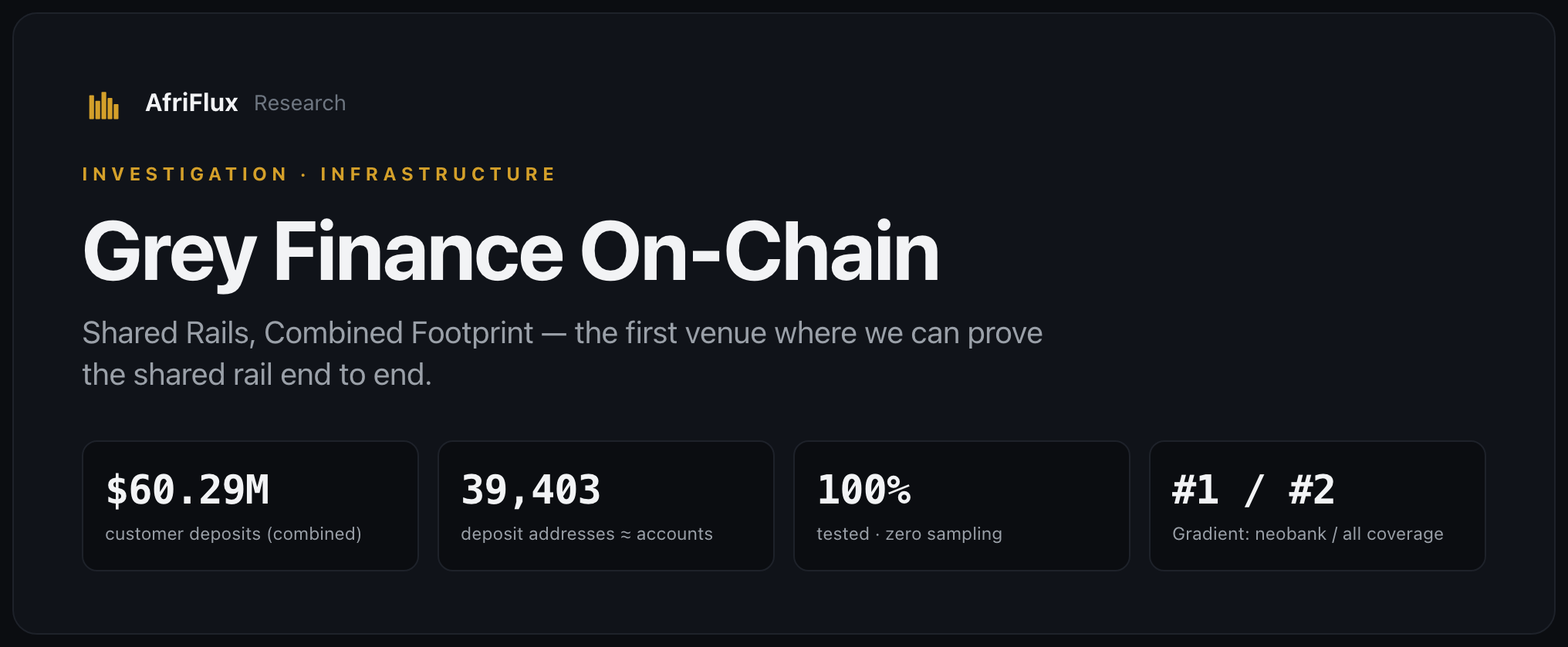
We mapped the wallets instead, and tested every single one. 39,403 deposit addresses across four chains, carrying $60,294,354 in customer deposits — each address individually verified against a 95% leak-back rule. Six failures, all of them entities routing their own money, not customers.
The product tells you what a company offers. The wallets tell you how the infrastructure actually operates. Sometimes those are two very different things.
What the wallets show is bigger than a product launch. Grey's Personal and Business products run on the same on-chain infrastructure — the same masters, the same provisioning, the same sweeping. There is no clean on-chain boundary between them. This is the first venue in the AfriFlux set where we can prove that shared-rail structure end to end, and it changes how the whole category has to be measured.
One infrastructure, two sides of the business
Grey does not run two separate on-chain systems for Personal and Business. We know because we tested it directly — funding both products and watching where the money went. On BSC and Solana our Business deposit swept to the same master that collects Personal deposits, and the same master paid the withdrawal. On Tron our Business deposit sat unswept, but the master that settles Grey's Tron withdrawals paid both our Personal and our Business ones.
Different addresses, identical infrastructure: common gas funding, common provisioning, common sweeping, common settlement. That is not a limitation of the mapping. It is a fact about how Grey is built — and it forces one honest choice: measure the combined footprint and state clearly what it contains. Forcing a split that does not exist on-chain would be a fabrication.
The combined footprint, month by month
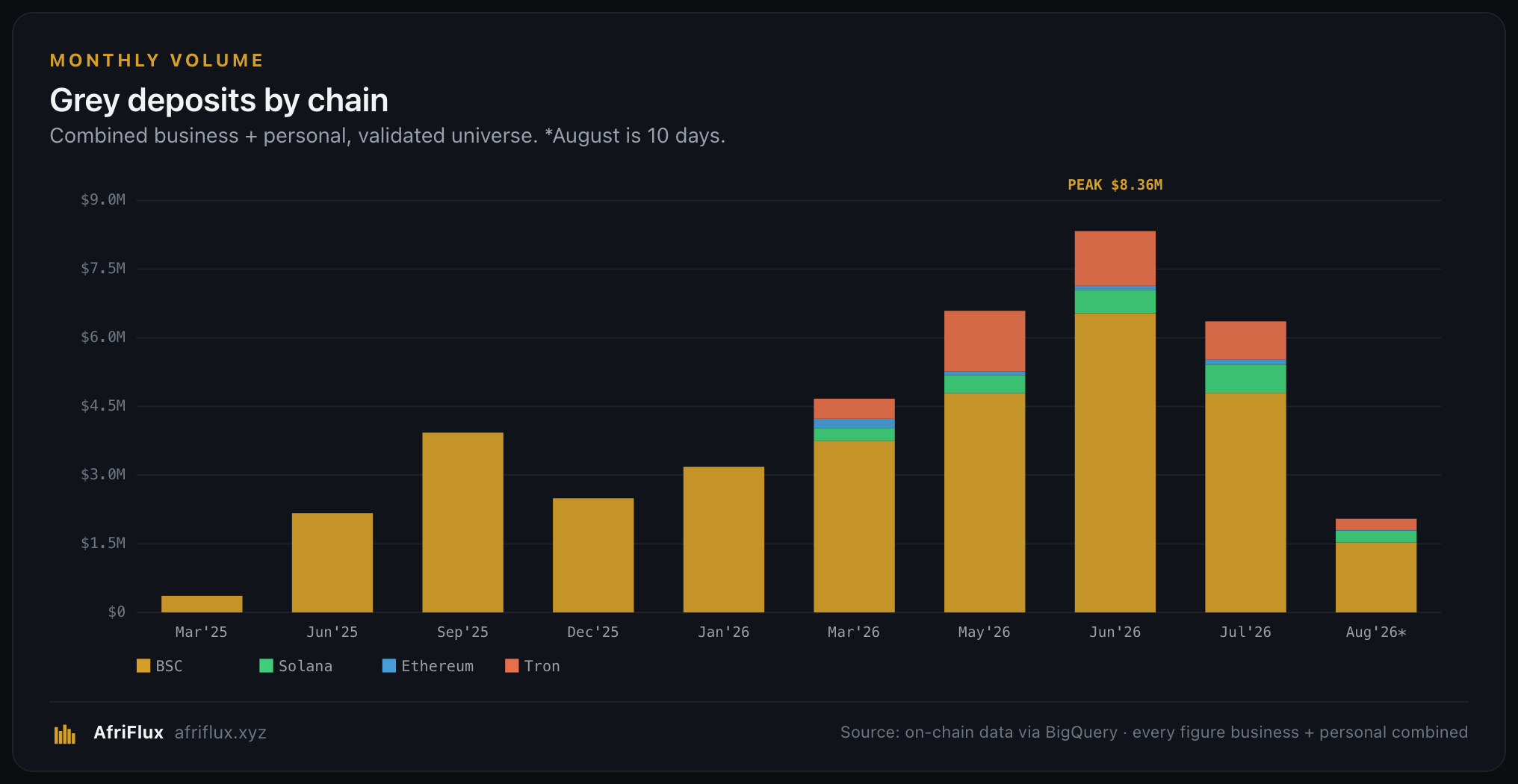
BSC has been the spine since March 2025; Solana, Ethereum and Tron were all added as retail rails in 2026. Volume compounded to a June 2026 peak of $8.36M before a July step-down — even as new accounts hit a record.
2026 has already doubled all of 2025
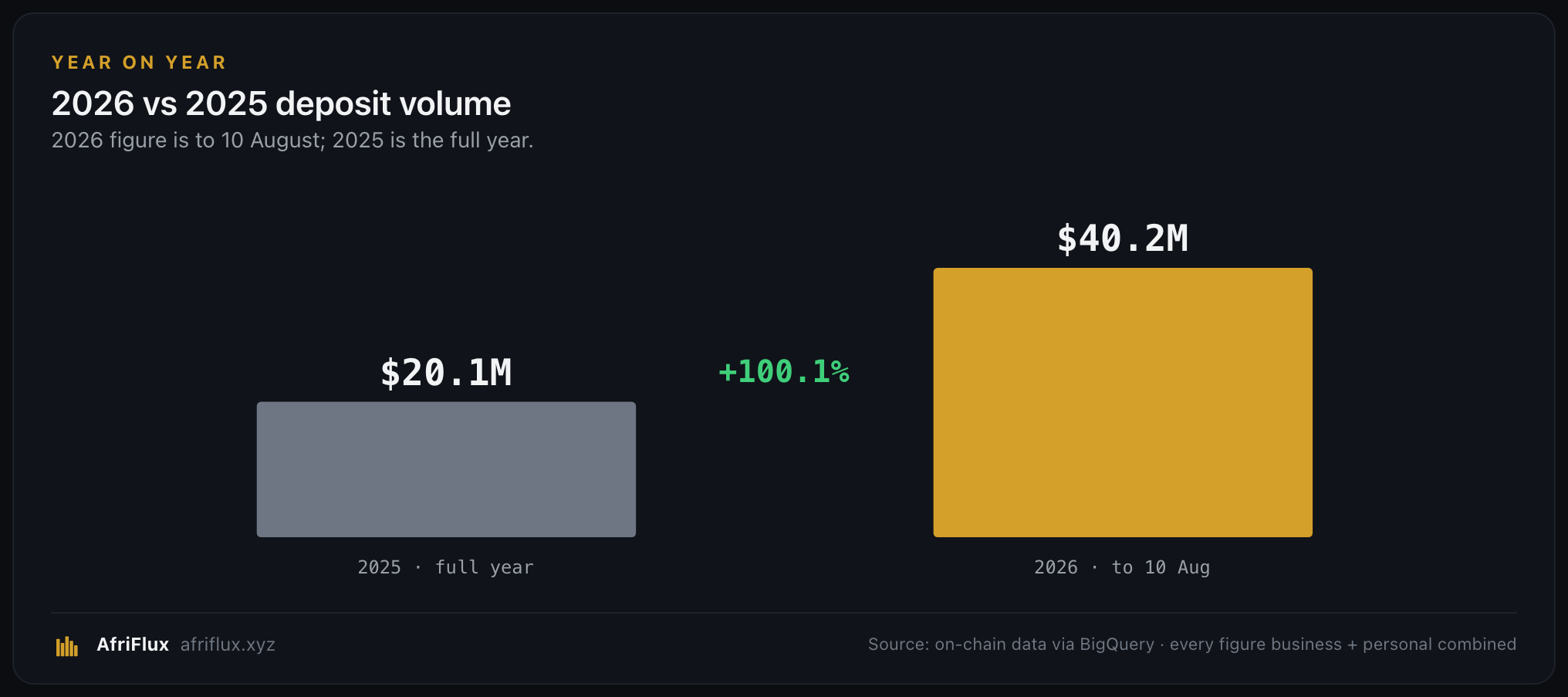
With nearly five months still to run, 2026 has already doubled the entire prior year — to the decimal. And the growth is broader than it is deep: volume doubled while the depositing wallet base grew far faster still.
The token mix inverted
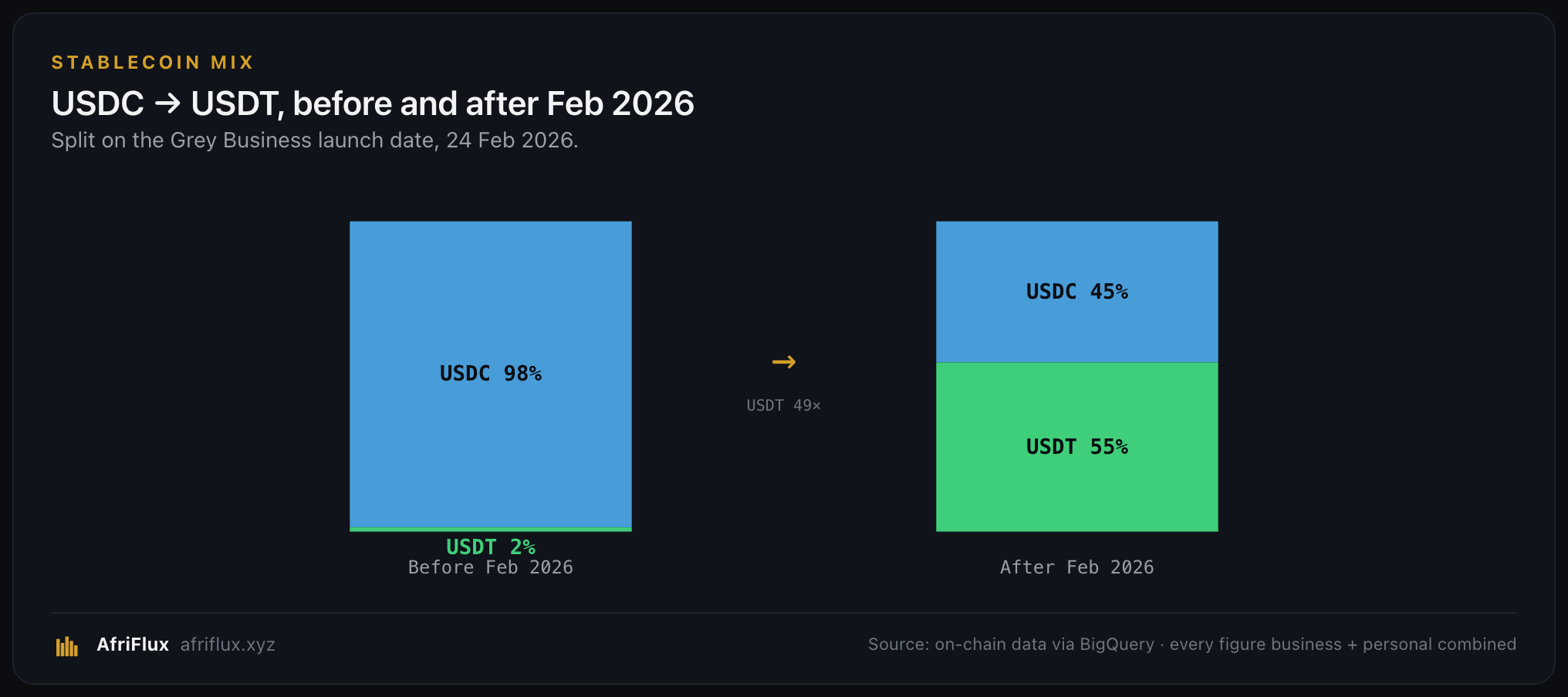
This is the sharpest before/after in the dataset. Grey went from a 98% USDC business to a USDT-majority one in six months. USDT volume grew 49x while USDC volume actually fell. The chain chooses the token, not the user — Grey issues one address per chain per account, so adding Tron (100% USDT) is adding USDT.
Consumer-shaped, with no whale
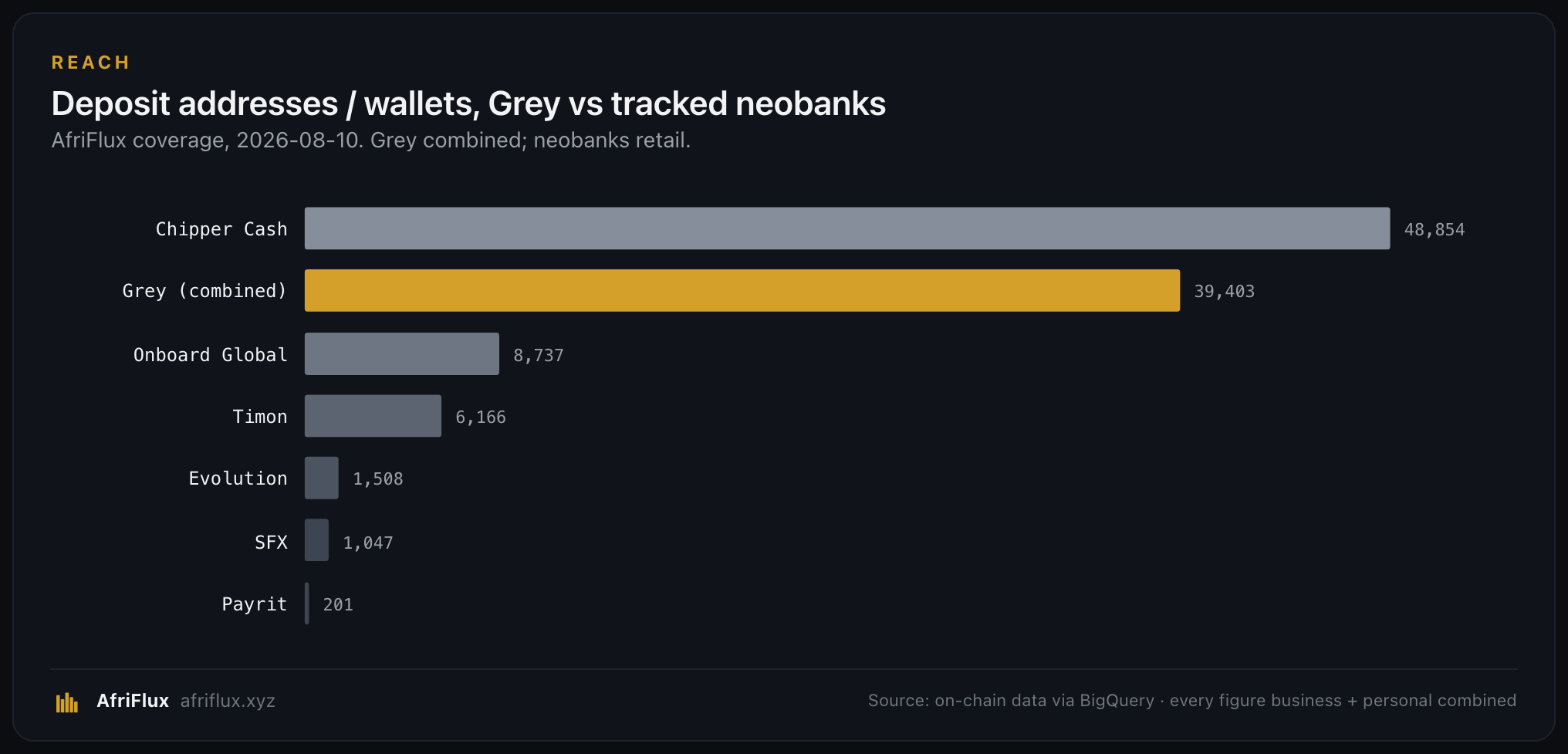
Grey's deposit base is consumer-shaped and deep: 39,403 addresses — the second-largest among the neobanks we track, behind only Chipper Cash (48,854) and well ahead of the rest of the category. Measured the same way (deposit addresses, not active wallets), and there is no whale in it: Grey's largest single depositor is 0.3% of BSC volume, and it takes roughly 1,000 addresses to reach two-thirds of the total flow. Because Grey issues a permanent address per account, that count is a defensible proxy for accounts — a claim few venues support. Across our wider coverage only the big exchanges and offramps (Roqqu, Spenda, Quidax) run larger address bases still.
Then something changed: the Tron collection halt
The clearest signal in the data is not a volume number. It is an infrastructure decision. Grey ran a 27-address Tron pilot for four months, rolled out 2,113 addresses in May 2026, then stopped provisioning entirely on 10 June. Nothing since.
Existing addresses did not go quiet — they kept receiving deposits, $840,688 in July alone. What stopped was Grey's collection. Only 49.5% of funded Tron addresses have ever been swept, and $3,149,710 of customer money sits uncollected in addresses Grey controls. The residual ages the wrong way for a backlog: a queue clears oldest-first, but the May cohort still held $331,350 three months later, and the total grows every month.
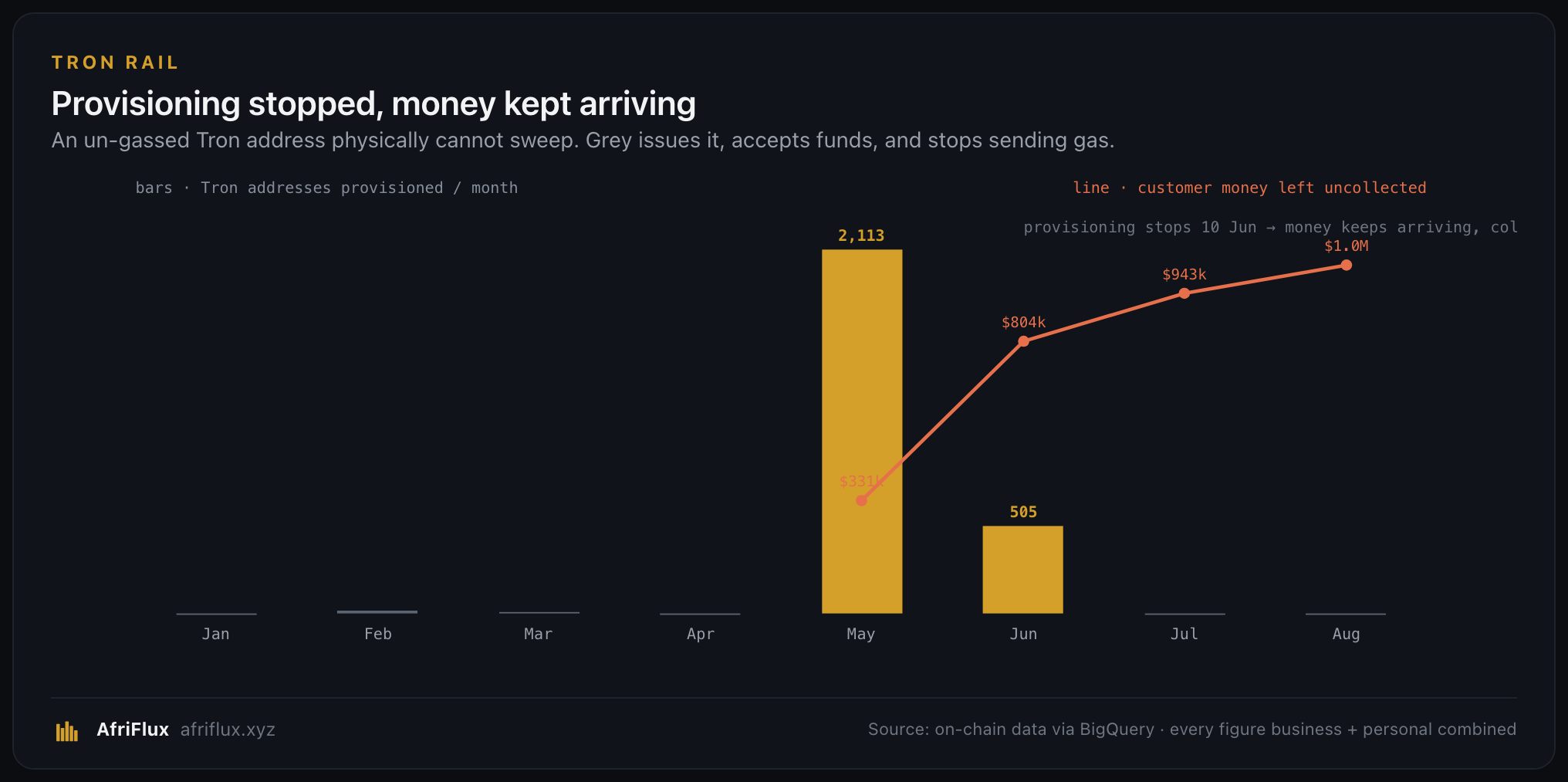
The evidence points to a collection halt, not a loss. The funds remain in Grey-controlled addresses and are recoverable through subsequent collection. But no product announcement would ever tell you it happened.
Where Grey sits — the AfriFlux Gradient
Lifetime volume measures scale. It does not measure momentum. The AfriFlux Gradient measures both — Scale (this-quarter volume, lifetime volume and market share) against Momentum (how much of a venue's all-time flow is happening right now), refreshed every quarter as a citable scoreboard. On lifetime volume alone, Chipper Cash is the largest tracked neobank ($65.8M) and Grey's combined footprint sits just behind ($60.3M). Score them on the Gradient and the order flips hard.
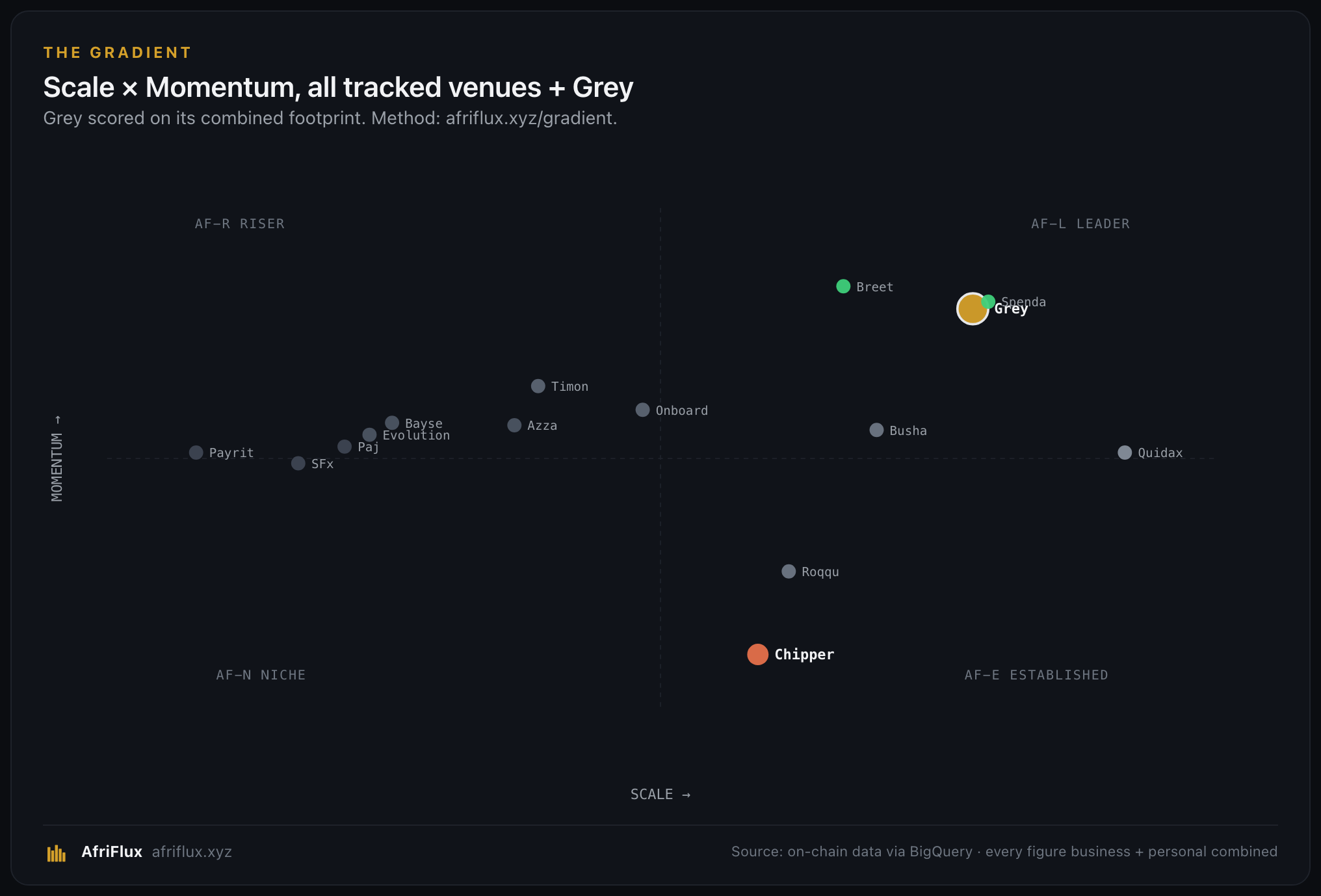
Dropped into the neobank set on the Gradient's own formula, Grey enters at #1 — AfriFlux Score 90.4, rated AF-L Leader — topping both axes. Chipper, the lifetime leader, lands at AF-E Established: real scale, near-dead momentum. Across the 14 venues we already track, Grey's combined footprint would rank #2 overall, ahead of Quidax and its $277M book, and only two venues (Breet and Spenda) outpace it on momentum.
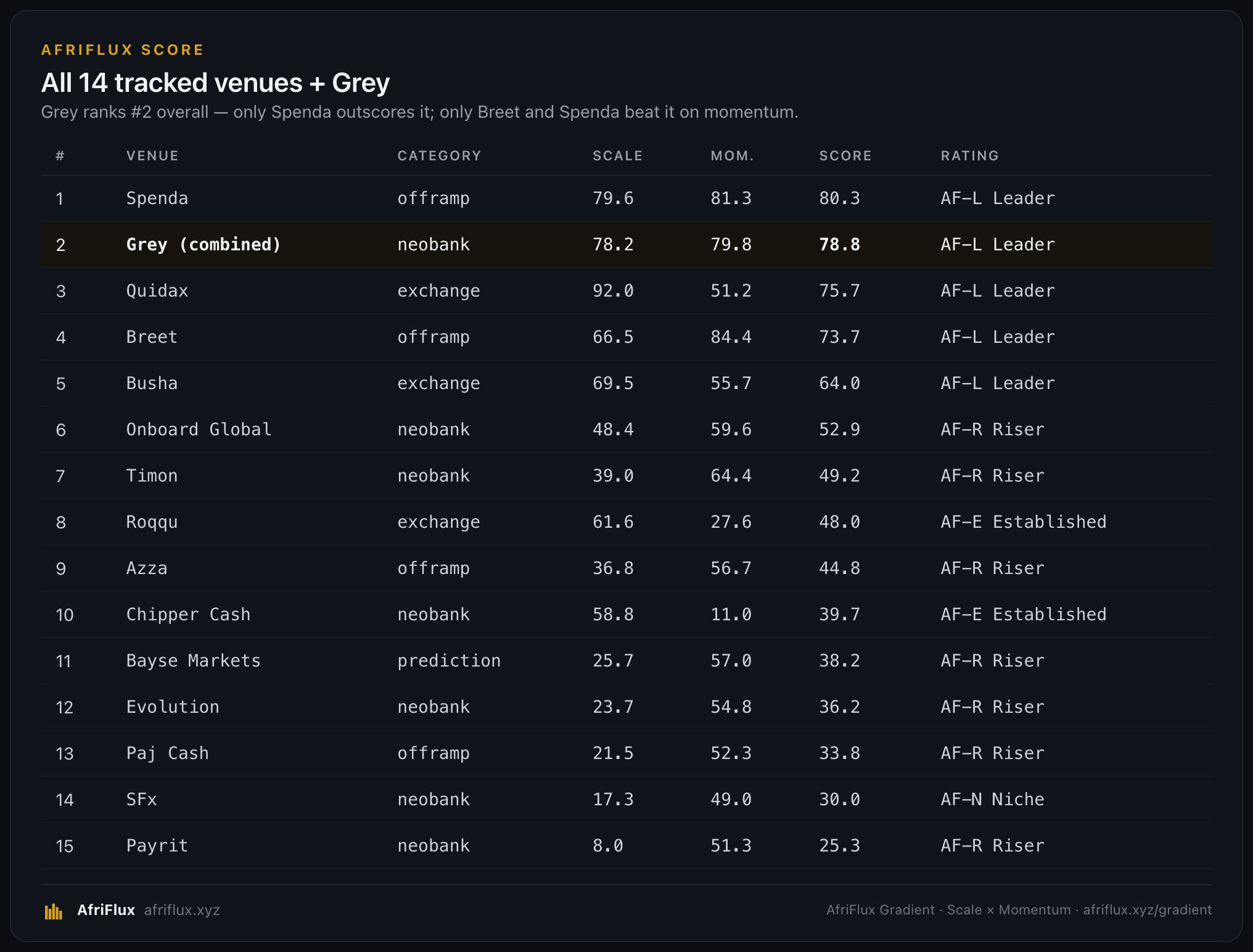
The prediction, on the framework's own terms
Read purely by size, the leaderboard barely moves and Chipper looks like the neobank to beat. Read by the Gradient, Chipper is a mature business past its own peak share, and Grey is the one venue combining top-tier scale with the highest momentum in the neobank set. If the trend holds — 2026 already double 2025, a run-rate roughly seven times Chipper's recent quarter, new accounts still setting records — Grey does not just enter the category. It enters at the top of it.
On lifetime volume, Chipper edges Grey. On the Gradient — the only measure that weighs momentum — Grey is the highest-rated neobank in our coverage, and the second-highest venue overall.
One caveat, stated plainly: this score runs on Grey's combined footprint, because that is all the chain lets us measure. Even a conservative retail-only slice keeps Grey in Leader territory, since the rating is driven by trajectory rather than raw size — but the exact placement firms up when the business/retail framework lands, and we will restate it then. The same map comes out every quarter, which is what makes it a scoreboard you can build a decision on.
Methodology
Structural enumeration, never a dollar threshold. Every deposit address was found from a structural anchor — Grey either gas-funded it, relayed its sweep (EIP-7702, the ERC-7821 selector 0xe9ae5c53), or sponsored its transaction fee (Solana, Fireblocks co-signed; Tron, a hardcoded 60.0000 TRX gas drop). Fleets are discovered from the master's own transactions, classified by mechanism — never from a single mechanism, or a whole generation of addresses disappears.
The 95% leak-back rule. Each candidate is then tested individually: does at least 95% of its stablecoin outflow return to Grey's master? These are single-purpose addresses — they receive, they sweep to the master, they do nothing else — which is exactly what makes address ≈ account hold.
Exhaustive, not sampled. 39,403 of 39,403 addresses were tested across all four chains — no thresholds, no confidence intervals. The six failures are each an entity moving tens of millions of its own money (the largest moved $66.5M), all excluded, so the columns sum exactly to $60,294,354. The $3.1M uncollected on Tron was checked against live on-chain balances, with the top holders matching to the cent.
What this is, and isn't. Validation is complete; enumeration is still a floor — an address Grey issued and never gassed has no on-chain link at all. This is the flow across the venues in AfriFlux coverage, not a census of the whole market. And above all: every figure here is business and personal combined, and no number in this report should be read as a retail figure.
Ratings per the AfriFlux Gradient (Scale × Momentum). Method: afriflux.xyz/gradient · launch note: afriflux.xyz/feed/the-gradient-scale-vs-momentum · afriflux.xyz/feed/venue-momentum-share-shift.