On 4 August 2026, Hurupay announced it was now Kolan. The legal entity didn't change — Hurupay Inc. is still the company and Kolan is a registered DBA. No contract was redeployed, no wallet migrated. From the outside it was a logo and a domain.
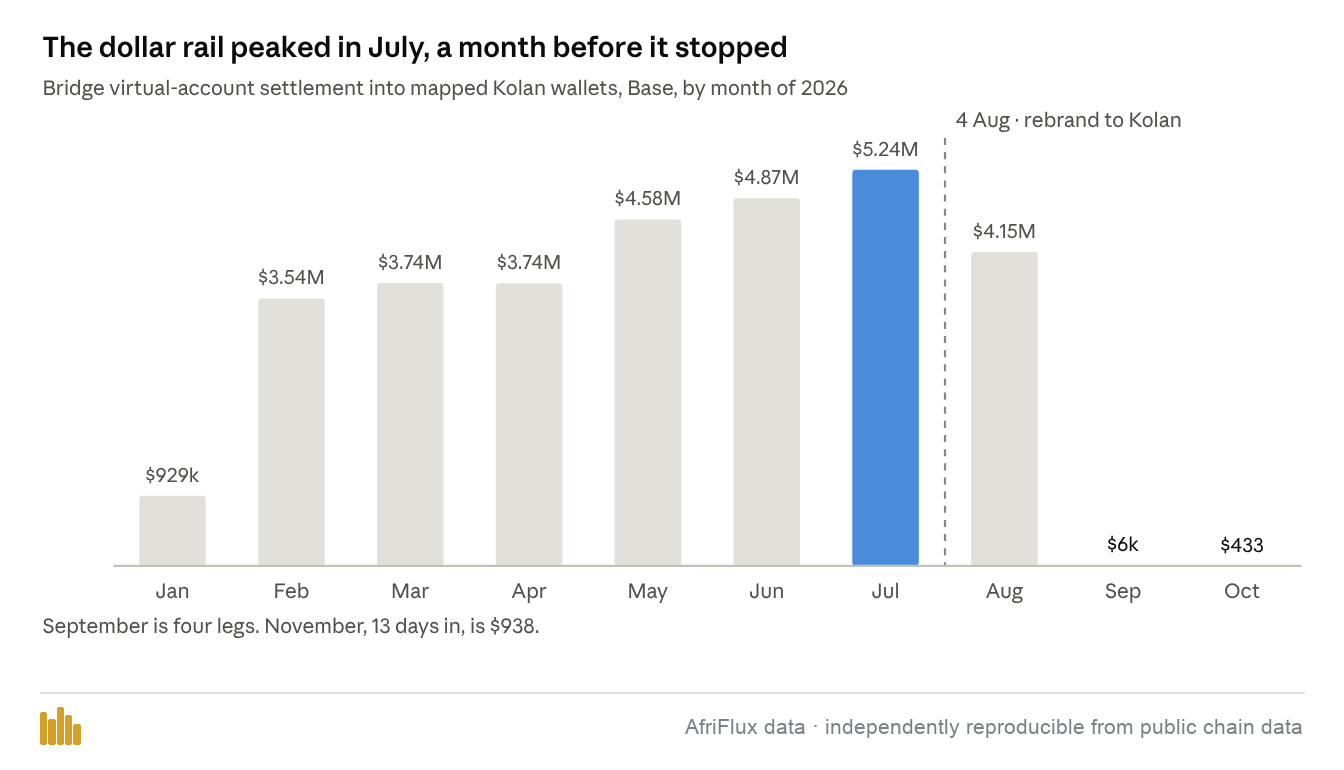
Four weeks later, the largest flow of money into the product stopped appearing on-chain. The chart at the top of this page is that fact: eleven months of dollar settlement into wallets we can map to Kolan, and then a cliff.
In July 2026, virtual dollar accounts issued through Bridge settled $5,240,549 into wallets we can map to Kolan — the highest month on record. In August, through the rebrand, $4,153,347. In September: $6,057, across four legs.
This piece is about the gap between those two facts, and about what it takes to say anything honest about it.
What Hurupay actually was
Kolan's earliest on-chain footprint is 27 January 2025, and it isn't Kolan's. It's a transfer from Bridge, the virtual-account issuer, into a user's wallet. Kolan's own infrastructure doesn't exist yet — the first of its routers appears around mid-January 2026, a full year later.
That ordering is the story in miniature. Before Hurupay built anything, it was already distributing dollars.
The product was a US dollar account. Bridge issues the account, someone gets paid into it, and the balance appears as USDC in a self-custody wallet on Base. The crypto is the settlement experience, not necessarily the source of funds.
Across the whole fleet we can observe, $31,091,404 arrived from Bridge in 18,580 legs — 79.8% of the $38.96M of gross inflow we can see.
Take Bridge out and what remains is smaller than it looks. Strip internal transfers and Kolan's own operational wallets, and genuine external stablecoin deposits come to at most $4.4M. Only about $484,000 of that arrives from a counterparty we can name as an exchange, and a good part of even that is one Bybit hot wallet that only started paying Kolan in September. The rest is unlabelled, and some of it may itself be fiat infrastructure we haven't identified. The $4.4M is a ceiling, not a measurement.
So: a dollar-account product with a crypto back end. Everything after August reads differently once that is established.
The business before the rebrand
Hurupay was not obviously in trouble going into the rebrand. The opposite.
| month | Bridge funding | module volume | active wallets | observable fees |
|---|---|---|---|---|
| 2026-06 | $4,865,105 | $5,885,257 | 3,695 | $6,697 |
| 2026-07 | $5,240,549 | $5,622,606 | 3,703 | $9,961 |
| 2026-08 · rebrand | $4,153,347 | $4,520,767 | 1,574 | $5,940 |
| 2026-09 | $6,057 | $1,021,394 | 968 | $1,204 |
| 2026-10 | $433 | $964,979 | 956 | $1,392 |
June was the product-volume peak. July was the funding peak and the best fee month on record. The rail was still running in August, after the rebrand.
Two timelines
The announcements and the chain do not line up.
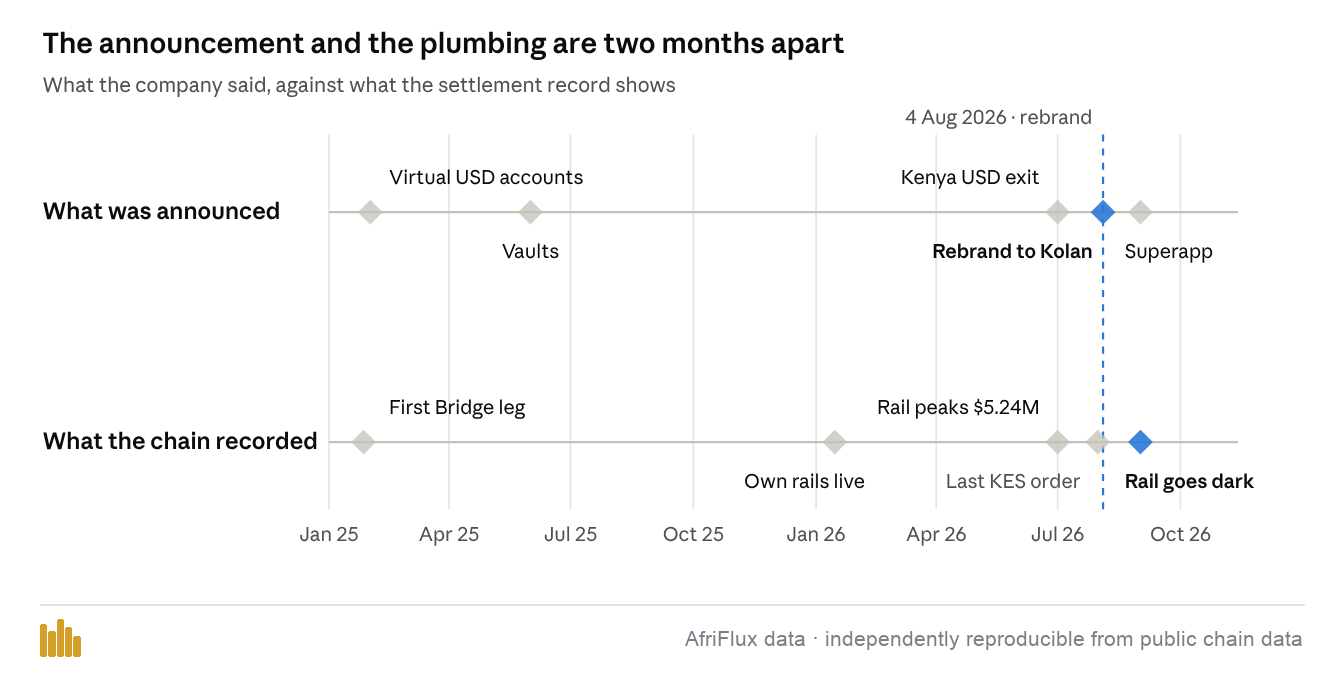
On 13 July 2026, Business Daily reported that Hurupay had stopped processing cross-border transfers and crypto in Kenya. The company's own email to customers, quoted in that story, said it "no longer supports USD banking services for customers in Kenya." That same month, the dollar rail recorded its highest figure ever.
On 4 August 2026, the rebrand. That month the rail carried $4.15M — lower than July, higher than any month before May.
In September 2026, it effectively stops.
Announcement and plumbing are two months apart. That gap is not visible in a press release, a funding round or an app-store listing. It is the specific thing a settlement record can contribute, and it is why this piece exists.
On the cause, the reporting is thinner than it looks
It is tempting to write that Kolan was pushed out of Kenya by money-laundering scrutiny. The sourcing does not support it.
Business Daily's story ran under an anti-money-laundering headline, but says in the body that "Hurupay did not disclose the reasons for the decision." The AML framing is the newspaper's own, and it presents Kenya's position on the Financial Action Task Force grey list as background — the country has been under increased monitoring since February 2024 — not as the cause. Crypto outlets then recycled the story as grey-list-driven, which is an interpretation layered on an interpretation.
The company rejects it outright. Hurupay told TechCabal in an email in August that the decision "had nothing to do with grey-listing or the money laundering assumptions," and was instead about "slow processing times and unreliability from our banking partners."
TechCabal's own assessment is the fair one: grey-listing is "a background risk, not proof that it caused a specific product change."
So no cause has been established by anyone. What this piece adds is not a cause either. It is a measurement — of when the money actually moved, which is two months later than the story implies.
The cohort is real, but smaller than reported
Kolan was not the only provider to change its Kenyan service. Over roughly a year, PayPal froze Kenyan accounts in June 2026 after demanding proof of employment and residence; Zepz paused the Sendwave Wallet in early July, citing technical difficulties; Twitch ended Kenyan creator monetisation from September 2025.
Wise is usually named alongside them and should not be. It told TechCabal that "it would be inaccurate to say that Wise restricted its services," while acknowledging that individual accounts can be restricted by routine identity checks. We note the dispute rather than resolve it.
Where the chain agrees, and where it doesn't
The Kenya exit shows up in one place beyond the dollar rail. Of the four currencies in Kolan's off-ramp book, KES is the only one that terminates — 84 orders and $8,589 in total, the last of them on 21 July 2026, eight days after Business Daily ran the story. Naira, Ugandan shilling and Tanzanian shilling all run to the present.
KES was thin, around five orders a month, so four months of silence is consistent with the exit rather than conclusive on its own. But it is the only currency that stops, and it stops on the date.
One reported claim the settlement record does not match: Business Daily wrote that the firm had also "removed Nigeria from the list of African countries it serves." The naira route did not stop. Naira is by far the largest currency in the off-ramp book — 7,392 orders and $496,684, 85.4% of its lifetime value — and it has an order in every single month before, during and after July 2026. It fell hard in August, along with everything else, and then recovered: October 2026 was 200 naira orders and $21,768, the third-largest naira month on record, and November was already fourth-largest twelve days in.
So whatever was removed — a country list on a website, new sign-ups, the naira virtual account — it was not the crypto-to-naira route, which is the one we can see. We flag the conflict rather than resolve it: a served-countries list and a settlement record are not the same object, and only one of them is in front of us.
One thing that did not happen: a refund spike. Hurupay's email told Kenyan customers that incoming payments would be "rejected and automatically refunded to the sender." That is a fiat-side event — a dollar payment bouncing at a bank account — and it cannot appear in a crypto-to-fiat order. In the off-ramp book, refunds fell through the whole period: 5.2% of value in June, 5.5% in July, 4.2% in August, 2.6% in September. Right word, wrong ledger.
The infrastructure stress test
The obvious objection to the last section is that we stopped looking properly.
We didn't.
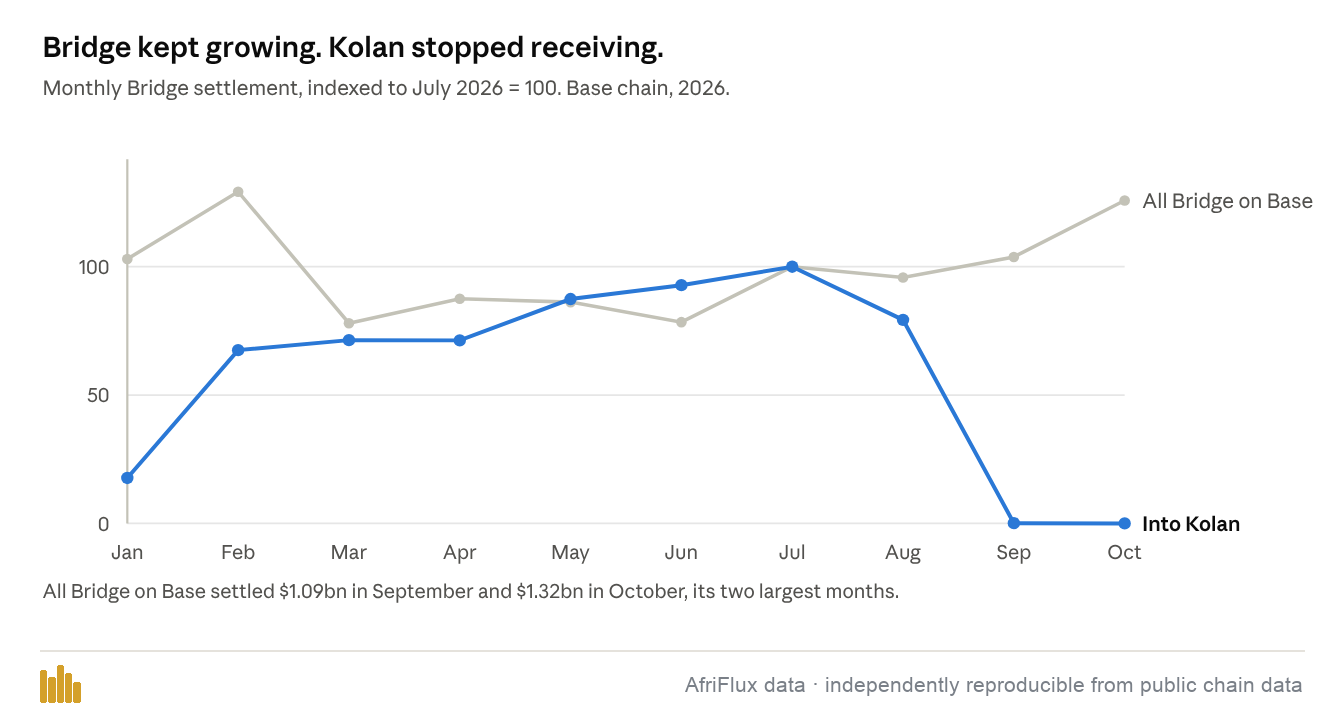
Bridge settled $1.09bn on Base in September across 717,172 legs to 140,914 recipients, and $1.32bn in October — its two biggest months on that chain. Across our whole Bridge record, seven chains from December 2024, it has carried $13.70bn and was still settling on 13 November 2026. The provider is fine. Kolan specifically stopped receiving.
The second objection is that the business simply moved somewhere else. We tested that too, and it is the strongest single result in the file.
Kolan runs a second, older rail on BSC with a completely different architecture. There is no router and no gasless relay: the relayer drips gas, the wallet signs for itself, and a flat $0.50 fee goes to a fee sink. That makes the fee sink an exact action counter.
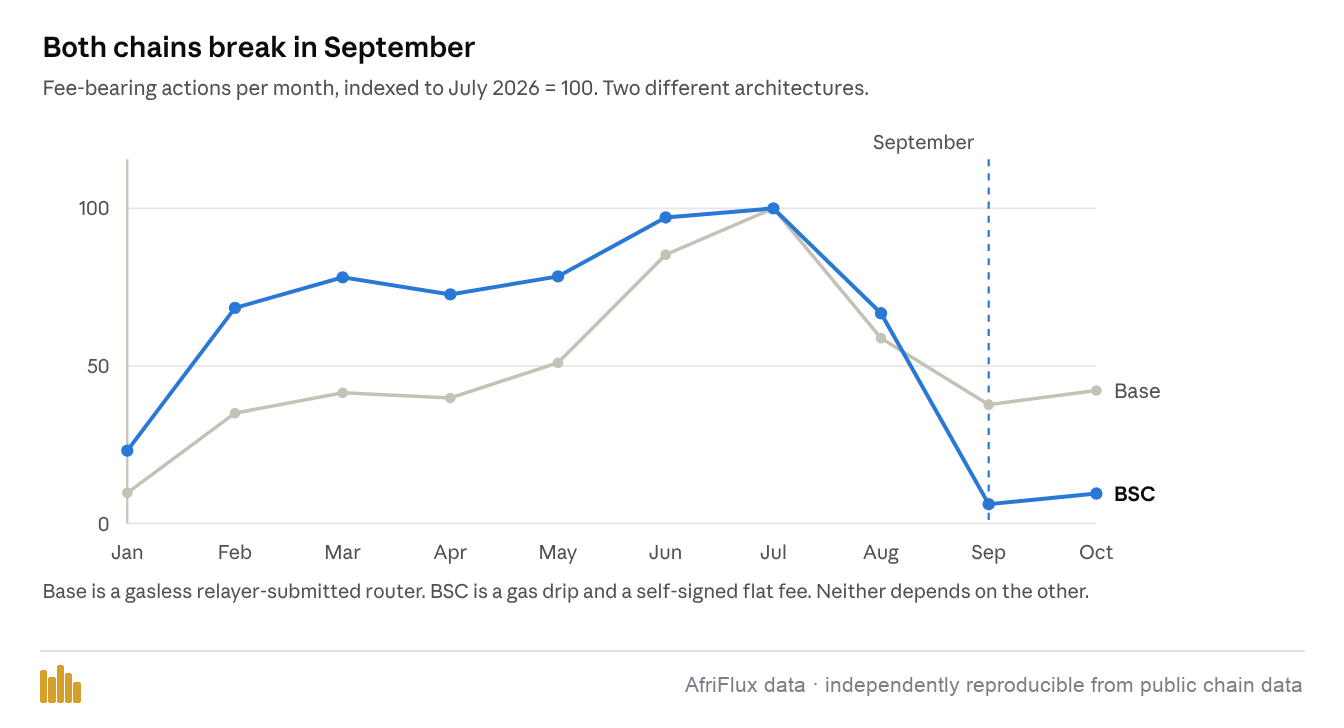
BSC lost 91% of its actions in September against August — the same month as Base, on a different chain, a different fee model and a different custody mechanism. Nothing migrated. A provider swap on one chain cannot do that. Whatever happened reached the whole product.
BSC is small in absolute terms: 4,330 actions and $2,236 in fees, ever, across 973 wallets. Its value here is not its size. It is a second, independent observation of the same break.
What the superapp delivered
By September, Kolan was a superapp: perpetuals, prediction markets, tokenised stocks, cards. The chain can price the parts that settle on-chain, and the figures are small.
- Perpetuals and prediction markets together: about $4,348 in observable lifetime activity. For perps specifically, $3,227 across 61 transactions, and 82% of it falls in the rebrand month — a launch spike, then very little.
- Yield. Vault activity had stopped by February 2026, before the rebrand.
- Cards, issued through Rain: 168 cards across 164 wallets, and $1,895 in measured issuance fees. This is the one new product with real adoption.
- The naira off-ramp: $562,537 lifetime at the time of the product review, 85.4% of it naira.
Cards deserve care, because they complicate the story. Card revenue fell from roughly $750 a month to roughly $190 while cards issued rose from 28 to 49. The reason is a tier change: a $3 tier appeared in October and displaced the $15 tier, and a $50 tier also sold in the observed period. What the chain shows is a change in what people bought — it does not establish that the $15 product was repriced. Cards fell from about 58% of observable fee income to about 14%.
The card cohort also behaves differently from the historical dollar-account base: card holders transact about twice as often, at roughly a quarter of the median value. A different kind of user, not a continuation of the old one.
And the line that actually broke isn't a new product at all. Cross-chain — the 0.335% fee line, the most profitable thing on the menu — fell from $2,193,937 in August to $48,545 in September, down 97.8% in a month.
The money got smaller
October: $964,979 of observable module volume, $1,392 in observable on-chain fees, 956 active wallets. Across the mapped rails Kolan records roughly $1,300 a month in fees. That is not company revenue — it is what the rails we can see collect.
The shape of the decline is the analytically interesting part.
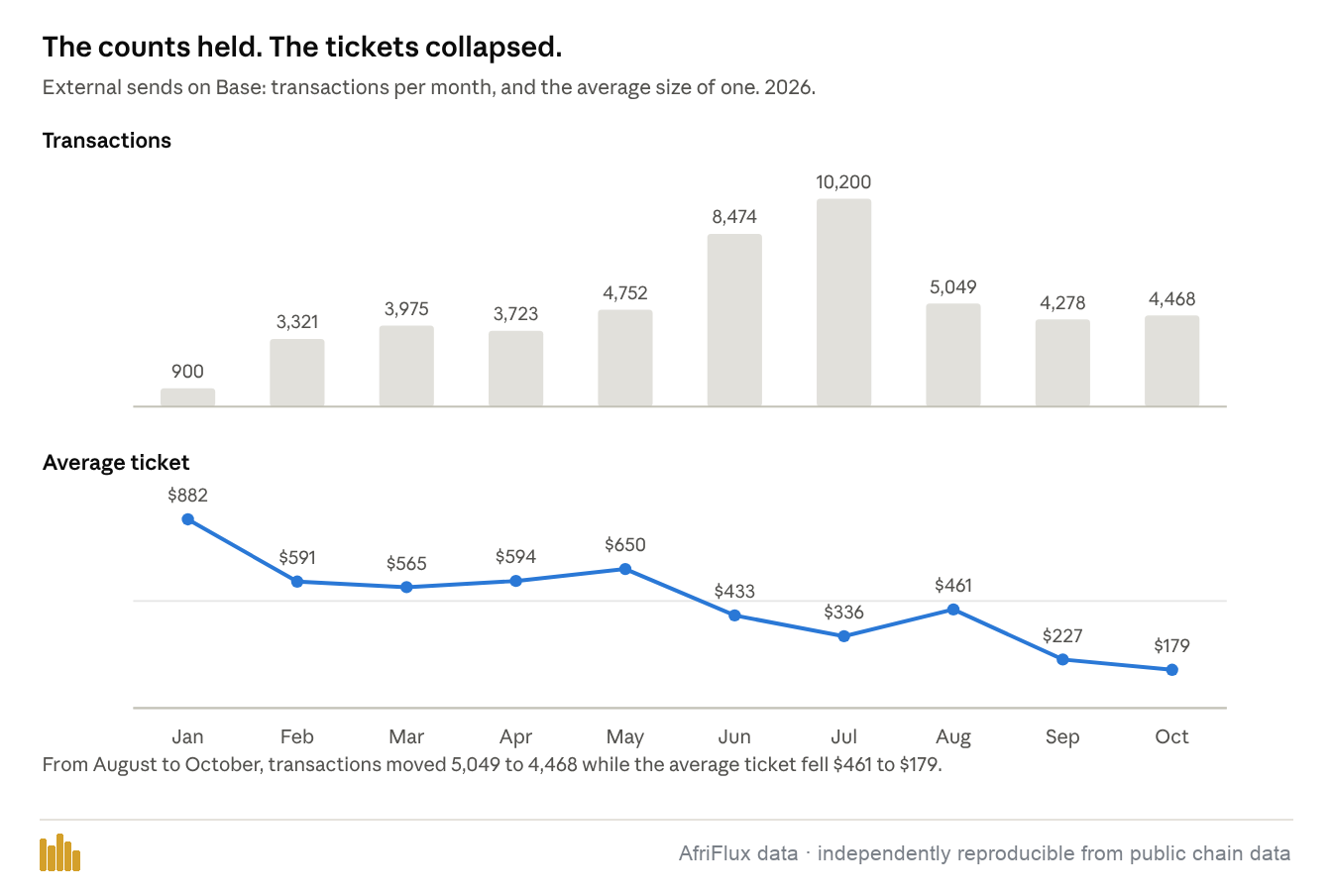
We are careful here. Flat transaction counts do not prove the same wallets kept transacting — that needs cohort evidence, and the cohort evidence says something different. What the counts support is narrower and still striking: activity continued at a similar frequency while the value moved per transaction fell by about 60%.
The acquisition curve is where it gets uncomfortable. June and July 2026 brought in 4,309 new wallets — 53% of every wallet the product has ever had, in two months.
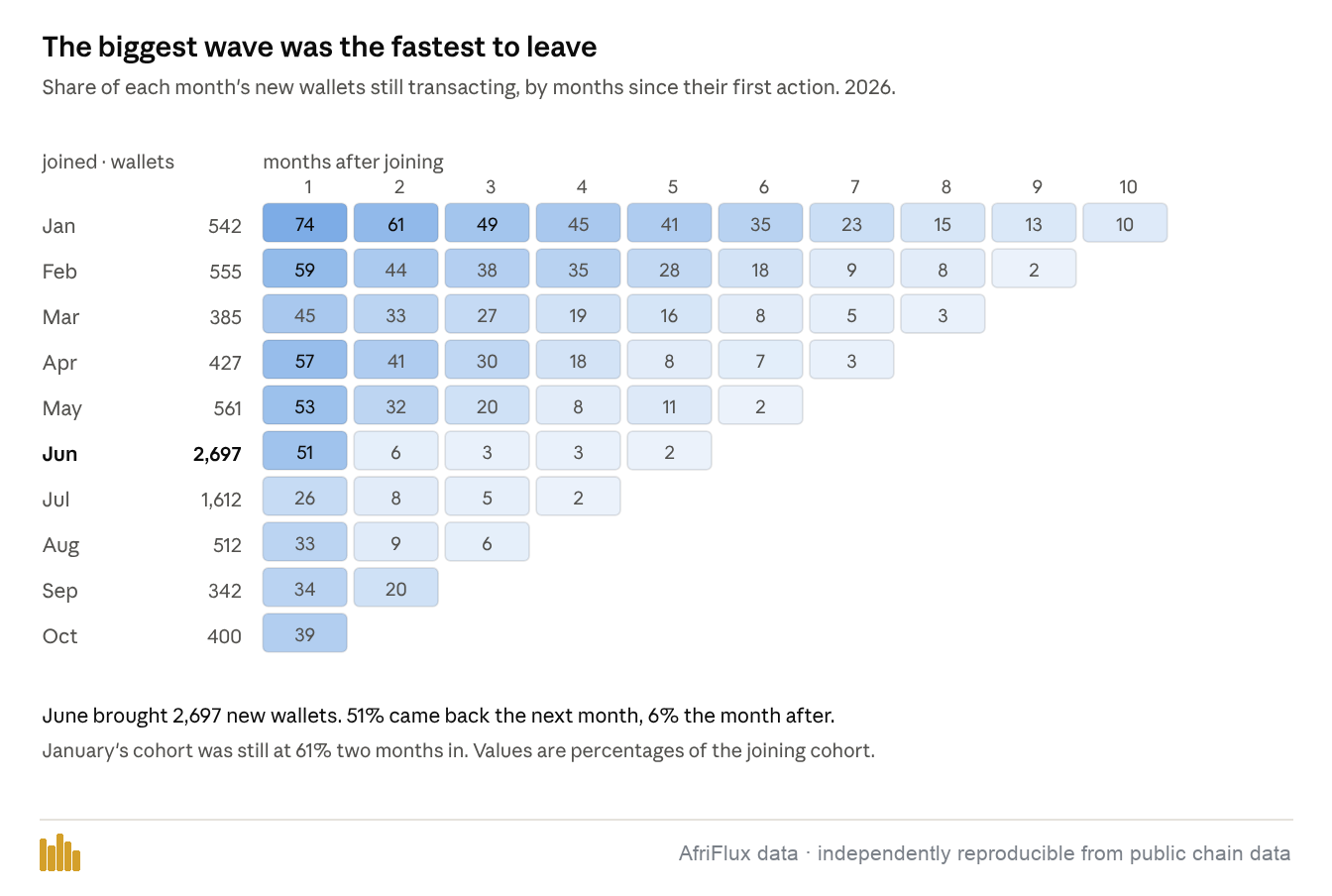
Read down the left column and the early cohorts look like a normal product: January's wallets were still 61% active two months in, 35% at six months. Read the June row and the campaign is visible as a different kind of event — 2,697 wallets, half of them back the next month, 6% the month after that.
By October, 12% of all wallets Kolan has ever seen transacted. The off-ramp book shows the same cohort failing to stick: 2,009 users, then 1,809, then 44.
The one line still moving
The naira off-ramp is recovering. October was 242 orders, $31,202 and 77 users across the whole book — the third-largest month in its history — and its share of observable flow has risen from 1.6% to 4.8% to 5.9%.
But it is still roughly 5% of flow. This is not an off-ramp pivot. Stripping out treasury movement, October's observable customer activity was 56.6% plain external sends at a flat $0.50 fee, 23.6% cross-chain and swap, about 10% genuine wallet-to-wallet transfer, and about 6.6% naira off-ramp.
Today Kolan is, on-chain, a send-and-withdraw app.
What we still cannot see
The dollar accounts are still being issued. A new virtual USD account was opened and passed KYC on 12 November 2026. The product did not die. What disappeared from mapped on-chain data is Bridge settlement into Kolan wallets. Someone is issuing those accounts now.
We tried to find out who, and failed. One address had the right silhouette. It appeared in mid-2026, 42.6% of its inflow is minted straight from the zero address — the signature of an institution with a Circle Mint account, which is exactly Bridge's shape — and it pays Kolan's cash-in treasury in bulk legs. We scanned its entire life on Base. It is not an account issuer.
| test | an account issuer | this address |
|---|---|---|
| minted into by Circle | yes | yes, 42.6% of inflow |
| pays each customer, mostly once | yes | 89,957 legs to 4,029 recipients — about 22 each; 38.8% paid once |
| money flows one way | yes | 15.4% of recipients also pay it back |
| leg sizes look like payouts | lumps in, payouts out | median out $67.23 |
| serves many venues | yes — Bridge pays 23 in our coverage | one, a single leg, $9.37 |
| stepped in when Bridge stopped | would have to | peaked in July, a month before, and has shrunk every month since |
Kolan takes 1.87% of its outflow. So the successor is unknown — not suspected, not narrowed. The one candidate was tested and eliminated.
Funded wallets that never transact are invisible to us. The fleet is built from on-chain actions, so a wallet that received money and did nothing leaves no fingerprint. We can find 64 of them holding $321,990, median $979, and we cannot bound the real figure: there are 557,307 Bridge recipients on Base, and the only way to tell which are Kolan's is an action these wallets never took. Every wallet count in this piece is a count of active wallets.
Card spend is unresolved. A $1 test purchase was still pending at the time of writing, inside the normal one-to-three-day settlement window. An absent on-chain leg at that point is not evidence of off-chain settlement.
Bridge may never have been the only provider. We measured it because we found it. A second USD rail we never identified would change the 79.8% figure.
What the case reveals
A company can own its interface, its customer relationship and its wallet experience while depending on somebody else for the actual issuance and movement of money. Customers see one app. Underneath, the service is assembled from providers whose names never appear on the screen.
When that arrangement changes, the economic shape of the business can change with it — and the first visible sign may be a number that stops appearing in a settlement record, two months after the announcement that was supposed to explain it.
Kolan's rebrand didn't break anything, and it didn't save anything. It sits one month before the rails stopped carrying the business, in the middle of a transition that is not finished. The interesting question was never whether Kolan survived the rebrand. It is who issues those dollar accounts now — and on that, so far, the chain is quiet.
Get the next investigation in your inbox. The Sweep is our Monday newsletter — one attributed on-chain number a week, with the method attached. Subscribe →
Methodology and definitions
Scope. This is observable on-chain activity across the venues AfriFlux tracks — not a census of the market, and not a company's books. Kolan settles on Base, through a gasless relayer-submitted router, and on BSC, through a gas drip and a self-signed flat fee. Both are included.
The fleet. Wallets are discovered from fee-bearing actions — module events on Base, fee-sink payments on BSC — and only then measured for inflow. Kolan is non-custodial: a deposit into a user's own wallet carries no Kolan fingerprint, which is why actions come first and deposits second. 8,285 wallets are in the mapped fleet; 8,139 have produced at least one module event.
Counting the dollar once. Gross inflow, module volume, treasury inflow and treasury payouts are different hops and different measures, and are never added. Bridge reaches users two ways — directly, and via Kolan's cash-in treasury — and is counted at the Bridge hop only.
The cash-in treasury. One address takes bulk legs from fiat providers (35 Bridge legs averaging $37,800) and makes thousands of small payments out (median $166, with 0.5% of outflows pairing to an inflow within five minutes and 0.3% counterparty overlap). It is the on-chain half of a fiat deposit, not wallet-to-wallet transfer, and it is excluded from customer activity.
Module volume is the first leg of each router transaction. The module is a pass-through — in equals out to the cent — so summing all three legs would treble-count.
Units. Wallets, never customers. Observable on-chain fees, never revenue. Upper bound where a figure is a ceiling.
Known blind spots. Funded-but-inactive wallets; off-chain product activity; card settlement; the identity of the current account issuer; and whether Bridge was ever the only one.
Published sources, and what each supports
| source | date | what it supports here |
|---|---|---|
| Business Daily, "US crypto firm exits Kenya amid anti-money laundering scrutiny" | 13 Jul 2026 | That the Kenya USD banking service ended, the customer email's wording, that the firm gave no reason, and that Nigeria was removed from its served-countries list. Not that AML caused the exit. |
| TechCabal, "The platforms that help Kenyans get paid are changing the rules" | 8 Sep 2026 | The company's statement and its attribution; the rebrand to Kolan in August; the PayPal, Sendwave and Twitch timeline; Wise's denial; and the judgement that grey-listing is background risk, not cause. |
| Business Daily, "Global firms block Kenya cash transfers in dirty money fears" | 18 Aug 2026 | The wider cohort of restrictions, and FATF's February 2024 listing of Kenya. Its characterisation of Wise is contested by Wise itself. |
What no source establishes. A cause. No regulator, no company and no reporter has shown why the Kenya USD service ended. This piece does not supply one either — it supplies a date.