Nigeria’s stablecoin money isn’t where you think it is
By AfriFlux · data: Q3 2026
Ask anyone in Nigeria what stablecoins are for, and you'll hear about people. Freelancers cash out dollars from foreign clients. People save in USDT. Traders move money between apps. That picture is accurate. It is also the smaller half of the story.
At AfriFlux we map Nigerian exchanges, offramps, neobanks and payment companies wallet by wallet. Across the 22 venues we track, 967 business-class accounts moved $2.26 billion in stablecoins between July and September. Over the same three months, 209,495 retail deposit addresses moved $493 million. Fewer than half a percent of the accounts carried 81% of the money we observed.
That is not an estimate of Nigeria's total stablecoin market; it is what we can see onchain. But within that view, the retail story everyone tells is the minority one. Most of the money is business money, and increasingly, it is businesses paying each other.
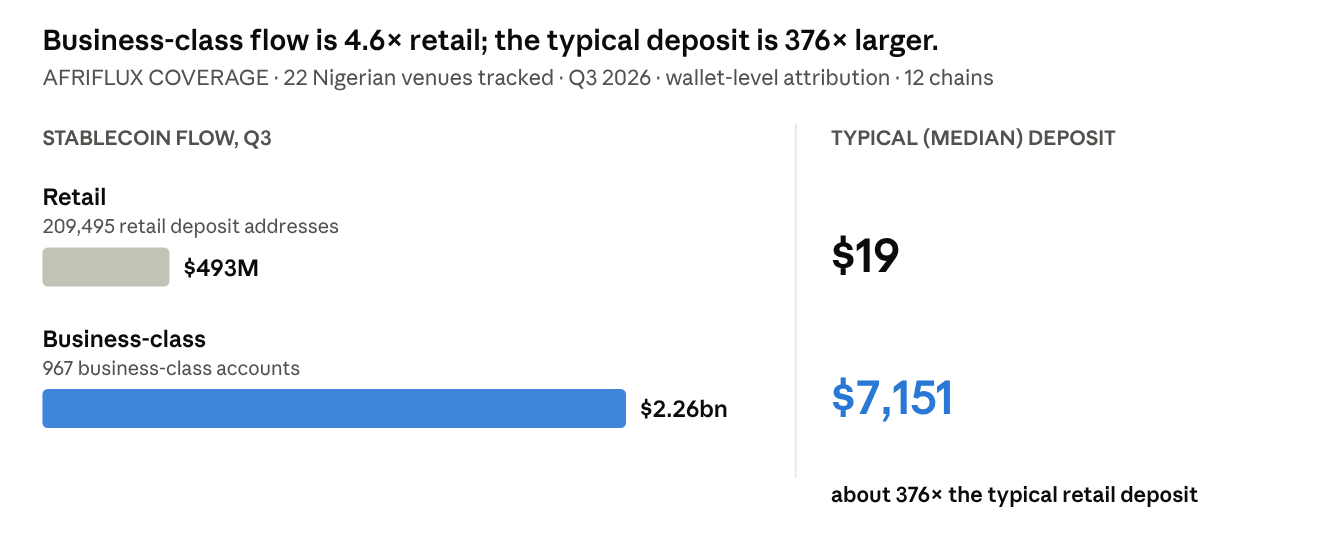
Source: AfriFlux observed coverage, Q3 2026 (1 July to 30 September), 22 Nigerian venues across 12 chains. Not an estimate of Nigeria's total stablecoin market.
A $19 market and a $7,151 market
The quickest way to see the split is a single deposit. The typical retail deposit in our Q3 data was $19. The typical business-class deposit was $7,151, about 376 times larger.
The rhythm is different too. A retail address made about nine deposits in the quarter; a business-class account made about sixty. Two in three retail addresses made at least two deposits; four in five business-class accounts did. Retail is many people making small deposits now and then. Business is a small number of accounts moving large sums constantly.
Both sides grew. Retail deposits rose 23% on the second quarter, from $402 million to $493 million, as about 59,000 more addresses started depositing. Business-class flow grew faster, by 40%, from $1.62 billion to $2.26 billion.
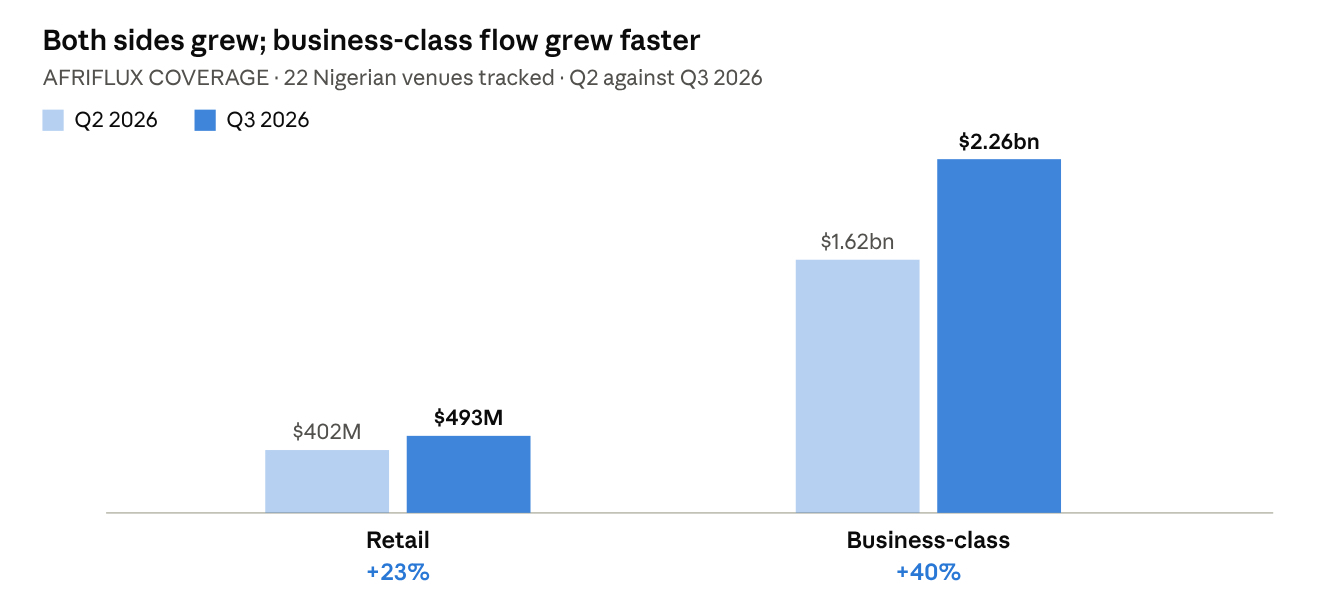
Source: AfriFlux observed coverage, Q2 and Q3 2026, same method both quarters.
Some venues, like Grey, Onboard, Raenest, and Accrue, serve both individuals and businesses through the same accounts. So, onchain, the two can't be clearly separated. We count their $35.6 million on its own rather than force it into either side.
CLASSIFICATION · We classify business activity by looking at on-chain behavior. This means we check the deposit size. We also look at confirmed company-to-company settlements. “Business-class” does not mean we have identified the legal entity behind every account.
A few big players carry the business side
Business money is concentrated. Obiex, an exchange where business clients use dedicated deposit addresses, saw $1.77 billion of business-class flow in Q3. This is an increase from $1.46 billion. Flutterwave's business-account flow rose from $62 million in the second quarter to $305 million in the third. Quidax's business-class flow nearly doubled, from $103 million to $190 million.
Flutterwave shows how lumpy this is. It had 186 business-class accounts in Q3; one carried 76% of the money and five carried almost all of it. Across all business-class flow, the top 1% of accounts moved a third of the value, up from under a quarter in Q2. That is why business flow can swing a headline number in a single quarter while retail moves steadily.
The part nobody announces: companies paying each other
The most interesting thing in the data is not size but shape. Nigerian fintechs and exchanges are settling with each other, wallet to wallet, every week. However, this activity isn’t visible in press releases or self-reported volumes.
We only name a relationship when the wallets show it. Payments go from wallets a company is known to control. These include its master and settlement wallets. Then, they move into the receiving company’s wallets or a specific deposit address. These payments must repeat over time. Five relationships met that bar in Q3:
-
Spenda to Quidax: $40.9 million in Q3. Master wallet to master wallet ($33.2 million), plus a Quidax deposit address that only Spenda funds ($7.7 million). Payments ran in all 27 weeks from April to September, and almost all of Spenda's payments to other companies go to Quidax.
-
Quidax to Obiex: $22.3 million. Quidax pays into Obiex business accounts every week, mostly into one deposit address that takes 82% of its inflow from Quidax.
-
Jeroid to Obiex: $4.3 million in Q3, paid every week, with a typical payment of $51,000.
-
Grey to Quidax: $2.8 million, master wallet to master wallet, mostly on Solana, in 26 of 27 weeks.
-
Azza to Daya Pro: ₦0.46 billion in cNGN since 24 August, the newest link. Azza is itself fed by solvers on the HyperFX exchange protocol, which sent it ₦0.38 billion in Q3. So naira stablecoin moves from an FX protocol, through one venue, into another.
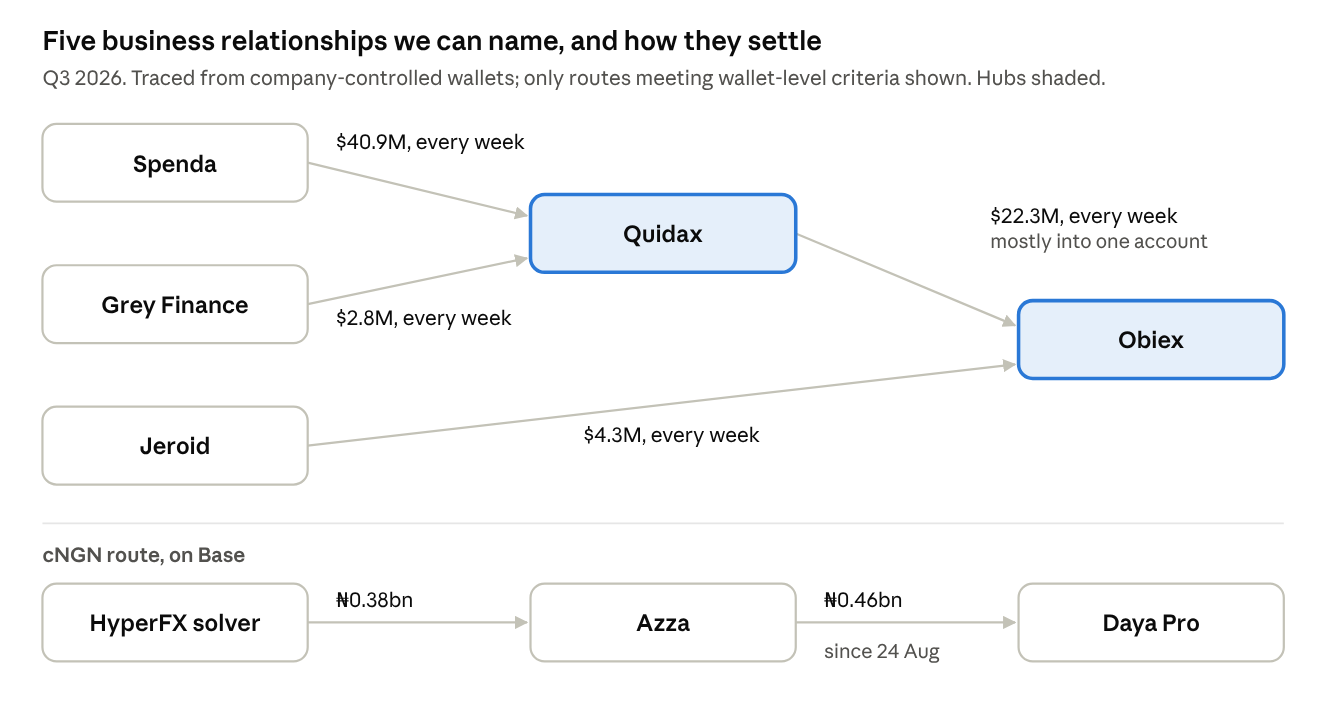
Source: AfriFlux, Q3 2026. Every payment was traced from the paying company's own wallets.
Put together, two venues act as hubs. Obiex receives business flow from nine of the venues we track, Quidax from six. Spenda's company payments go almost entirely to Quidax, and Quidax settles with Obiex, linking all three companies onchain every week.
There is an honest limit here. These named relationships add up to about $70 million, roughly 3% of business-class flow. The other 97% is real, measured money from counterparties we cannot identify onchain, and we leave it unnamed rather than guess.
Retail is wider, not richer
Retail looks nothing like the business side, and it is less evenly spread than the word “retail” suggests. The typical retail address deposited $49 in total over the quarter, yet the largest 1% of retail addresses carried 73% of retail value. That is more concentrated than the business side, where the top 1% carried 33%. Two hundred thousand addresses, mostly small, with a thin layer of high-value users on top.
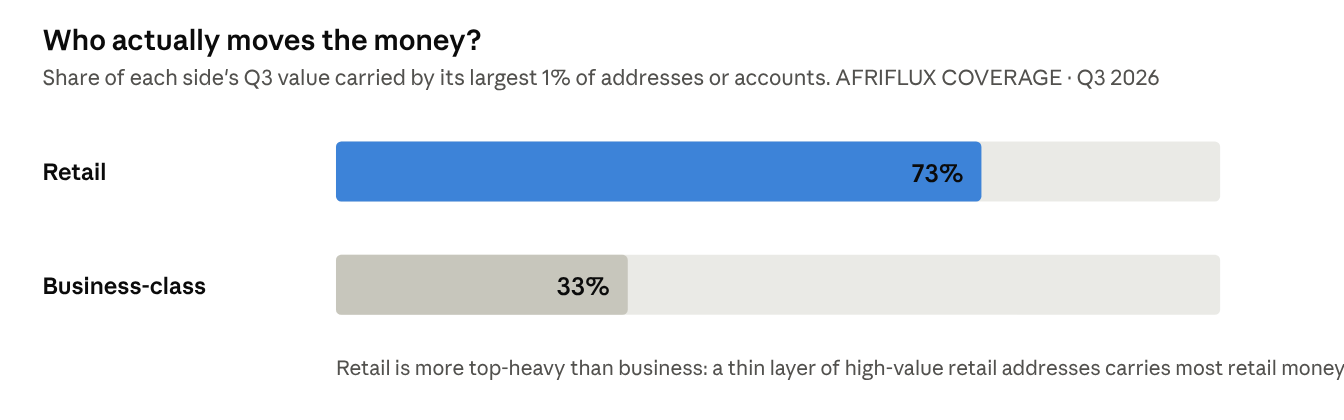
Source: AfriFlux observed coverage, Q3 2026.
Retail also grew by getting broader, not richer. About 59,000 more addresses deposited than in Q2, while the typical deposit fell from $22 to $19. The new money came from more people making smaller payments, not from existing users depositing more.
That is the structural difference in one line: business activity grows when a few accounts move more; retail grows when more people arrive.
Why this matters
If you think of Nigerian stablecoins as a retail story, you will look for demand, risk and opportunity in the wrong place. In the part of the market we can see, most of the money is business flow. Exchanges, offramps and payment companies move dollars on a weekly schedule.
That changes the questions worth asking. Who depends on these rails, and how heavily? How concentrated is that dependence, when one account can carry three quarters of a venue's business flow? And what happens to the wider system when one large counterparty changes its behaviour?
None of this makes retail less important. Retail is where the new users are: 59,000 more addresses in a single quarter. But most of the dollars are business money, and the part we can trace shows companies paying each other. That is the side of the market that gets the least attention.
What the chain can’t tell us
Everything here is read from public blockchains, which makes it verifiable but also bounded. An address is not a person: one person can hold several deposit addresses, and one business-class account can serve many customers. Some deposits can be misleading. At Onboard, most deposits on the Base network are actually payments into US-dollar virtual accounts. They aren't users topping up. And the chain does not show internal ledgers, fiat settlement or customer identity.
What it does show, precisely, is who paid whom, when and how often. That is enough to see that Nigeria's stablecoin economy is not one market. It is two, running on the same rails, and the interesting part is where they meet.
About the data. AfriFlux maps Nigerian exchanges, offramps, neobanks and payment companies wallet by wallet. For Q3 2026 (1 July to 30 September) we tracked USDT and USDC flowing into identified deposit infrastructure at 22 Nigerian venues across 12 blockchains. Retail and business activity are classified from onchain behaviour, including deposit size and proven company-to-company settlement. Named relationships require wallet-level evidence; unidentified flows remain unidentified.
Important: these figures represent AfriFlux's observed coverage, not an estimate of the total Nigerian stablecoin market. Onchain data cannot capture internal ledgers, offchain fiat settlement or wallets we cannot confidently attribute.
Many chains, different jobs: what AfriFlux tracked across 22 Nigerian venues in Q3
Oct 1, 2026
By AfriFlux · guest analysis for Mariblock · data: Q3 2026
Across the Nigerian venues AfriFlux tracks, no single chain runs the stablecoin economy. BSC carries half of customer deposits. Tron manages half of business-class flow. Solana handles most Bridge payouts to Nigerian fintechs. Base and Celo support the naira-stablecoin system. In Q3, venues and protocols moved chains to match.
Ask which blockchain is winning in Nigeria and you get the wrong kind of answer. The better question is what each chain is for.
Across the Nigerian venues AfriFlux tracks, stablecoin money in Q3 ran on twelve chains, and the main chains were not competing for the same job. One carries everyday deposits. Another carries business settlement. A third carries payouts from US-dollar virtual accounts into Nigerian fintechs. Two more host the infrastructure that turns dollars into naira stablecoins and back. These are observed AfriFlux coverage figures, not an estimate of Nigeria's total stablecoin market.
The Nigerian stablecoin economy in our coverage is multi-chain because it has several jobs to do, not because people spread out at random.
AFRIFLUX COVERAGE · 22 Nigerian venues and 5 infrastructure providers tracked · Q3 2026 · wallet-level attribution · 12 chains
Read down a column to see which chain leads that job; read across a row to see what a chain is used for.
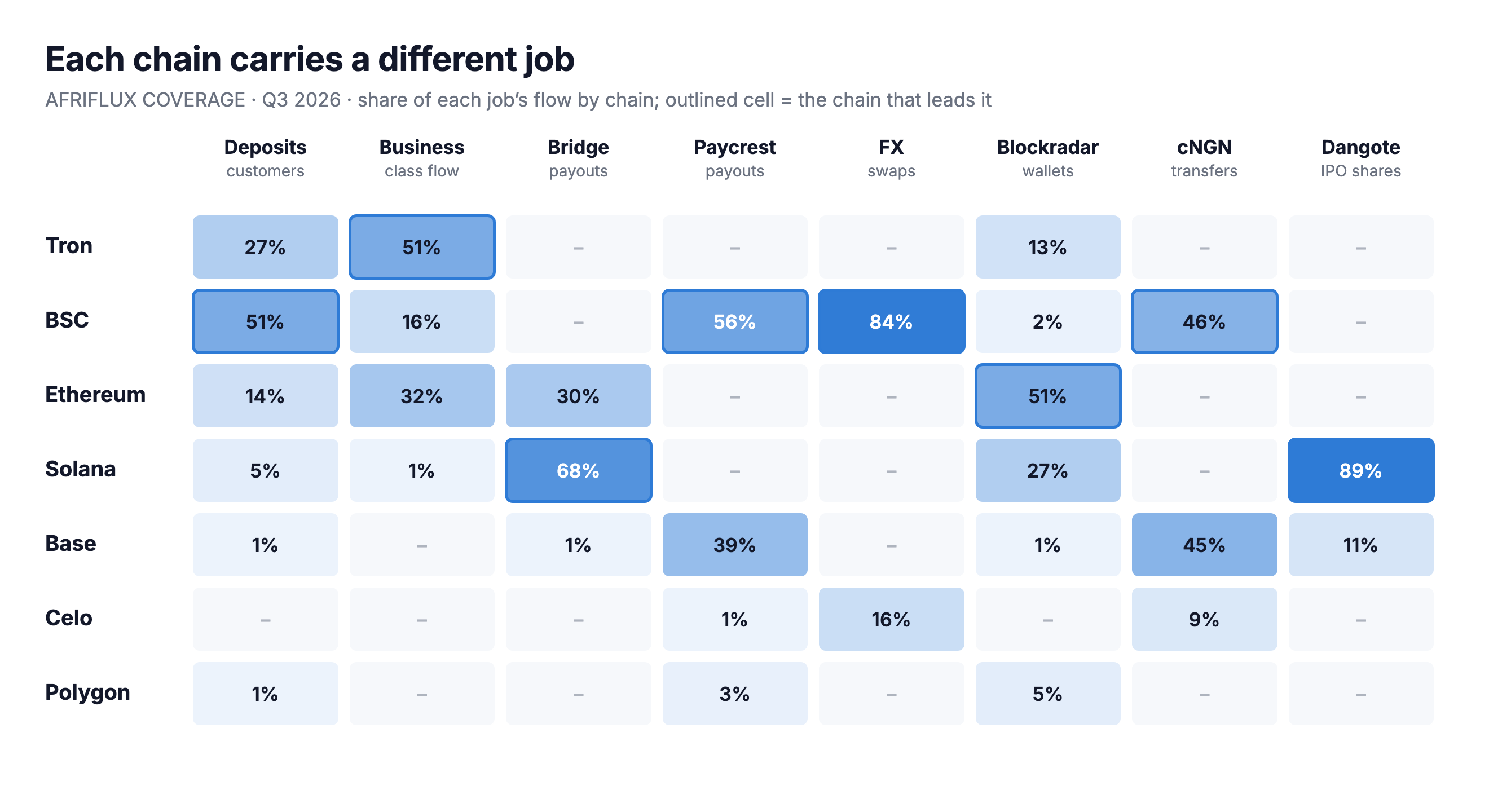
Source: AfriFlux observed coverage, Q3 2026 (1 July to 30 September). Dollars for most columns, naira for cNGN, net shares for the Dangote IPO; compare within a column.
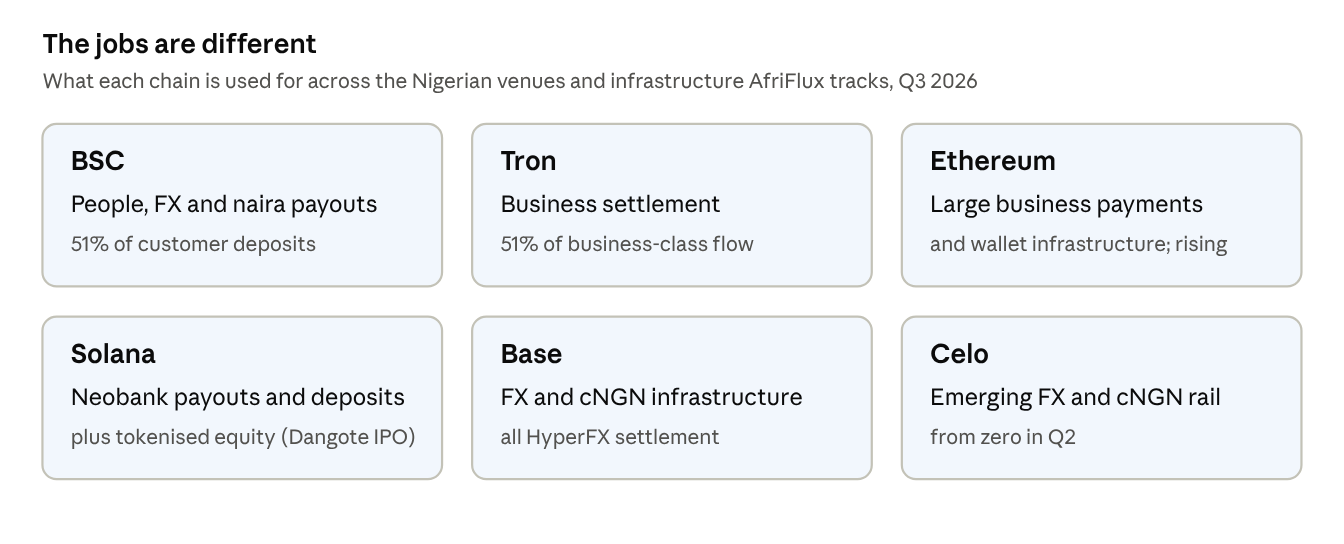
AfriFlux reading of the chain-by-job map above, Q3 2026
Where the people are: BSC
Across the venues we track, customer deposits grew 21% in Q3, jumping from $437 million to $528 million. BNB Smart Chain (BSC) accounted for about half of these deposits in both quarters.
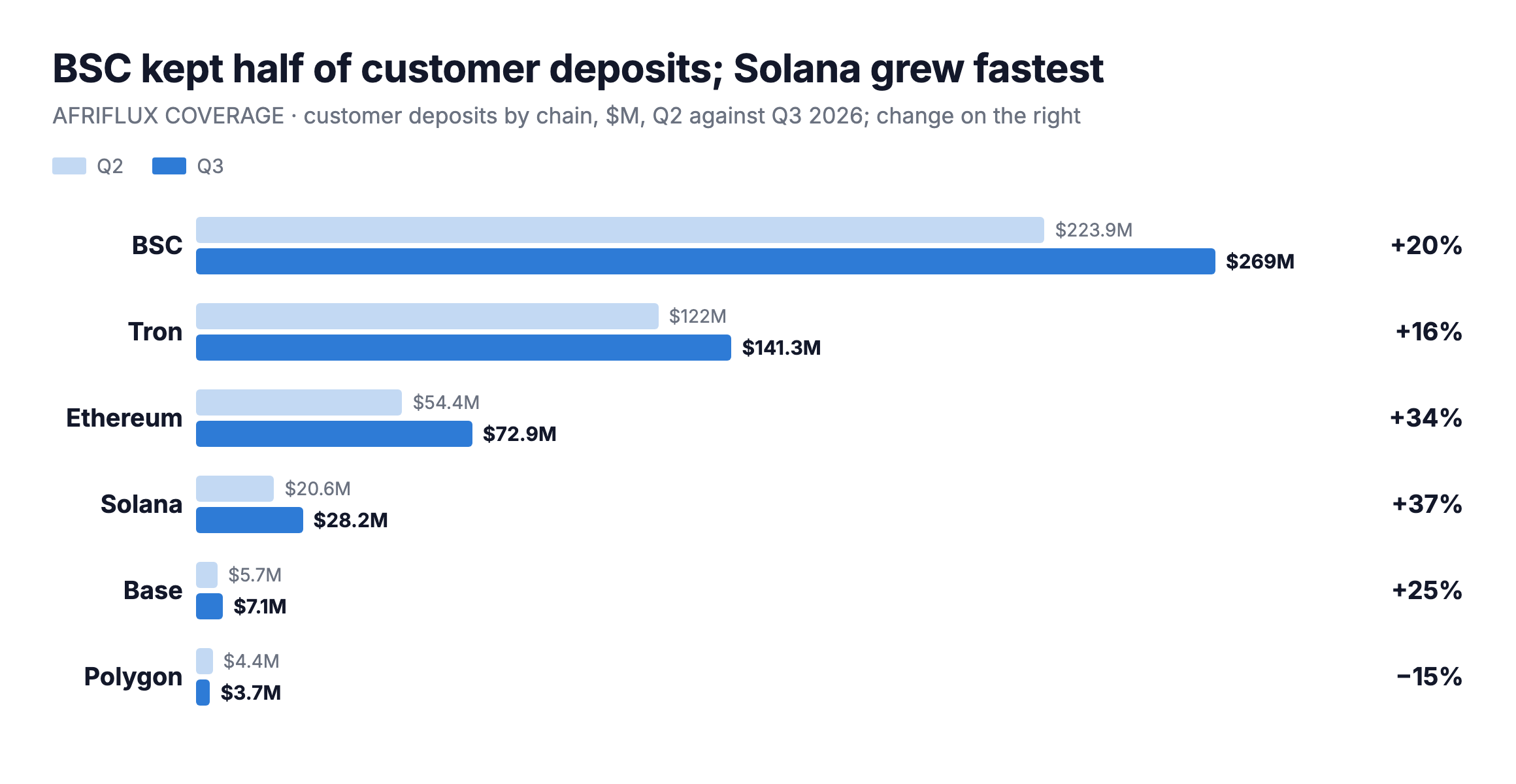
Source: AfriFlux observed coverage in Q2 and Q3 of 2026. Customer deposits include retail deposits from all venues and the complete flow of shared-rail neobanks.
BSC is where the people are. It had 104,751 active depositing addresses in Q3, up 55%. Its typical deposit is small, $11. Tron carries a quarter of customer deposits with far larger tickets: a typical $38, from about half as many addresses. Ethereum grew 34%; Solana, from a small base, grew fastest at 37%.
THE APP CHOOSES THE CHAIN · In our coverage, the app often decides which chain a customer uses. Venues provide deposit addresses for the chains they support, and users follow those instructions.
Where business settles: Tron, with Ethereum rising
Business-class flow tells a different chain story. Across the venues we track, it grew from $1.62 billion to $2.26 billion in Q3, and Tron still carried half of it. But Tron's share fell from 63% to 51% as Ethereum's rose from 21% to 32%.
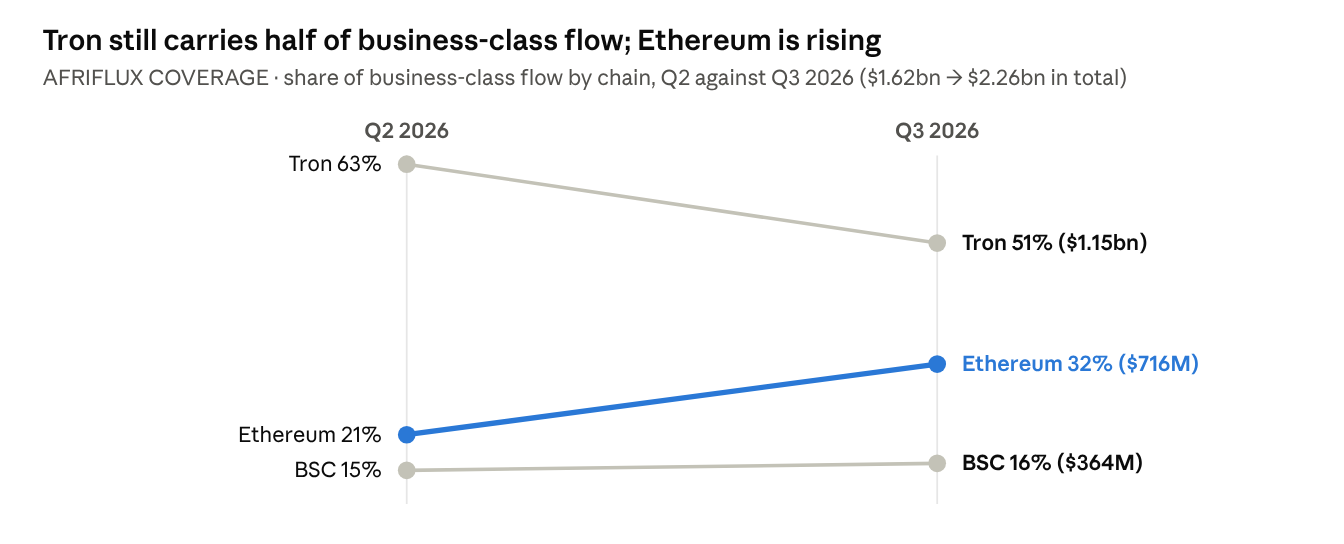
Source: AfriFlux observed coverage, Q2 and Q3 2026. Business-class flow includes above-band deposits at Obiex and Quidax, confirmed settlement into Quidax, and Flutterwave's business accounts.
Ethereum didn't replace Tron; it took a different slice of the business flow.
Two things moved Ethereum. Flutterwave's business accounts settle there, and they carried $305 million in Q3. Obiex's business clients sent more through Ethereum too: $401 million in Q3, up by half. In our coverage, large scheduled business payments are moving to Ethereum. Everyday deposits are not.
CLASSIFICATION · “Business-class” is classified based on onchain behaviour: deposit size plus proven company-to-company settlement. It is not a legal-entity registry.
Solana: the neobank chain, but not the way you'd expect
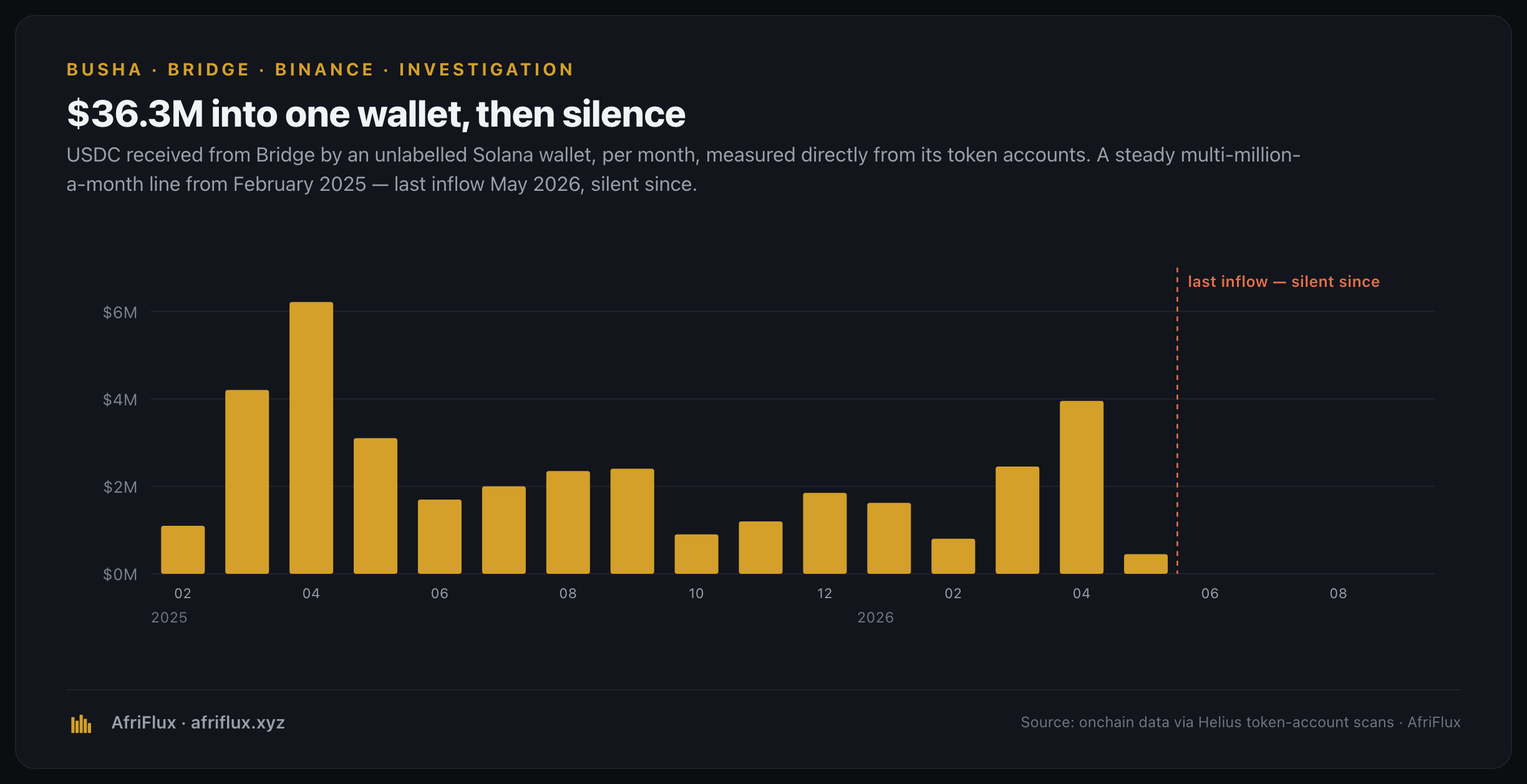
Solana is where US-dollar virtual accounts meet Nigerian fintechs. Bridge, the virtual-account provider for several neobanks, sent 68% of its payouts through Solana to the Nigerian fintechs we track in Q3.
But that flow shrank. Bridge's Solana payouts dropped 9%, going from $64.3 million to $58.8 million. Meanwhile, its Ethereum payouts nearly quadrupled, rising from $6.8 million to $25.4 million. Almost all of this went into one fintech. Solana's growth came from somewhere else: customers depositing into neobanks directly. Across all venues, Solana customer deposits grew 37%, broadly across the base rather than from any one venue switching chains.
Solana also took on a new job in September, when a slice of the Dangote Petroleum Refinery IPO was sold onchain. The NectarFi app changes USDC into cNGN and buys shares. Base keeps the other shares that buyers got directly from the issuer's contract and traded.
SOLANA'S NEW JOB · 89% of the Dangote IPO shares still held at the end of September were bought on Solana: 39,147 shares through NectarFi.
The naira machinery: BSC, Base and Celo
The system that converts dollars to naira stablecoins, and naira stablecoins to bank payouts, operates on three chains.
-
BSC carried 84% of FX swaps between dollar stablecoins and cNGN on Textile FX, and 56% of Paycrest's naira payouts. cNGN transfers on BSC went from ₦4.4 billion in Q2 to ₦59.2 billion in Q3.
-
Base manages all of HyperFX's cNGN settlements. It handles 39% of Paycrest's payouts and holds the largest cNGN supply pool, totaling ₦2.3 billion as of September. Its cNGN volume still grew, from ₦30.4 billion to ₦57.7 billion, but BSC caught up with it.
-
Celo emerged as a new rail: ₦10.9 billion of cNGN transfers and 16% of FX swaps in Q3, from zero in Q2.
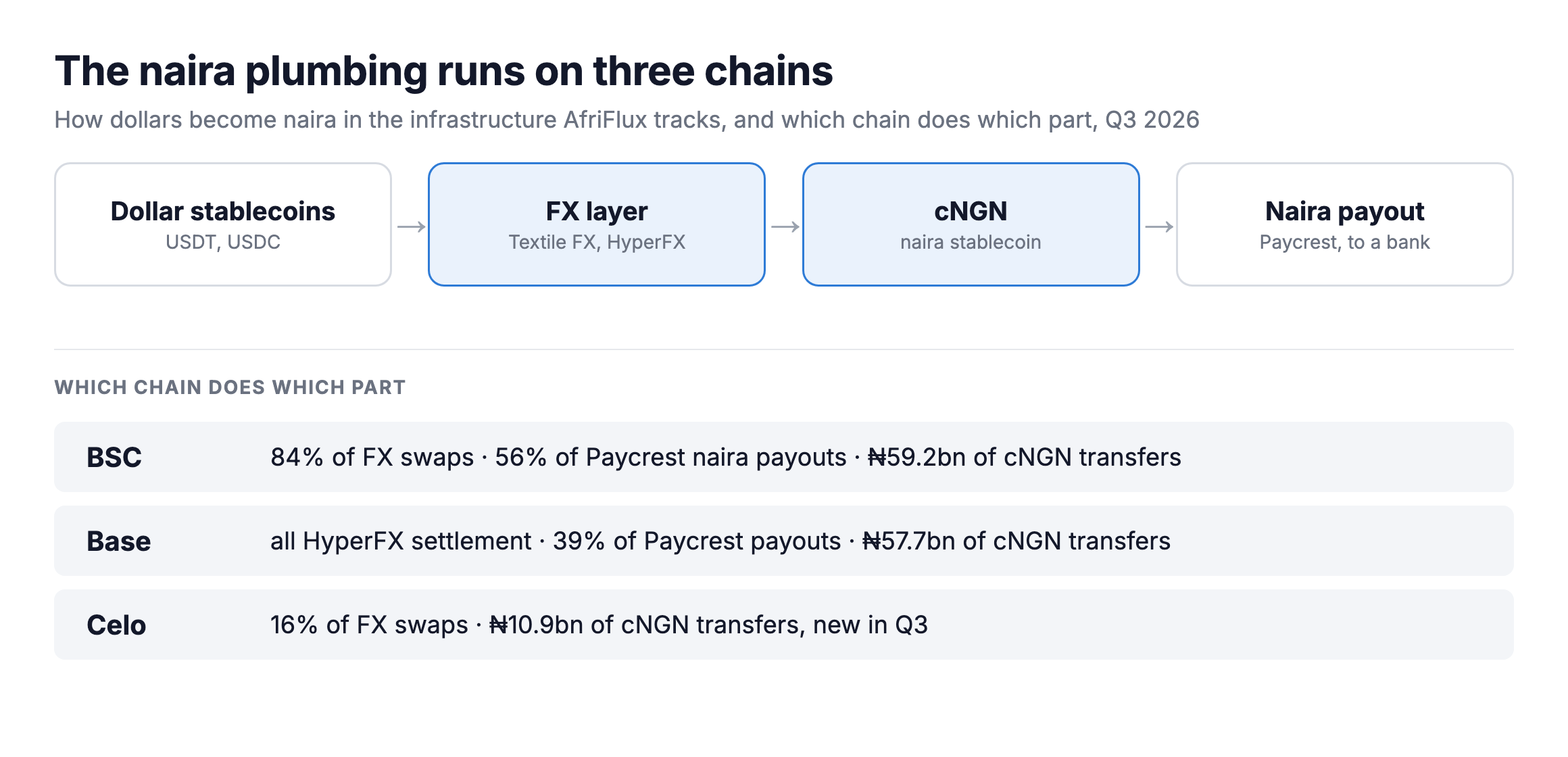
Source: AfriFlux observed coverage, Q3 2026. Shares show each protocol's Q3 flow within that coverage.
None of these chains carries much customer money directly; Base accounts for 1% of customer deposits. Their job is plumbing, and in Q3 the plumbing moved. Paycrest's naira payouts on BSC went from $0.08 million to $1.78 million, overtaking Base after FX activity moved onto BSC, and cNGN followed the BSC route.
Chains are changing jobs
The chain map is not fixed. Q3 had two persistent migrations: Daya Pro to BSC and Onboard to Tron. The shifts persisted month after month rather than appearing as one-off spikes.
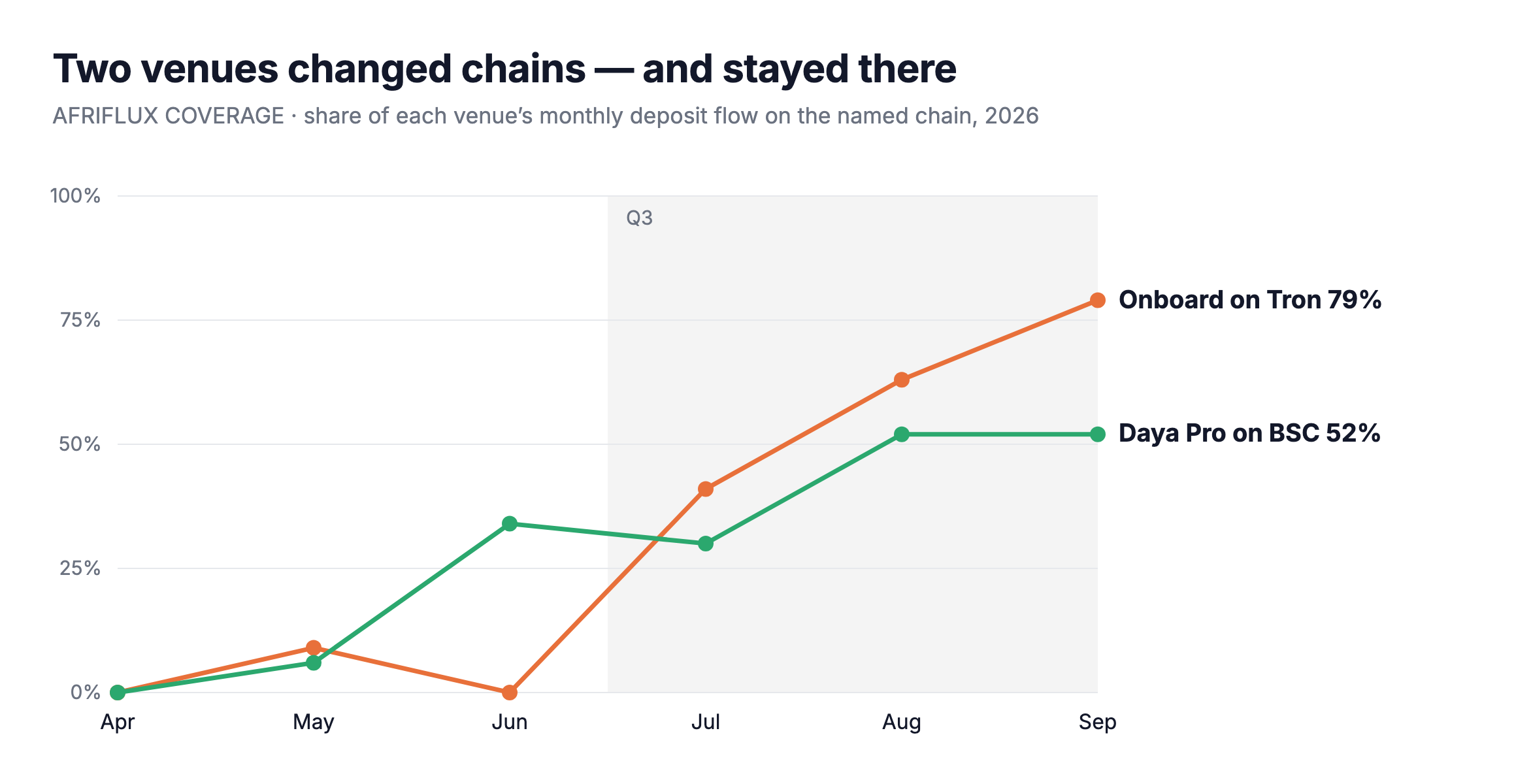
Source: AfriFlux data on monthly deposit flows by venue and chain, April to September 2026
-
Daya Pro increased its share of flow going to BSC from under a fifth to roughly half, as its deposits more than doubled.
-
Onboard's shift to Tron is a different kind of move. It stems from 70 large Tron depositors. Each deposited around $98,000 in Q3. This isn't about existing users switching chains. On Base, most of Onboard's deposits are payments into US-dollar virtual accounts, and those shrank.
The long tail moved too. Payments from venues to betting platforms left BSC almost entirely, from $513,000 in Q2 to about $1,000 in Q3, while what remained moved to Ethereum and Tron. Payouts to the peer-to-peer desk Remitano switched from Ethereum to Tron ($166,000 in Q3). The amounts are small; the pattern is the same: chains are used for specific jobs, and those jobs can move.
A multi-chain economy, not a single-chain winner
The Nigerian stablecoin economy in our coverage is multi-chain because it has several jobs to do, not because people spread out at random. BSC handles people and naira FX. Tron manages business settlements. Ethereum is gaining traction in large business payments. Solana supports neobank payouts and a growing customer base. Since September, it has also carried tokenised Nigerian equity. Base and Celo provide the naira-stablecoin infrastructure.
What the chain data cannot tell us is why each company chose its chain, what happens inside its database, or anything settled in naira at a bank. Addresses are not people. What it does show, precisely, is which chain carried which money, for whom, and how that changed in a single quarter.
We don't estimate markets; we map the part we can see. We don't assume identity; we attribute what the wallets prove. And we don't stop at volume; we follow the relationships between companies.
— AfriFlux
About the data. AfriFlux maps Nigerian exchanges, offramps, neobanks, and payment companies. It does this wallet by wallet. It also highlights the underlying infrastructure. This includes Blockradar, Bridge, Paycrest, HyperFX, and Textile FX. In Q3 2026 (July 1 to September 30), we tracked USDT and USDC deposits at 22 Nigerian venues across 12 blockchains. We also monitored cNGN transfers and the on-chain sale of Dangote Petroleum Refinery IPO shares. Customer and business-class activity is based on on-chain behavior. The analysis examines deposit size. It also considers verified company-to-company settlements.
Important: These figures show AfriFlux's observed coverage. They do not estimate the total Nigerian stablecoin market. Onchain data can't show internal ledgers or offchain fiat settlements. It also doesn't capture wallets we can't clearly identify.
Onchain FX in Q3
By AfriFlux · data: Q3 2026
Nigeria's stablecoin infrastructure is gaining a new layer: onchain FX.
In Q3, new FX infrastructure from Textile and HyperFX, both launched in June, scaled up alongside the payout and wallet systems that were already moving naira onchain.
The interesting part is what happened next.
These protocols did not need to build the entire route themselves. A wallet could swap USDT into cNGN through an onchain FX venue such as Textile, then send that cNGN into Paycrest, which handled the naira payout.
The result is one route. Underneath, several specialised protocols are doing different jobs. And in Q3, wallets in AfriFlux's coverage started connecting those pieces.
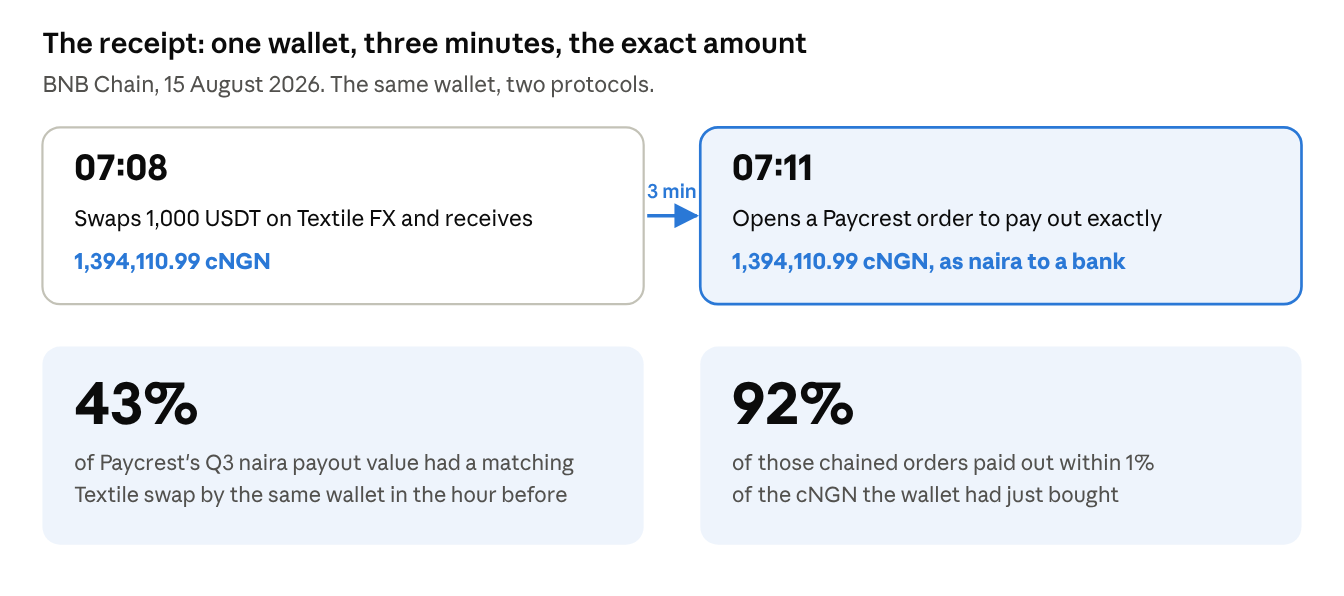
Source: AfriFlux, Textile FX fills and Paycrest orders read onchain, Q3 2026 (1 July to 30 September).
AfriFlux found that 43% of Paycrest's Q3 naira payout value had a matching USDT→cNGN swap on Textile by the same wallet within the preceding hour. In 92% of those chained orders, the cNGN purchased was within 1% of the amount subsequently paid out through Paycrest.
That doesn't show that every Paycrest payout follows this route. It is evidence that the same wallets were beginning to compose FX and payout infrastructure into a single flow.
AFRIFLUX COVERAGE
-
5 infrastructure providers
-
22 Nigerian venues tracked
-
Q3 2026
-
Wallet-level attribution
-
12 chains
The new FX layer
Textile and HyperFX both launched in June and became part of the Nigerian onchain FX stack in Q3.
The new setup splits functions instead of using one venue for dollar liquidity, FX conversion, and naira payout.
The FX layer handles the conversion. cNGN provides the naira-denominated settlement asset. Paycrest connects that onchain value to naira payout infrastructure.
The wallet is what makes the separate layers composable.
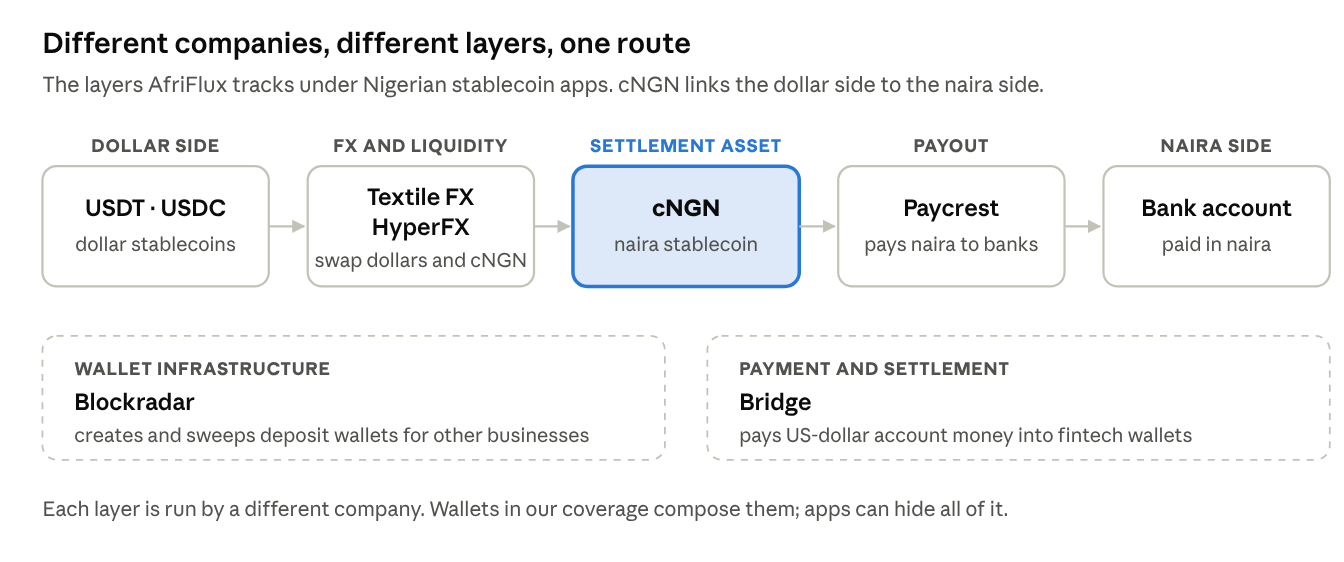
Source: AfriFlux infrastructure coverage, Q3 2026.
This changes what an “off-ramp” looks like.
The user may still experience it as a single conversion from USDT to naira. Underneath, the route can be assembled from separate protocols, each handling one part of the transaction.
The off-ramp is becoming composable infrastructure.
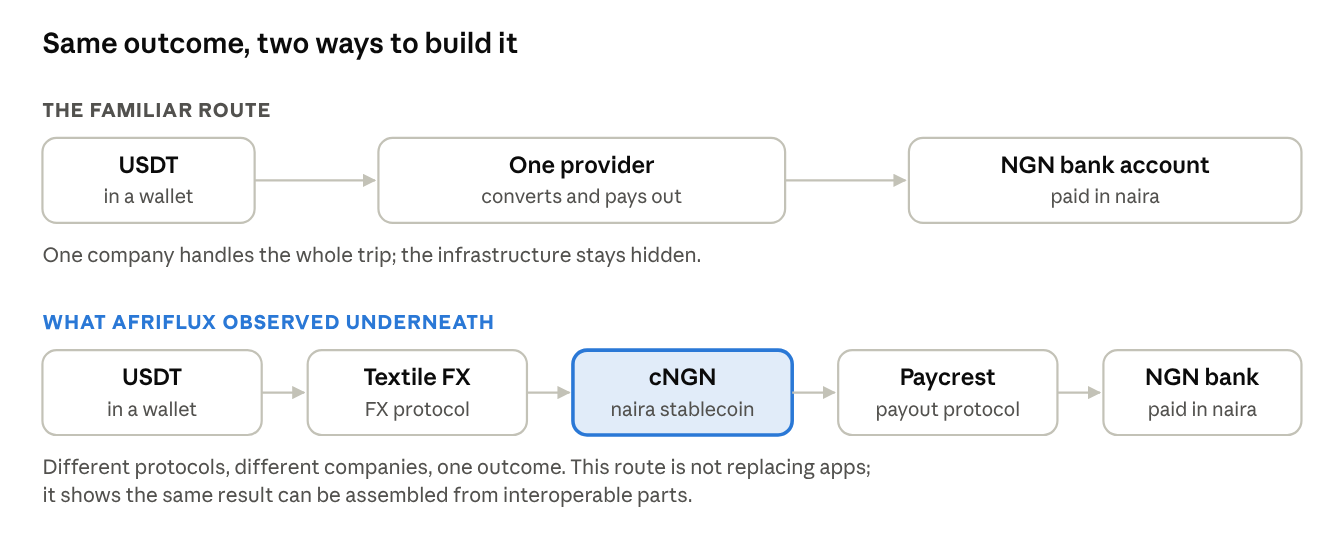
Source: AfriFlux observed coverage, Q3 2026. The one-provider route is illustrative.
The companies are different. The functions are different. But the wallet can compose them into one route.
cNGN finds a job
cNGN is the piece that connects the two sides of this stack.
In Q2, cNGN issuer activity in AfriFlux's coverage was mostly against unidentified desks. In Q3, the issuer's activity shifted toward the market and FX layer. Issuer-to-market and DEX flows increased from approximately ₦0.9 billion in Q2 to ₦15.7 billion in Q3.
That shift is important. A stablecoin is more useful when it’s not just held or created. It shines as a settlement asset between different market areas. In this case, cNGN sits between dollar liquidity and naira liquidity. A wallet can acquire cNGN through an FX venue, move it onchain, and use it as the input for a separate payout or financial application.
The naira stablecoin became useful by being connected, not simply by being minted.
The stack is starting to talk to itself
The clearest evidence is wallet behaviour.
In Q2, AfriFlux found zero wallets using more than one of Paycrest, HyperFX and Textile. In Q3, that number was 118.
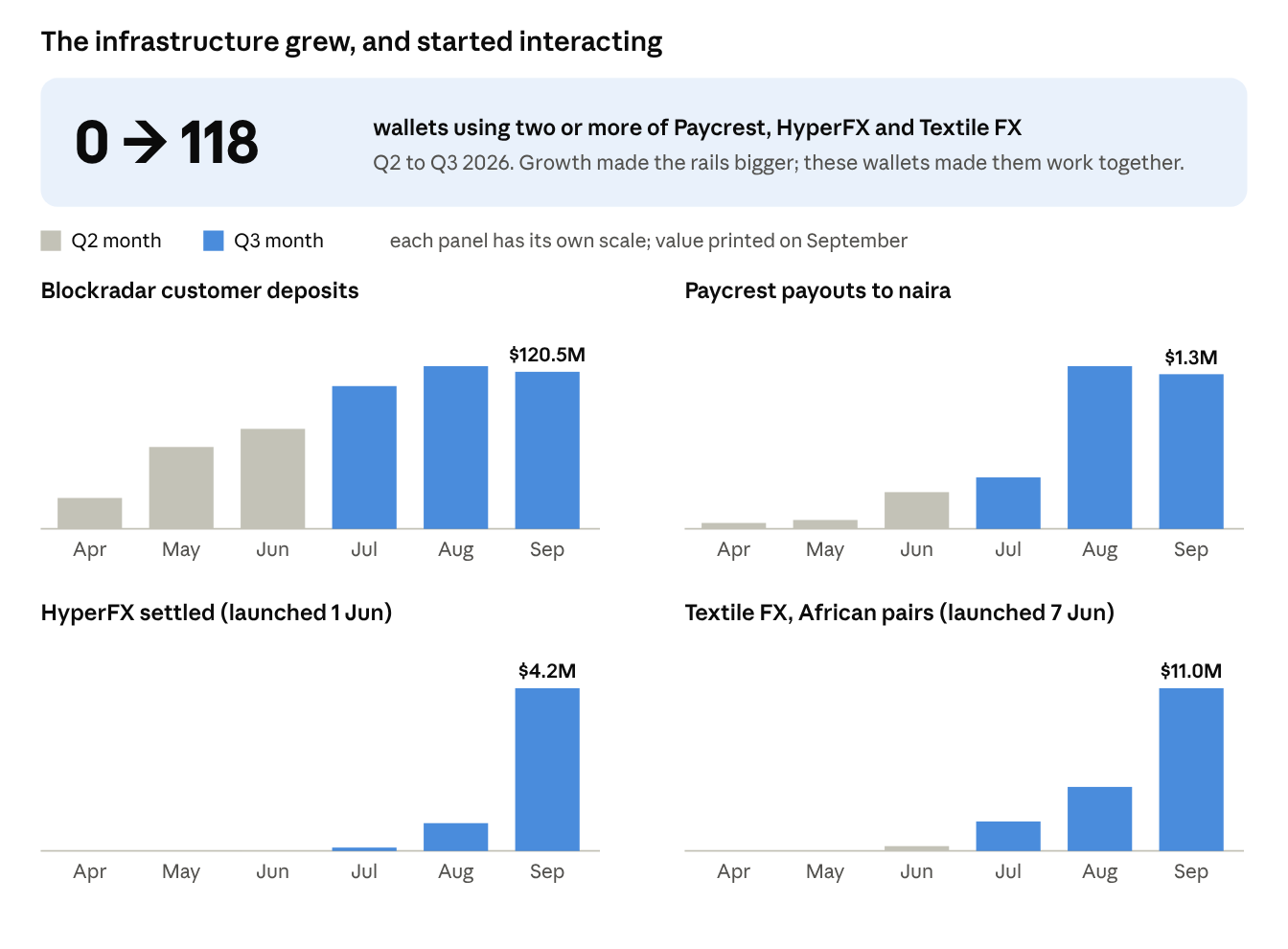
Source: AfriFlux, USD per month, April to September 2026, read onchain from each protocol's contracts and wallets.
The number is small compared to the broader market, but the change is important. Wallets that once used these protocols alone are now interacting with multiple parts of the stack.
Textile does not need to become Paycrest. Paycrest does not need to become an FX venue. HyperFX does not need to build a bank payout network.
Each protocol can specialise in one part of the transaction. The wallet connects those specialised layers.
That is what makes the new FX layer different from simply adding another place to swap stablecoins. FX, local settlement and payout can now sit across separate protocols and still form one transaction route.
And the stack goes beyond off-ramps
The same pattern showed up somewhere less obvious: equity.
During the Dangote refinery IPO tracked by AfriFlux, buyers on Solana had their USDC converted into cNGN, which was then used to buy the tokenised shares in the same flow.
USDC → cNGN → Dangote refinery shares
All 349 observed purchases, on Solana and Base, were paid in cNGN. The same contracts also issued a Nigerian Treasury Bill token during Q3.
This does not mean cNGN has become the settlement layer for every financial product in Nigeria. It hasn't.
It shows that the dollar-to-naira conversion and settlement system can handle more than just basic off-ramps.
The FX layer is becoming a bridge between various types of onchain money. On one side, we have dollar stablecoins. On the other, there are naira-denominated assets and financial products.
Connected does not mean decentralised
There is an important caveat. The infrastructure is becoming more connected, but it is still concentrated.
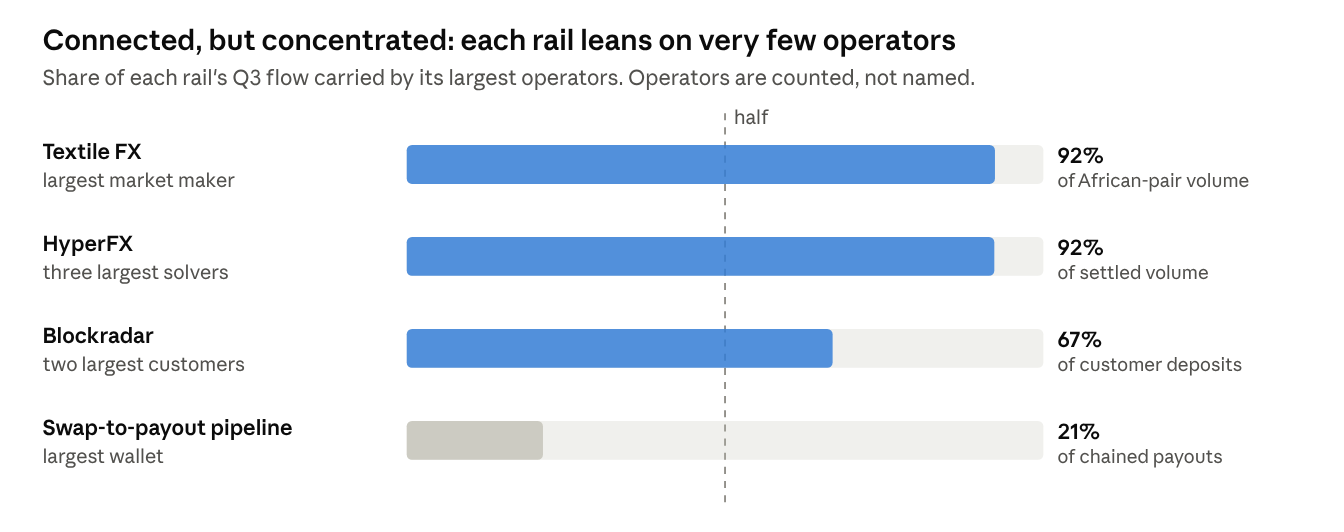
Source: AfriFlux, Q3 2026. Textile and HyperFX by settled USD; Blockradar by customer deposits; route by chained Paycrest payouts.
Two Blockradar customers accounted for roughly two-thirds of Blockradar's Q3 customer deposits. One Textile market maker accounted for 92% of Textile's African-pair volume. Three HyperFX solvers accounted for 92% of HyperFX's settled volume.
And the FX layer itself is still very new. Textile and HyperFX launched in June. So, Q3 is the first full quarter for AfriFlux to see how this new infrastructure works with the rest of the stack. There is not yet enough history to know whether these relationships persist.
But the Q3 data shows something new.
Onchain FX has entered the stack
In Q2, Nigeria's onchain money infrastructure looked more like a collection of separate products.
In Q3, a new FX layer appeared — and began connecting to infrastructure that was already there.
USDT could be converted through an onchain FX venue. cNGN could carry the naira leg. Paycrest could handle the payout.
Different protocols. Different companies. One composed route.
The user-facing apps can still hide all of this. Nigeria's stablecoin infrastructure is shifting. It's starting to feel less like separate products and more like a stack.
The important development in Q3 was not simply that more infrastructure launched.
It was that the new infrastructure started talking to the infrastructure that was already there.
The FX layer showed up. And the rest of the stack started connecting to it.
AfriFlux methodology
AfriFlux maps the infrastructure underneath Nigeria's stablecoin economy wallet by wallet.
For this analysis, we tracked five infrastructure providers. We also looked at 22 Nigerian venues and activities across 12 chains during Q3 2026, from July 1 to September 30.
The analysis looks at several key areas:
-
Paycrest orders
-
Textile and HyperFX activity
-
cNGN transfers
-
Blockradar deposit wallets
-
Bridge payments
-
Other relevant contracts
This direct onchain observation helps provide a clear picture.
A “chained” payout is a Paycrest naira payout where AfriFlux identified a USDT→cNGN Textile swap by the same wallet in the preceding hour.
Wallets are counted as addresses, not identified as people or businesses.
We describe holder or counterparty groups using AfriFlux classifications. These are based on how wallets behave.
The analysis describes the portion of the Nigerian stablecoin infrastructure visible in our coverage. It should not be interpreted as a census of the entire Nigerian market.
Same dollar, different products: AfriFlux’s Q3 look at Nigerian money apps, wallet by wallet
Oct 1, 2026
By AfriFlux · guest analysis for Fintech Is Easy · data: Q3 2026
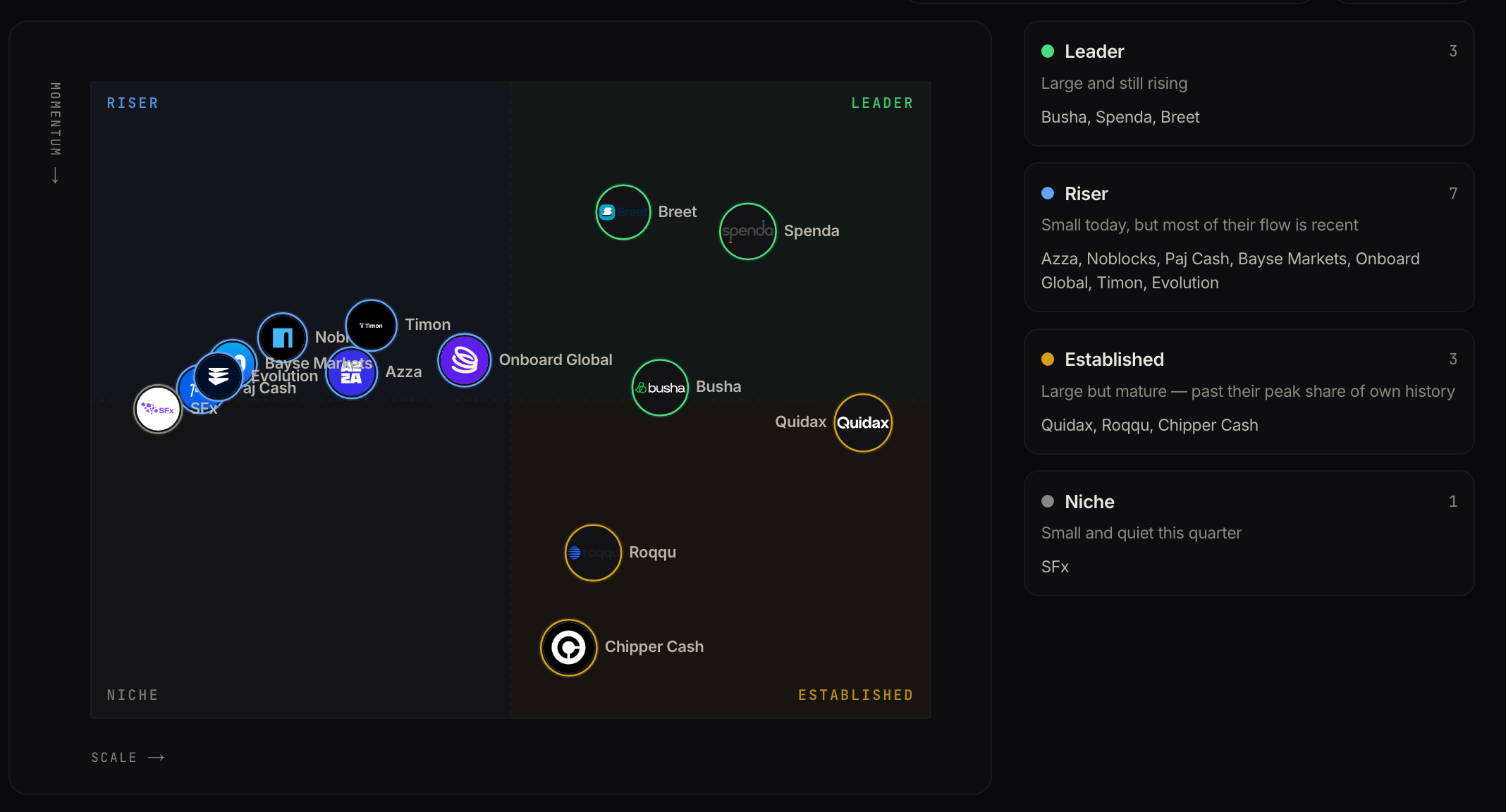
Across the Nigerian venues AfriFlux tracks, a typical deposit is $6 at Spenda and $600 at Daya Pro. The products are very different. Still, around 54% of new deposit addresses made another deposit within a month. This happened even as the number of new addresses doubled.
Nigerian fintech is often discussed as one market: people buying dollars. Onchain data shows something more useful. The same dollar stablecoin, USDT or USDC, is used to create different products. Each product draws a distinct type of user.
In the third quarter of 2026, AfriFlux tracked 239,190 customer deposit addresses across the Nigerian venues in its coverage. These addresses received $528 million in stablecoin deposits. This covers retail deposits plus the full flow at venues where individual and business customers share the same accounts. What those addresses did (how much they put in, how often they came back, where else they went) reads like a map of the country's money apps. These are observed AfriFlux coverage figures, not an estimate of Nigeria's total stablecoin market.
AFRIFLUX COVERAGE · 22 Nigerian venues tracked · Q3 2026 · wallet-level attribution · 12 chains
How we read behaviour from wallets
Every app in our coverage gives each customer a deposit address on each blockchain it supports. AfriFlux maps those addresses wallet by wallet and reads every USDT and USDC deposit into them. The deposit address is our unit. It is not a person, since one person can hold several, but it is the closest public trace of one customer account on one chain.
Two signals do most of the work below: how big a deposit is, and whether a new address receives a second deposit.
CLASSIFICATION · Customer deposits are kept apart from business-class flow. This looks at on-chain behavior. It includes deposit size and confirmed company-to-company settlements. Business-class flow is left out of this piece; venues that serve both through the same accounts are counted in full. This is not a legal-entity registry.
Same dollar, different products
Put the typical deposit against the share of new addresses that make another deposit, and the venues cluster by product type.
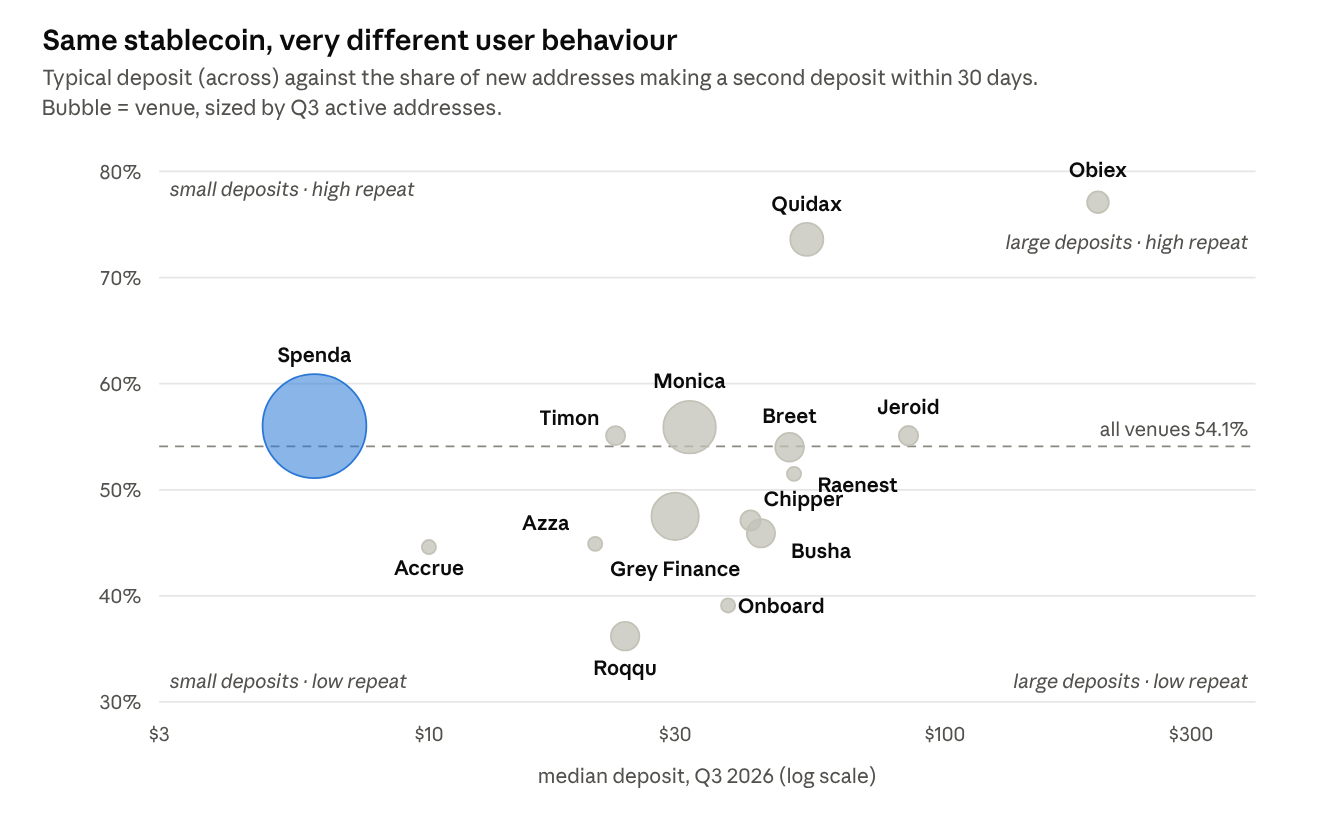
Source: AfriFlux observed coverage, Q3 2026. Return rate = new addresses (first deposit Apr–Aug 2026) making a second deposit within 30 days.
What kind of product is this?
-
Spenda: everyday. Small and frequent. It has 119,217 addresses—the most of any venue—a typical deposit of $6, and a 56% rate of new addresses returning within a month.
-
Quidax and Obiex: exchange. Repeat, multi-use. 74% and 77% of new addresses make a second deposit within 30 days.
-
Roqqu and Onboard: on-ramp. Lower repeat. 36% and 39% come back within a month (Onboard with a caveat, explained below).
-
Daya Pro: large-ticket. Its typical deposit, $600, is the largest of any venue; it has too few new addresses to form a cohort, so it sits off the chart.
This is not a ranking. Different deposit patterns show different behaviors. The same dollar stablecoin can serve different purposes.
The second-deposit rate held as users doubled
For a money app, a second deposit is one of the clearest onchain signals that a new address has become an active user. Across all venues in our coverage, 38% of new addresses made a second deposit within seven days and 54% within 30 days.
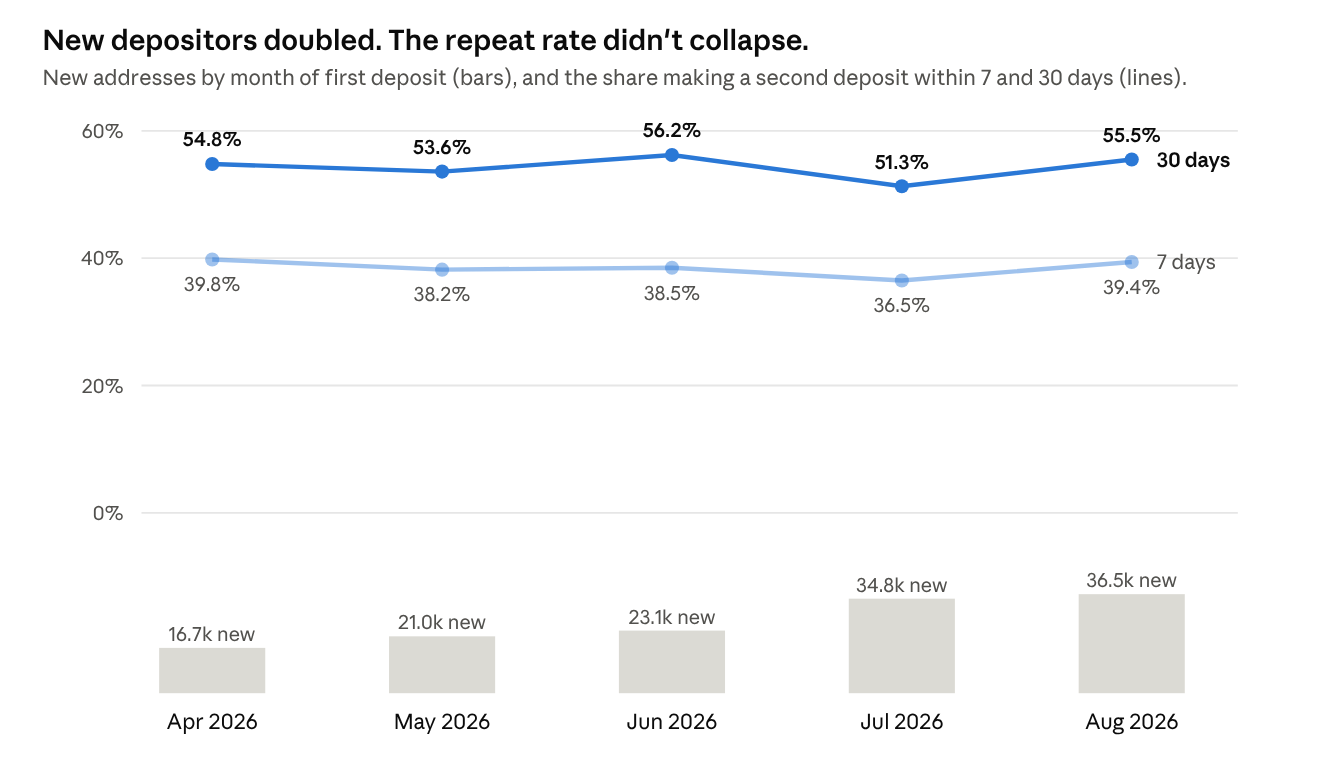
Source: AfriFlux observed coverage. Addresses whose first-ever deposit fell in each month, April to August 2026, all venues in scope.
The striking part is what did not happen. New depositing addresses more than doubled between April and August, from 16,690 to 36,489 a month, and the return rate held. In our coverage, faster growth in new depositing addresses did not dilute the share of new addresses that returned.
Exchanges activate fastest. A typical new address that returned to Obiex made its second deposit within 0.7 days; at Busha it took about a week.
METHOD · This is a repeat-deposit signal. It’s not about product retention. Users can stay active in the app without making another deposit on-chain.
Averages hide who a product serves
Averages flatten distinct products. Two views show it: how big a typical deposit is, and who carries the money.
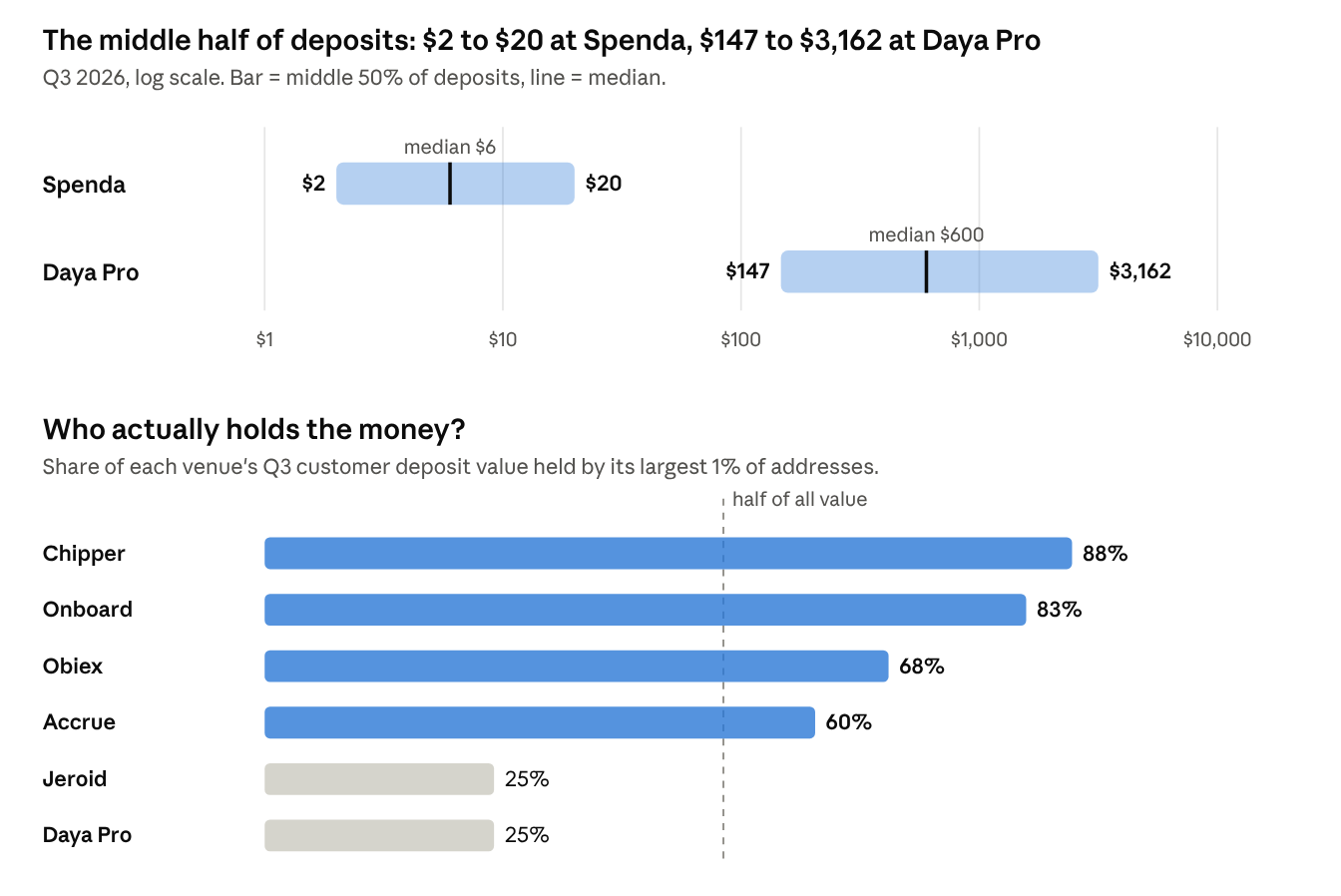
Source: AfriFlux observed coverage, Q3 2026. Top-1% shares are shown for the most and least concentrated venues with 500+ customer addresses.
At some venues a thin top carries most of the money: the top 1% of addresses carry most of the customer value at Chipper, Onboard, Obiex and Accrue. At Jeroid and Daya Pro, value is spread across many depositors. A venue with many addresses is not automatically a mass-market product; concentration is the key measure.
Frequency splits the same way. 27% of Obiex addresses and 24% of Daya Pro's made 20 or more deposits in the quarter. At Chipper, Timon, and Raenest, fewer than 3% did; most of their addresses deposited one to four times.
The token is the app's choice
USDT is the default almost everywhere, and users rarely switch: in most venues fewer than one in ten addresses used both USDT and USDC in Q3. Chipper is the exception. 62% of its customer value arrived in USDC, and its typical USDC deposit was about three times its typical USDT one. In our coverage, stablecoin choice looks like a product default more than a user preference.
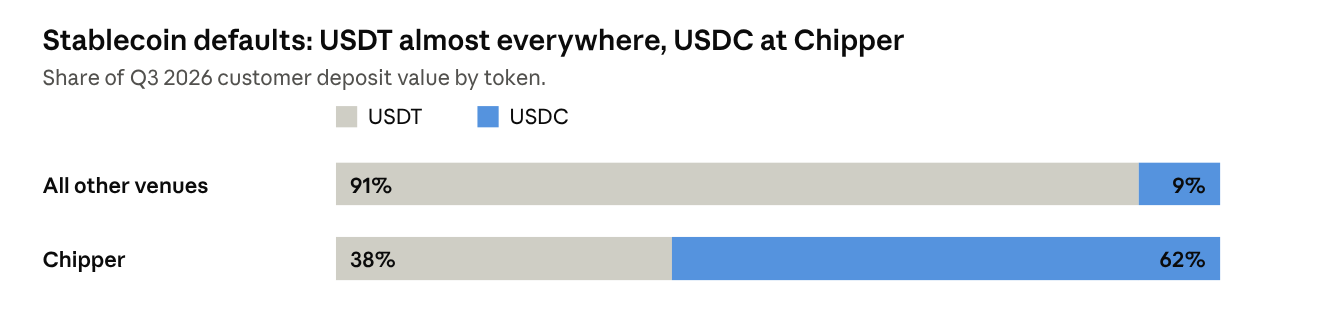
Source: AfriFlux observed coverage, Q3 2026 ($519.0M of customer deposits at other venues; $9.3M at Chipper).
Users move between apps
Most depositors use one venue, but the few who use several carry a large share of the money. Of 142,626 private wallets that paid into customer deposit addresses in Q3, 8,253 (5.8%) paid into addresses at two or more venues, and they carried 40% of the value. The most common pair was Monica and Spenda, with 1,828 shared wallets.
We excluded wallets from exchanges, venues, deposit systems, and payment rails. This way, we ensure that a hot wallet isn’t confused with a personal wallet.
There is a cleaner signal too: a venue's own wallet paying a customer deposit address at a different venue. That is a user withdrawing from one app straight into their account at another. In Q3 these moves came to $8.0 million, up 40% from the second quarter, across 2,338 addresses. Quidax's wallets sent 59% of it.
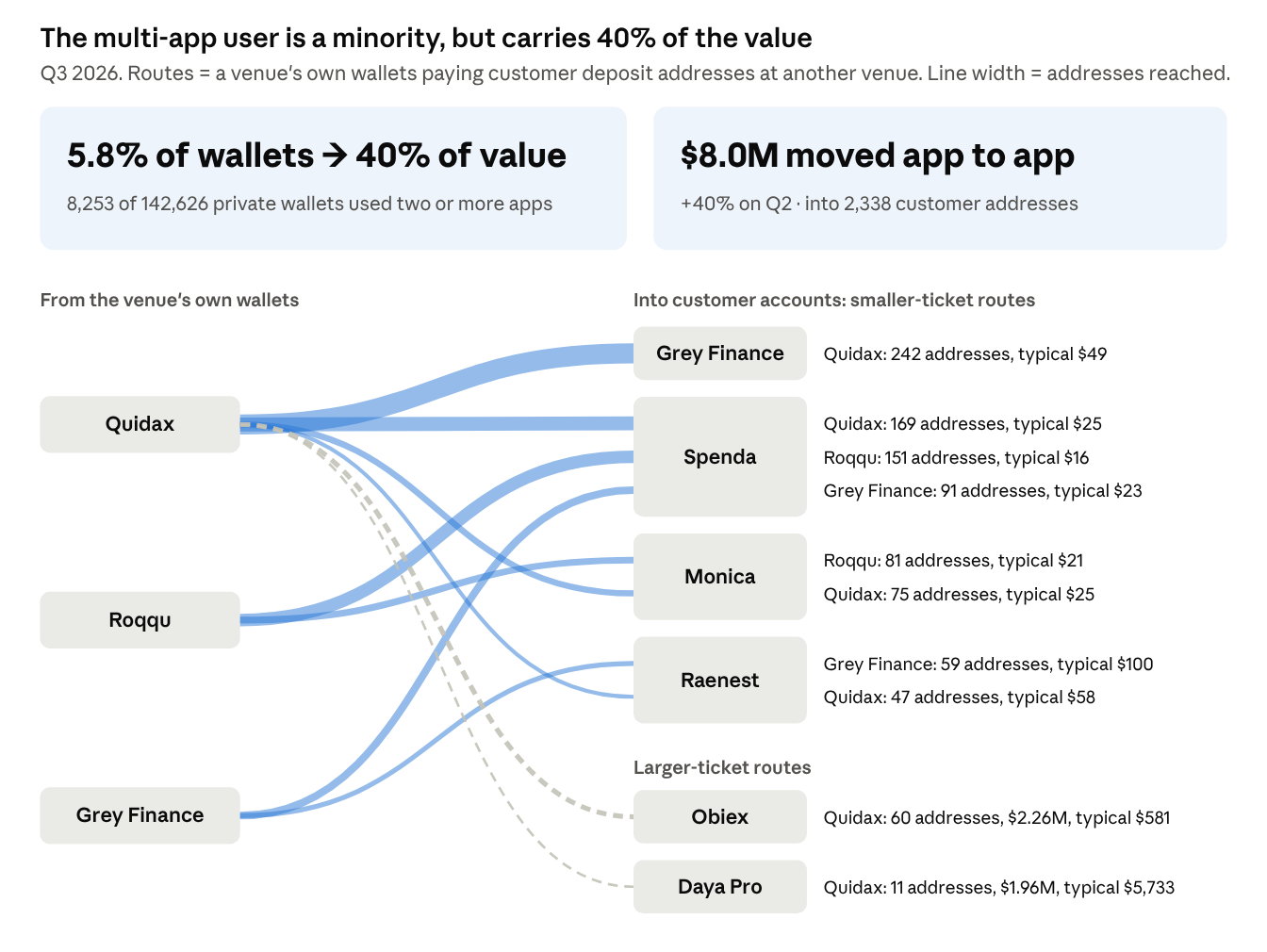
Source: AfriFlux, Q3 2026. Routes traced from venues' own wallets to customer deposit addresses at another venue; main routes shown (all routes total $8.0M).
Users are moving between apps, and that cross-app flow grew 40% quarter on quarter. The smaller-ticket routes include many addresses that make small payments. These payments mainly come from exchanges to everyday apps. The larger-ticket routes run from Quidax into Obiex and Daya Pro.
A new kind of user: the Dangote refinery IPO
In September a different kind of user appeared. From 14 September, shares in the Dangote Petroleum Refinery IPO could be bought onchain at ₦525 each through getEquity's tokenised offering. By 30 September, 235 wallets had bought.
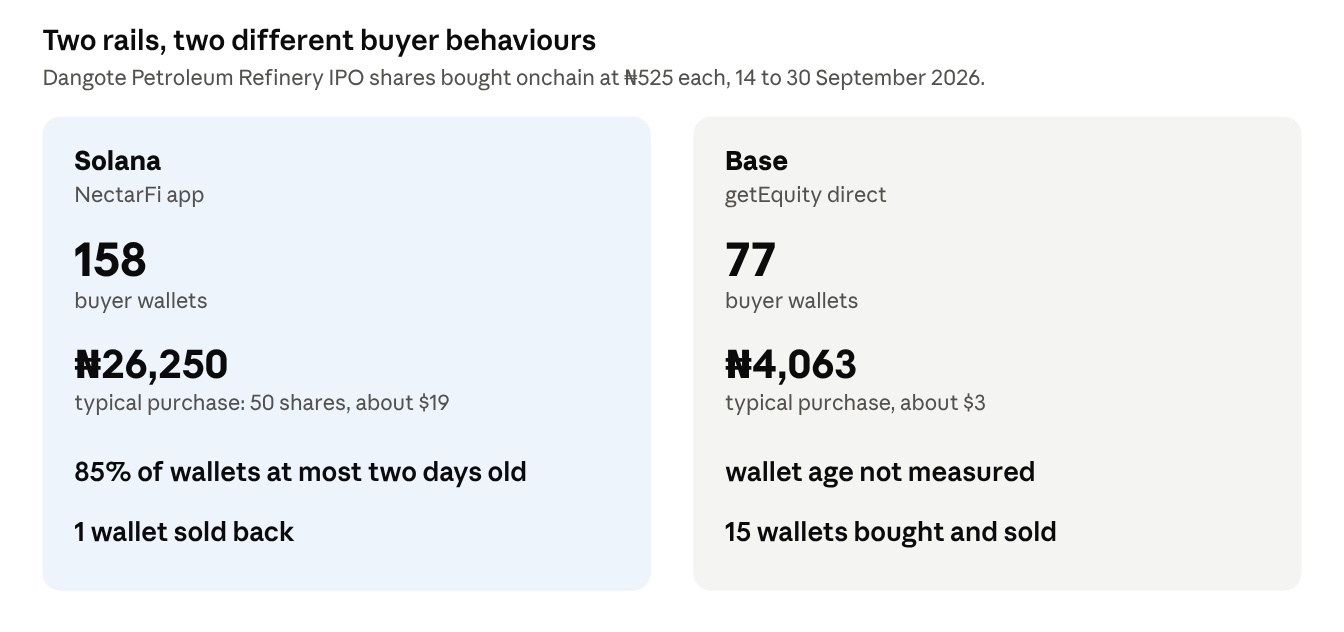
Source: AfriFlux, read from getEquity's sale contracts on Solana and Base, 14 to 30 September 2026. Wallets, not people.
The wallet patterns are consistent with new users making small first investments rather than established crypto traders. Most NectarFi buyers used a wallet created a day or two before they bought, which fits the app setting up a wallet for each new customer. They paid in USDC; the app converted it to cNGN, the naira stablecoin, and bought the shares in the same flow. Almost none sold back. Demand was front-loaded: 59% of the net shares held at 30 September were bought in the first three days.
The amounts are small: 43,941 net shares worth about ₦23 million. This is getEquity's tokenised slice of the IPO, not the IPO's size. What matters is the path: a dollar stablecoin bought a Nigerian equity through a naira stablecoin in a single flow.
What the wallets can and cannot tell us
An address is not a person. One person can have multiple addresses—one for each venue and chain. This means address counts are higher than the actual number of people. Return rates also understate how many people come back. A second deposit is not retention.
And some deposits don't reflect users choosing to top up. At Onboard, most deposits on the Base network are for US-dollar virtual accounts. These payments go directly into customers' deposit addresses via Bridge, making up 55% of Onboard's Base deposits in Q3. Its growth on Tron comes from 70 high-value retail addresses averaging about $98,000 each. Onboard's numbers describe payments received more than user behaviour.
LIMITATION · Public blockchains show deposit activity. They don’t show what happens inside the app. Conversions, balances, and fiat withdrawals are offchain. These details stay hidden.
The chain reveals the outline of Nigeria's money apps. They include:
-
An everyday wallet for small, frequent deposits.
-
Exchanges with higher repeat-deposit rates.
-
Products where a few large customers carry most of the money.
-
Users moving between apps, in a flow that grew 40% on the second quarter.
The stablecoin is the same. The products are not.
We don't estimate markets; we map the part we can see. We don't assume identity; we attribute what the wallets prove. And we don't stop at volume; we follow the relationships between companies.
— AfriFlux
Get the next investigation in your inbox. The Sweep is our Monday newsletter — one attributed on-chain number a week, with the method attached. Subscribe →
About the data. AfriFlux maps Nigerian exchanges, offramps, neobanks and payment companies wallet by wallet. In Q3 2026, from July 1 to September 30, we monitored USDT and USDC deposits. This was done at specific customer deposit addresses in Nigerian venues across 12 blockchains. Customer and business-class activity are classified from onchain behaviour; business-class flow is excluded here, but at venues that serve both through the same accounts, all activity is counted in full. Cohorts cover addresses whose first-ever deposit fell between April and August 2026. Dangote IPO figures are read from getEquity's sale contracts on Solana and Base. Routes between apps are named only where a venue's own wallets prove them; unidentified flows remain unidentified.
Important: these figures represent AfriFlux's observed coverage, not an estimate of the total Nigerian stablecoin market. Onchain data cannot capture internal ledgers, offchain fiat settlement or wallets we cannot confidently attribute.
About AfriFlux
AfriFlux is a crypto data and media company focused on stablecoins. We map stablecoins, exchanges, off-ramps, neobanks and payment infrastructure wallet by wallet, following how money actually moves across the system.