Think about the last time you sent money from your UBA app.
You typed the account number, the name came up, you entered your PIN, and the money landed a few seconds later, even though the other person banks with GTB or Opay. You didn't think about it.
But UBA didn't carry that money to GTB by itself. Banks don't send money straight to each other. They all plug into a shared system called NIP, run by NIBSS, and that system moves the money from one bank to another. Your UBA app is just how you reach it.
That shared system is a payment rail. A payment rail is whatever system actually moves the money from where it starts to where it lands. You've used one every week for years.
You already use more than one rail
Each way you move money in Nigeria runs on a different rail:
- Bank transfer. The UBA app or *919# sends money through NIP.
- Card. When you pay at a POS or withdraw from another bank's ATM, the card network moves the money. That's a separate system with its own rules and charges.
- Money from abroad. When dollars land in your domiciliary account, they've usually come through SWIFT, the system banks in different countries use to pay each other. It's slower, and charges come off along the way.
UBA connects to all of these. You choose the bank, and the bank chooses which rail does the work.
This is the main idea of this piece: the app you use and the rail that moves your money are two different things.
The new rails: blockchains
Now there's a new kind of money in Nigeria: digital dollars, called stablecoins. The two big ones are USDT and USDC. Each is designed to be worth one US dollar.
They don't move on NIP or SWIFT. They move on blockchains, open networks such as Tron, BNB Chain, Ethereum and Solana. Each blockchain is a separate rail.
Here's the part that confuses most people, so think about airtime.
₦1,000 of MTN airtime and ₦1,000 of Glo airtime are worth the same. But you can't use MTN airtime on a Glo line. The value is the same and the network is different.
Digital dollars work the same way. One USDT on Tron and one USDT on BNB Chain are both worth a dollar. But if you send USDT on Tron to an app that only accepts BNB Chain, it won't arrive where you expect.
At AfriFlux we track the apps where people deposit these digital dollars: exchanges, payout desks and dollar banking apps. We call them venues. A venue is like UBA, the place you deal with. The blockchain underneath is like NIP.
Which networks do people use?
From July to September 2026, ordinary customers deposited $612 million in digital dollars into the apps AfriFlux tracks. This is how it split by network:
- BNB Chain: 44.6%
- Tron: 27.6%
- Ethereum: 18.8%
- Solana: 5.8%
- All others combined: about 3%
There are dozens of blockchains, but four of them carry 97% of the money. It's like phone networks in Nigeria: there are a few small ones, but almost everyone is on one of the big names.
People switched, and nobody announced it
At the start of 2026, Tron was the most-used network for ordinary customers, at 35.8% against BNB Chain's 34.5%. By April to June the two had swapped places: BNB Chain had 42.5% and Tron had fallen to 31.3%. BNB Chain has stayed on top since.
Nobody announced it. Thousands of people made small choices, and the money moved. It's like the year you noticed half your friends had a second SIM from a different network. Nobody told you why. It just happened.
That's why we watch rails. You can see a switch like this in the data before anyone writes about it.
Businesses use a different network
Now look at business money: firms and big traders. From July to September that came to $2.24 billion, and the split looks very different:
- Tron: 50.6%
- Ethereum: 32.1%
- BNB Chain: 16.1%
Ordinary customers prefer BNB Chain, while business money prefers Tron.
The counts make this clearer. BNB Chain carried more business deposits than Tron: 32,397 against 20,878. But Tron carried three times as much money. The average business deposit on Tron was about $54,000. On BNB Chain it was about $11,000.
Think of your savings account next to a company's corporate account at the same UBA branch. One sees lots of small transfers, and the other sees fewer, much bigger ones.
(One caution: most business money in our data goes through a single exchange. So part of this pattern is that one firm's habit.)
The dollar and the network are different things
USDT and USDC are the money. Tron and Ethereum are the networks that move it. You can send USDT on Tron, on BNB Chain or on Ethereum, just as your naira is the same naira whether you send it by app or by *919#.
Ordinary customers send USDT almost every time: 89.2% of their money last quarter. Businesses are moving toward USDC. Its share of business deposits went from 7.1% in April to June, to 16.4% in July to September, and to 18.9% so far this quarter.
Flutterwave shows why. In the data we track, it has taken $405 million in digital-dollar deposits, and 95.6% arrived as USDC on Ethereum. The average deposit was about $141,500. That's one kind of dollar on one network, in amounts a corporate account would recognise.
A three-minute payment over three rails
Here's a real example from our data.
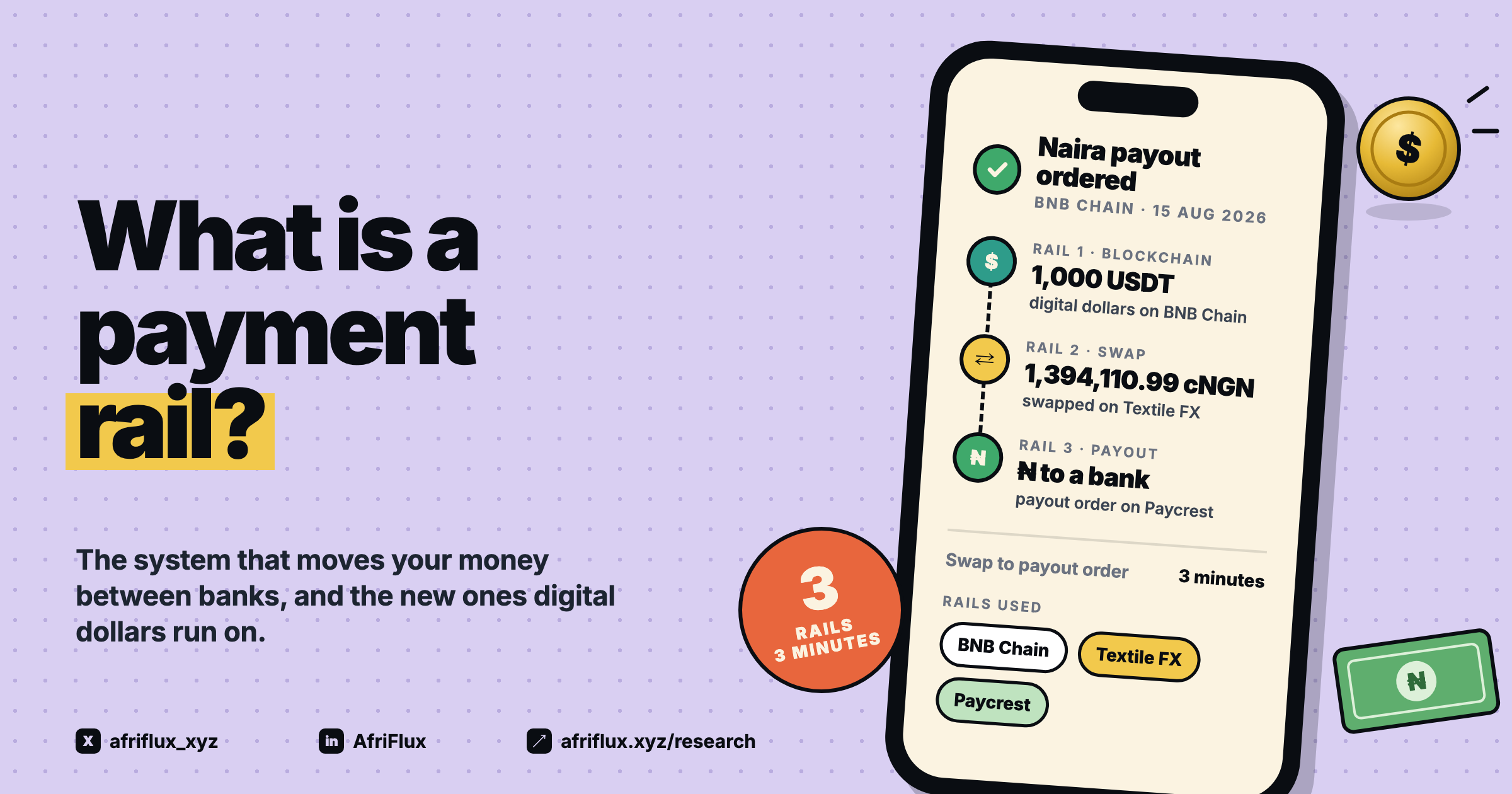
On 15 August, just after 8am Lagos time, a single wallet on BNB Chain did two things:
- At 08:08 it swapped 1,000 digital dollars for 1,394,110.99 cNGN, a digital naira, using a service called Textile. Textile does one job: it changes one currency into another, like a bureau de change.
- At 08:11, three minutes later, it sent that exact amount to a service called Paycrest and opened an order to pay it out as naira to a Nigerian bank account.
We can see both steps on the blockchain. We can't see the last one. The naira goes into the bank account through the normal banking system, and that part doesn't show up on the blockchain. So we know the payout was requested. We don't know the exact minute the money reached the bank.
Compare that with your dom account. Dollars arrive from abroad. You go to the bank or use the app to convert. You wait, then you transfer. Getting from dollars to a naira transfer request can take a day or two and pass through three different desks.
Here, two separate services each did one step, and the wallet joined them together. Going from dollars to a naira payout request took three minutes, and you wouldn't download either service as an app. Other apps plug into them, the same way UBA plugs into NIP.
This is new. From April to June, no wallet used more than one of these services. From July to September, 118 did. And 43% of Paycrest's naira payouts by value that quarter came within an hour of a matching dollar-to-cNGN swap by the same wallet.
The separate services have started working as one chain.
Three things your UBA years already taught you
1. One transfer can look like many. If you move ₦100,000 from your UBA account to your own Kuda account and back, nobody would say you spent ₦200,000. But count every movement and that's what it looks like.
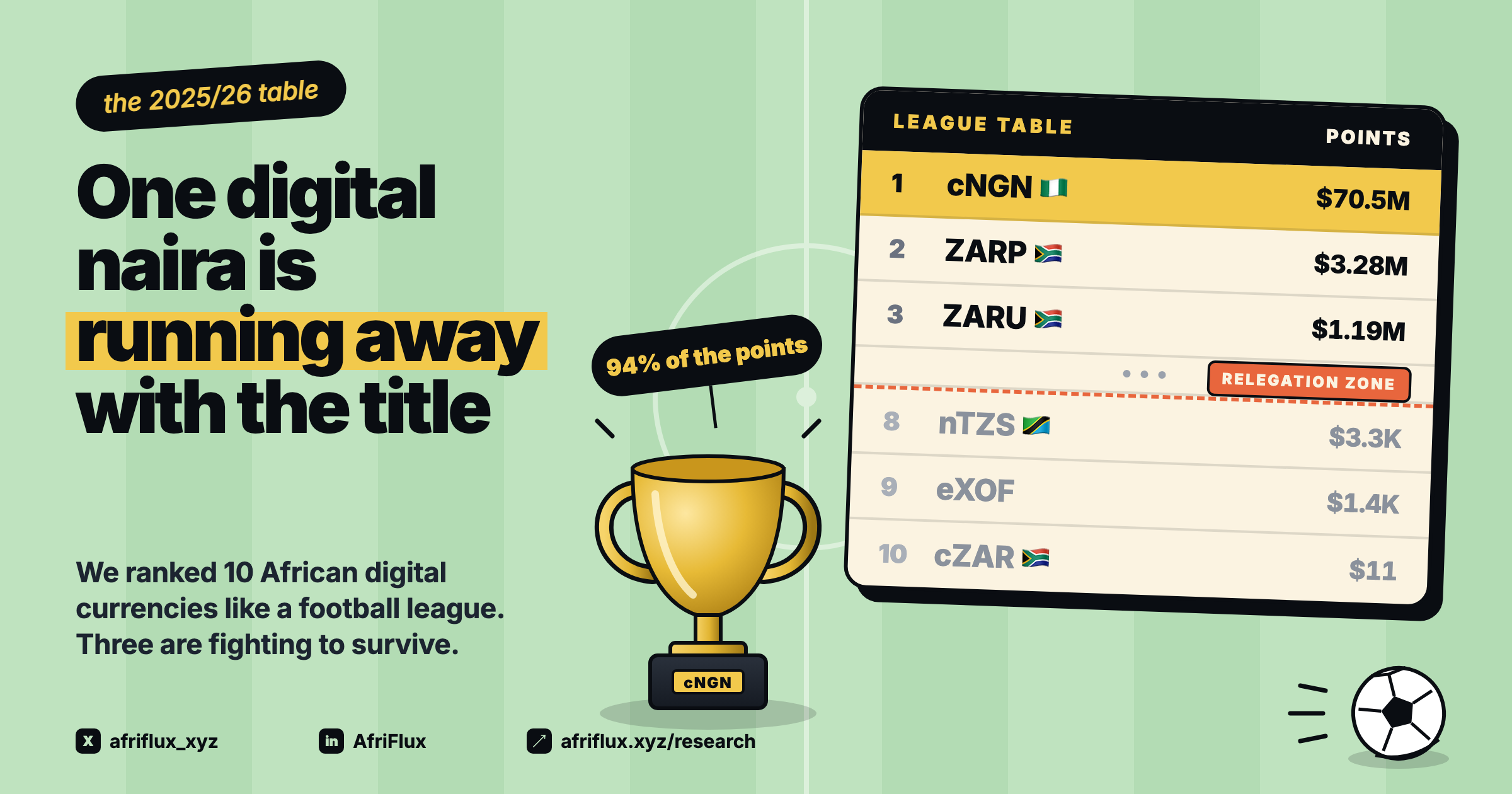
Digital money has the same problem, only bigger. cNGN has moved ₦163 billion on-chain over its life, but only about 1.5% of that looks like real payments between different people. The rest is the same money moving between wallets that belong to the same owners. And 88% of all cNGN ever created has already been destroyed (burned) again. People pass it through on the way somewhere else. They don't keep it.
That's why AfriFlux counts rail activity separately and never adds it to the market total. A single deposit can be counted once at the app and again on the rail.
2. A rail can depend on very few people. You know what happens when NIBSS has a bad day: transfers fail at every bank at once, because every bank depends on the same system.
The new rails can depend on even fewer players. On Textile, one market maker supplied 92% of the volume on African currency pairs last quarter. On HyperFX, another rail, three operators handled 92% of the money settled. If one of them pulls out, the whole service shrinks overnight.
3. The network decides who you can pay. You can't load MTN airtime onto a Glo line. In the same way, digital dollars on one blockchain don't reach an app that only accepts another. You have to convert first, and every conversion costs time or a fee.
Five questions to ask about any new rail
You'd ask these questions about a new bank. Ask them about a new rail too:
- What does it do? Move money, change currency, or pay out to a bank?
- Whose money is on it? Ordinary customers, businesses, or the operator moving its own funds?
- Is the money counted once? Or is the same payment counted at the app and again on the rail?
- How many players keep it running? Hundreds, or two?
- Where does it lead? Does it reach the banks and apps people actually use?
Back to your UBA app
Next time you send money and it lands in seconds, remember that NIP moved it, not your app.
The new rails work the same way. A thousand dollars became 1.39 million in cNGN, and three minutes later a naira payout order was on its way to a bank. That was three rails, and the person behind it never thought about any of them. That's how a rail should work.
But someone needs to watch the rails, because that's where you can see which way the money is moving before anyone announces it.
How we measured: figures cover the apps and rails AfriFlux tracks, not all of Africa. Network and token splits are stablecoin deposits into tracked venues for Q3 2026 (1 July to 30 September), with "so far this quarter" running to 25 October 2026; ordinary-customer and business deposits are measured separately. The 15 August example is two BNB Chain transactions at 07:08:17 and 07:11:34 UTC; the naira bank credit happens off-chain and is not observed. The cNGN, Flutterwave, Textile and HyperFX figures come from the AfriFlux notes linked above.