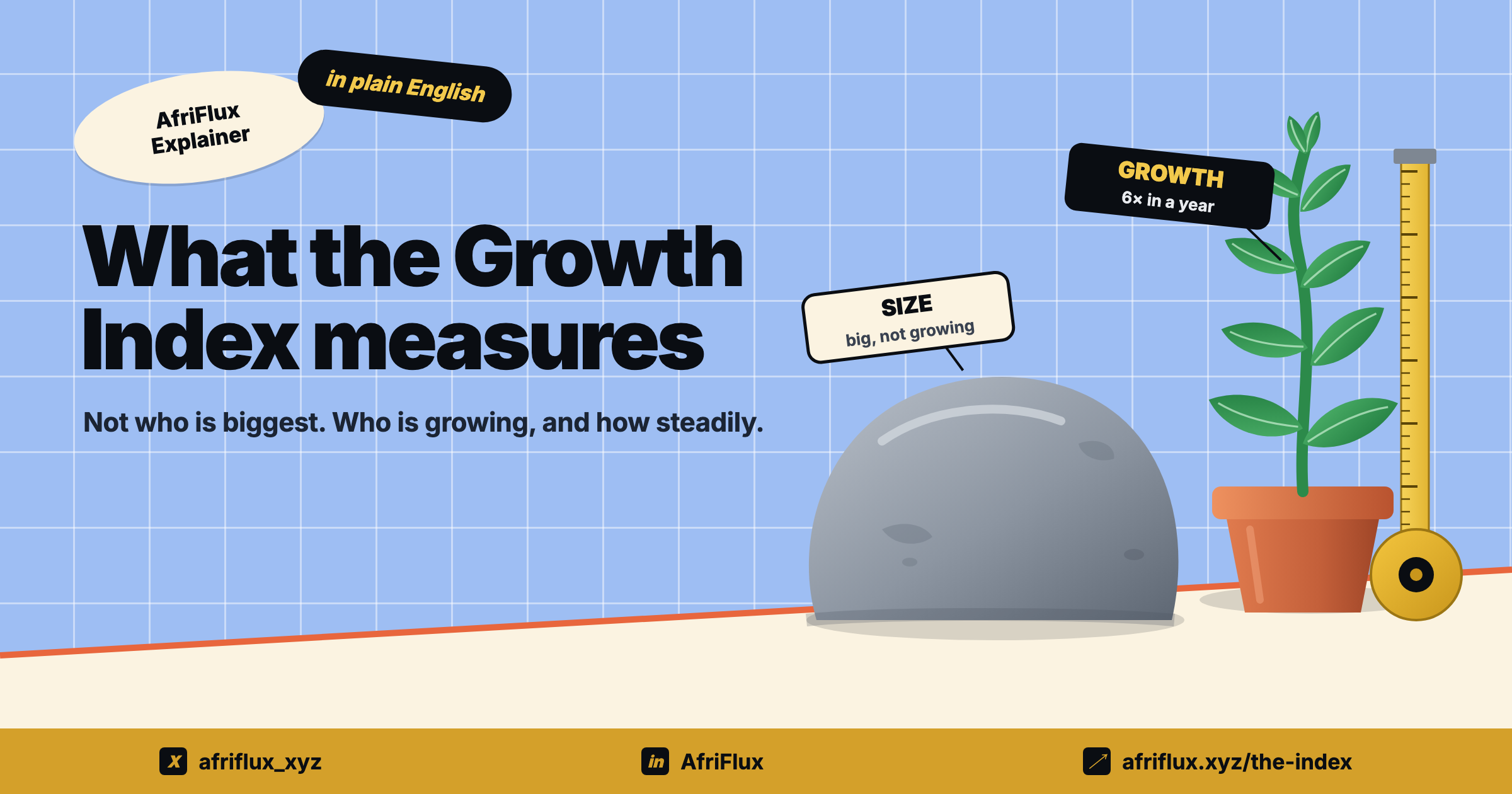
The Growth Index asks one question of every stablecoin venue we track. Is it growing, and does that growth last?
Exchanges, offramps and neobanks now move serious money in stablecoins. Most public rankings sort them by size, meaning who handled the most volume. That tells you who is big. It does not tell you who is gaining ground, who has stalled, or whose great month was a one-off.
People ask those questions when they pick a partner, cover a market or decide where to build. The Index answers them with evidence anyone can check, using the same rules for every venue. Each rule below exists to stop a specific kind of misleading number.
The examples below are real venues. They come from the September 2026 standing, published in October.
Why it ignores size
A venue moving $500 million a month that hasn't grown in a year is big, not growing. A venue moving $5 million that has grown every month for a year is the more interesting story. A size ranking buries it at the bottom.
So the Index throws size away in its first step. It starts with each venue's stablecoin flow: the money we can trace through its wallets on the blockchain. Then it turns that flow into a growth rate for each of the last 12 months. Going from $5M to $5.5M is 10% growth, exactly the same as going from $500M to $550M. From that point on, every venue stands on the same footing.
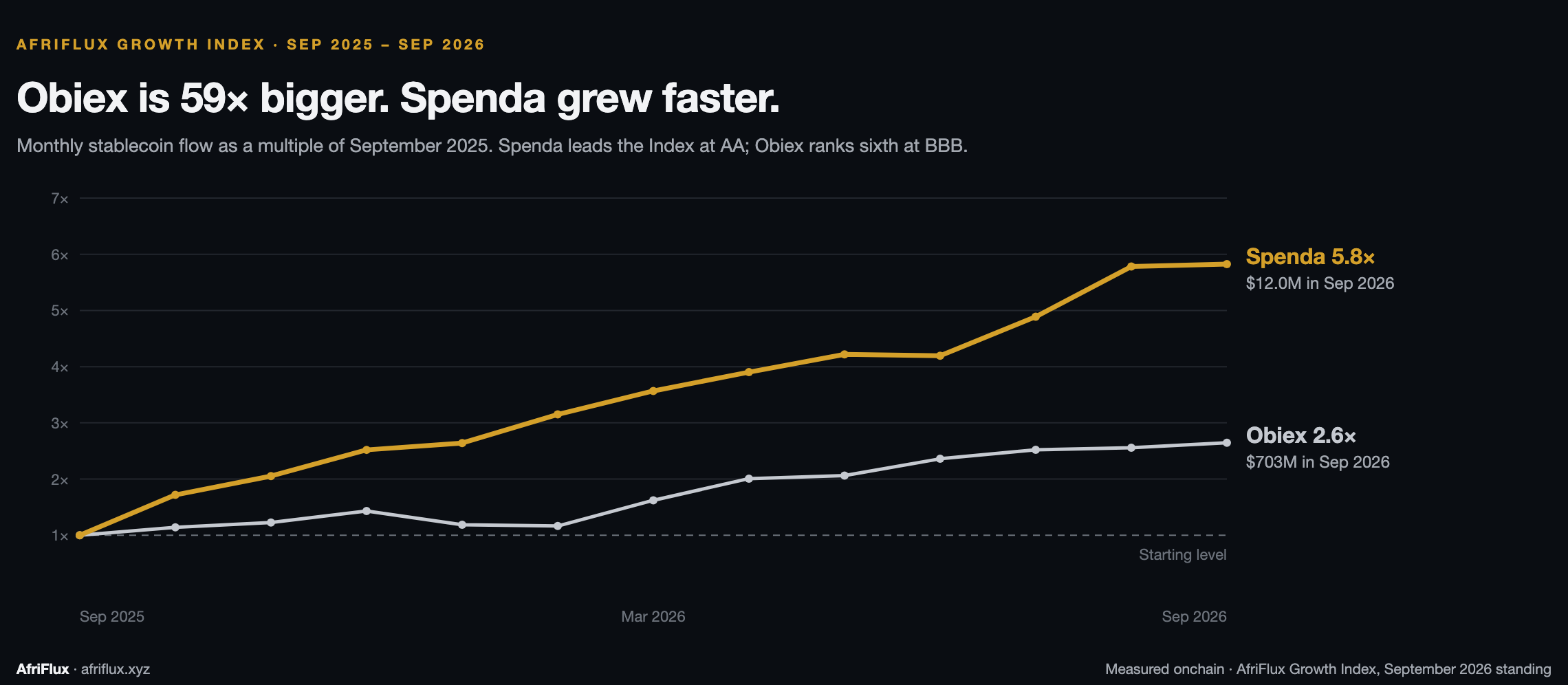
The September board shows why this matters. Obiex moved $703 million in stablecoins that month, about 59 times Spenda's $12 million. Yet Spenda leads the Index at AA (82), while Obiex sits sixth at BBB (66). Over the past year, Spenda's monthly flow grew almost 6 times. Obiex's grew about 2.6 times. Both are growing; one is growing much faster.
The biggest venue we track, VALR, moved $975 million in September. It ranks 16th of 25, at B. Its typical month over the past year showed almost no growth.
Two other choices sit in that first step, each closing a door on a misleading number:
- Blockchain records only. The Index reads what the chain shows, not what a company reports or what a third-party label claims. The records are public, so anyone can check them.
- Finished months only. The Index never scores the current month. Halfway through a month, every venue looks like it is shrinking or surging depending on the day you look.
How fast: Momentum
Momentum is a venue's typical monthly growth over the past year. The Index then compares it with every other venue's. It makes up 60% of the score.
"Typical" means the median (the middle value), not the average. That sounds like a technicality, but it decides whether one lucky month can pass for a good year. Here are two made-up venues over the same 12 months:
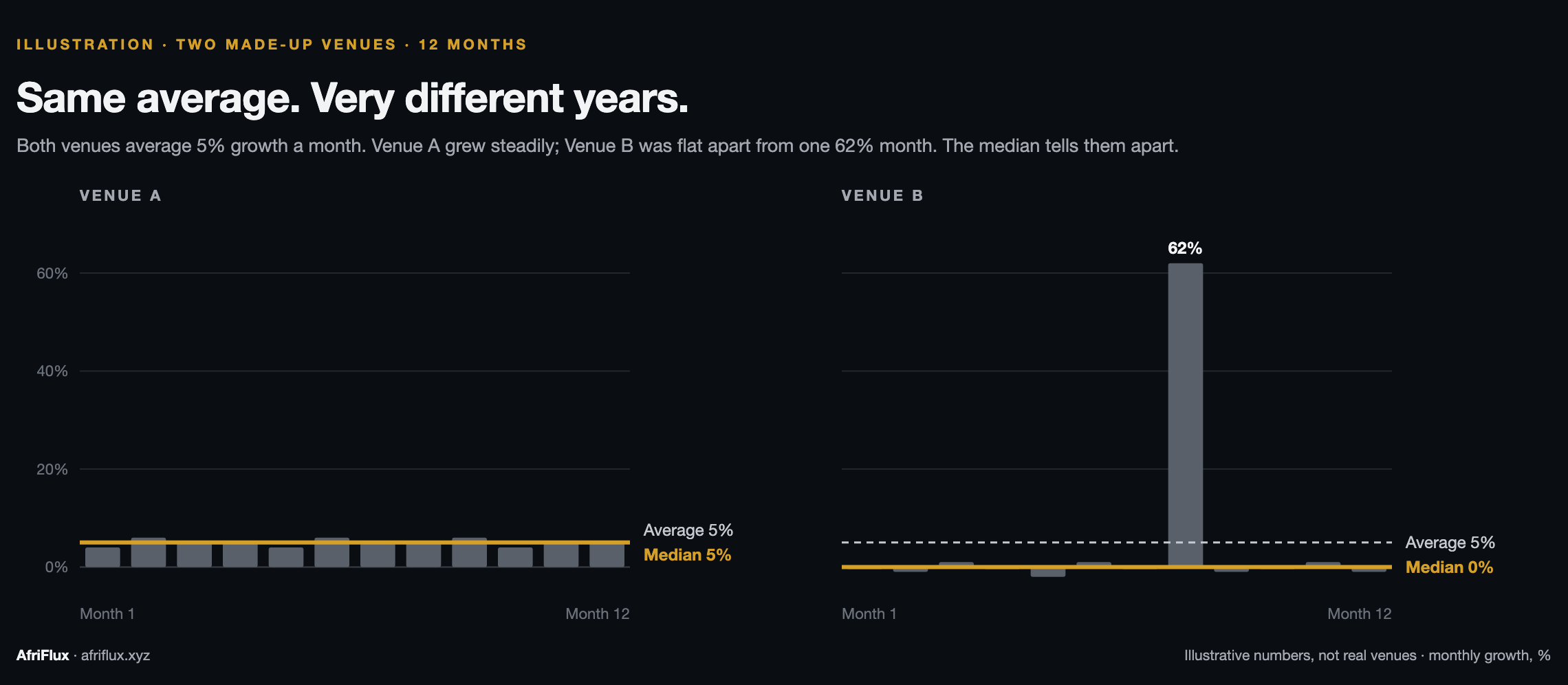
Both average 5% growth a month. Venue A got there by growing 4–6% every single month. Venue B was flat for eleven months and had one 62% month. A big listing, a promotion or one large customer can cause a month like that. The average can't tell them apart. The median can: 5% for A, 0% for B.
Real venues make the gap far wider. Raenest launched in September 2025, so its first full month started from almost zero. Its flow grew 50,337% in October. That one month pushes its 12-month average growth above 4,400% a month. Its median is 38%. Only the second number describes the venue as it actually runs today.
The median is then ranked against the field. When the whole market booms, everyone's numbers rise. A venue growing 8% in a month when the field grew 10% is losing ground, even though 8% looks good on its own. Ranking against peers rewards beating the market, not riding it.
In March 2026, Spenda grew 13%. That sounds strong, but the median venue we track grew 13% too, so Spenda only kept pace. Against the field, that was an average month, not a great one.
How steady: Consistency
Consistency measures how far a venue's growth strays from its own typical rate. It makes up the other 40%.
It uses a measure called median absolute deviation. That measure shrugs off a single wild month but catches swings that keep happening. One outlier month doesn't count against a venue all year. A venue that lurches between +30% and −20% month after month is.
Two real venues show the difference. Bayse Markets grew fast over the year, but in lurches: +325% one month, −82% the next, then +363%, −29% and +237%. Its Momentum is among the highest on the board (88 out of 100). Its Consistency is the lowest (4).
Roqqu grew modestly. It had three outlier months (−15% in February, +33% in June, −31% in August), but every other month landed between −1% and +12%. Its Consistency is a perfect 100: the measure saw three outliers, not a pattern.
It also ignores a steady upward trend. A venue growing a little faster each month is improving, not wobbling, so it reads as steady.
Steadiness counts because lasting growth is worth more than growth that comes and goes. A venue that grows 5% every month is a safer bet to build on than one that grows 20%, then gives it back.
From two numbers to one grade
Momentum and Consistency combine into a score from 0 to 100, weighted 60% speed and 40% steadiness.
Growth gets the bigger share on purpose. If steadiness counted equally, a flat but stable venue could climb near the top. It would get there by standing still. With 60/40, you have to grow to lead, and grow steadily to stay there.
Here is every venue on the September board, placed by its two scores:
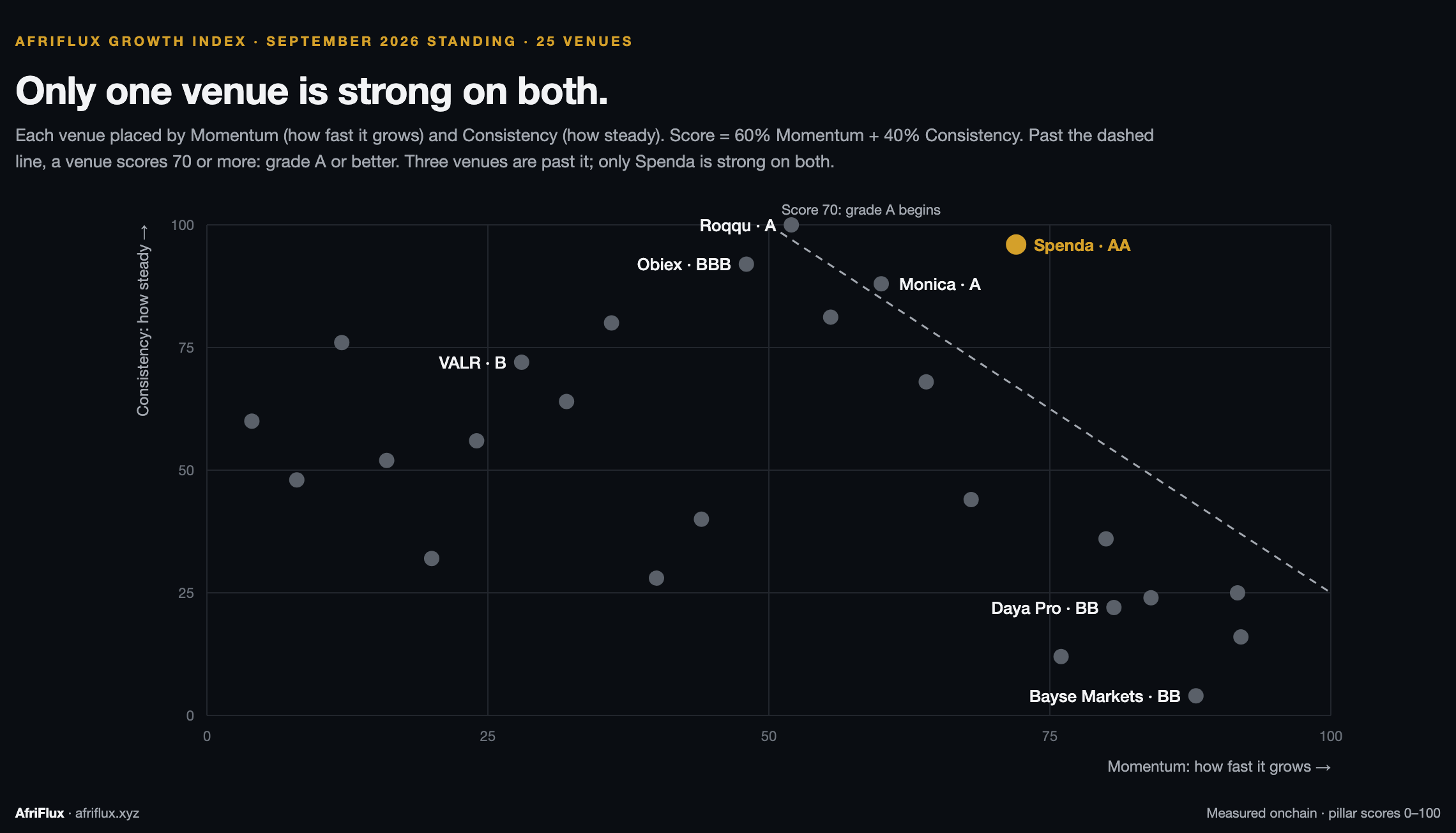
Three venues sit past the line where grade A begins. Spenda is the only one strong on both. Monica and Roqqu get there on steadiness, with middling speed. Bayse Markets, fast but choppy, lands in the middle at BB.
One step comes first: confidence. A venue with less than 12 months of history hasn't yet earned a score at either extreme. The Index pulls its score toward the middle (50) until it fills the year. So a newcomer with a spectacular start climbs the board slowly. It doesn't land at the top. The pull works both ways: it lifts a weak newcomer toward 50 too. Venues with fewer than 4 finished months also carry a Provisional label.
Daya Pro shows how this plays out. It launched in February 2026, and its monthly flow went from about $10,000 to $7.8 million by September. Its Momentum is 81, one of the highest on the board. Yet its grade has stayed between 55 and 62 every month since it joined. Part of that is choppy growth (Consistency 22). Part is that it has filled 8 of its 12 months, so its confidence is 67% and the Index still holds it toward the middle.
The final score maps to a grade:
| Grade | Score | What it means |
|---|---|---|
| AAA | 90–100 | Fast, steady growth |
| AA | 80–89 | Strong growth, mostly steady |
| A | 70–79 | Healthy growth; speed or steadiness lagging |
| BBB | 60–69 | Moderate growth, with a watch-item |
| BB | 50–59 | Flat or choppy growth |
| B | 40–49 | Slow and uneven growth |
| CCC | 25–39 | Shrinking and unsteady |
| D | 0–24 | Sustained decline |
What it doesn't tell you
A grade describes growth we can observe on the blockchain, and nothing more. It does not tell you:
- how big a venue is,
- whether it is profitable, solvent or well run,
- whether you should invest in it or do business with it.
The letters look like a credit rating, but this is not one. AAA means a venue is growing fast and steadily. It does not mean safe. A venue graded B may be large, profitable and doing exactly what it set out to do; it just isn't growing much right now.
Grades are not for sale. Commercial relationships with AfriFlux do not move them.
How to read a grade
Four rules explain most of what you will see from month to month.
- It is always a month behind. September's standing publishes in October. Waiting for the month to close is the price of never publishing a half-finished number.
- Every change has a named cause. When a grade moves up or down, the monthly report says whether Momentum or Consistency drove it.
- Grades are slow to move. Consistency looks at a full year, so one noisy month barely shifts it. A grade that changes has usually been heading that way for a while.
- Missing data is not decline. If a venue moves to new wallets we haven't mapped yet, the Index freezes its grade instead of letting it fall. A gap in what we can see is not a drop in business.
September 2026 shows these rules at work. VALR fell from BB to B, with Momentum named as the driver; its flow fell 14% in September. Spenda rose from A to AA, also on Momentum. Roqqu sat at BBB for seven straight months before moving up to A.
The method is public. You'll find its inputs, steps, weights, grade bands and rules on the methodology page. Only the exact internal formulas stay private. To check a grade, start with the venue's monthly growth line. Most of the story is in that one picture.
Figures from the AfriFlux Growth Index, September 2026 standing, measured onchain. The Growth Index is not a credit rating or a recommendation to invest. See the full standing.